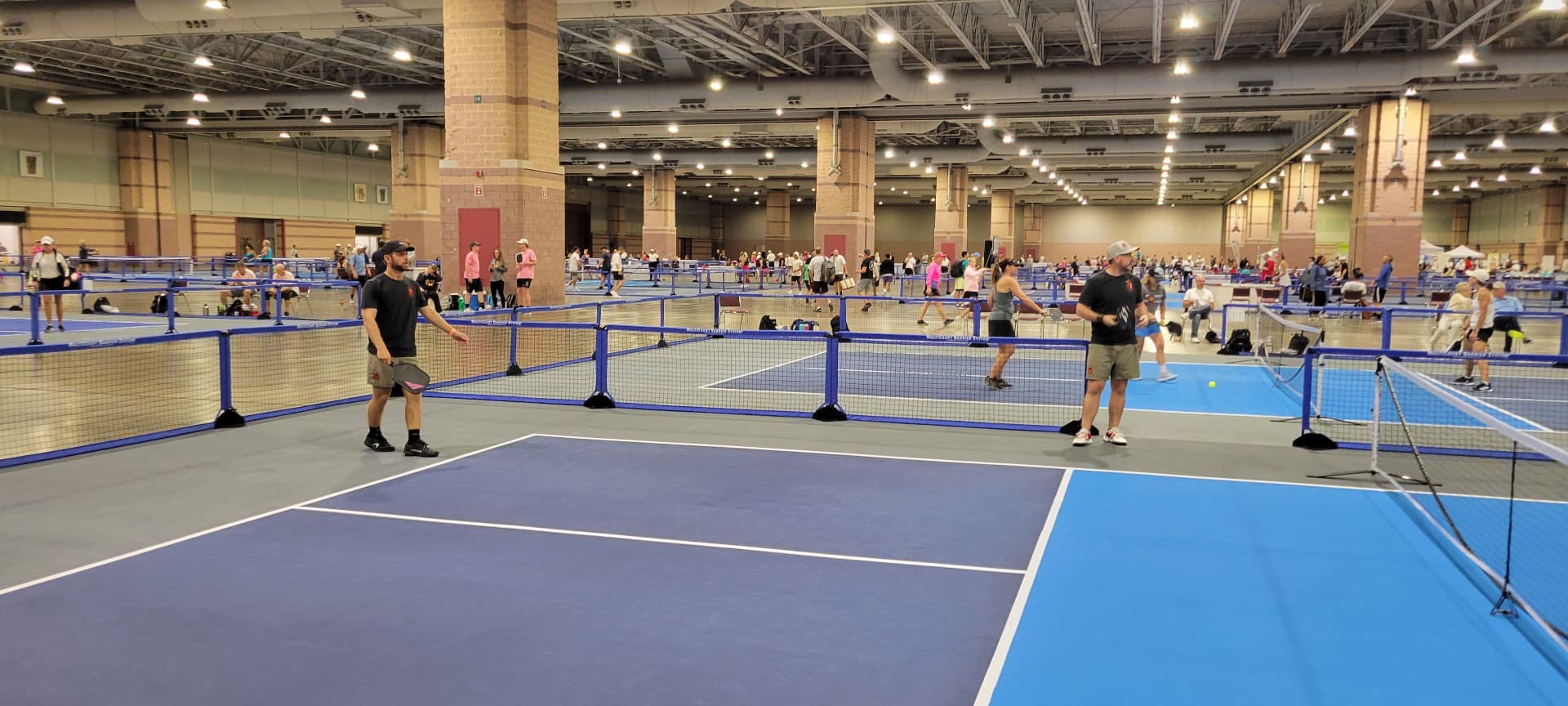
Need private courts at your Orlando venue, not an hour at someone else's club? The Pickleball Events Co. delivers professional pickleball courts to exhibit halls, resort lawns, ballrooms, parking pads, and office campuses across the Orlando area. We build them, staff the play, and remove everything when the program ends. A single-court, one-day activation typically begins around $10,000 (previously published starting-point language on this site), and multi-court or multi-day builds move into the mid-five and six figures. Every event is quoted individually, usually within 24 hours.
This page is for the people who book group experiences in Orlando: corporate meeting planners, incentive and DMC teams, association and show organizers, experiential agencies, and hotel or resort event sales. If you want a court for yourself tonight, a local club or public park is the right call. If you are planning a conference networking break, a resort offsite, an exhibitor activation, or a client day and want pickleball to be part of it, read on. For the national overview, start with pickleball court rental for events or pickleball corporate events.
Why pickleball fits Orlando's meeting calendar
Orlando is a meetings city as much as a vacation one. The Orange County Convention Center describes itself as the second-largest convention facility in the United States, with about 7 million total square feet and more than 2 million square feet of exhibit space across its West and North-South buildings. Around it sits a resort corridor that sells group business on lawns, pool decks, and ballrooms, and an incentive-travel market that brings teams to town with the theme parks already on the agenda.
That mix creates a specific problem for planners. Attendees arrive expecting something more active than another seated breakout, but the group is large, mixed in age and fitness, and often dressed for a meeting. Pickleball solves that better than most options. A beginner can learn enough to rally in a minute or two, rotations can run ten minutes between sessions, and nobody needs to change clothes for a short staffed game. People waiting their turn become an audience, which is the energy most networking breaks and exhibitor booths are trying to create.
It also keeps the group on property. Offsites booked near Lake Buena Vista or Kissimmee already involve plenty of transfers; a private court on the hotel lawn or in a ballroom gives the team a shared activity without another bus. If you are comparing options, see the corporate golf outing alternative and pickleball vs. other team-building activities.
A private event court vs. booking time at an Orlando club
Search for “pickleball court rentals” in Orlando and most results are clubs and parks that sell hourly court time. That is a good product for people who already play. It is a different product from a private event court, and mixing the two up is the most common reason early budgets go sideways.
Question
Hourly club or park court
Private event court at your venue
Where it happens
At the club's address, on its schedule, next to its members.
At the venue you already booked: exhibit hall, ballroom, resort lawn, parking pad, or campus.
Who is on the court
Your group, plus whoever booked the next hour.
Only your guest list, for the whole program window.
Transport
A bus or rideshare run off property, then back again.
None. Guests walk from the session room or the pool deck.
Branding
Usually limited to what the facility allows.
Optional wrapped courts, branded nets, and signage built for photos.
Staffing
Court time only, unless you hire a pro separately.
Hosts who teach first-timers, run rotations, and keep the line moving.
Best fit
Small groups of people who already play.
Mixed-skill corporate groups, conferences, and brand moments.
If a club is the better fit for your group, book the club. If you need exclusive courts at the place your attendees already are, that is what we do. The broader version of this comparison lives on private pickleball event space, and the budget side is covered in pickleball court rental cost.
Where Orlando event courts usually go
Rollout courts install on exhibit-hall concrete, carpet, ballroom floors, asphalt, parking decks, grass, and rooftops when access and load limits allow. In Orlando, most requests fall into four patterns.
Convention and trade-show floors
A staffed court in an exhibit hall or pre-function space pulls attendees out of aisle traffic into a short, hands-on moment. It suits exhibitors who need booth dwell time, and show organizers who want a networking zone people come back to between sessions.
Resort lawns, pool decks, and ballrooms
Orlando's meeting resorts sell group business around lawns, event pads, and ballrooms. A temporary court turns one of those spaces into a private amenity for a day or a multi-day block, then leaves the property as it found it.
Incentive trips and leadership offsites
Groups booked around Lake Buena Vista, Kissimmee, and International Drive already have the theme-park day on the agenda. A court on property gives them a shared activity that does not need another bus transfer or another queue.
Campus wellness days and brand pop-ups
Office campuses, corporate parking lots, and retail or mixed-use plazas across the metro can host a one-day court for employee appreciation, a benefits fair, or a product launch, provided the surface, access, and permissions check out.
20 × 44 ft, the same for singles and doubles (USA Pickleball rulebook, 2.A.1).
Minimum playing surface
30 × 60 ft per court, which leaves run-off around the lines (rulebook 2.A.3).
Recommended for competitive play
34 × 64 ft per court. Worth using if you are running a scored bracket rather than casual rotations.
Add for people
Queue space, a check-in or host spot, seating for people waiting, and a clear walkway that does not cross the court. On a show floor, this is usually what pushes the footprint beyond the court itself.
Court count should follow the program, not raw headcount. A single well-run court handles a steady stream of short rotations at a reception or booth. Two to four courts make sense for a conference networking zone that people return to across several days, or a team-building block where everyone is expected to play at once. Over-building is the most common scoping mistake: a half-empty second court looks worse in photos than one busy court with a line. Work through how many pickleball courts you need and court dimensions for events before you promise a footprint on the floor plan.
Convention-center load-ins: what to sort out first
At a large convention center, an activation succeeds or fails on logistics more than on paddles. Move-in windows are fixed by the show. The general service contractor and the venue set floor-protection rules, freight routes, and which tasks need house or contracted labor. Docks are busiest in the hours everyone else is loading. None of that is a reason to skip the court; it is a reason to share the exhibitor or event manual early, so the court count, crew size, and overnight plan match what the building allows.
For a single exhibitor, a branded court beside the booth is usually enough for lead capture and content. Show organizers running a networking zone tend to want two or more courts in a pre-function space or a corner of the hall. Multi-day shows usually keep courts in place overnight under the venue's security rules rather than tearing down and rebuilding each day. The details are in trade-show booth activation, setup and teardown timeline, and event site assessment.
Planning pickleball for an Orlando event?
Send the date, venue, and a rough court count. We come back with all-in pricing for a turnkey build, usually within 24 hours.
Central Florida weather is a program decision, not a footnote. Midday outdoor play in summer can wear out guests in business casual after one rotation, which defeats the point of a networking break. Many Orlando planners keep daytime courts indoors in a ballroom, exhibit hall, or covered space and save lawn builds for early-morning wellness sessions, evening receptions, or the cooler months.
Lightning needs a written plan. The National Weather Service office in Melbourne, which covers east-central Florida, calls Florida the lightning capital of the U.S. and says more people die from lightning in Florida than in any other state. Its guidance for outdoor event coordinators is to plan before storms threaten: know how far the group is from safe shelter and how long it takes to get there. When thunder is heard, play stops and everyone moves into a substantial building or an enclosed vehicle. Open-sided pavilions, tents, and covered patios do not count as shelter. Play resumes only 30 minutes after the last thunder.
Most Orlando corporate courts go up on private property, such as a resort lawn, a hotel ballroom, or a company campus, where the venue's own approval process usually governs. Public property is different. The City of Orlando requires a Special Events Permit for events on city property with more than 100 people, and for smaller events that involve vending, alcohol, temporary structures, or street closures. Applications are due at least 60 days before the event, need a paid park or venue reservation and a site plan, and some go to City Council for approval.
A mailing address does not always tell you which government is in charge. Kissimmee is in Osceola County, and many resort-corridor venues sit outside Orlando city limits, so ask the venue which jurisdiction and which fire, tent, or noise rules apply before you lock the date. We supply equipment details, layouts, and certificates of insurance; your venue or producer usually leads the permit file. More on event permits and permissions, insurance and liability, and noise and neighbor considerations.
Food, drinks, and “catering packages”
Planners often ask for a pickleball catering package. We do not sell one. We handle the courts, the staff, and the play, and we coordinate with whoever runs food and beverage. At most Orlando hotels and convention venues, that is the venue's own catering department working from your banquet event order, so the practical job is fitting the court program around service times.
A few things that make it work: keep drink stations close to the court but off the run-off area, schedule the busiest play before or between food service rather than during a plated meal, and make sure the caterer knows the footprint and walkways so carts are not routed across the court. For receptions, a host running short rotations beside the bar tends to draw more players than a court placed out of sight. The full guide is pickleball event catering and food and beverage planning.
Formats that fit Orlando agendas
Format should follow the goal. Conference networking breaks work best as staffed open play with short rotations, so people can drop in between sessions. Resort offsites and incentive groups often want a beginner clinic followed by a round-robin during a free afternoon. Sales teams sometimes want a light bracket with a scoreboard, and a smaller VIP block for sponsors or top customers can run alongside a public-facing court at an association meeting. Multi-day conferences get more from a court that stays in place as a daily amenity: morning wellness play, midday rotations, and evening open play at the reception.
Professional rollout courts, nets, paddles, and balls brought to your Orlando venue, built inside the load-in window, and removed at the end. One vendor and one invoice, not three.
Event hosts
Staff who teach the basics in a minute or two, run rotations, and pull in first-time players so the court does not become a hangout for the few attendees who already play.
Indoor or outdoor builds
Exhibit-hall concrete, carpet, ballroom floors, asphalt, parking decks, and lawns, with a subfloor where grass or uneven pads need one so the ball bounces true.
Optional branding
Wrapped courts, branded nets, and signage when the activation needs to photograph well for sponsors, recap content, or internal comms.
Venue coordination
Dock times, freight paths, floor protection, and house rules confirmed with the venue before the truck leaves, plus certificates of insurance when the venue asks for them.
Quote-based pricing
Court count, days on site, staffing hours, surface, branding, and travel set the number. See the pricing section below for the starting-point language previously published on this site.
Floor plans, dock and door sizes, freight elevator limits, and overnight storage rules. Orlando's big venues turn rooms over quickly between groups, and late site details are the usual reason a court count gets cut.
Choose indoor or outdoor with heat in mind
Daytime outdoor play in summer is hard on guests in business casual. Many planners keep midday courts indoors and save lawns for early mornings, evenings, or the cooler months.
Write the lightning plan before the event
Know where guests will shelter, how long it takes to get there, and who calls the stop. The National Weather Service says to wait 30 minutes after the last thunder before going back out.
Fit the build around the rest of the day
Catering, AV, and registration all compete for the same dock and hallways. We time the build and teardown around your agenda so the court does not collide with a keynote break or a banquet reset.
Treat staffing as part of the product
If the budget is tight, cut a court before you cut the host. An unstaffed court becomes a photo prop; a staffed one becomes the line people walk past twice.
Confirm who issues permissions
Inside a hotel or convention center, the venue's own approvals usually govern. Outdoor events on public property may need a city or county permit with long lead times.
We do not publish package menus or invented case results. The starting-point language previously published on this site is that a single-court, one-day activation typically begins around $10,000, and multi-court or multi-day builds move into the mid-five and six figures. Treat that as a starting point, not a menu price. In Orlando, the biggest movers are court count, days on site, staffing hours, whether the venue needs extra floor protection or a subfloor, branding, and travel. Pricing is not per guest, so a busy court that hosts many rotations in a day does not add a per-head line.
Conferences, resort offsites, exhibitor booths, and brand days. Tell us the date, venue, and rough court count, and we will come back with clear, all-in pricing, usually within 24 hours.
Can we rent a private pickleball court for a corporate event in Orlando?
Yes. We bring professional rollout courts to the venue you already booked, such as an exhibit hall, hotel ballroom, resort lawn, parking pad, or office campus, then build them, staff the play, and remove everything afterward. The courts are reserved for your group for the whole program window, so there is no shared club schedule and no bus to an off-site facility.
How much does a pickleball activation cost in Orlando?
It is quote-based. As previously published starting-point language on this site, a single-court, one-day activation typically begins around $10,000, and multi-court or multi-day builds for conferences and festivals move into the mid-five and six figures. Court count, days on site, staffing hours, surface or subfloor needs, branding, and travel move the number. We usually return an all-in quote within 24 hours.
Can you set up at the Orange County Convention Center?
Rollout courts are designed for convention floors, and the OCCC has more than 2 million square feet of exhibit space across its West and North-South buildings, according to the center. Whether a court fits your show depends on the show's floor plan, the general service contractor's rules, the move-in schedule, and any labor requirements, so send the exhibitor or event manual and we will scope the build against it.
How much floor space does one event court need?
The court lines are 20 × 44 ft. The USA Pickleball rulebook sets a minimum playing surface of 30 × 60 ft and recommends 34 × 64 ft for tournament play. For an event, add space for a queue, a host station, seating, and a walkway that does not cross the court.
What happens if a thunderstorm rolls in during an outdoor Orlando event?
Play stops and guests move to a substantial building or an enclosed vehicle. The National Weather Service advises waiting at least 30 minutes after the last thunder before resuming, and notes that open-sided pavilions and tents are not safe shelter. We agree the shelter location and the person who calls the stop before the event, and many Orlando planners pick an indoor backup space at the same time they book the lawn.
Do we need a permit for an outdoor pickleball event in Orlando?
It depends on where the event is. On private property such as a resort, hotel, or campus, the venue's approvals usually govern. The City of Orlando requires a Special Events Permit for events on city property with more than 100 people, and for smaller events with vending, alcohol, temporary structures, or street closures. Applications are due at least 60 days ahead. Venues outside city limits follow their own county or municipal rules, so ask the venue which jurisdiction applies.
Do you offer pickleball catering packages?
No. We focus on the courts, the staff, and the play. Most Orlando hotels and convention venues run food and beverage through their own catering departments, so we time the court program around your banquet event order and share our footprint with the caterer early. Our catering and food-and-beverage planning guide covers the details.
Which areas around Orlando do you serve?
The greater Orlando area, including International Drive, Lake Buena Vista, Kissimmee, Winter Park, and Sanford. If the venue has a flat footprint, workable access, and permission to host, we can scope courts and staff for it.