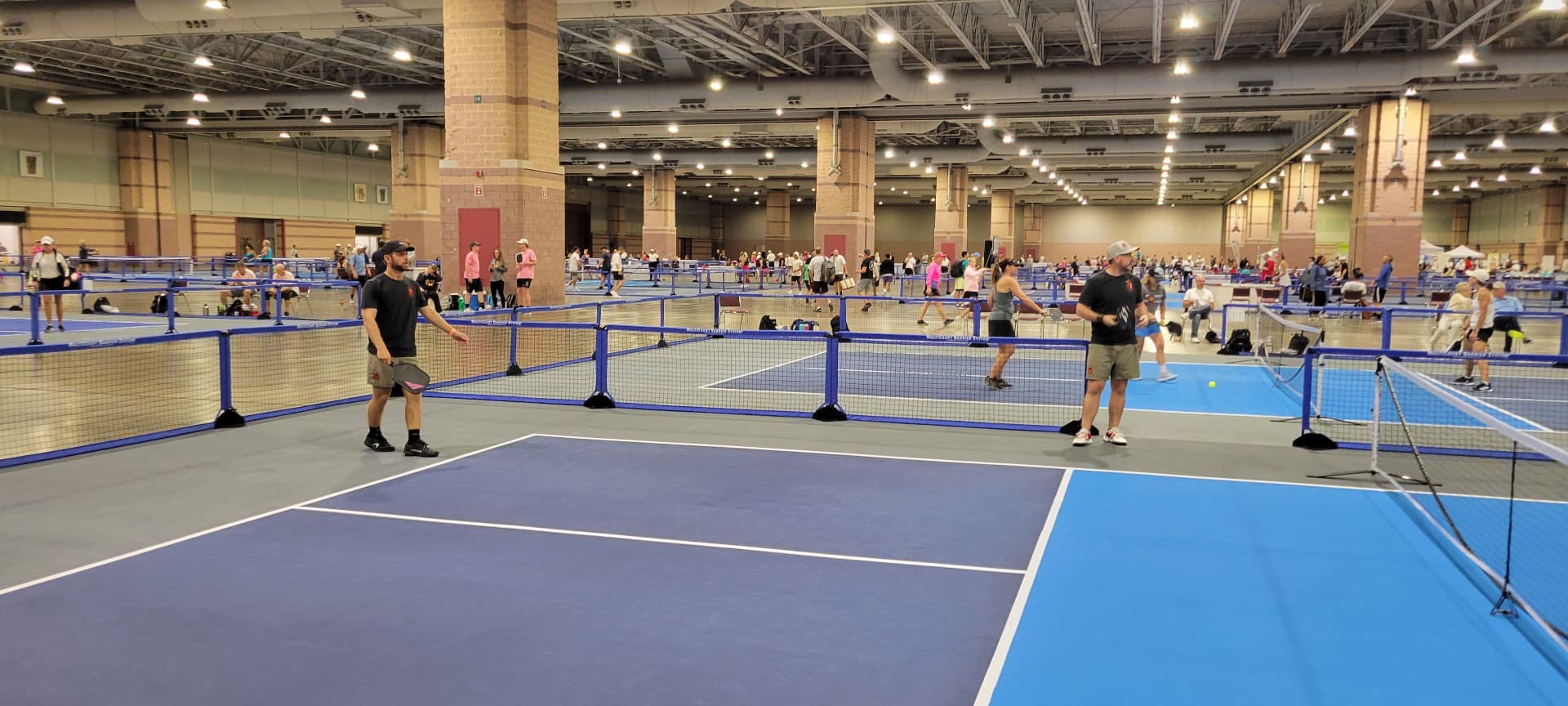
Pickleball at trade shows and conferences: the short answer
A conference or trade show pickleball activation is a staffed, professional rollout court (or a block of courts) built inside the convention center, hotel, or outdoor plaza where your program is already happening. Attendees play in short, staff-run games between sessions or at a booth; the court is removed at move-out. It works because it gives a seated, badge-scanning, slide-watching crowd something physical and social to do, and because almost anyone can rally after a few minutes of coaching.
The planning reality is that a full court is big. An official court is 20 × 44 feet, and with safe run-off an event court needs roughly a 30 × 60 foot footprint — about 1,800 square feet, or the floor area of eighteen standard 10 × 10 booth spaces. So the real decision is not whether pickleball is fun at a conference. It is where on your program and your floor plan a court of that size earns its space, and which side of the show is paying for it. This page is the planning hub for that decision; each option below links to a deeper guide.
Who books a conference court — and why it matters
The same court gets bought for very different reasons depending on who holds the contract. Know which seat you are in before you request a quote, because it changes the footprint, the format, and who approves the plan.
Show organizers and association meeting planners
You control the floor plan and the agenda, so you can put a court in a featured zone, a registration concourse, or an outdoor plaza and program it as an attendee amenity, a morning wellness block, or a closing tournament. The goal is attendee engagement and a reason to stay on the floor. See pickleball for association annual meetings and multi-day conference programming.
Exhibitors and their booth builders
You are renting space from show management and working inside the exhibitor manual. A court has to fit your booth (usually an island) or sit in a sponsored zone, and the goal is dwell time and qualified leads. The trade show booth activation guide covers booth math, union labor, and lead capture in detail.
Sponsors
A sponsor pays the organizer for a branded court, lounge, or tournament and gets the naming, signage, and content. The court becomes inventory the organizer can sell. Our sponsorship packages guide and sponsor activation ROI guide show how to structure and measure it.
Event agencies, DMCs, and production companies
You are delivering the activation for a client and need a fulfillment partner who will work under your brand and your run of show. See white-label pickleball for event agencies and incentive travel and DMC programs.
Five ways a court fits a conference program
These are the builds planners ask about most. They are not mutually exclusive — a large show might run a sponsored feature court on the floor and a tournament on the final afternoon — but each has a different footprint, staffing plan, and approval path.
| Build | Best for | Space and timing | Deep guide |
|---|
| Featured show-floor court | Organizers who want a traffic anchor in the hall | Full ~30 × 60 ft footprint in a featured zone; runs during exhibit hours | Trade shows and expos |
| Exhibitor booth court | Exhibitors chasing dwell time and leads | Usually an island booth large enough for the full footprint; built at move-in | Booth activation |
| Sponsored court or lounge | Organizers selling sponsorship inventory | Featured zone, foyer, or plaza; branding on court, net, and signage | Sponsorship packages |
| Wellness block or attendee tournament | Multi-day meetings that need a break from sessions | Morning or late-afternoon blocks; often outside the exhibit hall | Conference programming |
| Reception or networking court | Welcome receptions and evening events | Ballroom, terrace, or plaza for a few evening hours | Networking reception |
If you are still choosing a building, the convention centers and trade halls guide covers venue-side questions, and the hotels and resorts guide covers conferences held in hotel ballrooms and on resort lawns.
Space math: a court is not a 10 × 10 booth
The most common mistake is pricing a court before checking the floor plan. Work it in this order:
- Footprint. Plan on about 30 × 60 feet per court, including run-off. Two courts side by side need roughly double the width. Our court dimensions for events guide has layouts.
- Ceiling. Lobs and high serves need room. The site guidance is at least 18 to 20 feet of clear height over the whole court — check for hanging signs, rigging points, and low ductwork, not just the rated ceiling of the hall.
- Floor. Rollout courts go down on concrete exhibit floors, carpeted ballrooms, and level plazas. Grass and uneven ground need a subfloor. See surface and subfloor requirements.
- Neighbors. A paddle makes a sharp pop. Place the court away from session rooms and quiet sponsor meetings, and read noise levels and neighbor considerations.
- Spectators and aisles. A good game draws a crowd. Leave room for people to watch without spilling into the aisle, because most exhibitor rules require aisles to stay clear.
If the full footprint will not fit, say so in your quote request. It is better to move the court to a foyer, plaza, or adjacent ballroom than to squeeze a court that plays badly and blocks traffic. Our court-count guide helps size a multi-court block.
Convention-center realities to plan around
Convention centers and large hotels run on rules that do not exist at an office or park event. None of them are deal-breakers, but they set the timeline and part of the cost, so read your show's exhibitor manual (sometimes called the exhibitor service kit) before you lock a plan.
The general service contractor and exclusive services
Most shows appoint an official general service contractor that handles freight, carpet, furniture, and signage, and many venues reserve certain services — often electrical, rigging, and material handling — as exclusive to in-house or designated providers. That means the court crew may build the court, but someone else may move the crates from the dock to your space and run any power you order. Which services are exclusive varies by building and by show.
Labor jurisdiction
In many convention cities, specific tasks fall under union jurisdiction, and the line between what an exhibitor or outside contractor may do and what must be done by venue labor is set by the building and the show. We confirm those rules with show management or the venue during planning rather than guessing. For a market-specific example, the Las Vegas event court guide covers convention-floor logistics there; the Atlantic City, Orlando, New York, and Chicago pages cover other convention markets.
Move-in and move-out windows
Shows assign targeted move-in times and hard move-out deadlines. A single court on an open floor installs quickly, but a multi-court build shares the floor with every other exhibitor, so it is usually scheduled into the move-in window before the show opens. The setup and teardown timeline explains how build day runs.
Power and lighting
The court itself does not need power. Power is only needed for what you add around it — scoreboards, screens, audio, lead-retrieval devices, or extra lighting. Order it through the show the same way any exhibitor would. More in power and lighting requirements.
Approvals and insurance
Expect show management to review the floor plan for an active-play space, and expect a certificate of insurance request that names the parties the venue or show requires. Attendee waivers and the split of liability between organizer, exhibitor, and vendor should be settled before the contract is signed — see pickleball event insurance and liability and permits and permissions.
Programming that keeps a conference court full
A court with no plan sits empty while sessions run and gets swamped at breaks. Staff fix that by matching the format to the agenda:
- During sessions: short beginner clinics and open rallies for the attendees who are on the floor.
- At breaks and lunch: quick timed games with rotating partners so the line keeps moving.
- Morning blocks: a wellness or early-play session before the first general session.
- Final afternoon: a bracket or challenge that gives attendees a reason to stay through the last day.
- Evening: a reception-style court where play is the icebreaker, not the main event.
The format guide compares round-robin, bracket, and open play, the scoring and bracket apps comparison covers running scores and brackets on site, and the run-of-show template helps you slot the court into the agenda. Court-side staffing is covered in pickleball event staffing.
Measuring it: leads, sponsors, and attendee value
Decide what success means before the show, because it changes the setup. An exhibitor usually measures qualified conversations and scanned badges, so the booth needs a scan point where people wait to play, not after they leave. A sponsor measures visibility and content, so branding on the court surface, net, and signage matters more than court count. An organizer measures attendee engagement and whether the floor stayed busy. We do not publish response-rate or ROI figures for these activations; the honest approach is to set your own baseline and compare it with your past shows. The sponsor ROI and pickleball event marketing guides walk through what to track.
What a conference or trade show court costs
Pricing is quote-based because show-floor builds vary more than almost any other event type. For reference only: earlier versions of this site described a single-court, one-day turnkey activation as typically beginning around $10,000 (previously published starting-point language, not a current price — only a written quote confirms cost). Conference and trade show quotes move with:
- Number of courts and number of show days the court stays up
- Staffing hours across exhibit hours, breaks, and any evening program
- Move-in and move-out windows, especially after-hours or overnight builds
- Venue-side charges billed by the show or building, such as material handling, labor, and power — these are usually billed to the exhibitor or organizer directly, outside our quote
- Custom court, net, and signage branding
- Crew travel to the host city
The pickleball court rental cost guide breaks down the line items that sit outside an activation quote, and how to write an RFP for a pickleball event helps you compare vendors line by line.
What to send for a quote
You do not need the floor plan finished. These details produce a usable first quote:
- Show or conference name, city, venue, and dates (including move-in and move-out if known)
- Your role: organizer, exhibitor, sponsor, or agency/DMC working for a client
- Where the court would go: booth number and size, featured zone, foyer, ballroom, or outdoor plaza
- Expected attendance and the hours you want the court active
- Format ideas: open play, clinics, timed games, tournament, reception
- Branding and lead-capture needs, and any rules already sent by show management
Fulfillment is delivered by our partner Pickleball Management Group, an official USA Pickleball rollout-court partner whose builds include 25 rollout courts on the floor of the Atlantic City Convention Center for the USA Pickleball Indoor Championships and an indoor installation and inaugural tournament at the Hawaii Convention Center. See the case studies.
Venue or convention center that wants a court to keep after the show? Compare roll-out court options and venue use cases at PickleCourt USA: trade show and expo pickleball courts.
In partnership with PickleCourt USA