Corporate Events · Retreats & Offsites
Pickleball for corporate retreats and offsites
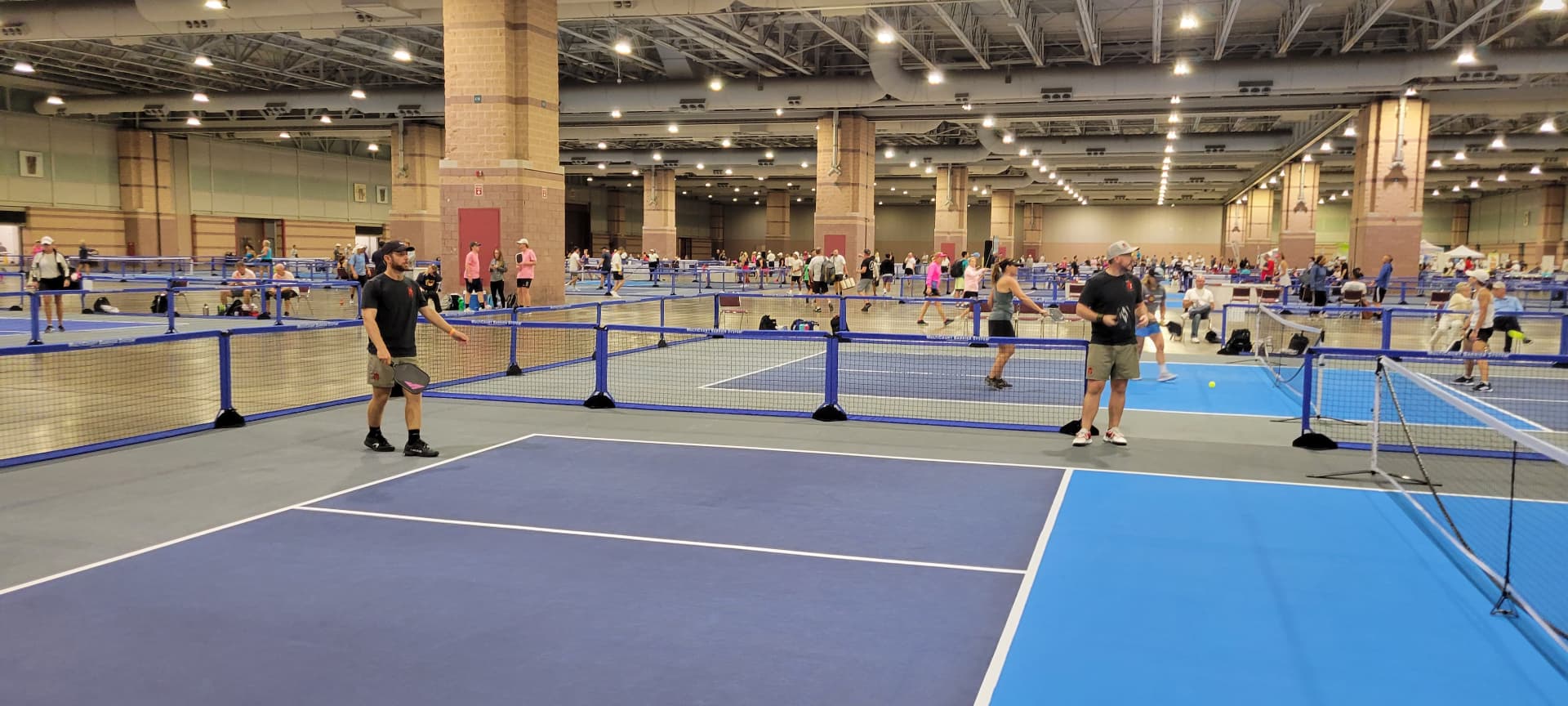
Pickleball fits a multi-day corporate retreat as a 60–90 minute block between working sessions, an opening-night icebreaker, or a closing-day tournament — and because attendees are staggered across the agenda rather than released all at once, most retreats only need one or two courts, not one per guest. A rollout court with a subfloor system installs on the lawn, gravel lot, or event space most lodge and resort venues actually have, and it is priced by court count and days on-site rather than by headcount.
Why retreats are adding a physical block to the agenda
The corporate retreat market has grown fast — one industry estimate puts it at roughly $31.8 billion in 2024, on pace to more than double by the mid-2030s — and more than seven in ten mid-size and large companies now run at least one annual offsite, typically budgeting somewhere between $1,000 and $3,000 per attendee once travel and lodging are included. What has changed more than the spend is the shape of the agenda: retreats have gotten shorter and more purposeful, with research on hosted offsites putting the average length at just under four days, and a growing share of companies running more frequent, shorter "micro-retreats" instead of one long annual trip. Retreats built with real outcomes in mind — not just a change of scenery — tend to allocate deliberate time for something physical and shared, on the logic that a room full of people who have been in back-to-back sessions since 8 a.m. do not walk into the next strategy workshop any sharper for having skipped a break.
That is the gap pickleball fills well. It does not require changing clothes into gym gear, it does not sideline anyone who is not already athletic, and a 60- to 90-minute block is long enough to actually matter without eating into the working agenda a retreat was booked to accomplish in the first place.
Where it fits in the agenda
Opening-night icebreaker
A casual, low-pressure hour the evening people arrive — before the retreat's real work starts, while people are still travel-tired and haven't settled into their usual work groups. Open play, not a bracket, works best here.
Midday reset between sessions
The most common slot: a 60–90 minute block between a morning strategy session and an afternoon workshop. Staffed courts mean people can wander in and out without a rigid schedule interrupting the day's real agenda.
Closing tournament
On the last full day, once the working sessions are done, a bracket-style tournament gives the retreat a clear, energetic finish before people scatter to travel home the next morning — see our corporate tournament guide for how to structure the bracket itself.
Why it works for a retreat roster specifically
Retreats are increasingly built around real outcomes — strategy sessions, planning workshops, skills training — which means long stretches in a conference room. A pickleball block gives the agenda a physical reset between working sessions instead of another breakout in the same room.
A retreat guest list usually spans a VP who has not exercised competitively in a decade and a coordinator two years out of college. Pickleball's low skill floor keeps both groups actually playing together instead of the retreat quietly splitting into an athletic clique and everyone else.
Retreat venues are rarely built for organized sport — a mountain lodge, a vineyard, or a ranch property has lawns and gravel lots, not courts. A rollout court with a subfloor system installs on grass or uneven ground without needing a paved surface.
A short, two-day leadership offsite might use pickleball as one 90-minute block on day one. A week-long company retreat can run it as a standing option every afternoon, with a closing bracket on the last day.
Planning a retreat or offsite?
Tell us the venue, dates, and headcount — we'll scope a court block that fits around your working agenda.
Planning it around the venue, not the other way around
- Confirm the retreat venue's surface before you book — a mountain lodge lawn, a vineyard gravel lot, and a resort's paved event space all need different setups, and grass or gravel needs a subfloor system to play true.
- Size courts to how many people will realistically play at once, not total attendee count — a retreat agenda usually staggers people across sessions, so you rarely need a court for every single guest at the same time.
- Build in a rain plan if the retreat is outdoors and seasonal — lodge and resort dates are often locked a year out, long before anyone can see the forecast for that week.
- If the retreat spans multiple days, ask whether staff can run the same courts as a standing option each afternoon rather than a single scheduled block — it gives people who skip one session a second chance to join.
A sample two-day retreat with a court built in
Day one: attendees arrive in the afternoon, and the court opens for casual open play from 5 to 6:30 p.m. before dinner — no schedule, no bracket, just a way for people who flew in from different offices to loosen up together before the retreat's real content starts the next morning. Day two: the working sessions run all morning, and the court reopens from 1 to 2:30 p.m. between the last workshop and a closing strategy discussion, staffed so people can drop in and out on their own schedule. If the retreat runs a third day, that is the natural slot for a short bracket — see our corporate tournament guide for how to size courts and build a timeline that fits inside a closing morning rather than taking over the whole day.
This is a different build than a single-day company outing. A field day or a summer picnic is usually the entire event, scheduled and staffed around itself. A retreat court is one component of a longer, working agenda, which changes how it gets scoped — staffing needs to flex around session breaks rather than running one continuous block, and court count follows how many people are likely to show up at any given hour, not the full attendee list. See our court-count guide for how that math differs from a tournament bracket, and our staffing guide for how ratios change for an open, drop-in format versus a scheduled one.
Fitting a court into a venue that was not built for one
Most retreat venues — lodges, vineyards, ranch properties, resort lawns — were built for meetings and lodging, not organized sport, which is exactly why a portable court matters here. Grass, gravel, and uneven ground all need a subfloor system underneath the rollout court to play true; a paved event lot or a resort tennis court can often take one directly. Our surface and subfloor guide covers what each site type needs, and our indoor vs. outdoor guide is worth a look if the retreat has a backup ballroom or event space in case the weather does not cooperate. If the retreat is a recurring annual trip to the same property, it is also worth comparing a portable rental against a semi-permanent installation the venue keeps year to year — some retreat and resort properties find the math favors a standing court once they are booking the same activity every year. And if golf has traditionally been the retreat's go-to outdoor activity, our golf outing alternative guide covers what changes when a shorter, more inclusive format replaces a half-day round.
Sizing it to the retreat you're actually running
A 15-person leadership offsite and a 200-person all-company retreat both benefit from the same basic idea, but the build looks different. For a small leadership group, one court is usually enough — the point isn't to run a full bracket, it's to get a dozen executives who spend most calls staring at the same screen actually standing across a net from each other. For a larger company-wide retreat, two or three courts running as a standing option across the afternoon block tends to work better than trying to schedule every attendee through a single court in a tight window — people rotate in and out on their own time between the sessions they're assigned to. Either way, resist the instinct to over-build. A quiet court with a few people rotating through steadily reads better than an empty one built for a crowd that never fully assembles at once, and it's a cheaper build besides.
Who typically books this
Requests tend to come from three places: an HR or people-ops team planning the annual all-company offsite, an executive assistant or chief of staff scoping a smaller leadership retreat, and increasingly, the retreat venue or resort itself, offering it as an amenity option to groups booking their conference space. If you're coming from the venue side rather than the corporate side, our hotels and resorts program covers how properties add this as a bookable option for the groups already staying with them, rather than sourcing it separately for a single client. And if the retreat is really an incentive trip sourced through a destination management company rather than an in-house offsite, our incentive travel and DMC programs guide covers how that booking relationship and itinerary planning differ.