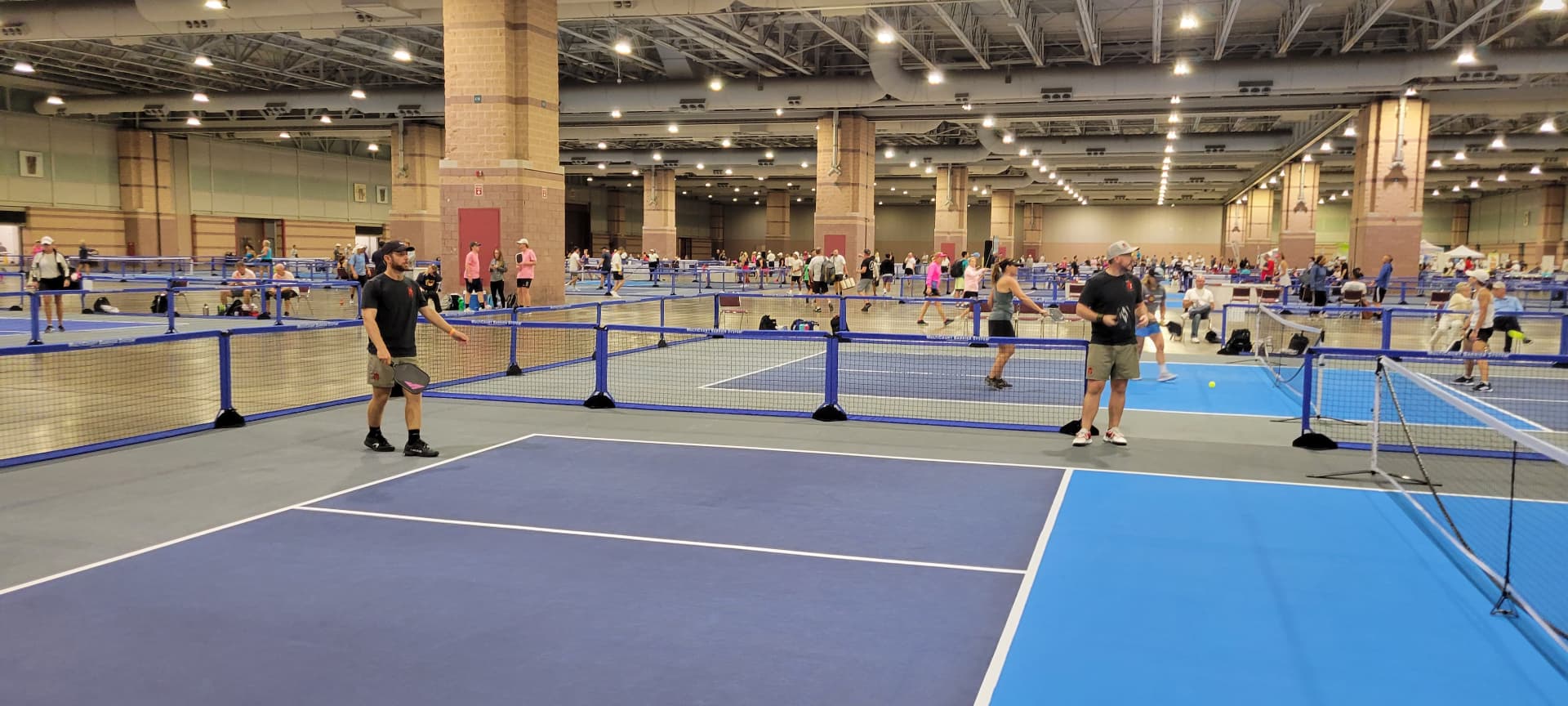
Pickleball event marketing means using a live, branded pickleball activation as a marketing channel — at trade shows, product launches, festivals, sponsorships, and corporate events. Instead of a static booth or interruptive ad, you give people a game to play, wrapped in your brand, staffed and run so the experience feels effortless to the guest and measurable to the brand.
This playbook is for marketing, experiential, and sponsorship teams who need more than a one-line pitch. It covers why the format works, which activation shapes convert for different KPIs, how to brief a turnkey court, how to measure results, and how budget usually frames — with links to deeper guides on measuring ROI, pickleball participation statistics, and our brand activations service line.
Not every branded court lives on a show floor. The same rollout system works as an evening icebreaker at a conference networking reception, as the draw at a grand opening or ribbon-cutting, or as a multi-stop campaign — see the multi-city activation tour guide when the brief spans more than one city.
Why pickleball works for event marketing
The sport earns the marketing brief for six practical reasons — not because it is trendy in isolation, but because those reasons map to the outcomes brands already buy experiential for.
Mass, all-ages appeal
The underhand serve and short court mean almost anyone at your event can step on and play within minutes — not only watch. That turns a booth or festival footprint into participation instead of foot traffic that glances and keeps walking.
Dwell time you can feel
A live court holds people longer than a screen, giveaway table, or static wrap. Longer dwell time is where sales conversations, demos, and content capture actually happen.
Built-in shareable moments
Games are social and photogenic. Attendees post themselves without being asked, which extends the campaign past the room — especially when courts and nets are wrapped in your creative.
Active, not interruptive
Experiential marketing works when people associate your brand with something they enjoyed doing. A rally is a better brand memory than another interruptive ad or QR dead-end.
A fully brandable surface
Courts, nets, paddles, and surrounding signage become a wrapped canvas. Your logo shows up in every photo, livestream, and influencer post shot on-site.
Lead capture that feels natural
Sign-up-to-play, waitlist QR codes, spin-to-win after a rally, or staffed demos during changeovers turn fun into a measurable contact list without feeling like a hard sell.
Activation formats that convert
Pick a format that matches the job in the brief. A lead-gen show-floor court and a content-first influencer day can use the same physical court — and still need different staffing, offers, and shot lists.
Branded show-floor court
A wrapped court on a trade-show or conference floor stops aisle traffic and creates a natural gathering point for demos and conversations. Staff run short rallies so the booth never looks empty, and sales can pull warm prospects off the sideline into a deeper chat.
Sponsor-activation tournament
A bracket or round-robin tied to your sponsorship — prizes, a leaderboard, and pro staff running the whole thing. Works when you already bought title or hospitality rights and need the on-site moment to match the spend.
Play-with-a-pro or celebrity draw
A known player or creator on court pulls a crowd and gives attendees a story worth sharing. Best when the talent fits the brand and you have a content team ready to capture the queue.
Lead-capture and giveaway loops
Sign-ups to play, timed challenges, or swag tied to a completed rally convert engagement into a list. Build the capture flow into the staffing plan so it is not an afterthought at the table.
Content and influencer days
A built court as the backdrop for a shoot, creator collaboration, or product-launch content day. The activation is the set — useful when the primary KPI is assets and impressions rather than on-site leads.
Pop-up launch or retail takeover
A temporary branded court outside a store, at a launch party, or on a plaza draws a line and gives the launch a physical reason to linger. Pair it with sampling, demos, or a limited drop so the court feeds the commercial goal.
Product launches and public festivals are two of the highest-content settings. Our brand activations and product launches guide covers how a fully branded court gets scoped for a launch pop-up, and our city festivals and street fairs guide covers what changes when the activation is one draw inside a bigger public event. A title-sponsored court at a charity gala is a different brief again — see the nonprofit fundraiser guide.
How to brief a turnkey pickleball activation
A clean brief saves weeks of back-and-forth. Lock these four decisions before creative polish — they drive court count, staffing, and whether the day hits the KPI.
Venue and footprint first
Confirm the pad: booth size, ballroom, lawn, rooftop, parking deck, or plaza. Note load-in path, elevator or dock access, ceiling height indoors, and whether the surface needs a subfloor for grass or uneven ground.
Write the marketing job in one sentence
Lead capture, dwell time for demos, UGC for a campaign, sponsor fulfillment, or foot traffic for a launch are different jobs. The format, staffing, and measurement all follow from that sentence.
Size courts to peak crowd, not average
Under-courting creates a line that kills energy; over-courting wastes budget. Peak aisle traffic at a show or peak hour at a festival should drive court count more than all-day averages.
Decide KPIs before creative
If you need leads, design the sign-up path and offer. If you need content, schedule creators and shot lists. If you need sponsor impressions, plan wrap placement and photo angles before the day of.
- Share the event date, city, indoor vs outdoor preference, and expected peak headcount in the footprint.
- Attach brand guidelines and any must-have wrap placements (logo lockups, campaign URLs, legal lines).
- Say whether you need lead capture hardware/software, a creator day, or sales staff on the sideline.
- Flag permit, HOA, or venue rules early — load-in windows and noise limits shape the run of show.
When the brief is ready for a formal buy, our RFP guide for pickleball events and site assessment overview help procurement and ops ask the right questions. For timeline planning, see how far in advance to book.
Get a quote for your marketing activation
Tell us the event type, city, date window, and whether the job is leads, content, or sponsor fulfillment. We come back with clear pricing — usually within 24 hours.
Confirmed starting point: a single-court one-day activation typically begins around $10,000, with multi-court and multi-day builds moving into mid-five and six figures depending on staffing, wrap, and programming.
What to measure (so ROI is not anecdotal)
Agree on primary and secondary KPIs in the brief, then instrument the day accordingly. A court that looks busy but captures nothing still fails a lead-gen brief.
- Dwell time at the activation — average minutes people stay in the footprint versus a neighboring static booth.
- Leads or sign-ups captured on-site — QR scans, waitlist entries, demo requests, or email/SMS opt-ins tied to play.
- Social and UGC volume — posts, stories, and tagged assets that use the wrapped court as the backdrop.
- Qualified conversations — sales-assisted demos or meetings booked from the sideline during the event.
- Downstream conversions — pipeline or promo codes attributed to the activation when your CRM can connect them.
For benchmarks, tracking setups, and how sponsorship teams report activation value, use the sponsor activation ROI guide. For participation context you can cite in a deck, see pickleball statistics.
Where pickleball event marketing fits
The same physical product — a staffed, branded rollout court — slots into the marketing moments where engagement and dwell time matter most.
Trade shows & conferences
Aisle stop, dwell time, and sales conversations on a crowded floor.
Brand activations & product launches
A physical reason to linger when the campaign needs more than a stage moment.
Festivals & community events
Foot traffic, family appeal, and content that outlives the weekend.
Sponsorships & sporting events
On-site fulfillment that matches title or hospitality spend.
Corporate events
Internal brand moments, client hospitality, and culture days with a marketing edge.
Charity fundraisers
Sponsor visibility and content when the brand is backing a cause.
Why pickleball over other racquet-sport activations
Brands weighing an interactive court format sometimes ask about padel instead. Pickleball generally wins the marketing brief: it is learnable in minutes so more attendees actually play (not just watch), and it installs as a portable rollout court that fits a booth footprint, ballroom, or rooftop rather than needing a fixed enclosure. See our pickleball vs. padel comparison for the full breakdown.
Marketing a single activation and marketing a full circuit are different jobs. If the campaign is headed to more than one city this year, the multi-city activation tour guide covers routing, budget, and how to keep branding and content strategy consistent stop to stop. For trade-show booth footprints specifically, see pickleball trade show booth activation.
Budget framing stays honest: a single-court one-day turnkey activation typically begins around $10,000; multi-court and multi-day builds scale from there. Exact quotes depend on city, staffing, wrap complexity, and programming — request one rather than treating any public range as a fixed menu price.
Pickleball event marketing: FAQs
What is pickleball event marketing?
It is using a live, branded pickleball activation as a marketing channel — at trade shows, product launches, festivals, sponsorships, and corporate events. Instead of a static booth or ad, you give people a game to play, wrapped in your brand, staffed and run for you.
Does pickleball event marketing work for both B2B and B2C?
Yes. For B2B, a court on a conference or trade-show floor creates dwell time and natural conversations with prospects. For B2C, a branded activation at a festival, retail, or sponsorship event drives engagement, content, and foot traffic. The format flexes to the audience and the KPI.
How do you brand the courts?
Courts, nets, and surrounding signage can be custom-wrapped with your logo, colors, and campaign creative, so the activation is a content-ready marketing asset that shows up in every photo and post. Paddle and staff apparel branding are common add-ons when the campaign needs full immersion.
How do you measure the ROI of a pickleball activation?
Common measures include dwell time at the activation, leads or sign-ups captured on-site, social impressions and user-generated content, qualified sales conversations, and downstream conversions tied to the event. Build lead capture and tracking into the activation so results are not just anecdotal — see our sponsor activation ROI guide for a fuller measurement framework.
How much does a pickleball marketing activation cost?
Turnkey activations start in the five figures. A single branded court for a one-day event typically begins around $10,000 (confirmed pricing for a standard single-court one-day activation), scaling with court count, days, staffing, custom branding, and programming. Multi-court or multi-day builds move into mid-five and six figures. We return an exact quote, usually within 24 hours.
How far in advance should we book a branded pickleball activation?
Lead time depends on custom wrap production, travel, and how busy the event calendar is in your city. For trade shows and national launches, earlier is safer so creative and court count can lock with the rest of the booth plan. See our guide on how far in advance to book pickleball courts for planning ranges by event type.
Can a pickleball activation run indoors on a show floor or ballroom?
Yes. Rollout courts install on many indoor surfaces when ceiling height, load-in, and a flat pad allow it. Indoor builds are often the right call for conferences, hotel launches, and weather-proof backups — confirm the footprint with a site assessment before you print booth graphics around an assumed court size.
Pickleball vs padel for a marketing activation — which should we choose?
For most marketing briefs, pickleball wins on learnability and footprint: more attendees actually play, and a portable rollout court fits a booth, ballroom, or rooftop without a fixed enclosure. Padel can make sense for a niche audience already deep in that sport. See our pickleball vs padel comparison for the full breakdown.