Event Playbook · Employee Wellness & Benefits Fairs
Pickleball for employee wellness days and benefits fairs
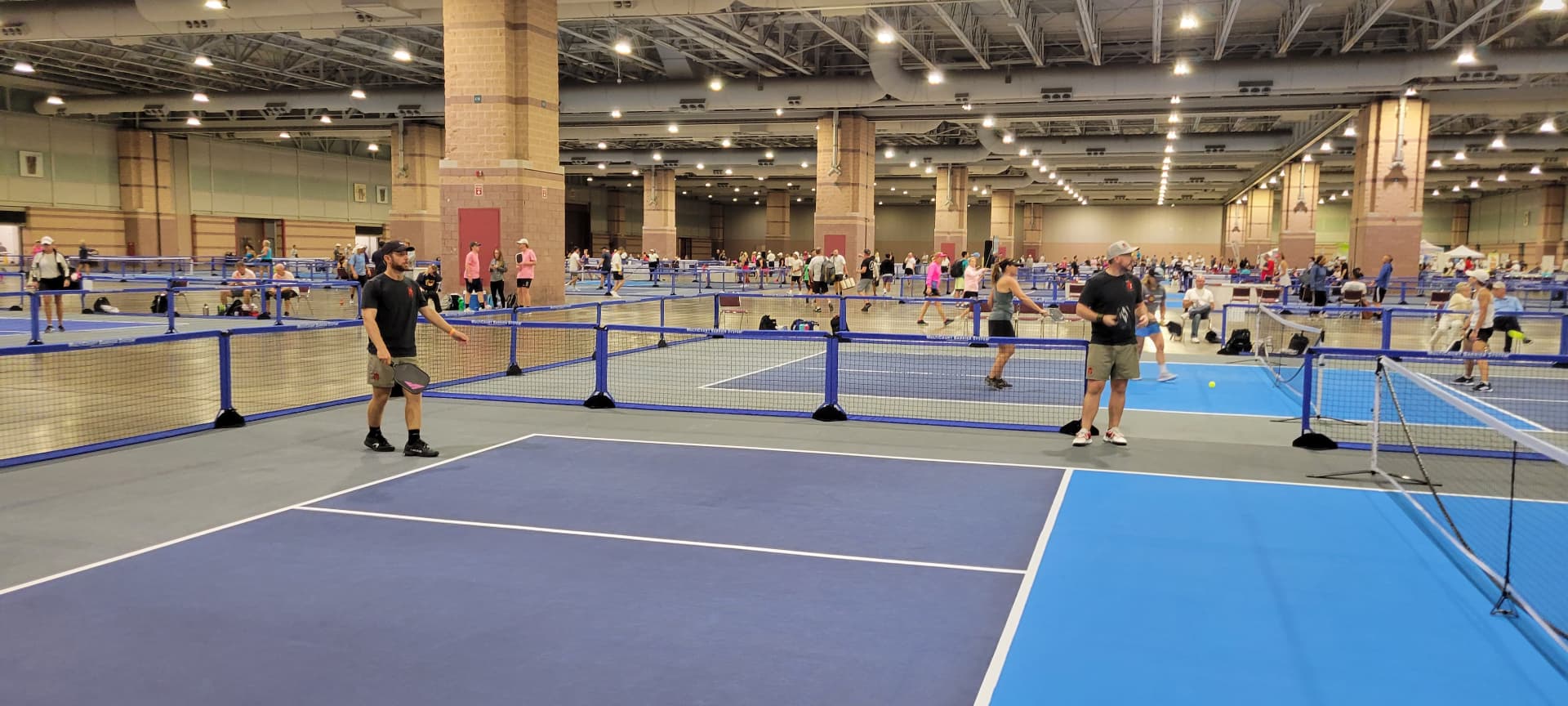
A turnkey pickleball activationgives HR and benefits teams a physical, social station for a wellness day or open-enrollment fair that doesn't require anyone to sign up in advance. Courts are delivered, built, staffed, and removedon your campus, lobby, or parking lot, so the person running the event doesn't become the person setting up equipment. It works as a lunchtime pop-up next to broker tables, a full wellness-day headliner, or a rotating schedule across a multi-building campus.
Why a court moves the needle when a pamphlet doesn't
Wellness budgets keep growing, but participation is the persistent problem. Industry data puts average corporate wellness program participation around 30–35% even at companies that invest heavily — most of the benefit goes unused because engaging with it takes a deliberate opt-in. A court doesn't have that problem. Nobody enrolls in a pickleball rally; they just walk over on their way to lunch.
Industry surveys put average corporate wellness program participation at roughly 30–35%, even at companies that invest heavily in the benefit. A booth or app rarely closes that gap. A court in the courtyard or parking lot does, because nobody has to enroll in anything to walk over and hit a few balls.
Benefits fairs are built around tables, QR codes, and biometric screening lines. A court is the one station where someone moves their body instead of scanning a badge — which is also the easiest thing for HR to photograph and put in the recap email.
Brokers report mental health and wellbeing as the fastest-growing benefit investment category this cycle. A shared, low-skill-floor activity that mixes departments for twenty minutes is a cheap, visible way to put that budget line into something employees actually notice.
One staffed court runs a satellite office wellness afternoon. A rotating multi-court schedule across buildings covers a full corporate campus during open enrollment week without anyone on the HR team learning event logistics.
Four ways companies actually run this
The right format depends on whether pickleball is the whole event or one station among many. Match the format to the calendar slot, not the other way around.
Set the court just outside the vendor-table room — in a courtyard, lobby, or parking area — so it pulls foot traffic without competing with broker booths for indoor square footage. Run 15–20 minute hosted rotations so people can play between meetings and still make it back to their desk.
When the event is built entirely around wellbeing — health screenings, a 5K, mindfulness sessions — the court becomes the social anchor people gather around between stations. Budget more court hours and staff time since this is the draw, not a side attraction.
Large employers with several offices or a sprawling campus often run the same activation on a rotating schedule — one building per day during open enrollment week, or one satellite office per month. Book it as a single scoped plan so staffing and branding stay consistent site to site.
If your wellness platform awards points for participation, the court can be a check-in station — badge scan or sign-in sheet, then play. Keep the rules simple; the value is the activity itself, not building a scoring system around it.
Want a shorter, social happy-hour version instead of a fair-adjacent activation? See our company happy hour guide. If leadership wants a scored, competitive event instead of an open wellness activity, that's a different brief — see corporate pickleball tournament. Fitness clubs and gyms running their own member wellness nights should read pickleball for fitness clubs and gyms instead — that page covers the club-hosted version of this idea.
Planning a wellness day or benefits fair?
Tell us your campus address, dates, and expected foot traffic — we'll scope courts and staffing that fit the calendar slot, not take over the whole event.
Do this, skip that
Do
- Site the court where people already walk between the parking lot, cafeteria, or main entrance — not in an overflow lot nobody passes.
- Keep hosted rotations short (15–20 minutes) so employees can join between meetings without asking their manager for an hour off the calendar.
- Loop in facilities and security early on campus access, freight paths, and whether the court needs to clear by a specific time for another event.
- Coordinate timing with your benefits broker or carrier reps if the wellness day runs alongside open enrollment — they usually want foot traffic near their tables too.
- Brief staff to make the first rally friendly to someone in office clothes and dress shoes — most attendees are not changing into athletic wear on a workday.
Don't
- Don't schedule a scored bracket into a lunch-hour wellness pop-up — that's a different product; see our corporate tournament guide if leadership wants a winner.
- Don't promise attendance numbers to HR leadership based on total headcount. Court throughput is driven by staffing and rotation length, not company size.
- Don't skip the certificate of insurance conversation with facilities — corporate campuses almost always require one before anything gets built on the property.
- Don't bury the activation deep in the building where only people already headed to the gym will find it.
- Don't leave the court unstaffed during a benefits fair. An unhosted court next to a health screening line creates equipment confusion, not engagement.
Corporate campus logistics, not conference-venue logistics
Office parks and corporate campuses run differently than hotels and convention centers. Facilities teams and building management aren't booking outside vendors every week, so building in extra lead time for approvals is worth more here than almost anywhere else we work.
Corporate campuses vary widely — some have loading docks and event coordinators who do this monthly, others have never had an outside vendor build anything on the lawn. Share a site photo or floor plan early so load-in timing, elevator size (for indoor atrium installs), and any badge-access requirements for our crew are settled before the date.
A large share of benefits fairs cluster into a few weeks each fall as employers run open enrollment. Trucks, staff, and courts book up fastest in that window — the same booking-lead-time guidance that applies to any peak season applies here, only more so, because HR calendars are usually locked months ahead of the fair itself.
Expect your facilities, legal, or risk team to ask for a certificate of insurance naming the company or the campus property owner. Corporate legal review can take longer than a venue's own approval process, so start that conversation as soon as the date is close to firm — not the week of the event.
Indoor lobbies, atriums, and gyms are the weather-proof default and usually the easiest to book with facilities. Outdoor courtyards, lawns, and parking areas photograph better for the recap email but add a weather contingency conversation, especially for an event locked to a single fall or winter date.
Deeper references: insurance and liability, indoor vs outdoor rental, and how far in advance to book.
Sizing a court to your headcount
A single court supports four players at a time, so throughput comes from staffed rotation speed, not from matching court count to company size. A 5,000-employee campus doesn't need five courts if the event window is three hours and rotations run fifteen minutes apiece.
One court with a two-to-three-hour staffed window covers a satellite office or single-building wellness afternoon comfortably.
One to two courts running a full day, or a rotating single-court schedule across buildings during open enrollment week, keeps staffing costs proportional to actual foot traffic instead of total headcount.
A single scoped plan covering multiple offices on a rotation — booked once, staffed and branded consistently — is usually simpler for HR to manage than treating each site as its own vendor search.
For a fuller sizing walkthrough, see how many pickleball courts you need, and for the tradeoffs between open play, round robins, and brackets, see event format options.
Why participation, not attendance, is the real metric
HR teams sometimes ask us to project a headcount before the event happens. We don't — total badge scans depend on your building traffic, not on us. What we can control is making sure the people who do walk by actually stop: a visible court, a host who waves people over instead of waiting for them to ask, and rotations short enough that someone can play between two meetings without rescheduling either one. That combination consistently outperforms a longer activation window with a quieter setup.
If your wellness program already tracks engagement — app check-ins, points, biometric screening completion — a court is easy to fold into that measurement without inventing a new metric. Just decide the check-in method before the event, not during it.
Making the internal budget case
Mental health and wellbeing benefits are consistently reported as one of the fastest-growing investment categories for employers right now, alongside a broader corporate wellness market that continues to expand year over year. That growth is a budget-conversation asset: a physical, social activation is a concrete, photographable use of that line item rather than another line in a benefits guide nobody reads cover to cover. If you need a broader framework for making the case to leadership, our team-building ROI guide covers what's realistic to claim and measure.
Pricing honesty for HR and benefits buyers
Turnkey activations are quoted as a scoped line item — court count, hours on-site, staffing, and travel — not a fake per-employee menu. A single-court, half-day wellness activation at one office typically begins around $10,000. Multi-building rotations across a campus, or multi-day coverage during open enrollment, move up from there depending on how many sites and days are in scope. Compare the drivers that move a quote up or down in our pickleball court rental cost guide, then request a quote with your campus address, dates, and expected foot traffic.
How to brief us (what we need in the first email)
A clean first brief shortens quote turnaround, especially when a corporate legal or facilities review is already part of your timeline.
- Company name, campus or office address, and whether the activation is indoor (lobby, atrium, gym) or outdoor (courtyard, lawn, parking lot).
- Event date(s) and the exact window pickleball needs to be active — not the fair's full open hours if the court is only staffed for part of it.
- Whether this is a standalone wellness day, part of a benefits fair alongside broker tables, or a multi-building rotation.
- Expected foot traffic or building headcount, so staffing and rotation length are scoped realistically.
- Whether facilities or legal requires a certificate of insurance before booking, and who that request should go to.
- Branding: company-only, or co-branded with a wellness vendor or carrier partner.
For a general framework on adding pickleball to any event, see how to add pickleball to your event. If procurement needs a formal RFP for a large employer rollout, use how to write an RFP for a pickleball event.