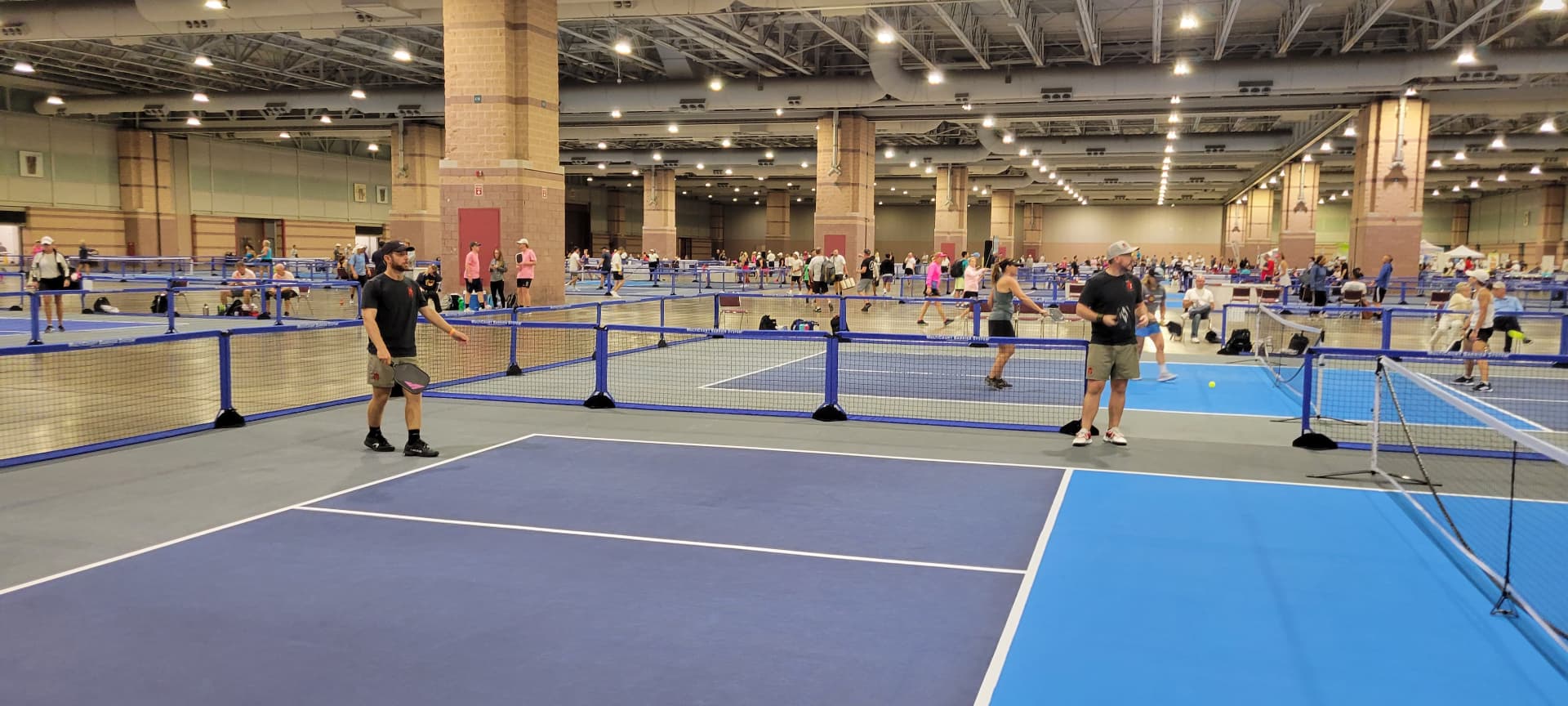
Event Day Planning · 2026
How to build a run of show for a pickleball event
A run of showis the minute-by-minute, guest-facing schedule for your event day — check-in, warm-up clinic, main play blocks, buffers, and awards — with one owner named for each segment. It is different from the crew's build schedule, which covers load-in and teardown before and after guests arrive. A workable run of show builds in roughly 10–15% buffer time, places it deliberately after your highest-variance blocks, and gets read aloud with staff and the venue at least a day ahead so conflicts surface before the first guest does.
Run of show vs. build schedule vs. format
Planners often conflate three different documents. The build scheduleis the crew's clock — when trucks arrive, how long the court takes to install, and when teardown starts; our setup and teardown timeline guide covers that in depth. The format — round-robin, bracket, or open play — decides how play itself is structured; see our format guide before you fill in a single time slot. The run of show is what ties both of those to the guest experience: what's happening, on which court, run by which staffer, at every point in the day.
Skip this distinction and you end up with a beautifully built court and no plan for what actually happens on it — or a tight tournament bracket with no time built in for the beginners who showed up without ever having held a paddle.
The core blocks of a pickleball event day
Where guests get oriented — name tags, paddle assignment, and a quick rules primer for anyone who's never played. Understaffing this block is the single most common way a run of show falls behind before the first serve.
A short, staffed block so mixed-skill guests get comfortable before anything is scored. Skipping this is why events end up with a crowded court of confident regulars and a bored group standing on the sideline.
Round-robin rotations, bracket matches, or open play — whichever format fits your goal and time budget. This is the block your format decision actually shapes; see our format guide before you fill in times here.
A deliberately unfilled block placed after high-variance segments — Q&A-style breaks, VIP arrivals, meal transitions. It is not free time to program over; it's the insurance that keeps the rest of the day on schedule.
The moment most guests remember. Protect this block's start time even if earlier blocks ran long — cutting warm-up time is far less costly than cutting the moment with the trophy and the crowd.
Sample run of show: half-day corporate off-site
A single-court or two-court event, roughly three hours of guest-facing time. Adjust block lengths to your actual headcount and court count.
| Time | Block |
|---|---|
| 11:30 AM | Court open, staff on-site, final walk-through |
| 12:00 PM | Check-in & welcome |
| 12:20 PM | Beginner clinic / warm-up rotation |
| 12:45 PM | Buffer (10 min) |
| 12:55 PM | Round-robin play, all skill levels |
| 2:00 PM | Buffer (10 min) — reset courts, hydration break |
| 2:10 PM | Finals / final rotation |
| 2:30 PM | Awards & group photo |
| 2:45 PM | Wind-down, guests depart |
| 3:00 PM | Teardown begins |
Sample run of show: full-day conference or festival build
A multi-court activation running most of a business day, with rotating crowds rather than one fixed guest list. Buffers are longer and more frequent because variance compounds over a longer day.
| Time | Block |
|---|---|
| 7:00 AM | Crew load-in, court build (see setup & teardown timeline) |
| 9:00 AM | Staff briefing, final court check, signage placed |
| 9:30 AM | Doors / booth open, court visible and staffed |
| 10:00 AM | First clinic block — rotating beginners through in short waves |
| 11:30 AM | Buffer (15 min) — reset between morning and midday crowd |
| 11:45 AM | Midday tournament block — bracket or timed round-robin |
| 1:00 PM | Buffer (15 min) — lunch-hour crowd transition |
| 1:15 PM | Afternoon open play / second clinic wave |
| 3:30 PM | Buffer (15 min) — reset for finals crowd |
| 3:45 PM | Finals |
| 4:15 PM | Awards, sponsor recognition, photos |
| 4:45 PM | Booth/court winds down, staff begin breakdown prep |
| 5:30 PM | Teardown begins |
Need a schedule that matches real staffing?
Tell us your format, guest count, and goals — we'll help sequence the day around the courts and crew in your quote.
Buffer time: the most-skipped line item
A schedule with zero slack looks efficient on a slide and falls apart in practice. A workable rule of thumb is to build roughly 10–15% of your total event time into explicit, labeled buffer — not vague hope that things run on time. Place it deliberately: right after a clinic wave that always runs long, before a VIP or sponsor moment that can't start late, and around any meal or crowd transition. Label each buffer block as exactly that in your written run of show, so staff treat it as insurance rather than free time to fill with one more activity.
Buffers compound in value on longer, multi-court days, where one late rotation can cascade into every block behind it. A full-day festival or trade show build should carry more total buffer than a tight two-hour off-site — not because the crew is less capable, but because there's simply more time for variance to accumulate.
Staffing sync: who owns each block
A run of show is only as reliable as the staffing behind it. Name one person responsible for check-in, one for running the clinic, one for scoring and rotations, and one for the microphone during awards — even if the same two staffers rotate through multiple roles across the day. Our event staffing guide covers typical roles and ratios so the names on your run of show match real headcount, not a wish list.
Walk through the finished document out loud with staff and your venue contact — start to finish, at least a day before the event. Reading it minute by minute is what surfaces the conflicts a written page never will: two things scheduled in the same space, an award moment with no microphone confirmed, or a scoring plan nobody actually explained to the person running it.
Adapting the template to your format
Round-robin play creates steady, predictable block lengths that are easy to schedule tightly — good for a run of show with a hard end time. A single-elimination bracket narrows the field as the day goes on, which means match lengths get less predictable in the afternoon and later blocks need more buffer, not less. Open play needs almost no internal structure beyond a start and stop time, which makes it the easiest format to schedule but the hardest to guarantee a "moment" from. Decide the format using our format guide before you lock times into the run of show — reversing that order is how schedules end up rebuilt the week of the event.
If your event has an outdoor component, decide the weather trigger and fallback block now, and pair this schedule with our weather contingency plan so a rain call doesn't mean improvising the whole day live.
Run-of-show mistakes that undo a good event day
A schedule with zero slack looks tidy on paper and falls apart by 11 a.m. Build in roughly 10–15% of the day as explicit, labeled buffer — not hope — placed after your highest-variance blocks.
Cutting the clinic to save 20 minutes usually costs you the whole afternoon: unconfident players avoid the court, staff spend the day coaxing instead of running rotations, and the space looks emptier than it should for the crowd you actually have.
A run of show that lists activities without naming who's responsible for each one turns into a group project nobody runs. Assign one name to check-in, one to the clinic, one to scoring — even if it's the same two people wearing different hats at different times.
Reading the run of show out loud with your staff and the venue contact — start to finish, at least a day ahead — catches the conflicts a document never will: two things scheduled in the same space, a scoring plan nobody explained, an award ceremony with no microphone.
An outdoor run of show without a decision point for rain isn't a schedule, it's a hope. Name the trigger time and the fallback block before the day starts, and pair it with a real weather contingency plan.
Pickleball event run of show: FAQs
The questions we hear most from planners building out the day-of schedule for a pickleball activation.