Pricing Guide · 2026
How much does it cost to rent a pickleball court?
A turnkey pickleball activation — courts delivered, installed, staffed, and removed for you — starts in the five figures. A single-court, one-day corporate event typically begins around $10,000, and multi-court trade-show, conference, or festival builds scale into the mid-five and six figures. The price is driven by court count, days on-site, staffing, travel, surface, and branding. Every event is quoted individually — usually within 24 hours — so you put a real number in the budget instead of a guess.
Two products buyers confuse: facility rental vs. turnkey activation
Most searches for "how much does it cost to rent a pickleball court" mix two very different products. Renting court time at a local facility means you go to their location on their schedule, bring your own guests (or join open play), and pay by the hour. That is useful for a small private hit or a recurring club block. It is not what makes pickleball work at a conference, corporate off-site, festival, or brand activation where there is no court on site.
Previously published facility ranges on this site put casual court time roughly in the $7–$45 per hour band and multi-court facility buyouts roughly in the $400–$1,000 per hour band (for example, previously published figures around $400/hr for up to eight courts and $700–$1,000/hr for up to sixteen). Those numbers are not confirmed current prices and are not a guarantee of what any facility will charge today — treat them as soft industry context only. Facility pricing also varies by market, time of day, and whether you need exclusive buyout time.
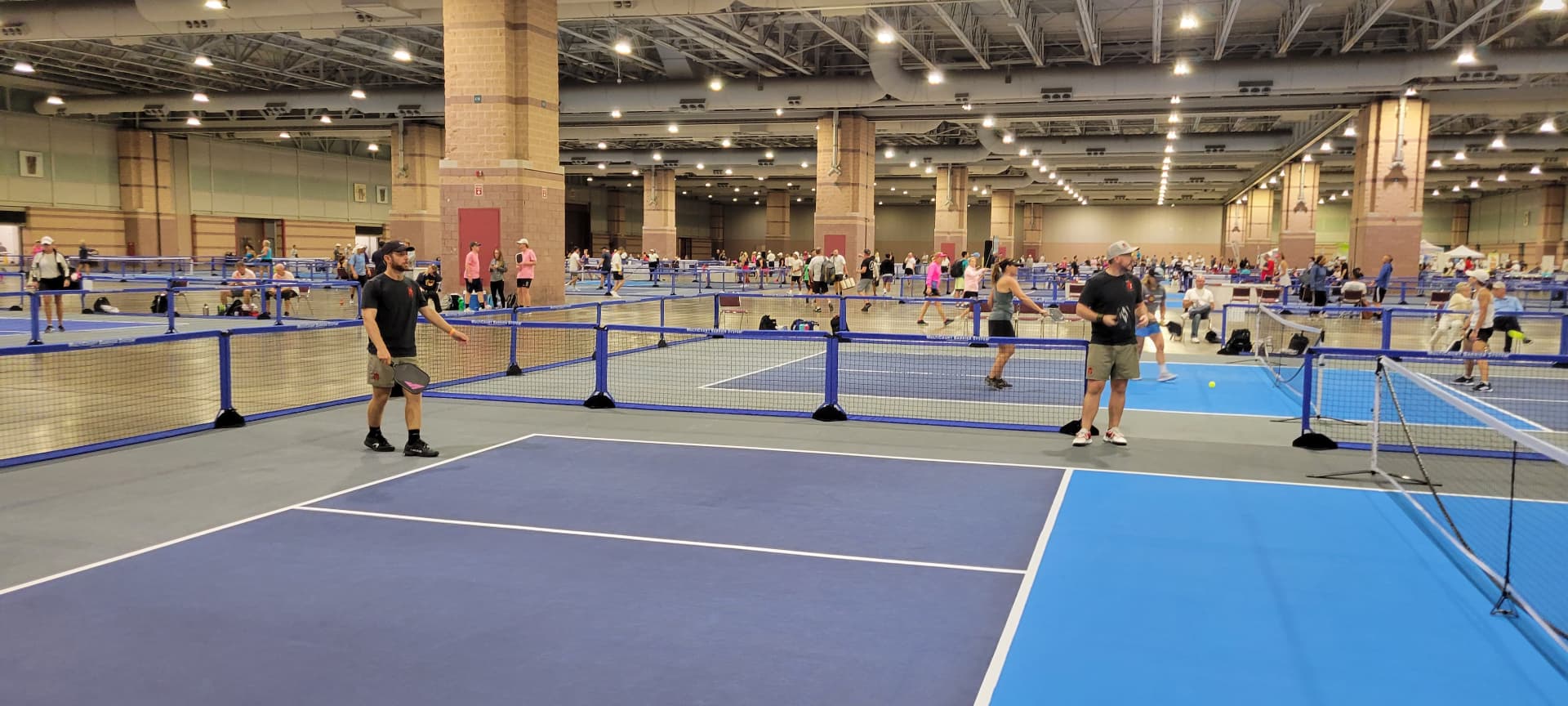
A turnkey activation is the event product: professional rollout courts, nets, paddles, and event staff brought to your venue — a convention floor, hotel lawn, parking garage, company campus, plaza, or private property — with delivery, installation, programming, and teardown handled as one project. Because it includes logistics and people, it is priced per event rather than per hour. That is the pricing this guide is about, and it is the product The Pickleball Events Co. delivers nationwide.
What drives pickleball court rental costs
Turnkey quotes are project-based. These six levers explain almost every difference between a lean one-day build and a six-figure festival grid. Court count and days on-site move the number the most; staffing, travel, surface, and branding decide whether the experience feels premium or thin.
The single biggest driver. One court for a corporate day vs. 10+ for a conference or festival changes the build, crew, trucks, and programming — not just the square footage.
A one-day activation costs far less than a multi-day trade show or a seasonal resort install. Extra days add court rental time, overnight security or storage, and staff shifts.
Pro event staff to run clinics, round-robins, and tournaments — priced by headcount and hours. See our event staffing guide for roles and ratios. If the budget is tight, cut a court before you cut the host running it.
Distance to your venue, load-in windows, and convention-center or union labor rules. Booking a single exhibitor footprint? See our trade show booth activation guide for union-labor specifics.
Installing on grass, a rooftop, or a parking garage may need a subfloor; asphalt, concrete, and most carpet install directly. Details live in the surface and subfloor guide.
Custom-wrapped courts, nets, and signage for activations cost more than standard courts, and wrap lead times matter. Branding is optional on a private team day and almost required on a sponsor or booth build.
What's included — and what's optional
Every activation is built around your event. The courts and logistics are the foundation; the rest are options you add to fit your goals and budget — so no two quotes look the same. See our full equipment rental checklist for exactly what's standard versus an add-on, and how to add pickleball to your event for the planning sequence before budget.
Rollout courts, nets, and paddles installed at your venue on the surfaces we scope — the foundation of every activation.
Full logistics: transport, build, and removal, handled on one invoice so your planner is not coordinating three vendors.
Hosts on-site to welcome players, keep courts active, teach short mini-clinics, and protect the brand experience.
Beginner-friendly instruction so everyone can play, not just the regulars. Optional add-on when the guest list is mixed.
A pro player for exhibitions, clinics, and photos — a headline draw for VIPs and crowds. Optional add-on.
Structured round-robins, brackets, and formats scaled to your guest count and dwell time. Optional add-on.
Courts, nets, and signage wrapped in your brand for a content-ready activation. Optional add-on with print lead time.
Branded paddles, apparel, and prizes your guests take home. Optional add-on.
Confirmed planning ranges (turnkey activations)
These are the planning bands we use on-site. They are not a fixed menu — every event is quoted individually — but they are the honest floor and scale you should put in a draft budget before a site walkthrough.
| Event scope | Typical range |
|---|---|
| Single court · 1 day · corporate / team-building | Typically begins around $10,000 |
| 2–4 courts · 1–2 days · trade show or conference | Mid five figures |
| 6+ courts · multi-day · festival or branded activation | High five to six figures |
Ranges are general estimates for turnkey activations and vary by market and scope — a build in a busy hub like Austin, Denver, Houston, Seattle, San Francisco, Boston, Philadelphia, Minneapolis, Indianapolis, Tampa, Raleigh, Columbus, or Kansas City can carry different travel and crew costs than a smaller market — the same goes for San Antonio , Salt Lake City, and St. Louis. For an exact number, request a quote.
Scenario ranges: corporate day, trade show, festival
Use these scenarios to stress-test an internal budget before you send an RFP. They map to the confirmed planning bands above — not to invented per-player fees or facility hourly menus.
One well-staffed court on a hotel lawn, campus green, or ballroom often outperforms two unstaffed courts. Scope for clinics and short round-robins so mixed skill levels play in the first ten minutes. Budget planning usually starts at the single-court, one-day floor (typically around $10,000) and moves up when you add a second court, a pro clinic block, or overnight install.
Court count follows booth footprint and dwell time, not the full show attendance. A single branded court inside an exhibitor footprint can cycle 100+ players in a day when staff run tight rotations. Multi-court show-floor or plaza builds for larger conferences move into mid-five figures once you add days, branding wraps, and union labor windows. See the trade show booth activation guide for exhibitor-specific constraints.
Six or more courts, multi-day schedules, overnight security or storage, and custom wraps push activations into the high-five and six-figure band. Court count should follow how busy you want the space to look — over-building spreads the crowd thin. Pair this page with how many courts you need and the site assessment guide before you lock a festival grid.
Court count itself is not guest-list size divided by four. Format and dwell time matter more — see how many courts you actually need and the court dimensions for events guide (~30 × 60 ft per court with run-off). If it is a scored team competition, the corporate tournament guide shows how court count follows heat size. Pricing a smaller private build — a milestone birthday or family celebration rather than a corporate event? Our birthday parties and milestone celebrations guide covers what that scale typically looks like.
Need a number for the budget deck?
Tell us your date, city, venue, and rough court count — we return clear, all-in turnkey pricing, usually within 24 hours.
What a site assessment changes
Planning ranges get you into the right budget conversation. A site assessment is what turns that conversation into a final number. We check the usable pad (not the brochure square footage), ceiling or overhead clearance, distance from the legal unload point to the court zone, surface condition, power and lighting needs, and any house or union rules that change who can push a cart and when.
Soft lawn, wet turf, or an uneven parking deck may need a subfloor — that adds materials and build time even when the court dimensions stay exactly 20 × 44. A rooftop with a long elevator path adds labor. Evening or night play may need lighting; outdoor summer blocks need heat and hydration planning. None of those invent a new price category — they refine the same drivers already listed above. Share photos and a floor plan early so the first quote is close to the last one.
Indoor vs. outdoor also changes the build even when the line dimensions do not. Read indoor vs. outdoor pickleball court rental and power and lighting requirements before you promise a start time on the run-of-show. Once pricing is settled, most planners next want the build-day clock — the setup and teardown timeline guide covers load-in windows and per-court build time.
How payment and deposits work (without inventing percentages)
A deposit at booking secures your date and starts the process of reserving courts, staff, and travel. The balance is due on a schedule tied to your event date and spelled out in your project agreement. We do not publish a fixed deposit percentage on this page because terms are set per project, market, and lead time — not because the process is vague. Ask for the deposit and balance dates in writing when you compare vendors so cash-flow assumptions match reality.
If your event is a recurring wellness day or a one-off that might move, lock the change terms before you compare price alone. See our full cancellation and rescheduling policy guide for what is typical when plans change. Weighing a turnkey rental against building a permanent court on your own property instead? Our permanent court vs. event rental comparison breaks down when each path makes sense without pretending they share the same line item.
How to get the most for your budget
Budget efficiency on a turnkey activation almost never comes from stripping staff or guessing court count from headcount alone. It comes from scoping the outcome, booking with enough lead time, and putting logistics and people on one invoice.
Peak event seasons and convention weeks fill trucks and crews first. Lead time keeps travel and rush costs down — see how far in advance to book.
Sourcing courts, paddles, and freelance instructors separately rarely saves money once you add trucking, floor protection, insurance, and planner hours.
One well-run court with staff often creates more buzz than several empty ones. Cut a court before you cut the host running it.
Foot traffic, dwell time, team-building, VIP entertainment, or content — each scopes a different build. Outcome-first briefs prevent over-building.
Grass, rooftops, long hand-carries, and union rules change the quote. Photos and floor plans before booking beat change orders the week of the show.
Wraps and printed nets need lead time. Lock brand yes/no when you lock court count so print does not delay load-in.
Procurement, vendors, and making the internal case
Before you sign with anyone, run the vendor checklist — it covers the questions that separate a real turnkey build from a facility renting out a truck. Confirm insurance and COI requirements early; they are a common line item that catches planners off guard. Sourcing this through a formal procurement process? See how to write an RFP for a pickleball event so vendor quotes come back comparable on courts, staffing, branding, and labor rules — not on marketing slides alone.
If you still need to make the case internally for why this line item is worth approving, our team-building ROI guide covers what engagement research actually supports and how to measure your own event instead of quoting a generic stat. Pair that with an honest court count from the dimensions and capacity guides, and the budget conversation gets short.
Expert insights: why pickleball court rental costs vary so much
The biggest misconception about pickleball court rental pricing is that it should scale linearly with court count or guest count. In reality, the cost structure is heavily weighted toward fixed logistics — trucks, crews, and setup time — with variable costs that do not grow proportionally. A single court for a corporate day might cost $10,000 because you are paying for a full truck, a two-person crew, and a four-hour build window. Adding a second court to that same truck and crew often costs only 20–30% more, not 100% more. This is why bundling with one vendor almost always beats sourcing courts, staff, and logistics separately.
Staffing is the second-biggest variable that planners underestimate. An unstaffed court sits empty most of the day unless your guest list is already pickleball-fluent. A single well-trained host can run 100+ players through one court in an eight-hour event by managing rotations, teaching basics, and keeping energy high. That host costs roughly $500–$1,500 depending on market and experience level, but the ROI on foot traffic and guest satisfaction is enormous. Cutting staff to save money almost always backfires — you end up with expensive courts that nobody uses.
Surface and subfloor costs are the third surprise. A concrete or asphalt pad costs nothing extra — the court rolls out and plays. Grass, turf, or an uneven parking deck may need a subfloor system that adds $2,000–$5,000 and 2–4 hours of build time. A rooftop or a space with a long hand-carry from the truck adds labor that compounds. Always share photos and floor plans before you lock a quote so the first number is close to the final one.
How much does it cost to rent a pickleball court: FAQs
Below are the most common questions we hear about turnkey pickleball court rental pricing, cost drivers, and how to budget for your event.