Event Playbook · Trade Shows
Pickleball activation for a trade show booth
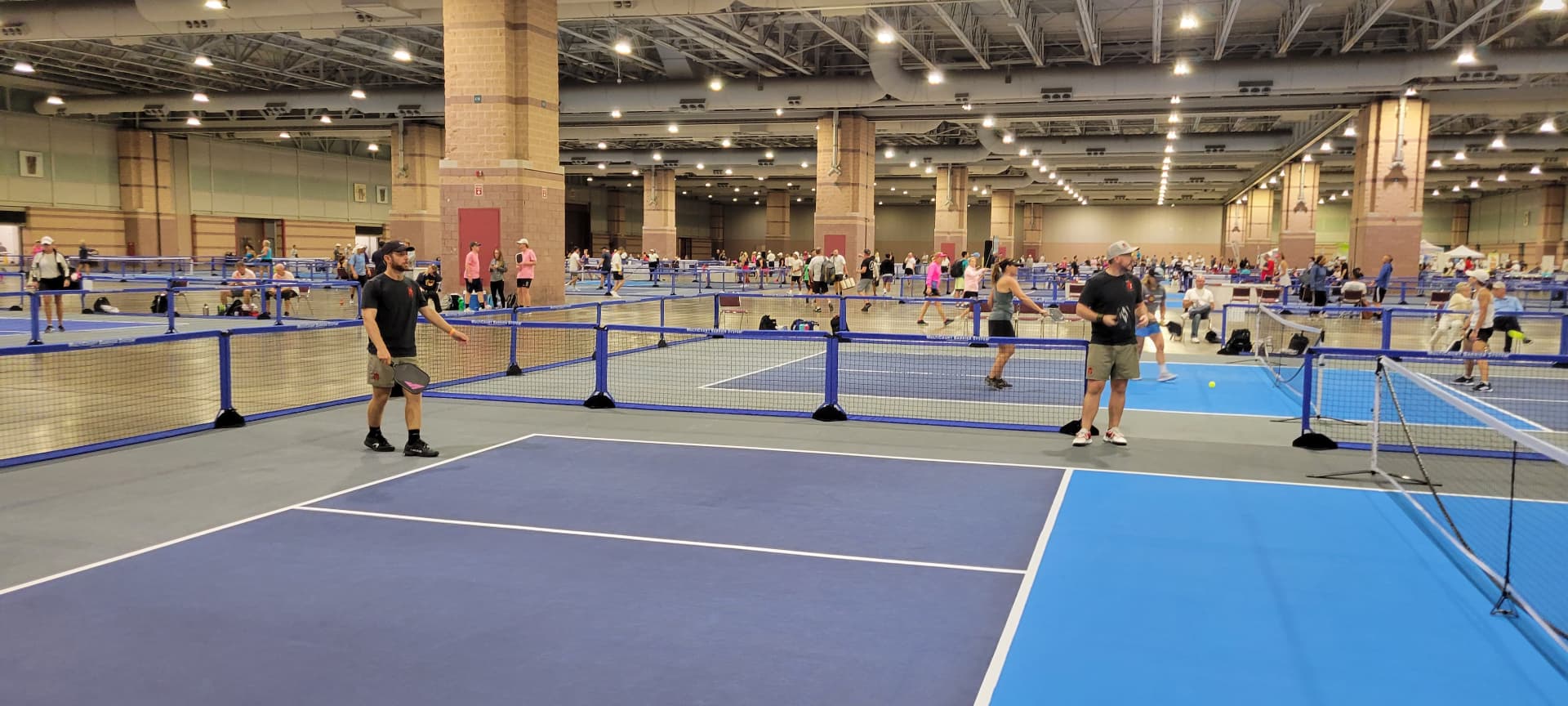
A regulation pickleball court needs roughly 20x44 ft, so it fits comfortably starting around a 20x30 or larger island booth— not a standard 10x10 or 10x20. At a union convention center, plugging into show power and moving freight off the dock generally go through the venue's union crews, ordered in advance through your exhibitor kit, not handled by your own staff. Put lead capture at the entrance to the court, staffed separately from whoever runs the games, so the line moves instead of backing up into the aisle.
Does your booth actually have room?
Court footprint is the first filter, before staffing or lead-capture planning matters at all.
| Booth size | Fit | Notes |
|---|---|---|
| 10x20 or 10x30 inline | Doesn't fit a full court | A regulation court needs 20x44 ft minimum. Inline booths this size can run a mini putting-green-style pickleball wall or a paddle-skills challenge instead — not a real court. |
| 20x20 island | Tight, but workable | Fits one court with almost no run-off. Expect players and spectators to spill into the aisle — confirm with show management that your booth's traffic won't violate fire-lane rules. |
| 20x30 to 20x40 | Comfortable one-court build | Room for a court plus a proper spectator rail, a lead-capture station off to the side, and staff to work the line without crowding the aisle. |
| 30x40 or larger island | Two courts, or one plus a stage | Big enough to run a second court for capacity, or pair one court with a small stage for a bracket final, giveaway, or sponsor announcement. |
Full dimension math — including run-off and spectator space — is in the court dimensions guide.
Union labor rules that catch exhibitors off guard
Every convention center runs its own version of these rules, and your show's general contractor and exhibitor services manual are the actual source of truth — but four categories come up on nearly every union show floor:
At most union convention centers, plugging anything into venue power — a scoreboard, PA, or lighting — has to be done by the venue's or show's electrical contractor, not your crew, even if the cord is already in hand. Order it through the exhibitor kit, not on-site.
Hanging a banner or truss sign above the court is almost always rigging-labor territory. If your booth build includes overhead branding, that's a separate line item and a separate crew from the court install.
Freight coming off the dock to your booth space is typically moved by union material handlers, billed by the pound or crate. A rollout court and its cases count as freight like anything else — get an estimated weight to your general contractor ahead of time.
Some show floors reserve any structural booth build to union I&D labor, which can include laying flooring or platforms. A rollout pickleball court usually reads as exhibitor-owned equipment rather than booth construction, but confirm this with your show's exhibitor services manual — it varies by venue and by show.
None of this is unique to pickleball — it's the same show-floor labor structure any exhibitor with a powered, freight-heavy booth element deals with. The mistake we see is exhibitors assuming a rollout court is simple enough to skip the exhibitor kit paperwork, then finding out at load-in that the electrical drop needs a union order placed days earlier.
Tell us your show and booth size.
We coordinate directly with general contractors on union labor, drayage, and load-in windows — you don't have to translate the exhibitor kit yourself.
Lead capture without wrecking the line
The whole point of a booth activation is dwell time and a lead — a court that draws a crowd but never converts them into a scanned badge is a fun afternoon with nothing to show your sales team afterward. A few things separate booths that capture well from booths that just look busy:
- Put the scanner or sign-in table at the entrance to the play area, not at the exit — you capture the lead before the excitement of playing fades, and it keeps the line moving in one direction instead of backing up.
- Separate the person running the line from the person running the court. Staff trying to do both ends up doing neither well, and the line is usually where booths lose people.
- Cap games at a fixed number of points or minutes so throughput is predictable — an open-ended rally format is fun for two players and a bottleneck for the fifty behind them.
- Give walk-away value even to people who don't play — a paddle-skills challenge, a quick photo moment, or a giveaway entry keeps foot traffic flowing to your booth even during a full rotation.
Staffing this correctly is a headcount question as much as a strategy one — see our event staffing guide for how a lead-capture role sits alongside a court host on a trade-show build. Once the booth is running, tie leads back to a number that survives a budget review — our guide to measuring activation ROI covers the metrics that matter beyond foot traffic. Doing this at more than one show this year? Our multi-city activation tour guide covers how to amortize a branded booth build across a full circuit instead of pricing each show separately.
The follow-up gap that wastes the whole activation
A court that draws a crowd and captures badges still fails if nobody calls the leads afterward — and industry reporting on trade show lead generation puts the scale of that problem at up to 80% of trade show leads never receiving any follow-up at all, while companies that follow up within 24 hours convert several times more often than those who wait a week or more. It's a sales-ops problem, not a booth-design one, but it's worth raising with whoever owns your leads before the show — a great activation that feeds a follow-up process nobody executes on is a wasted booth budget no matter how good the dwell time looked.
The same research points to why an interactive format like a court tends to outperform a passive display in the first place: booths built around demos or games see meaningfully longer dwell times than a static booth, and competitive, game-based formats in particular tend to out-draw passive ones on both time-on-booth and leads captured per hour. That's the mechanism behind the traffic — not just that a court looks different, but that playing keeps someone at your booth measurably longer than watching does.
Why a court beats a demo screen
Most booth elements ask an attendee to stop and watch. A pickleball court asks them to stop and play, and playing takes longer than watching — which is the entire economics of booth traffic. It also self-selects for a crowd: a rally in progress draws spectators the way a quiet demo station never does, and it gives your booth staff an easy, low-pressure opener ("want to hit a few?") instead of a cold pitch. The trade-off is real, too — a court needs more floor space, more labor coordination, and more lead time than a screen or a giveaway bin, so it's not the right call for every booth size or budget. It earns its footprint on a show floor where dwell time and memorability matter more than raw booth count reached.
Once the booth logistics are sorted, the rest follows the same planning as any activation: the cost guide covers what drives your quote, and the setup and teardown timeline shows how build day runs once you're past dock scheduling. If you're comparing vendors for a show-floor build specifically, run the vendor checklist — ask directly whether they've coordinated with union general contractors before, not just whether they own courts. For the fuller picture of what a trade show program can include beyond one booth, see our trade shows & conferences page. If your conference also has an evening welcome reception on the agenda, that's a different build entirely — see our conference networking reception guide for the icebreaker version of this activation. Working a stadium concourse or a tailgate lot instead of a convention floor? Our sporting events and fan activations guide covers that footprint and its own timing constraints. Reserving part of your footprint for top accounts and VIPs rather than general show-floor traffic? See our client entertainment and hospitality guide for how a hosted format works alongside a public booth activation. Still weighing a booth build against a hotel or campus activation instead? Our venue selection guide compares the trade-offs across venue types before you commit floor space.