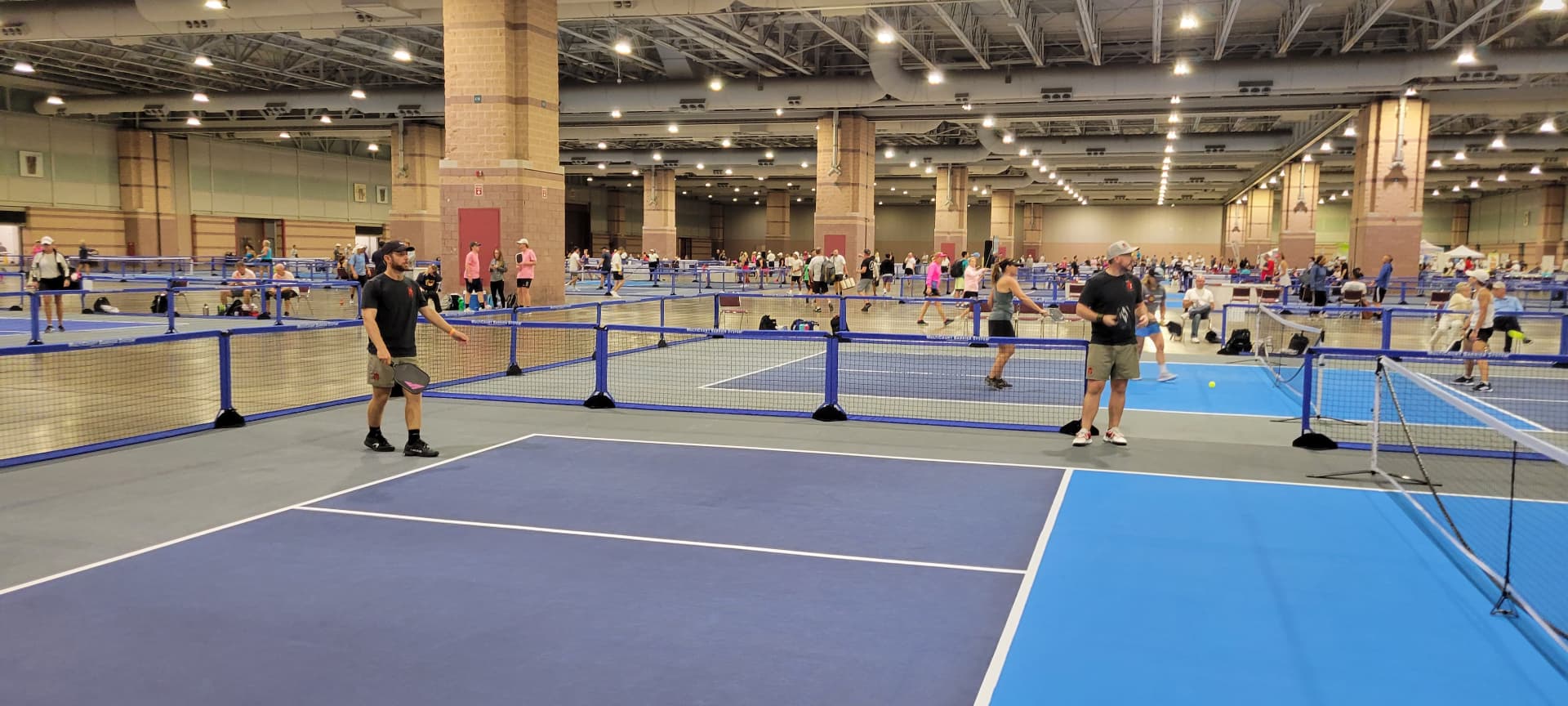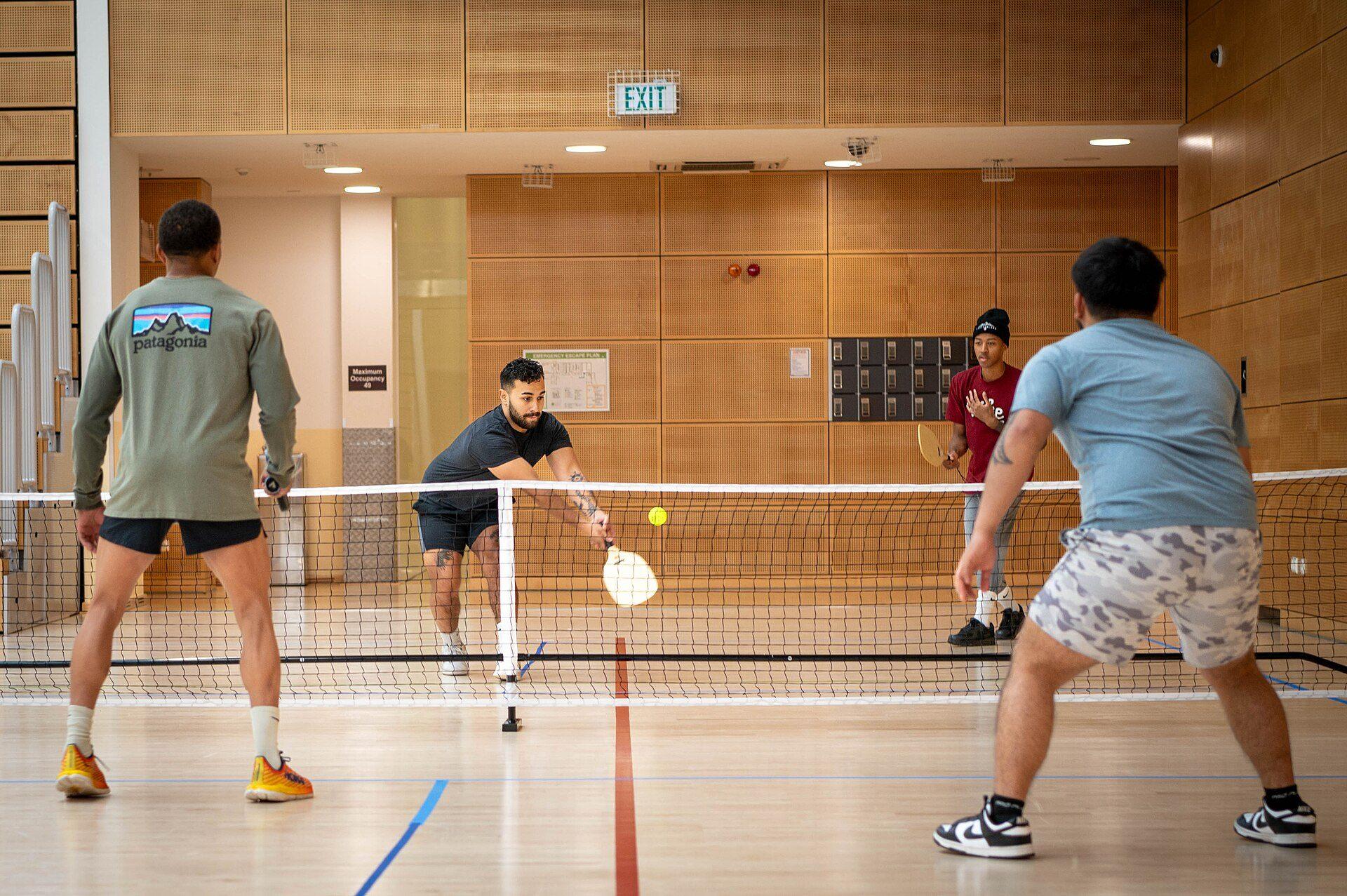
Header photo: co-workers learning doubles on a portable net during an organization-wide connection day that put escape rooms, baking classes, and pickleball on one agenda (Spangdahlem Air Base, Germany; U.S. Air Force photo by Senior Airman Imani West, public domain). Most corporate events look like this — a room or lot that was never built for sport, a mixed group, and a two- to three-hour block.
Short answer
Pickleball corporate events are company gatherings — team-building days, client entertainment, offsites, sales kickoffs, holiday parties, and conference activations — where professional rollout courts are brought to your office, campus, hotel, or venue, staffed by hosts who teach first-timers and run the format, and removed afterward. You need roughly a 30 × 60 ft level area per court, about one court per 8–12 players for a half-day format, and a quote built on courts, hours, staffing, surface, and travel. We deliver it turnkey, nationwide, on one invoice.
What a pickleball corporate event actually is
Nobody on your team has to own paddles, know the rules, or book a public facility. The court system, nets, paddles, and balls arrive; a crew builds the court on whatever flat space you have; hosts greet people, teach a short clinic, and run a format that keeps courts full; then the crew breaks everything down the same day or the next morning. It is an activity block that fits inside the event you were already planning, not a separate outing you have to bus people to.
That is the whole service on this page. Fulfillment is delivered through our partner, Pickleball Management Group, an official USA Pickleball rollout-court partner whose crews have built courts on convention floors, parking garage rooftops, and grass. We are the single point of contact for planning, the quote, and the day-of run.
Who books corporate pickleball events — and what each needs from us
Corporate pickleball rarely comes from one department. The person filling out the quote form changes what a good answer looks like, so here is how the request usually arrives:
HR, people, and culture teams
Team-building days, employee appreciation, onboarding cohorts, and wellness days and benefits fairs. The brief is participation: the quiet analyst and the executive who has not played a sport in years should both get on court. What they need from a vendor is beginner-first programming, a clear accessibility plan, and paperwork that clears legal — certificates of insurance, a waiver approach, and a heat or weather plan for outdoor dates.
Executive assistants and office managers
Often asked to “find something better than another happy hour” on a short timeline. They need a fixed scope, a firm arrival and teardown window that facilities will approve, and one invoice. The company happy hour and summer picnic guides cover the lighter-weight versions.
In-house corporate event and meeting planners
Offsites, leadership retreats, and sales kickoffs booked into a hotel or resort. The pickleball block has to slot into a run of show between general sessions, respect the property’s load-in rules, and never make the next session start late. See corporate retreats and offsites for agenda placement.
Sales, marketing, and account teams hosting clients
Customer appreciation days, partner summits, and suite-night alternatives where the goal is conversation, not a trophy. These events lean on hosted doubles, a play-with-a-pro moment, and branded courts that show up in the photos. More in pickleball for client entertainment.
Agencies, DMCs, and production companies
Booking on behalf of a corporate client and running it inside their own program. They need us to work under their run of show and, often, their brand. Our white-label guide for agencies and incentive travel and DMC programs page explain how that works.
Why pickleball works for company groups
Most corporate activities have a skill problem. A golf outing rewards the handful of people who already golf and parks everyone else in a cart. A softball game turns into the same six people doing the running. Pickleball has a low skill floor: the court is small, the paddle is short, the ball is slow, and a beginner can rally after a few minutes of coaching. That is what makes it work for a guest list that spans ages, fitness levels, and job titles.
It is social by design. Corporate play is almost always doubles, so four people share a court and talk the whole time. Partner rotations mix people who would never sit together at dinner, which is the point of a team-building or client event. And because the court is compact, it fits where a sports field never would — a parking lot, a hotel lawn, a ballroom, a rooftop deck. If you are weighing it against other options, read pickleball vs. a golf outing, pickleball vs. other team-building activities, and pickleball vs. padel for corporate events.
Match the format to the goal
The court is the same in every case; the format is what changes. Pick the goal first, then the format follows.
| Event goal | Format that fits | What staff focus on | Go deeper |
|---|---|---|---|
| Team building / cross-team mixing | Beginner clinic, then a partner-rotating round robin | Teaching, rotations, keeping every court full | Team-building formats |
| Friendly competition / offsite finale | Seeded bracket or pool play with a final | Scoring, brackets, finishing on time | Corporate tournament |
| Client relationships | Hosted doubles and a play-with-a-pro moment | Pairing guests, pacing, photos | Client entertainment |
| Celebration / open attraction | Open play beside food and music | Welcoming walk-ups, short turns | Holiday parties |
| Conference networking | Drop-in court at a reception or break | Fast intros, short rallies | Networking reception |
| Ongoing culture | Recurring after-work league | Schedules, ladders, standings | Corporate league |
If you are unsure which to pick, the round robin vs. bracket vs. open play guide explains the trade-offs. For most first-time company events, a clinic followed by a round robin is the safest choice: nobody is eliminated, everyone plays with new people, and the block ends on time.
A sample three-hour team-building block
This is a planning template, not a fixed package. It assumes a half-day format, a dedicated hard surface, and a group sized at about one court per 8–12 players.
- Before doors: crew installs courts and nets; hosts set paddles, balls, and a check-in point. One or two courts on a dedicated surface often go in a couple of hours before start.
- First 20–30 minutes: welcome, safety notes, and a short clinic — grip, serve, the kitchen line, and how scoring works.
- Next 90 minutes: round robin with rotating partners. Games to 11 typically run about 15–20 minutes, so each court clears roughly 3–4 games an hour.
- Next 30 minutes: a short final, an executives-vs.-volunteers exhibition, or open play for anyone who wants more.
- Last 15 minutes: group photo on the court, recognition, and handoff to the next agenda item. Teardown starts after the group leaves.
Our run-of-show template has a version you can paste into your agenda, and how many pickleball courts you need shows the court-count math for larger groups.