Event Planning · Site Considerations
How loud is pickleball at an event — and what venues and neighbors should know
A pickleball paddle striking the ball peaks around 99–106 dB at the point of contact, and typically reads near 70 dBA at about 100 feet — roughly 30 dBA louder than tennis at the same distance. The sound is a sharp, high-frequency crack rather than a thud, which is why it carries and draws attention even though a single court isn't loud in absolute terms. For an event, the fix is mostly a planning question — court placement, barriers, and scheduling — not a reason to avoid the sport.
The actual numbers
A hard paddle-on-ball hit peaks around 99–106 dB measured right at the point of contact — a short, sharp impulse, not sustained sound.
A hard hit typically registers near 70 dBA at roughly 100 feet from the court, versus about 40 dBA for tennis at the same distance — a meaningful gap that's the real source of most noise complaints.
Most standard paddles produce a sharp crack around 1,100–1,200 Hz with a decibel output of 85 or higher — a frequency range the human ear is especially sensitive to, which is why pickleball reads louder than its raw dB number suggests.
USA Pickleball's Quiet Category certifies paddles below roughly 600 Hz and under 80 dB — the OWL, the first certified quiet paddle, is reported to cut noise by about half against a standard paddle.
Figures reflect commonly cited industry measurements and USA Pickleball's Quiet Category announcement; exact readings vary by paddle, ball, and site acoustics.
Why it reads louder than the raw number suggests
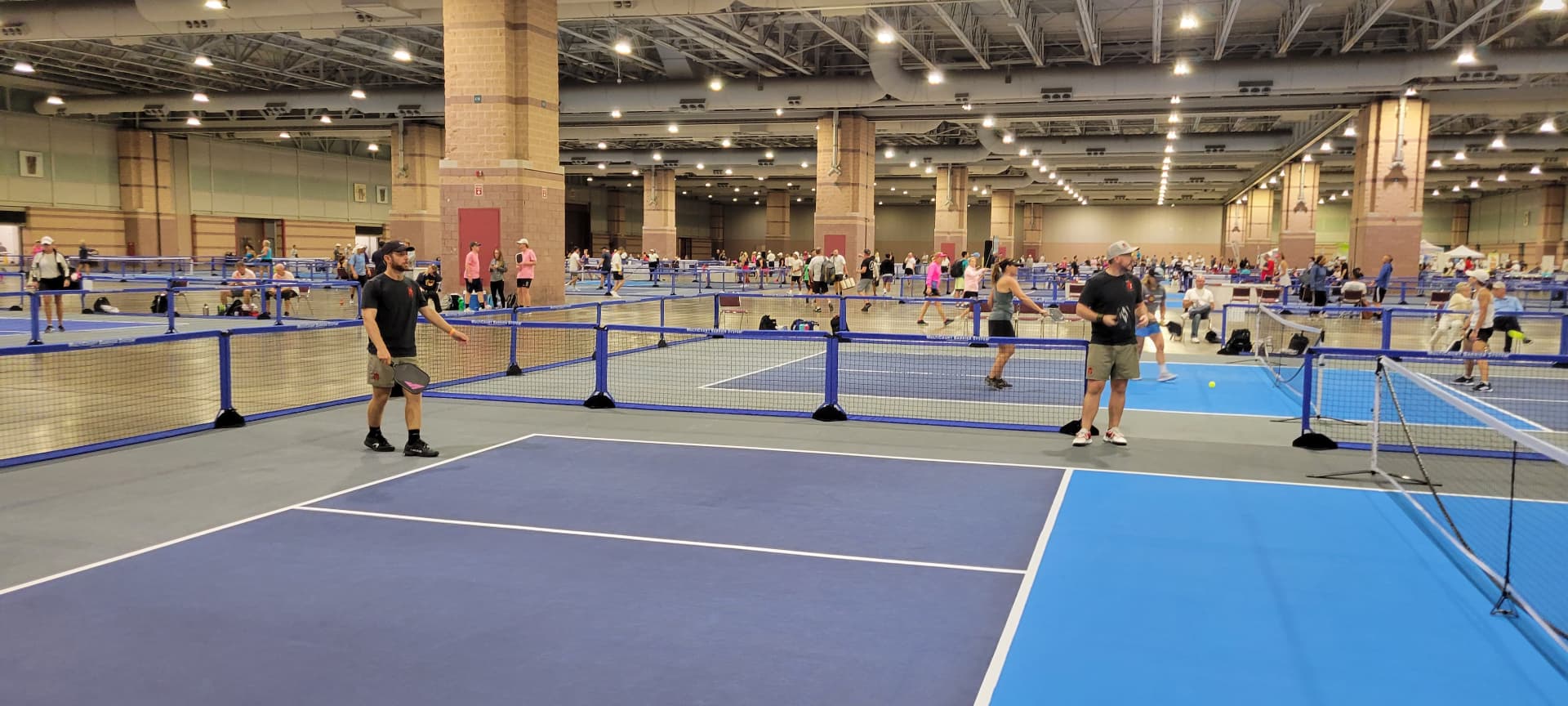
Pickleball noise is a perception problem as much as a decibel problem. Tennis produces a lower, duller thud from strings meeting a felt ball; pickleball is a hard paddle face meeting a hard plastic ball, which produces a short, sharp transient concentrated around 1,100–1,200 Hz — a frequency band human hearing is tuned to notice, the same range that makes a smoke alarm or a car alarm hard to ignore. Add in that rallies are shorter and paddle contact happens more often per minute than in tennis, and a single court generates far more of these attention-grabbing impacts over the course of a game than the equivalent tennis match does.
That combination — sharper sound, more frequent impacts, and a pitch the ear is primed to pick up — is the actual driver behind the noise complaints that have made headlines around residential courts nationally. It is a real, documented dynamic of the sport, not a myth, and it is worth planning for honestly rather than dismissing.
What actually reduces noise at an event build
The single biggest lever. Every doubling of distance from a court cuts perceived noise roughly in half, so siting courts away from guest rooms, residences, or a shared property line does more than any equipment choice.
Temporary acoustic fencing or barrier walls between a court and a noise-sensitive edge — a hotel wing, a residential fence line — knock down direct sound transmission without changing how the game plays.
For a corporate clinic, wellness day, or open-play block, standard rental paddles are fine on most sites. On a genuinely noise-sensitive property — next to guest rooms, or bordering homes — quiet-category paddles measurably cut the sharpest part of the sound.
Ending organized play by early evening and avoiding early-morning starts sidesteps the hours when most residential noise ordinances and neighbor patience are tightest.
Building on a noise-sensitive site?
Tell us about guest rooms, residences, or a shared property line nearby when you request a quote — we'll plan court placement and any barriers around it from the start.
Who actually asks about this — and why it's a real planning question
Three groups raise noise before anything else. Hotel and resort teams siting a court near guest rooms or a pool deck they don't want disrupted by mid-morning play. HOA boards and community managers weighing a resident event against homes that share a fence line with the proposed court location. Downtown, plaza, and shopping-center hostswhose activation sits within earshot of offices, apartments, or businesses that will still be operating during the event. In every case the question isn't whether pickleball makes noise — it does — it's whether the layout and schedule account for who's nearby.
That's a planning conversation we have as part of every quote, not an afterthought. A site plan that puts the court 150 feet from the nearest guest wing instead of 40 feet, wrapped up by 7 p.m. instead of running into the evening, solves most of what would otherwise become a noise complaint the morning after.
Rooftops, courtyards, and other sites that amplify sound
Some sites make noise a bigger factor than others before a single ball is struck. A rooftop with no wind break can carry sound further than a ground-level lot with landscaping around it. A courtyard boxed in by three or four building walls reflects and amplifies impact noise instead of letting it dissipate, the same way a parking garage amplifies a car door slamming. A downtown block lined with hard storefronts behaves similarly. None of these sites rule out a build — they just move noise planning earlier in the conversation, alongside the same subfloor and surface questions a rooftop or garage build already requires for the court itself to play true.
Open, ground-level sites with some distance and landscaping between the court and the nearest sensitive edge are the easiest case, and most corporate campuses, hotel lawns, and festival lots fall into that category without any special handling. The sites worth flagging early are the tighter ones — a downtown plaza ringed by apartments, a resort courtyard between two guest wings, an HOA amenity space backing directly onto homes. Mentioning that layout when you request a quote is what lets us plan placement and barriers before the date is locked, rather than adjusting after a neighbor calls the front desk.
Noise versus your venue's permit and ordinance rules
It's worth separating two different things. The sound of play itself — paddle on ball — is rarely what triggers a municipal permit on its own. What does trigger a separate sound or noise permit, even at a private venue with its own ordinance, is amplified sound: a DJ, a PA system, or a tournament-bracket announcer mic. Our full event permits and permissions guide covers both triggers and who's responsible for pulling each one. If your build is at an HOA or residential-adjacent community specifically, our HOA and neighborhood events guide covers how a resident-facing build typically gets approved alongside a board's other concerns. And if you're still deciding between an indoor ballroom build and an outdoor lawn or lot, our indoor vs. outdoor comparison covers noise as one of several factors — alongside weather, surface, and lighting — that should drive that call.
Once placement and scheduling are settled, the rest of the build follows the same process as any activation — see our event playbook for the full timeline, and our power and lighting guide if your event runs into the evening and needs lit courts on top of the noise plan. For a site that's already tight on space and acoustics — a rooftop, a parking deck, or a courtyard boxed in by buildings — check our surface and subfloor guide too, since the same sites that complicate sound often complicate the build surface as well.