New York, NY
Pickleball court rental for events in New York City
Need courts at your New York venue, not hourly time at someone else's club? The Pickleball Events Co. delivers professional pickleball courts to expo floors, piers, lofts, hotel ballrooms, rooftops, and corporate campuses across the five boroughs, North Jersey, Westchester, and Long Island, then builds them, staffs the play, and removes everything when the program ends. A single-court, one-day activation typically begins around $10,000 (previously published starting-point language on this site), and multi-court or multi-day builds move into the mid-five and six figures. Every event is quoted individually, usually within 24 hours.
Request a New York quoteThis page is written for the people who book experiences in New York: experiential and event agencies, brand marketing teams, DMCs, production companies, hotel and venue event sales, and corporate meeting planners. If you are a player looking for a court tonight, a local club or a city park is the right call. If you are planning a product launch in SoHo, an exhibitor booth at the Javits Center, a sales kickoff on the waterfront, a holiday party in a Chelsea loft, or a client night in Midtown and want pickleball to be part of it, read on. For the national overview, start with pickleball court rental for events or pickleball corporate events.
Why a pickleball activation works in New York
New York audiences are hard to impress and short on time. Guests at a launch, a show, or a company party have usually seen the photo wall, the branded lounge, and the open bar many times over. What still pulls people in is something they can do with their hands in the first minute. Pickleball is easy to learn, works across ages and fitness levels, and fits into a ten-minute rotation between sessions, meetings, or drinks without anyone changing clothes. A staffed court turns spectators into participants quickly, and the people waiting their turn become an audience, which is exactly the energy most activations are trying to create.
It also suits how New York events get judged after the fact. A bright court with motion and people laughing makes better social and recap content than a static installation, which matters in a market where so many activations are built partly for the footage and the press. And because a rollout court is temporary, the venue does not need a permanent amenity or a long-term commitment; it arrives, plays for the program, and leaves the floor the way it was. If you are weighing it against other options, our pages on pickleball vs. other team-building activities and pickleball vs. padel for corporate events lay out where a court is and is not the better fit.
Where New York activations usually land
These are the four kinds of requests that come up most for a market like New York. They describe the logistics planners deal with, not invented client stories.
New York is where many consumer brands launch in front of press, creators, and foot traffic at the same time. A wrapped court with hosts gives a launch an activity people join in the first minute, and it produces motion footage a static installation cannot.
Exhibitors and show organizers use a staffed court to pull attendees out of aisle traffic and hold them long enough for a conversation and a badge scan. Organizers use multi-court zones as a networking hub attendees return to between sessions.
Sales kickoffs, team days, and year-end parties in lofts, pier venues, and hotel ballrooms get a shared activity that mixes departments and seniority without a long briefing or a change of clothes.
Finance, media, and agency teams host clients in a city where everyone has seen every open bar. A reserved court with coaching gives a client night something to talk about, and a court built for a shoot goes up and comes down on the call sheet.
Deeper format notes live on brand activations and product launches, trade show booth activations, corporate holiday parties, and court rental for photo shoots and commercial productions.
Venues planners already use in the New York market
The anchor for trade shows is the Javits Center on Manhattan's West Side. Its 2021 expansion created about 500,000 square feet of contiguous exhibit space, added a truck marshaling facility for loading, and opened a rooftop pavilion and terrace that can host up to 1,500 guests. On the Lower East Side waterfront, Pier 36 at 299 South Street is a large sports-and-events facility with a 15,000-square-foot deck on the East River and a 55,000-square-foot lot that simplifies loading. In Brooklyn, the Brooklyn Expo Center in Greenpoint offers roughly 28,000 square feet of exhibition space, and just across the Hudson the Meadowlands Exposition Center in Secaucus has about 61,000 square feet of contiguous exhibit space for shows that want New York reach with easier truck access.
Beyond those, most New York activations happen in rented lofts and studios, hotel ballrooms, rooftop venues, office lobbies and plazas, and corporate campuses in Westchester, North Jersey, and Long Island. We name these public venues because planners in this market already work with them, not because we claim exclusive arrangements with any of them. Every building sets its own rules for vendors, and we work inside them.
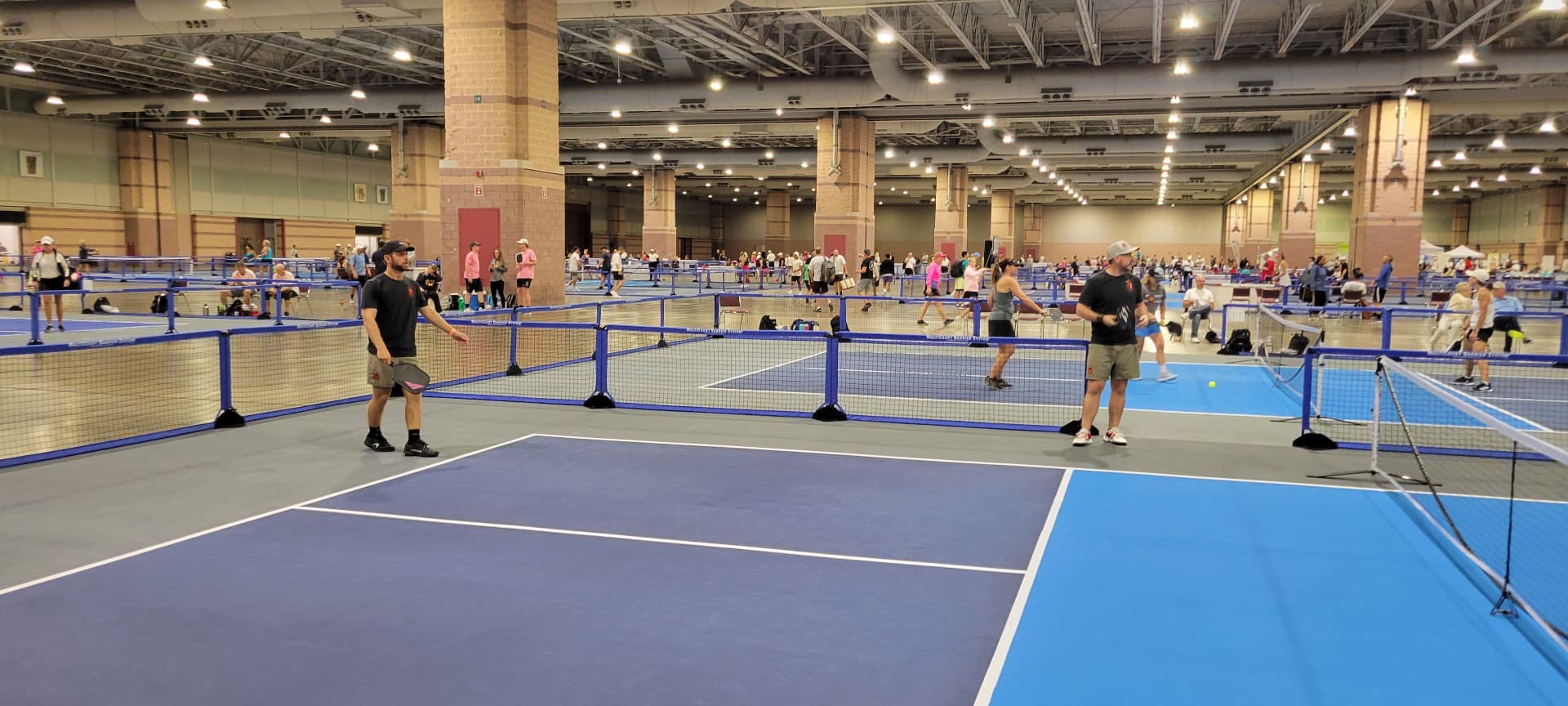
Show-floor activations succeed on logistics. Each venue and each show has its own move-in schedule, floor-protection rules, freight access, and labor requirements, set by the venue and the show's general services contractor. What we need is the exhibitor manual or event packet and the space dimensions. From there we confirm the court count that fits, how the build is staged, and whether courts can stay in place overnight on a multi-day show. One branded court next to an exhibitor space is usually enough for lead capture and content; two to four courts suit association networking zones and conference hubs. For the scale reference, the USA Pickleball Indoor Championships build at the Atlantic City Convention Center put 25 rollout courts on one convention floor, delivered through our fulfillment partner network (see case studies). Networking formats for multi-day shows are covered in pickleball for trade shows and expos and multi-day conference programming.
Have a venue and a date already?
Send the venue name, the room or space dimensions, and your show or event dates. We will check the fit, flag any access issues, and come back with an all-in New York quote, usually within 24 hours.
Get a New York quoteWhat makes New York builds different
Pickleball itself works the same in every city. What changes in New York is everything around the court: getting it into the building, finding room for it, and keeping it on good terms with the neighbors.
Many Manhattan and Brooklyn venues schedule deliveries by dock appointment, limit load-in to set hours, and require a certificate of insurance before a vendor sets foot in the building. Freight elevator size decides whether rolls and subfloor go up in one trip or several. We ask for the venue's vendor packet first, because it shapes the build plan more than anything else.
A regulation court is 20 × 44 ft inside the lines, and an event court needs roughly a 30 × 60 ft footprint once you add run-off. In a city where square footage is the budget, we often recommend one well-staffed court over two cramped ones, or a smaller skills zone when the room simply does not have 1,800 square feet to spare.
Summers are hot and humid, winters are cold, and rooftops and piers add wind. Outdoor play works best from spring through early fall with shade and water; from late fall through winter, most New York pickleball activations move indoors to ballrooms, lofts, and expo halls.
Paddle noise and amplified sound carry between buildings. Outdoor amplified sound in New York City needs an NYPD sound device permit filed at the local precinct at least five days ahead, and residential neighbors are rarely far away, so we plan court placement, music, and hours with that in mind.
Rooftops deserve a separate note because they come up constantly in New York briefs. A rooftop court is possible when the structure, access, and wind exposure work, and the payoff on camera can be big. Our fulfillment partner network has built eight rollout courts on top of a parking garage for a charity event in Scottsdale, so elevated builds are not new, but every roof is its own engineering question. The venue has to confirm load limits and rules, the freight elevator has to fit the materials, and the plan needs a wind and weather fallback. The specifics are in pickleball for rooftop and terrace events, surface and subfloor requirements, and the weather contingency plan.
On space, check how many pickleball courts you need and court dimensions for events before you commit a footprint on the floor plan. Over-building is the most common scoping mistake, and in New York it is also the most expensive one, because every extra court displaces bar, seating, or exhibit space you are already paying for. Court count should follow dwell time and goals, not headcount alone.
Permits and paperwork in New York City
Most indoor activations at a hotel, venue, or private office never touch a city permit; the building's own approvals, insurance requirements, and house rules govern. The picture changes once any part of the event sits on public property. Street events on a curb lane, sidewalk, or street, and events on pedestrian plazas, go through the Street Activity Permit Office within the Mayor's Office of Citywide Event Coordination and Management. Its published deadlines run 14 days for a small street event, 30 days for a medium one, and 45 days for a large one; applications need a site plan and run of show; and organizers must carry at least $1 million in liability insurance. The city also notes that some elements need separate agency sign-off first, such as tents or structures over certain heights, generators, and amplified sound.
City parks issue their own special event permits through NYC Parks, and amplified sound is allowed only in some parks and for limited hours. Outdoor amplified sound anywhere in the city needs an NYPD sound device permit, filed at the precinct where the event takes place at least five days ahead. Filming on public property generally runs through the Mayor's Office of Media and Entertainment, which matters if the activation doubles as a content shoot. Your venue, agency, or producer usually leads these filings; we supply equipment specs, footprint drawings, and certificates of insurance when they are needed. These rules change, so confirm current requirements with the relevant office for your date. Our guides on event permits and permissions, insurance and liability, and noise and neighbor considerations cover the general picture.
What a turnkey New York build includes
Professional rollout courts, nets, paddles, and balls delivered to your New York venue, built inside the load-in window, and removed when the program ends. One vendor and one invoice instead of separate court, staffing, and trucking line items.
Event staff who teach the basics in about a minute, run short rotations, and pull in first-timers, so the court works for the whole guest list rather than the few people who already play.
Convention carpet, ballroom floors, polished concrete in lofts and warehouses, pier decks, parking lots, and rooftops where the venue confirms load limits, with subfloor where an uneven pad or turf needs it so the ball bounces true.
Wrapped court surfaces, branded nets, and simple signage when the activation has to photograph well for social, press, or sponsor recaps. Branding is optional and quoted as its own line.
Dock appointments, freight elevator dimensions, certificates of insurance, floor protection, and house labor rules worked out before the truck leaves. In New York, the schedule usually breaks on access, not on paddles.
A single-court, one-day activation typically begins around $10,000 (previously published starting-point language on this site). Multi-court and multi-day builds move into the mid-five and six figures. Every New York event is quoted individually.
Staffing roles are defined in the pickleball event staffing guide, equipment in the equipment rental checklist, and build timing in the setup and teardown timeline. Evening events need a plan for light and power, covered in power and lighting requirements, and the full process from first call to teardown is on how it works.
Formats that fit New York agendas
The format should follow the goal. For a launch or press event, open play with hosts and two-minute rotations keeps the court full and the camera busy; nobody wants a bracket at a launch. For an exhibitor booth, a short challenge (return three serves, win a branded paddle) gives booth staff a natural moment to start a conversation and scan a badge. For a sales kickoff or team day, a beginner clinic followed by a light round-robin mixes departments and gives competitive teams a scoreboard without a full tournament. For client hospitality, smaller groups, more coaching, and a court reserved for the guest list work better than an open line.
Dress codes matter more in New York than most places, because so many events happen straight from the office. Guests in business attire will happily play a few points indoors on a smooth surface; they will not play a long outdoor match in August humidity. Keep rotations short for receptions and holiday parties, save longer play for athletic-wear team days, and give people somewhere to put a bag and a drink. The trade-offs between formats are laid out in round robin vs. bracket vs. open play, and agenda-specific notes live on sales kickoff events, client entertainment and hospitality, conference networking receptions, and incentive travel and DMC programs. For invite-only play, see private pickleball event space.
Timing around the New York calendar
Spring and fall are the busiest stretches for New York events, and big citywide weeks compress hotel rooms, venues, crews, and trucks at the same time. That affects you even if your event is small, because the freight elevator and dock you need may already be booked by someone else's load-in. Lock the venue and its delivery windows first, then the court plan. Summer works well for outdoor and waterfront activations with shade and hydration built in, and the holiday season is the peak for indoor corporate parties, when a staffed court is a welcome change from another round of passed appetizers.
As a working rule, a few weeks to a couple of months of lead time keeps the most options open. Anything on public property adds the city's permit lead time on top. The detail is in how far in advance to book pickleball courts, and a ready-made timeline for the day itself is in the run-of-show template.
For agencies, DMCs, and production companies
Much of the event work in New York is run by agencies and producers on behalf of a brand. If that is you, we can operate as the court and staffing vendor under your creative and your client relationship, follow your run of show, and keep our name off the build if you prefer. That model is described on white-label pickleball for event agencies. If New York is one stop on a wider program, the national multi-city activation tour page covers how we keep the build consistent from city to city. Nearby Northeast markets include Philadelphia, Boston, and Atlantic City, and our Los Angeles and Orlando pages show how the plan changes by market. When procurement wants a formal process, how to write an RFP for a pickleball event gives you a ready checklist.
Honest pricing for New York activations
We do not publish package menus or invented case metrics. The pricing language already used on this site is that a single-court, one-day activation typically begins around $10,000, and multi-court or multi-day builds move into the mid-five and six figures. Treat that as a previously published starting point, not a menu price. In New York, the biggest movers are court count, how many days the courts stay up, staffing hours, branding, whether the surface needs a subfloor, and how much access complexity the building adds, such as overnight load-ins, small freight elevators, or long carries from the dock. You are not charged per guest who plays, so a well-staffed court can host many rotations in a day without a per-head line item.
If you are comparing this with booking hourly time at a club, those are different products with different budgets; the pickleball court rental cost guide explains both. If someone is asking whether a permanent court would make more sense for an office or building amenity, read permanent court vs. event rental.
What to send for a fast quote
A clean New York brief answers nine things: the goal (booth traffic, networking, content, team-building, or VIP hospitality), the date and hours, the venue name and address, the surface and whether it is indoor or outdoor, a rough court count, staffing yes or no, branding yes or no, the venue's delivery rules (dock windows, freight elevator size, certificate-of-insurance requirements), and any permit or noise constraints you already know about. With those, we return all-in pricing, usually within 24 hours. Without them, any number is a guess. The Pickleball Events Co. works with event companies, agencies, DMCs, producers, and meeting planners; we are an event activation service, not a club that rents court time to the public.