Court Installation
Pickleball court installation for properties, clubs, and homes
Permanent, semi-permanent, and roll-out pickleball courts for commercial properties, HOAs, clubs, resorts, campuses, and homeowners. Indoor, outdoor, rooftop, or grass — nationwide.
Get an installation quoteThis page is for a court that stays
The Pickleball Events Co. is a B2B shop for two related things: event activations, and courts you buy and install. If you need pickleball for a date — a corporate off-site, a trade show, a festival, a resident day — that offer lives on pickleball court rental for events. This URL owns the other half: installing a pickleball court on a property. Permanent. Semi-permanent. Roll-out. For an HOA board, a club manager, a resort amenities director, a campus planner, a developer, or a homeowner who wants a private court.
Design and installation are fulfilled through Pickleball Management Group, an official USA Pickleball rollout-court partner. That partnership is why a court is not limited to a perfect existing slab. The same partner network has put rollout courts on grass at the US Open Pickleball Championships in Naples, on a parking garage in Scottsdale, on a convention floor in Atlantic City, and inside the Hawaii Convention Center — work we attribute to that network, not as builds this brand executed alone.
The install conversation starts with the site, not a catalog. Indoor or outdoor. What is on the ground now. How many courts you actually need. Whether the court is a forever amenity or a season you may want to take up later. We look at the space, then quote it — usually within 24 hours of having those details. There is no starting-at number on this page, because a backyard conversion and a multi-court club build are not the same job.
Not ready to commit a pad? A one-day amenity event is a real way to test demand first — a resident tournament or clinic for an active adult or 55+ community, or a lease-up amenity day for an apartment or multifamily community — before budget goes to a permanent build. Those days are booked as event rentals, not as this install. If you're still weighing the two paths, our permanent court vs. event rental comparison breaks down the cost ranges and trade-offs for a corporate campus specifically.
The install
Courts we install
The court types below are the install menu — commercial, residential, community, indoor and rooftop, conversions, and full club development. Each one is scoped to the property, not pulled from a one-size package.
Commercial courts
Permanent and temporary courts for offices, campuses, retail, and hospitality — including empty warehouses, big-box retail, and unused facilities repurposed into pickleball venues.
Residential & backyard courts
Design and installation for homeowners who want a private court, sized and surfaced to the space you have.
HOAs & community centers
Amenity courts that raise property value and keep residents on-site — planned around your community's space, budget, and approval process.
Indoor & rooftop builds
Court installation inside ballrooms, gyms, and warehouses, or on top of parking structures and rooftop decks using engineered subfloor systems.
Conversions & resurfacing
Convert an existing tennis, bocce, or sport court to pickleball, or resurface a worn court so it plays true again — often without tearing out what's already there.
Club development
End-to-end design, build, and management for full pickleball facilities of any size — from a few courts to a destination club.
Permanent, semi-permanent, or roll-out
People searching "install a pickleball court" are usually deciding how long the court should stay, not whether they want the sport. Those are three different products on the same site visit.
A permanent court is the amenity. It is designed to remain on the property — a backyard pad, an HOA complex, a club conversion, a campus courtyard. The work covers what the site actually needs: assessment, layout, base or subfloor, surface, regulation lines, nets, and the fencing or lighting the design calls for. It is the right call when residents, members, or guests will use the court as part of daily life on the property.
A semi-permanent court stays for a season or a defined window and can come up later. Resorts and hotels use this when they want pickleball on a lawn, a deck, or an unused tennis court through high season without committing the surface forever. Corporate campuses and clubs use it to prove the amenity before a capital project. The court is real. The commitment is not poured in.
A roll-out court is the professional court system itself, installed for ongoing use rather than a single event date. Indoors it goes into a gym, a ballroom being converted, or a warehouse becoming a venue. Outdoors it sits on concrete or asphalt, or on a PickleDeck subfloor over a rooftop, a parking deck, or grass. The same system can be more or less permanent depending on the site and how the property wants to live with it. That decision is part of the quote, not a guess on a product page.
Install on almost any surface
The PickleDeck subfloor system lets us build a true-playing court on concrete, asphalt, rooftops, parking decks, and grass — so a court isn't limited to sites with a perfect existing slab. It's the same engineering that put rollout courts on grass at the US Open and on a parking structure for an eight-court charity build.
A hard, reasonably flat pad — concrete or asphalt — is the straightforward outdoor base. An existing tennis or sport court is often the same: the base is already there, and the install is a conversion or a resurface rather than a new pad. Grass, many rooftop decks, and some parking structures are the reason PickleDeck exists. A ball will not bounce true on turf. A rooftop is rarely dead level, and the membrane underneath it is not something you want a court grinding into. The subfloor creates the playing plane so the court can go where a poured slab cannot.
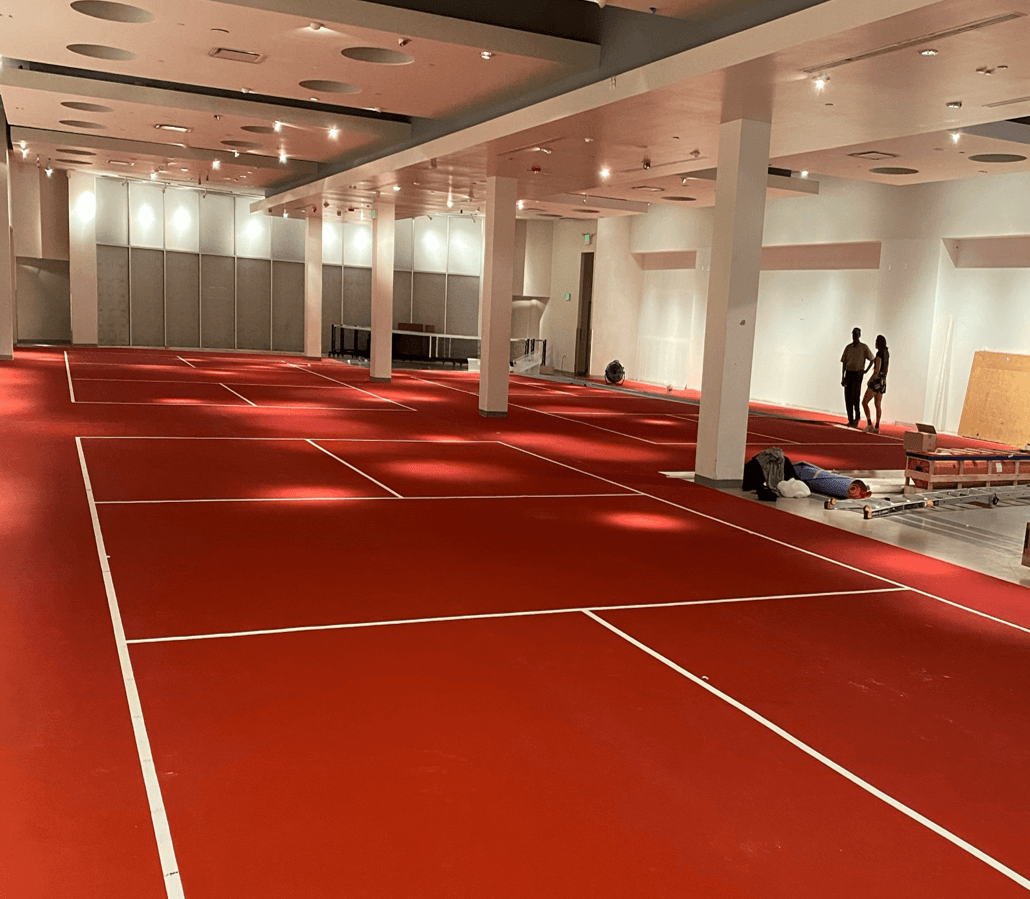
Indoors, the question is the room, not the weather: a gym, a warehouse, a repurposed retail box, a ballroom being turned into a year-round venue. The same partner network that put 25 rollout courts on the Atlantic City convention floor for the USA Pickleball Indoor Championships is the network that installs a single indoor court for a club or a converted commercial space.
Who we build for
The buyer is almost always someone responsible for a property, not someone shopping a weekend hobby kit. An HOA or community-center board wants an amenity that raises the property and keeps residents on-site, planned around space, budget, and the approval process. A club wants members playing on property instead of driving to a public park. A resort or hotel wants a court guests will book around. A campus or office wants a courtyard that actually gets used. A homeowner wants a private court sized to the lot. A developer wants the amenity in the renderings and in the ground.
Who a property install is actually for
HOAs and community centers.The request is usually one court or a small complex that can survive a board vote. Space, neighbor sightlines, and how the court will be programmed matter as much as the surface. We plan the amenity around the community's approval process rather than dropping a pad and hoping the meeting goes well.
Country clubs, athletic clubs, and tennis clubs. The most common job is a conversion: an underused tennis, bocce, or sport court becoming one or more pickleball courts, or a worn court getting a true surface again. Members already know where to park. The club already has the footprint. The install is how the calendar catches up with the sport.
Resorts, hotels, and hospitality. A court on a lawn, a rooftop, an unused deck, or a tennis court that no longer earns its keep. Some properties want it permanent. Some want it for a season. Either way the court has to look like it belongs on the property, not like equipment left over from a weekend activation.
Corporate campuses and universities. A courtyard or rec-field court that staff or students can actually use, not a line item that sits behind a locked fence. Indoor conversions of unused warehouse or gym space show up here too, especially where weather makes a single outdoor pad a seasonal asset.
Homeowners. A backyard court sized and oriented to the lot you have. Fencing, lighting, and windscreen are part of the design conversation when the site needs them — they are not a menu of invented add-on prices. We quote the court after we see the space.
Developers and municipalities. Amenity courts for a new community, a park, or a mixed-use site. The work is the same as any other install — site, surface, count — with more stakeholders on the drawing.
Convert a tennis court to pickleball
Converting an existing tennis or sport court is one of the cleanest install paths, because the hard part — a flat, drained base — is often already done. A standard tennis court can typically become two to four pickleball courts, depending on how you want to use the run-off and whether you keep a tennis layout in the mix. Bocce and other underused sport courts convert the same way when the base is sound.
We regularly work with the existing base rather than tearing it out. That is a site call, not a slogan: if the slab or asphalt is in good enough shape, resurfacing and restriping is the job. If it is not, the quote says so. Lighting and fencing already on the court can stay in the plan when they still serve the new layout. We do not invent a fee for those extras here; they show up on the quote when the site needs them.
Clubs and communities use conversion when demand has already moved and the tennis courts are sitting. Homeowners use it when a sport court on the lot is the wrong game. In both cases the question is the same: can this pad play pickleball properly, and how many courts should it hold?
How a court installation works
Site assessment
We review your space — indoor or out, surface, drainage, access, and how many courts fit — and confirm what's possible.
Design & surface plan
Court layout, surface system, fencing, nets, and lighting, matched to how the space will be used and your budget.
Base & subfloor
Proper base prep or the PickleDeck subfloor system so the court plays true on concrete, asphalt, rooftops, or even grass.
Surface, lines & equipment
Final playing surface, regulation lines, nets, and accessories installed and inspected — ready to play.
The first step is a site look, not a sales deck. Indoor or outdoor. What is on the ground. Access for the crew. Drainage. How many courts you think you want, and how the space will actually be used — open play for residents, member programming, guest amenity, a private backyard. Photos and a rough footprint are enough to start. You do not need a civil set on day one.
From there we design the court to the site: layout, surface system, and the fencing, nets, and lighting the space calls for, matched to use and budget. If the pad is already there, the plan is often a conversion or a resurface. If it is not, the plan includes the base or the PickleDeck subfloor that makes the surface playable. Then the court goes down — surface, regulation lines, nets, accessories — and gets inspected before anyone plays.
We do not publish a build calendar in days on this page. Sites differ. Permits, when a jurisdiction requires them, are a local fact, not a package we price in a paragraph. What we will say, because it is already how we work: once we have the site details, the quote comes back with clear pricing, usually within 24 hours.
Ready to install a pickleball court?
Tell us about the site and how you want to use it. We quote after a look — usually within 24 hours.
Get an installation quoteThe footprint that actually matters
USA Pickleball's official court-construction guidance is the spec we build to. The playing lines measure 20 feet wide by 44 feet long — the same rectangle for singles and doubles. The non-volley zone (the kitchen) is bound by a line 7 feet from the net on each side. The net is 36 inches tall at the sidelines and 34 inches at the center. Those are the lines. They are not the space you need to hold.
The USA Pickleball Rule Book, as published on USA Pickleball's construction page, recommends a minimum total playing surface of 30 feet by 60 feet, with 34 feet by 64 feet preferred. The extra room beyond the 20 × 44 lines is run-off so players can chase a ball without hitting a fence, a wall, or the next court. Outdoors, courts should be oriented north–south so players are not staring into morning or late-afternoon sun.
That preferred 34 × 64 footprint is the number to take to a lot, a rooftop, or a board packet — not the 20 × 44 playing rectangle alone. A backyard that can hold the lines but not the run-off will play cramped. A club converting one tennis court should count how many full footprints fit, not how many sets of lines can be painted edge to edge. We confirm the count on the site assessment.
What an install quote is, and is not
Every install is quoted after a site look. Court count, indoor versus outdoor, the surface system, site prep and base work, fencing, and lighting all move the number. We return that number — usually within 24 hours — instead of posting a range that would be wrong for half the properties that ask.
What you send to get a real quote: the city and the property type, indoor or outdoor and what is on the ground now, roughly how many courts, photos or a simple sketch if you have them, and whether this is a permanent amenity, a seasonal install, or a conversion of something already there. You do not need a locked construction set. You do need an honest picture of the site.
What this page will not do: reprint event-rental ranges, invent a starting-at, or guess a permit fee. If the question is what a one-day activation costs, that belongs on pickleball court rental cost — a different product. If the question is a court that stays, use the form on this page.
Work already delivered by the partner network
These are real projects fulfilled by Pickleball Management Group, attributed to that partner network — not claimed as work The Pickleball Events Co. executed alone. They are the proof that a court can go where a conventional poured pad cannot, and that the same network installs at championship scale and at property scale.
USA Pickleball Indoor Championships
Atlantic City Convention Center, NJ
25 rollout courts installed on the convention floor — the scale reference point for what a single indoor build can carry.
US Open Pickleball Championships
Naples, FL
A pop-up court activation that included a court built directly on grass using the PickleDeck subfloor system — a build many thought couldn't be done.
Hawaii Convention Center
Honolulu, HI
Indoor court installation and an inaugural tournament that drew more than 3,500 players and spectators.
HonorHealth Charity Activation
Scottsdale, AZ
Eight rollout courts installed flawlessly on top of a parking garage for a standout charity event.
Court installation by city
We quote U.S. installs by city through the partner network — not a 50-state coverage claim. The cities below have their own install pages for local context. If your property is not on the list, tell us the city anyway.
Planning a one-time event instead of a court that stays? That is a turnkey activation — courts delivered, built, staffed, and removed — not this install.
See event court rentalPickleball court installation: FAQs
Do you install permanent courts, or just event rentals?
Both — but they are different offers. This page is for buying and installing a court that stays: permanent, semi-permanent, or roll-out, for a property, HOA, club, resort, campus, or home. Event activations — courts delivered, built, staffed, and removed — live on our pickleball court rental for events page. Design and install are fulfilled through Pickleball Management Group, an official USA Pickleball rollout-court partner.
Where can you install a pickleball court?
Almost anywhere a court can play. We install indoors in ballrooms, gyms, and warehouses; outdoors on lots, lawns, and courtyards; and on rooftops and parking decks. The PickleDeck subfloor system lets us build a true-playing court on concrete, asphalt, rooftops, parking decks, and grass — the same system used by the partner network to put a court on grass at the US Open.
Can you convert an existing tennis or sport court to pickleball?
Yes. Converting a tennis, bocce, or underused sport court to one or more pickleball courts — often two to four from a single tennis court — is a regular install. We also resurface worn courts. In many cases we work with the existing base rather than tearing it out.
How much does it cost to install a pickleball court?
Every install is quoted after a site look. Court count, indoor vs. outdoor, the surface system, site prep and base work, fencing, and lighting all move the number, and no two properties are the same. We return clear pricing, usually within 24 hours of hearing your details. Event-rental pricing is a different question and lives on our pickleball court rental cost page.
What is the difference between a permanent, semi-permanent, and roll-out court?
A permanent court is designed to stay as a property amenity — base, surface, lines, nets, and the extras the site needs. A semi-permanent court stays for a season or a defined period and can come up later, which is common at resorts, hotels, and properties that want the amenity without pouring a forever slab. A roll-out court is the professional court system itself, installed for ongoing use indoors or out; with the PickleDeck subfloor it can sit on concrete, asphalt, a rooftop, a parking deck, or grass. Which path fits is a site and use question, answered on the quote.
Do you install residential and backyard courts?
Yes — for individual homeowners as well as HOAs and community centers. We size and surface the court to the space you have and how you plan to use it.
What areas do you serve?
U.S. installs are quoted by city — we do not claim coverage in all 50 states. Dedicated city pages currently cover Nashville, Washington, D.C., San Diego, Charlotte, and Columbus; if your property is elsewhere, tell us the city on the quote form.
I want courts for one event, not a court that stays. Is that you?
Yes — that is the other half of the business, and it is a different page. A turnkey activation (courts delivered, built, staffed, and removed) is booked on our pickleball court rental for events page. This page is only for install and buy.
Get an installation quote
Tell us about your space and how you want to use it — we'll come back with clear pricing, usually within 24 hours.