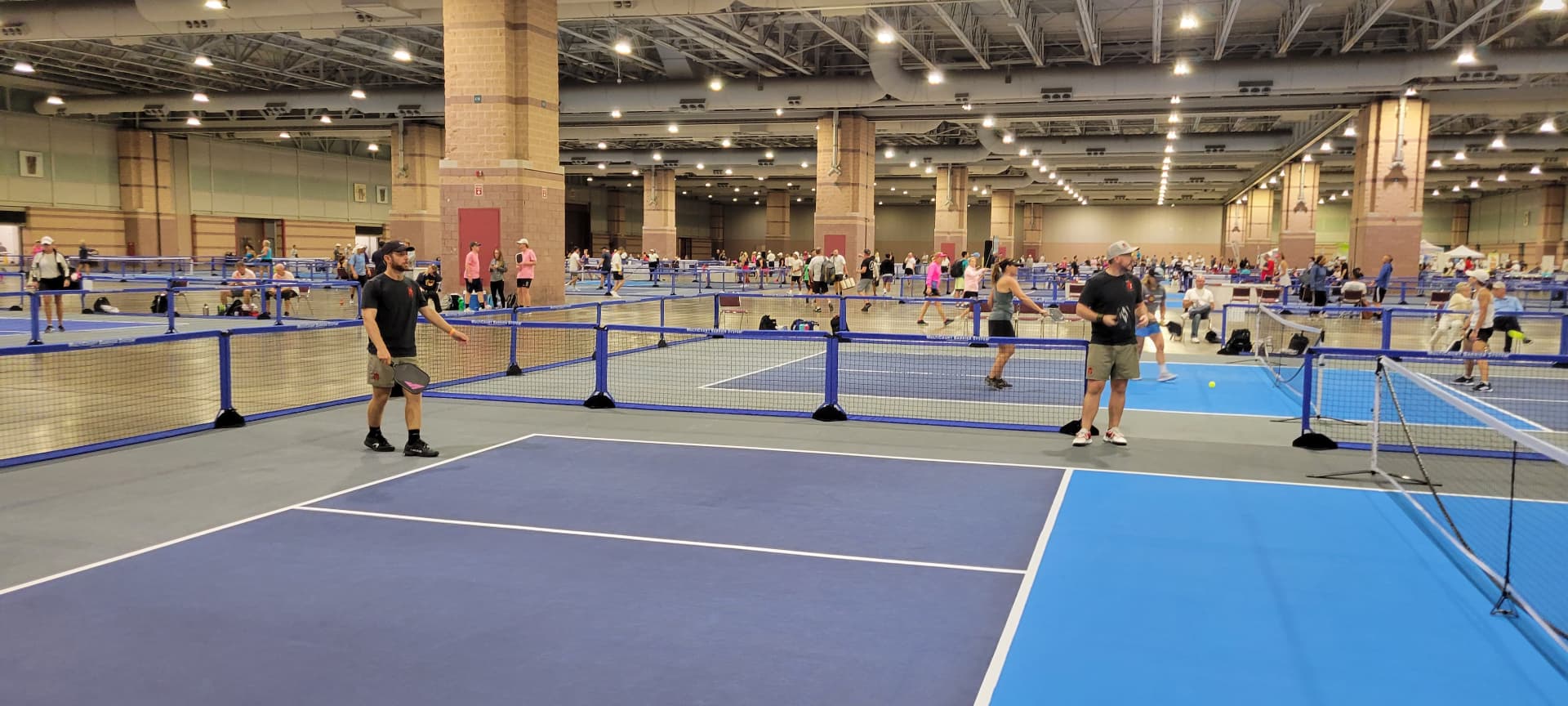
Event Safety · Outdoor Activations
Heat safety and hydration planning for outdoor pickleball events
Pickleball is lateral, stop-start, high-intensity movement — closer to light manual work than passive spectating, which is why heat planning for players and staff matters more than for a typical outdoor cocktail hour. As a planning reference, occupational heat-safety guidance uses 80°F heat index as the point where water, shade, and a cooling area should already be set up, and 90°F+ as the point where scheduled breaks and active monitoring take over from water access alone. None of that is exclusive to a workplace — it's a useful, borrowed benchmark for any outdoor event where people are moving hard in the heat.
Heat index thresholds and what changes at each
| Heat index | What it means for your event |
|---|---|
| Under 80°F heat index | Standard play, standard water access. No format changes needed. |
| 80–89°F heat index | Baseline caution zone — water, shade, and a cooling area should be set up and visibly available, not just present somewhere on-site. |
| 90°F+ heat index | Escalated planning — shorter rotations, mandatory scheduled breaks, and active staff monitoring rather than water access alone. |
| Heat advisory or excessive-heat warning issued | Move to shoulder hours (morning/evening), move indoors, or reschedule — this is the point where format changes stop being optional. |
Heat index, not raw air temperature, is the number that matters — humidity changes how heat actually feels and how hard the body has to work to cool itself, which is why the same 88°F day can be a non-issue in Denver and a real planning concern in Houston or Tampa.
Hydration stations: how many, and where
The planning benchmark worth borrowing here is roughly one quart of water per person per active hour, positioned within about 100 feet of where the activity is actually happening — which for a court means the sideline, not a beverage table on the other side of the lawn. For a single court, that's one well-stocked station within easy reach of the bench. For a multi-court build, that means a station per court or every couple of courts, not one central table serving all of them — the walk to get water is itself a reason people skip it when they're mid-rotation and don't want to lose their spot.
Ice matters as much as volume. Water that's sitting out at ambient temperature by mid-afternoon doesn't get consumed at the same rate as water that's actually cold, and cooling towels or a misting fan at the sideline do more for perceived heat than shade alone. None of this is expensive — it's mostly ice, coolers, and cups — but it has to be planned as a line item, not assumed to be "handled" by whatever the venue already has out.
Planning a summer outdoor event?
Tell us your date, city, and time of day — we'll flag if your window needs a heat plan before you finalize the schedule.
Adjusting the format instead of just adding water
Water and shade handle the baseline, but the format itself is the bigger lever once it's genuinely hot. Shorter rotations — capping games at a lower point total or a fixed time rather than letting a bracket run long — cycle people off the court and into shade more often. Scheduling the flagship match play or tournament rounds for morning or early evening instead of midday, with open play or a lighter clinic format filling the hottest hours, keeps the highest-intensity play out of the worst window. And building in more substitute players than you'd normally staff means nobody has to push through six straight games because there's no one to sub in — which is often the actual reason someone plays through the early signs of heat exhaustion instead of stopping.
What staff should actually be watching for
Heat exhaustion looks like heavy sweating, fatigue, dizziness, and a headache — uncomfortable but generally reversible with water, shade, and rest. Heat stroke is the emergency version: confusion, stopped sweating, or a hot, dry appearance despite exertion, and it needs immediate medical attention, not a water break. Staff running clinics or courtside supervision should know the difference and know they have standing authority to pull a guest off the court and into shade without waiting for a manager to confirm it — the few minutes lost to "checking with someone" is exactly the gap that turns a manageable situation into a real one. This is the same "one named decision-maker, decided in advance" principle covered in our weather contingency plan guide, applied to heat specifically rather than storms.
When NOT to run a full-intensity outdoor activation
If a heat advisory or excessive-heat warning is active for your date, that's the point to stop treating this as a hydration-station problem and start treating it as a format problem. Shifting a midday activation to morning or evening hours, swapping a full tournament bracket for a lighter clinic-and-open-play format, or moving indoors entirely are all better answers than running the original plan with extra water added on top. This matters most in markets where summer heat is the norm rather than the exception — outdoor events in Houston, Phoenix, Las Vegas, Orlando, and San Antonio should default to a heat plan for any June-through-September midday date, not treat it as an edge case.
A heat plan is one part of the broader outdoor-event picture — see our weather contingency plan for rain, lightning, and wind stoppers, and our indoor vs. outdoor guide if you're still deciding between a lawn and a ballroom for a summer date. Staffing ratios that account for substitute players and a cooling-area attendant are covered in our event staffing guide, and if your venue is a hotel or resort property, our hotels and resorts guide covers guest-facing programming considerations specifically. None of this changes your core pricing much — see the activation cost guide for what actually drives the number.