Event Playbook · Corporate
How to run a corporate pickleball tournament
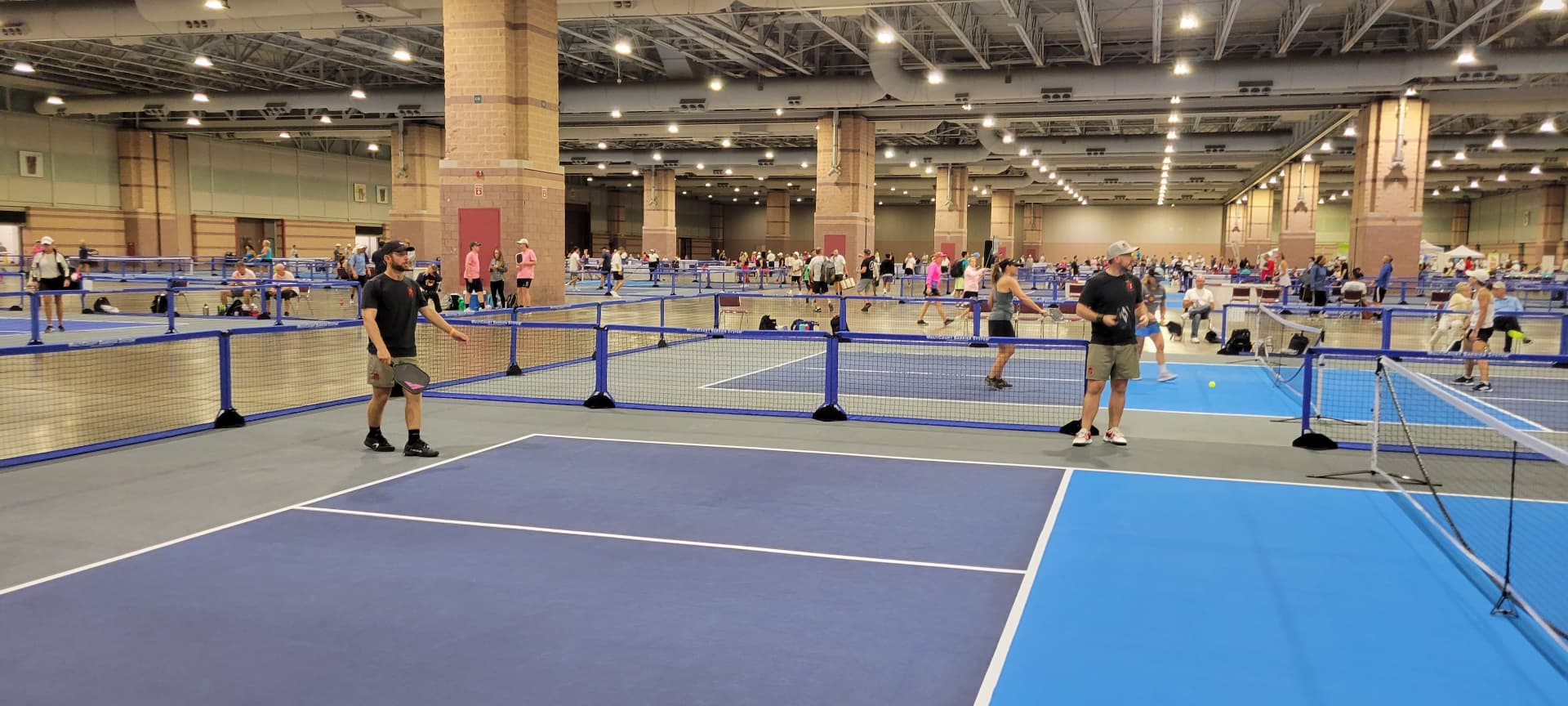
For a corporate pickleball tournament, use a round-robin pool format so every employee gets several games regardless of skill, plan one court per 8–12 players for a half-day, and budget 15–20 minutes per game to 11. A staffed turnkey setup handles brackets, scoring, reffing, and equipment — so your team invites players and shows up. The goal is participation and a shared finish, not crowning the office's best athlete.
The Pickleball Events Co. delivers the turnkey corporate activation — courts, staff, and programming at your venue — so you own the event experience without juggling freelancers. A single-court, one-day build typically begins around $10,000; multi-court tournament days scale into the mid-five and six figures. Get a quote usually within 24 hours.
Why companies run pickleball tournaments
A company tournament works when it gives mixed-skill employees a reason to play together in a short window — not when it copies a club ladder. Pickleball is unusually forgiving for first-timers: most people are rallying within minutes, which is why it outperforms a company 5K or softball game for getting non-athletes on the field. The bracket is the structure; the product is conversation between games, a fair shot for beginners, and a finale people actually watch.
Use this page as the planning spine. For how pickleball compares to other team-building formats, see our team-building comparison. For engagement framing when someone asks what the spend buys, see our team-building ROI guide— without inventing percentages your event has not measured yet.
1. Pick a format that maximizes participation
The goal of a company tournament isn't to crown the best athlete — it's to get everyone playing and talking. That points to one default for most events, with two alternatives when the brief is different:
Split players into small pools where everyone plays everyone. Guarantees each person several games regardless of skill — the point of a team event. Top finishers advance to a short bracket for a clean champion moment without eliminating half the room in round one.
Fast and simple, but half the field is out after one game. Fine as a short finale after pools; weak as the whole event. Beginners you invited get eliminated before they warm up, which kills the social goal.
Winners rotate up, no fixed bracket. Low pressure and flexible for a festival or happy-hour vibe, but no clean champion moment and harder to photograph as "the tournament." Use when the brief is mingling, not medals.
For a deeper comparison of round-robin, bracket, and open play — including when each breaks — see our event format guide.
2. Size the courts to your headcount
Court count is the lever that decides whether people play or wait. Get it wrong and the best bracket design still feels broken.
Plan roughly one court per 8 to 12 players for a half-day tournament. A game to 11 takes about 15 to 20 minutes, so a single court runs about 3 to 4 games an hour. Forty players usually want about 4 courts; 100-plus usually wants 8 or more.
You can run fewer courts and stretch the schedule, but long waits are where corporate energy dies. More courts keep people playing instead of standing around with a drink and a phone. Court count is also the biggest cost lever, so size it on purpose.
Each court needs a real pad (comfortably about 30 × 60 ft with run-off), not brochure square footage that includes stages and buffet lines. Confirm load-in, flooring, and clear spectator paths before you invite the whole company.
Map court count to budget in the cost guide, confirm how many pads fit your venue in the space guide, and see how the math changes for booths or festivals in how many courts you need by format. The 1-per-8–12 ratio here is specific to a tournament bracket with rotations — not a staffed trade-show booth.
3. Build a realistic half-day timeline
A clean half-day schedule for a mixed-skill corporate field (assumes courts are already built and ready):
| Time | What happens |
|---|---|
| 0:00–0:20 | Check-in, paddle handout, quick rules clinic for beginners |
| 0:20–0:40 | Warm-up and a coached "how to play" round on each court |
| 0:40–1:40 | Round-robin pool play — staff run scoring and rotate players |
| 1:40–2:10 | Semifinals and final on a show court while others spectate |
| 2:10–2:30 | Awards, team photo, and wrap |
That schedule is play time only. For load-in windows, per-court build time, and teardown, see the setup and teardown timeline. If the tournament is one block inside a longer retreat, see corporate retreats and offsites for how a closing-day bracket fits a multi-day agenda.
Ready to scope court count and staffing?
Send headcount, date, and venue constraints — we design the bracket and quote in 24 hours.
4. Design for beginners, not ringers
The fastest way to lose the room is to let two competitive players dominate while everyone else watches. Corporate tournaments succeed when first-timers leave having played several games — not having spectated a club match.
- Open with a five-minute rules clinic so first-timers are not lost on serve, scoring, and the kitchen.
- Mix skill levels across teams so two club players do not dominate while everyone else watches.
- Seed early pools so beginners play beginners first — confidence before chaos.
- Keep scoring visible and light: staff call lines and rotate pairs so nobody has to "know how tournaments work."
- Design the finale for the room: a short bracket people can cheer, not a three-hour grind after pool play.
If a full bracket feels like too much production for a lighter afternoon among other stations, see pickleball for corporate field days. Bringing in outside sponsors or partners to help offset the build cost — common at franchise conferences and sales kickoffs? Our guide to selling pickleball event sponsorships covers how to structure and price tiers. Replacing an annual golf outing instead? See the golf outing alternative guide.
5. Let a staffed setup handle the rest
The difference between a memorable tournament and a chaotic one is who's running it. Roles and ratios are covered in our event staffing guide. A turnkey activation typically covers:
- Bracket design and live scoring, so no one on your team has to run a spreadsheet from the sideline
- On-court hosts and referees to teach beginners and keep games moving on time
- All equipment — courts, nets, paddles, balls — delivered, built, and removed
- Pacing that fits your window, so the event ends on time with a clean finish and a photo moment
Equipment beyond the courts themselves — scoreboards, extras for bracket play — is listed in the equipment checklist. For formats beyond tournaments (clinics, open play, brand tie-ins), see how to add pickleball to your event.
Common failure modes (and how to avoid them)
Looks efficient on paper. In practice it benches half your invite list after one loss and turns the rest of the block into spectators. Use elimination only as a short finale after pools.
One or two courts for 80 people means long lines and phones out. Either cut the invite list, extend the window, or add courts. Waiting is the enemy of team-building.
If the brief quietly rewards the athletes, non-athletes disengage. Corporate tournaments succeed when beginners leave saying they actually played — not that they watched.
Someone has to own check-in, late arrivals, and the awards handoff. If that person is also trying to play, the bracket stalls. Assign a staffed lead or a vendor host.
What to put in the vendor brief
A clear brief gets a usable quote faster than a vague "tournament for the company." Include:
- Date, city, indoor vs outdoor, and hard start/end times
- Approximate player count and whether guests of employees are invited
- Venue constraints: load-in path, floor type, union rules, rain plan
- Format preference: pools-only, pools + short final, or open play
- Branding needs: logos on nets/boards, photo moment, awards
- Who is the day-of lead on your side, and how we reach them mid-event
For a full RFP structure vendors can answer without guessing, see how to write an RFP for a pickleball event. Pricing is quote-only: as planning context, a single-court one-day activation typically begins around $10,000; multi-court and multi-day builds move into mid-five and six figures depending on scope. Ask for itemized categories so you can see where court count, travel, and staffing actually land — details in the rental cost guide.
Indoor vs outdoor and weather contingency
Most corporate tournaments run outdoors on a campus lawn, parking pad, or plaza — or indoors in a gym, ballroom, or warehouse when weather or attire demands it. Outdoor builds need a rain call written into the run-of-show before invitees leave the office: who decides, by what time, and whether you move indoors, delay, or convert to open-play under cover. Indoor builds need freight elevators, floor protection, and a clear teardown path so the next booked room is not delayed. Neither is harder than the other; each fails when those constraints show up on game day instead of in the quote.
If heat is the risk — late spring through early fall outdoor blocks — plan shade, water, and shorter game lengths before you pad the invite list. See our heat safety and hydration planning guide and the weather contingency plan so the bracket does not become a safety briefing mid-pool.
Who should own the day on your side
Even with a staffed vendor, someone on the company team needs to own invitations, executive RSVPs, awards copy, and the soft close when the CEO wants "five more minutes." That person should not also be stuck in a pool match during check-in. Give them a radio or phone bridge to the court lead, a printed player list with late-add blank lines, and authority to cut a pool short if the finale is slipping. Tournaments fail less from bad paddles than from nobody knowing who can change the schedule.
If legal or facilities needs certificates of insurance, venue riders, or ADA path confirmation, start those threads when you request the quote — not the week of the event. Accessibility layout for temporary courts is covered in our ADA accessibility guide; insurance and liability language belongs in planning, not in a hallway conversation after load-in.
Where this format travels next
The same round-robin spine works outside a corporate office: orientation-week brackets through college orientation and welcome week, member or guest days through country clubs and private clubs, and charity fundraiser tournaments with sponsorship built into the format via the nonprofit fundraiser guide. Running a multi-day sales meeting instead of a single office event? See pickleball for sales kickoffs. Want an evening finale under lights? The glow-in-the-dark guide covers lighting and equipment for a night close.