Facilities & Workplace Amenities · Updated September 2026
Permanent pickleball court vs. event rental for a corporate campus
Choose the path that matches frequency and budget owner. A turnkey event rental — courts delivered, built, staffed, and removed — typically begins around $10,000 for a single-court one-day activation; multi-court / multi-day builds move into the mid-five and six figures, with a quote usually back within 24 hours and no capital cycle. A permanent campus court is a facilities/finance project: previously published planning ranges on this page (roughly $20k–$40k outdoor, higher for premium or indoor) are not live quotes and not verified current national data — run a site-specific bid. A hybrid (seasonal install or recurring programmed days) sits in the middle when you want rhythm without owning a fixed asset yet. The deciding question: is this an ongoing amenity, or a dated experience?
Who owns the decision — and the budget
Permanent-vs-rental debates stall when the wrong committee owns the brief. HR can love the people outcome and still lose six months waiting on a capital packet facilities never prioritized. Facilities can love a clean conversion and still watch the project die because finance will not fund an amenity without attendance proof. Start by naming the owner out loud.
HR / workplace experience / events
Owns the people outcome: engagement, wellness days, retreats, appreciation events, and culture programming. Event rental fits this lane because it is a dated service with a clear deliverable, not a permanent improvement to the land.
Facilities / real estate
Owns the property outcome: pad condition, drainage, fencing, lighting, ADA path of travel, and how a court sits in the campus master plan. Permanent and semi-permanent builds live here — even when HR is the internal champion asking for them.
Finance / legal / risk
Owns capital thresholds, depreciation, insurance riders, and liability allocation. A one-day activation is typically a vendor contract with certificates of insurance. A permanent court is a fixed asset conversation with different sign-offs.
Practical rule: if the money sits in an events or wellness operating line, lead with rental or recurring programming. If the money sits in a capital or campus-improvement line — and facilities is already surveying pads — lead with permanent or semi-permanent, but still run a demand-test activation first when turnout is unproven. For the people-side formats that usually fund the rental path, see corporate retreats and offsites, employee appreciation day, and corporate pickleball tournaments.
The trade-offs, side by side
Factor
Permanent build
Event rental
Who owns the budget
Usually facilities + finance (capital or major project). Legal and insurance often join for a fixed asset on the property.
Usually HR, workplace experience, or the events team — an operating / program line, not a capital request.
Approval & timeline
Site survey, budget sign-off, contractor selection, and construction lead time. Often months before the first ball is in play.
A clear quote — usually within 24 hours — and a booked date within weeks. No capital-budget cycle required.
Upfront cost
Previously published planning ranges on this page put a standard outdoor court roughly in the $20k–$40k band (more for premium or indoor). Those are not live quotes and are not verified current national data — use a site-specific bid.
Turnkey single-court one-day activations typically begin around $10,000. Multi-court / multi-day builds move into the mid-five and six figures.
Ongoing responsibility
Yours: resurfacing, nets and fencing, drainage, lighting upkeep, and liability for a permanent structure on your property.
Ours for the event window. We deliver, build, staff, and remove the court — nothing stays on your campus after teardown.
Flexibility
Fixed to one footprint. If the campus master plan changes or demand underperforms, it is a sunk asset.
Moves with the calendar — different building, courtyard, parking pad, or city each time.
Best fit
Consistent year-round demand: lunchtime leagues, standing wellness programming, or a talent-amenity leadership intends to keep funded.
One-off or occasional morale days, offsites, or a demand test before anyone commits capital.
Cost honesty: what we can say, and what we will not
Event rental pricing on this site is confirmed for how we quote activations: a single-court one-day activation typically begins around $10,000, and multi-court / multi-day programs scale into the mid-five and six figures. Surface type, travel, staffing, branding, and days on-site move the number — which is why every date gets its own quote. Full breakdowns live on our pickleball court rental cost guide and the broader court rental for events overview.
Permanent construction is a different product with different vendors. Earlier versions of this page stated outdoor, premium, and indoor dollar bands as if they were current national cost data. They were not verified as live market surveys. We keep the previously published planning ranges visible so older links and internal briefs still resolve honestly — and we label them clearly so nobody mistakes them for a bid.
Outdoor / premium (previously published)
Previously published planning ranges on this page: roughly $20,000–$40,000 for a standard outdoor court and $25,000–$55,000 for a premium outdoor build with upgraded surfacing, fencing, and lighting. These are not live quotes and are not verified current national data. Converting an existing tennis or basketball court is often cheaper than new construction — confirm with a site-specific bid.
Indoor conversion (previously published)
Previously published planning range: typically $30,000–$60,000 once lighting, HVAC adjustments, and flooring are factored in. Same honesty rule — planning context only, not a quote for your building. Year-round indoor play can matter in some climates; it does not by itself justify inventing a price.
Prefer a decision framework and a site walk over asserting fake construction prices. If permanent is the goal, start the contractor conversation with photos, a site plan, and your first-play date — not a blog number.
Approval timelines that actually matter
A rental timeline is a service timeline: share date, city, surface, and rough court count; get a clear quote (usually within 24 hours); lock the date; host the day; tear down. The friction is calendar and venue access, not a capital packet. That is why wellness days, retreats, and appreciation events usually start here — see how to add pickleball to your event for the planner sequence.
A permanent timeline is a project timeline: concept → facilities walk → rough order of magnitude → capital request → procurement → permitting if required → construction → punch list → opening. Even a “simple” conversion can stretch across fiscal quarters when finance meetings, insurance riders, and ADA path reviews stack up. If leadership wants employees playing this quarter, do not pretend a permanent pour fits that calendar.
Hybrid timelines sit between them. Recurring programmed days can be booked as a series of rentals without waiting on concrete. Seasonal or semi-permanent installs need more site diligence than a one-day activation, but still less than a forever amenity — and they can come down when the campus plan changes.
Test demand with an event day first
Share your date, campus city, surface type, and rough court count. We come back with clear, all-in event rental pricing — usually within 24 hours — so facilities and HR decide with real turnout data later, not a guess now.
Permanent courts put long-horizon risk on the property owner: resurfacing cycles, net and fence repairs, drainage issues, lighting failures, and the insurance posture of a fixed recreational amenity. Those costs do not appear in a glossy “build it once” slide. They show up in facilities work orders for years.
Turnkey rentals concentrate risk in the event window. The activation vendor delivers, installs, staffs, and removes the court; certificates of insurance and a clear scope of work define who covers what while guests are on court. When the trucks leave, the campus is not left holding a structure it did not want to maintain. For deeper planner detail, see event insurance and liability and event site assessment.
Legal reviewers usually clear a dated vendor contract faster than they clear a permanent improvement — not because rental is “safer” in every absolute sense, but because the obligation has an end date. If your risk team is already saturated with capital projects, that alone can decide the path for this fiscal year.
How to test demand with a rental first
Pick one real date with a real audience — wellness day, retreat, appreciation event, or lunchtime open play — not a vague “sometime this year.”
Instrument the day: headcount through the court, wait times, repeat players, and qualitative feedback from beginners vs regulars.
Hold a 30-day debrief with HR and facilities together. If turnout is soft, you spent an event budget, not a capital budget. If turnout is strong, you have evidence for the next ask.
Only then model permanent vs recurring rental vs seasonal hybrid using your actual frequency — not a blog breakeven example.
Previously published illustrative math on this page used a ~$30,000 permanent example against ~$10,000 event days to sketch a three-to-four-rental breakeven. That was planning arithmetic only. Your construction bid, maintenance reserve, and true annual frequency will move the crossover point — sometimes a lot. Do not treat the old example as a forecast.
Site conditions change which path is realistic
Dollar comparisons without a site walk are theater. The same “we want pickleball” request can mean a cheap conversion on an idle tennis court, a heavy new pad behind the parking structure, or a one-day install on grass that never should become permanent asphalt. Match the surface to the decision.
Tennis or basketball conversion
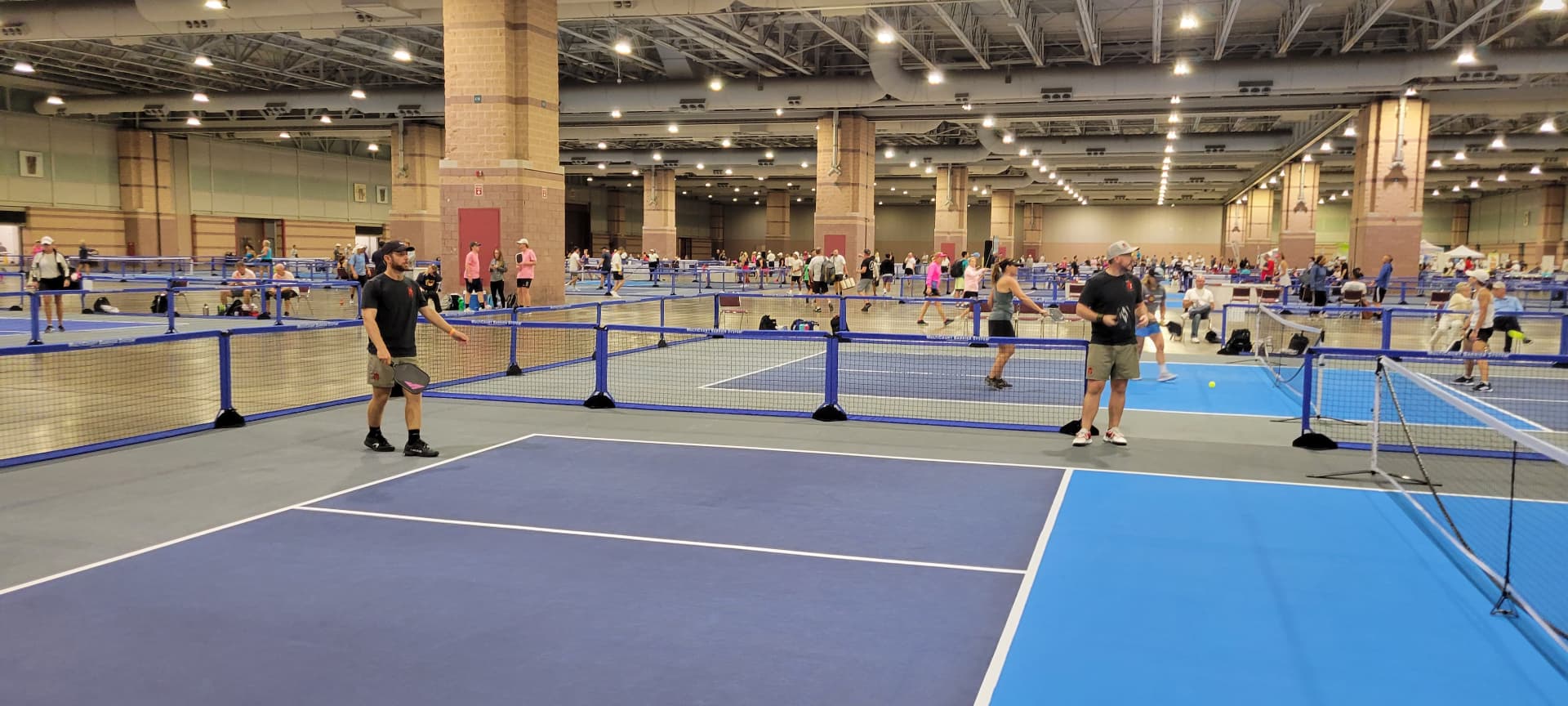
An underused hard court on the same footprint is often the simplest permanent path — resurfacing and re-lining rather than new construction from the subbase up. For events, the same pad is an easy rental install with known dimensions and access.
Raw pad or new outdoor build
New asphalt or concrete, fencing, nets, and surfacing make permanent the heavier lift. A turnkey rental still works on a suitable flat pad for the event window without committing the campus to that footprint forever.
Parking, grass, or courtyard needing subfloor
Surfaces that would need temporary subflooring for a permanent-feel install are common rental sites. The crew brings the system in and out with the activation — which is why parking decks, lawns, and plazas often favor rental or seasonal hybrid over capital construction.
Permanent is the right call when the campus will actually use the court as infrastructure — not as a one-time photo opportunity. It sends a different talent and culture signal than a single activation day, and it can be the cheaper multi-year path when frequency is high and facilities already has a clean conversion or funded pad.
Leadership wants a year-round amenity employees can use without booking an event vendor each time.
You already have verified, recurring demand — not a hope that people will show up.
Facilities has an easy conversion (tennis/basketball) or a funded pad in the master plan.
Finance prefers one capital spend over a multi-year string of activation invoices at your expected frequency.
You are willing to own maintenance, resurfacing, and liability for the life of the court.
Permanent and semi-permanent installation through our fulfillment partner network is available in markets we currently serve — we do not claim to build in every city. Start with pickleball court installation for how that path works, then ask for a site-specific conversation. Event rental remains the primary CTA on this page because most corporate teams still need a dated experience before they are ready to own asphalt.
When event rental wins
You need a date on the calendar in weeks, not a capital project in months.
The budget sits with HR or events, and capital is not available this cycle.
You want to measure turnout before anyone pours or resurfaces anything.
The only viable play space is temporary (parking, grass, plaza, ballroom) or multi-city.
You want staffing, nets, paddles, and teardown included — then a clean site the next morning.
Rental also wins for multi-city programs and national tours where a permanent court in one HQ courtyard does nothing for the other offices. If the brief is “same experience, different campuses,” you are describing a portable activation, not a capital amenity. Court count guidance for those briefs lives in how many pickleball courts do you need.
The hybrid middle path: seasonal and recurring
Not every campus wants forever asphalt, and not every culture team wants a one-and-done field day. Hybrid options keep momentum without forcing a false binary:
Recurring programmed days — monthly or quarterly turnkey activations on a standing calendar. Employees get rhythm; facilities never inherits a structure. See recurring pickleball programming for venues.
Seasonal / semi-permanent installs — a court that stays up for a defined window (for example spring through fall) and comes down when weather, construction, or master-plan work requires it. More commitment than a single day; less than a capital forever decision.
Demand-test → decide — one strong activation, a joint HR/facilities debrief, then either a permanent bid, a seasonal plan, or a recurring rental series. The sequence matters more than the first quote.
Hybrid is where many sophisticated campuses land for a year or two. It produces the attendance data finance wants, gives employees something real, and keeps optionality if the headquarters footprint changes.
RFP questions checklist
Whether you are writing an internal brief or a vendor RFP, force the decision criteria onto paper. Vague “bring us pickleball” requests produce mismatched quotes. Use this list as a starting checklist — and pair it with how to write an RFP for a pickleball event when the path is clearly an activation.
What is the primary goal — one event day, seasonal programming, or a permanent campus amenity?
Who is the budget owner (HR/events vs facilities/finance), and what approval threshold triggers capital review?
What is the target first-play date, and is weather contingency required?
Describe the surface: existing tennis/basketball, raw pad, parking, grass, indoor floor, or rooftop.
How many courts, how many hours of play, and do you need staffing / clinics / scoring support?
Who carries liability during play, and what certificates of insurance are required from the vendor?
For permanent paths: who owns resurfacing, nets, fencing, lighting, and drainage after handoff?
Is a demand-test rental acceptable before any capital bid is issued?
Do you need branding, sponsor marks, or photo moments built into the court presentation?
If demand is strong, what is the preferred middle path — recurring rental days or seasonal/semi-permanent install?
A practical decision sequence
If you need a default playbook that does not invent construction prices or oversell permanent coverage:
Name the budget owner and the first-play date. If both are in the events/HR lane this quarter, start with rental.
Walk the site once with photos: conversion candidate, raw pad, or temporary-only surface.
Run one instrumented activation. Capture headcount and qualitative demand.
Debrief HR + facilities + finance together. Choose permanent, seasonal hybrid, or recurring rental with evidence.
Only then issue a permanent bid or lock a multi-date rental series — never both at once without a reason.
Pickleball Events Co’s primary offer is the turnkey event activation. Permanent and semi-permanent work goes through fulfillment partners where we have coverage — honest availability, not a nationwide build claim. When you are ready for numbers on an event date, use the quote form below or get a quote.
Permanent court vs. event rental: FAQs
How much does it cost to build a permanent pickleball court on a corporate campus?
Earlier versions of this page published planning ranges of roughly $20,000–$40,000 for a standard outdoor court, $25,000–$55,000 for premium outdoor builds, and $30,000–$60,000 for indoor conversions. Treat those as previously published planning ranges only — not live quotes and not verified current national cost data. Actual cost depends on site prep, conversion vs new build, local labor, fencing, lighting, and finishes. Get a site-specific bid from a qualified contractor or installation partner before you put a number in a capital request.
How much does a turnkey event rental cost?
A single-court one-day activation typically begins around $10,000. Multi-court and multi-day builds scale into the mid-five and six figures depending on court count, days on-site, staffing, travel, surface, and branding. Every activation is quoted individually — usually within 24 hours.
Is it cheaper to rent for events or build permanently?
It depends on frequency and who owns the budget. Occasional campus events usually stay cheaper as rentals because you avoid capital, maintenance, and long-term liability. High-frequency year-round use can justify a permanent build over a multi-year horizon — but only after you have real attendance data, not a guess. Previously published ~$30k breakeven examples on this page were illustrative planning math only; run your own model with a current construction bid and your expected rental frequency.
Can we test demand before committing to a permanent court?
Yes — that is one of the most common reasons companies start with an event rental. A one-day or seasonal turnkey activation produces real participation numbers before anyone commits capital budget to a permanent structure, and it is much faster than a construction approval cycle.
Do you build permanent courts, or only event rentals?
Our core business is the turnkey event activation — delivered, built, staffed, and removed for your event day. Permanent and semi-permanent installation is available through our fulfillment partner network in markets we currently serve; availability and site-specific pricing vary. We do not claim to build in every market. See our court installation pages for how that path works, and use the quote form for event-rental pricing.
What about a hybrid — seasonal or recurring programming without a permanent pour?
That middle path is real. A subfloor-based court can stay up for a season and come down for winter or a campus change, and recurring scheduled event days give employees a rhythm without a capital project. Hybrid suits companies that want more than a single morale day but are not ready to own a fixed asset.
Who usually has to approve a permanent court vs a rental?
Event rentals typically clear through HR, workplace experience, or the events team as an operating expense. Permanent builds almost always route through facilities and finance, and often legal/risk for insurance and liability on a fixed structure. Knowing which committee you need — and which timeline they run on — should happen before you compare quotes.
What site conditions make permanent harder than rental?
Parking decks, grass courtyards, plazas, and indoor floors that need temporary subflooring are usually easier as rentals because the system comes and goes with the crew. Existing tennis or basketball courts are often the easiest permanent conversions. Raw new pads are the heaviest permanent lift. A short site assessment clarifies which path is realistic before the budget fight starts.
Get a clear quote for your campus activation
Share the date, city, venue or campus surface, and rough headcount. We return clear, all-in pricing for a turnkey court build — usually within 24 hours — so you can compare rental against any permanent bid with real numbers on both sides.