Event Planning · Capacity & Format
How many pickleball courts do you need for your event?
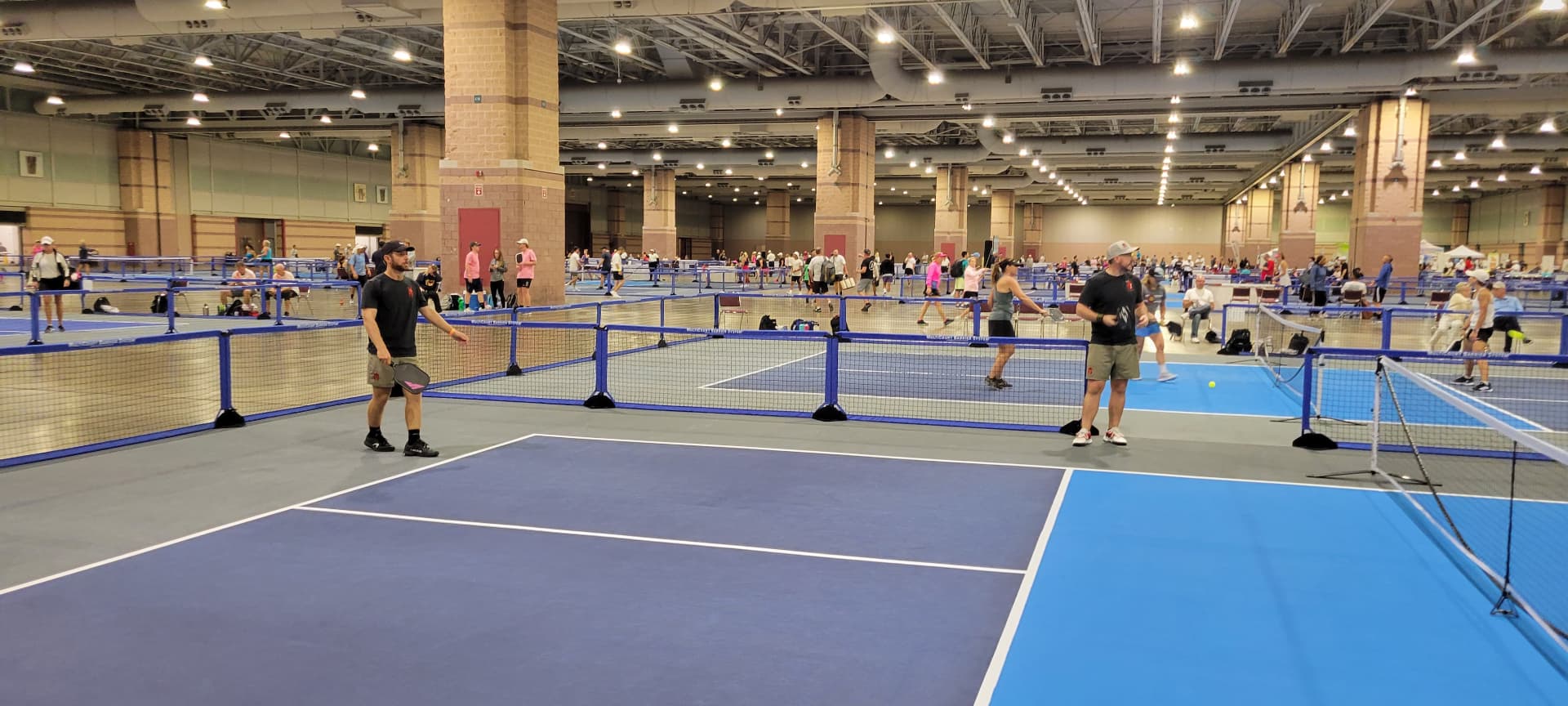
It depends on format more than headcount. A structured tournament needs roughly 1 court per 8–12 players so everyone actually gets several games — games to 11 typically run about 15–20 minutes, so one court clears roughly 3–4 games an hour. A staffed open-play or trade-show booth format runs on far fewer courts — 1 well-staffed court can engage well over 100 people across an event day through short rotations. A festival or brand activation scales by simultaneous crowd and footprint, not total attendance, since a court is a draw, not a queue that processes every guest.
The Pickleball Events Co. owns the turnkey event activation — courts delivered, installed, staffed, and removed at your venue — not a facility open-play rental. Use the chart below to right-size the build, then request a quote (usually within 24 hours). A single-court, one-day activation typically begins around $10,000; multi-court builds scale into the mid-five and six figures.
Court count by format, not just guest count
Planners who start with “how many people are coming?” usually over-order courts or under-order the wrong kind of experience. Start with what success looks like: scored games for registered players, continuous short rotations for booth traffic, or a visible branded draw for a festival crowd. Then map court count to that job. For a full build-vs-outcome framework, see how to add pickleball to your event. If your team wants standings and brackets, that is a different product from a mixer — our corporate tournament guide and round robin vs bracket vs open play comparison walk through the format choice in detail.
Every registered player needs several real games, so court count has to keep pace with the bracket. Plan roughly one court per 8–12 players for a half-day format — a game to 11 typically runs about 15–20 minutes, so one court clears roughly 3–4 games an hour. Under-court a tournament and the wait between rounds kills the energy you are paying for.
A single well-run court out-punches its count here, because you are not seating full matches — you are cycling short rallies, mini-clinics, and quick rotations through a booth. One staffed court can meaningfully engage well over 100 people across a show day. Adding a second court mainly buys shorter lines at peak traffic, not proportional total capacity.
Court count tracks expected simultaneous crowd and footprint, not total attendance. A single branded court draws a crowd and holds attention whether the festival has 500 or 5,000 people on-site, because only a fraction are playing — or watching — at once. More courts buy simultaneous games and a bigger visual footprint, not coverage of every attendee.
Guest × format starting ranges
Use the table below as a starting point — not a hard formula. Final counts depend on your venue's real footprint, how much wait time you will tolerate at peak, and whether staff are running rotations or just handing out paddles. Ranges assume doubles play and a typical half-day or full-day corporate / public event window.
| Guests | Tournament | Staffed open play / booth | Festival / activation |
|---|---|---|---|
| 25–50 | 1 court | 1 court | 1 court |
| 75–150 | 2 courts | 1–2 courts | 1–2 courts |
| 250–400 | 3–4 courts | 2 courts | 2–3 courts |
| 500–750 | 5–6 courts | 2–3 courts | 3–4 courts |
| 1,000+ | 8+ courts | 3–4 courts | 4–6 courts |
Starting ranges only. For tournament math in detail — bracket format, timeline, and staffing — see the corporate tournament guide. Cost context for how court count flows into a quote lives in the court rental cost guide.
What 50, 100, and 250 guests usually look like
Headcount examples help when the invite list is clearer than the format brief. These sketches assume a typical corporate or brand event — not a permanent club install — and they still bend around the pad you can give the courts.
One court covers most formats. For a short open-play mixer or cocktail activation, staff the court hard and keep rotations short. For a half-day tournament among a small group that actually wants scored games, one court still works if the bracket is compact and you accept some waiting between rounds — or add a second court only if the venue footprint is easy and you want continuous play.
Format splits the answer. A structured tournament usually wants two courts so pool play clears in a reasonable half-day window without long gaps. A staffed booth or open-play format at the same headcount often still runs well on one court; a second court is the line-shortener at peak, not a requirement for total engagement.
Tournament planners should think in the 3–4 court range so registered players get real court time. Booth and open-play builds usually land at two courts when you expect a continuous stream of passersby. Festival and brand activations still size to simultaneous crowd and available pad — two or three courts is a common sweet spot when you want a visible cluster without sprawling across the floor.
Member guest-days at a country club or private club usually behave like the staffed open-play column — one well-run court over a full afternoon, not a court per player — unless the club is intentionally hosting a scored member tournament.
Not sure which column fits your event?
Tell us your headcount range, format, and venue footprint — we'll recommend a court count and quote it, usually within 24 hours.
Why over-building courts backfires
More courts sound safer. In practice, extra pads without a wait-time problem dilute energy, inflate cost, and leave empty rectangles in the photo set. Right-size first; expand only when the line or the bracket proves you need it.
An unstaffed or half-full court reads as unused décor in photos and pulls attention away from the courts that are actually busy. Planners who rounded up "just in case" often end up with quiet pads that undercut the activation they paid to create.
Court count is usually the single biggest driver of activation cost. A single-court one-day activation typically begins around $10,000; multi-court and multi-day builds move into the mid-five and six figures depending on staffing, travel, surface, branding, and venue rules. Rounding up courts without a wait-time problem is an expensive insurance policy.
One court with a dedicated host running clinics and rotations almost always creates a better guest experience — and better content — than three quiet courts spread across a room. Add courts to solve a specific problem: past wait-time complaints, a footprint that comfortably fits more, or a headcount that genuinely needs the throughput.
A court is only as busy as the person running it. Our event staffing guide covers how many hosts, referees, and instructors each format actually needs once the court count is set.
Footprint and space before the RSVP count
Venue pad is often the real governor on court count — not the invite list. Each court needs the playing surface plus run-off so players can move safely and spectators can stand without blocking egress. Ballrooms lose space to stages, bars, buffet lines, and dance floors; outdoor plazas lose space to tents, stages, and fire lanes. Measure the rectangle you can actually give the activation, then choose a court count that fits cleanly with room to breathe.
If the pad only supports one court well, do not force a second. A single well-placed court with strong staffing outperforms two pinched courts that block circulation or sit half in a hallway. When you are still early in planning, quote against footprint and format goal rather than waiting for a final headcount — freight windows and print lead times often need a court count before RSVPs close. The court dimensions for events guide covers the footprint math per court so you can brief the venue and the vendor with the same numbers.
Staffing vs court count
Court count and staffing are a paired decision. Throughput comes from short, managed rotations as much as from painted lines. Treat them together or you will either overspend on quiet courts or understaff a busy one.
For most corporate, trade-show, and cocktail-hour budgets, fewer courts run well by dedicated staff beat more courts stretched thin. A single court with an attentive staffer creating short rotations and beginner walkthroughs produces more buzz than three courts with nobody managing the line.
The right moment to add a court is when peak wait climbs past what your format can tolerate — roughly when guests start leaving the line before they play, or when tournament rounds slip the published schedule. Staffing alone cannot invent a second playing surface; courts alone cannot invent a good rotation.
Tournaments need scorekeeping and bracket flow. Booths need greeters and clinic energy. Festivals need hosts who can pull passersby into a short rally without stopping foot traffic. Court count and staff mix should be designed together — see our event staffing guide for how hosts, referees, and instructors map to each format.
Wait-time math that actually helps
One doubles court supports four players at a time. Everything else is rotation design. In a tournament, a game to 11 often lasts about 15–20 minutes, so a single court clears roughly 3–4 games per hour. If you have 24 players in pool play and you want each pair to play several games in a half-day window, two courts keep the bracket moving; one court leaves long gaps that feel like a stall.
In a booth or open-play format, turns are much shorter — often a few minutes of rallying with a host — so the same court processes far more people across a day even though only four play at once. That is why one staffed court can engage 100+ guests across a show day without needing a tournament-scale build. Watch peak wait, not total attendance: if the line grows past what guests will tolerate (they leave before they play, or they never join), add a court or shorten the turn. If the line stays short, more courts usually waste budget and dilute the energy you wanted in the first place.
Festival and brand activations sit between those poles. You are rarely trying to process the whole gate through a game. You are creating a visible, active cluster that draws dwell time and photos. Size to the simultaneous crowd you want around the courts and the pad you can brand — then staff it so the court never looks abandoned between rallies.
Indoor vs outdoor: what changes the count
Indoor vs outdoor rarely changes the guest-to-court intuition — it changes what count is practical. Outdoor plazas and parking-lot builds can offer more contiguous footprint, but weather holds, sun angle, and surface protection become part of the plan. Indoor ballrooms, hotels, and convention carpet often have a tighter pad, ceiling height, freight elevator path, and load-in window that cap how many courts you can place cleanly without fighting the rest of the show.
Confirm the real pad and logistics before you lock a multi-court build. A two-court outdoor plan that becomes a one-court indoor plan the week of the event is a common scramble when footprint was assumed instead of measured. Compare options in our indoor vs outdoor rental guide once the format and rough court count are clear.
Common planner mistakes
- Sizing courts to total attendance instead of format and peak simultaneous play.
- Copying a daytime tournament build into a cocktail-hour or booth brief.
- Ordering extra courts before measuring the real pad the venue can give you.
- Skipping staffing to "save budget," then wondering why the court sits quiet.
- Waiting for final RSVP counts before locking a court count the freight window already needs.
- Ignoring indoor vs outdoor constraints — weather holds, ceiling height, and load-in path all change what count is practical.
How to brief a vendor (what belongs in the quote request)
A clean quote request gets you a clean court-count recommendation. Share the four inputs below and a turnkey vendor can recommend a build instead of guessing. Missing any one of them usually means either a padded court count “just in case” or a change order later.
Give a low–high range, not a single hopeful number. "80–120 expected, 150 invite list" is more useful than "about 100."
Tournament bracket, staffed open play, trade-show booth, festival activation, or cocktail-hour mixer — say which outcome you want. Format drives court count more than headcount.
Share the pad you can actually give the court(s), not brochure square footage that includes stages, bars, and buffet lines. Photos or a floor plan beat guesses.
When will most people try to play — a 75-minute cocktail hour, a full show day, or a half-day bracket block? Peak window sets wait-time math.
Add anything that changes logistics: indoor vs outdoor, branding needs, union or COI requirements, and whether you need hosts for beginners or referees for scored play. With those lines filled in, The Pickleball Events Co. can return all-in pricing quickly. A single-court one-day activation typically begins around $10,000; multi-court and multi-day builds scale into the mid-five and six figures depending on staffing, travel, surface, branding, and venue rules — every event is quoted individually.
Putting it together
Lock format first, then footprint, then court count, then staffing. Headcount informs the plan — it should not be the only input. Once you have a rough court count, confirm it fits the venue with the dimensions and space guide, sanity-check budget with the cost guide, and staff it with the right mix from the staffing guide. The event playbook ties court count, format, and run-of-show into a full plan.
The Pickleball Events Co. delivers professional pickleball courts nationwide for corporate events, trade shows, brand activations, festivals, hotels, campuses, clubs, and private celebrations — set up, staffed, and removed so your planner stays focused on the rest of the show. Ready for a court-count recommendation with clear pricing? Use the form below or get a quote — usually within 24 hours.