Quoted per city and venue
Pickleball court rental for events — delivered, built, staffed, and removed
A turnkey pickleball activation for a corporate event, trade show, festival, or brand launch. We bring professional rollout courts and event staff to your venue, run the day, and clear out — on one invoice.
This is a full event service, not a court rental you set up yourself.
Get a QuoteA full event service, not a self-serve rental
When planners search for pickleball court rental for events, they are usually trying to solve a logistics problem, not shop for a mat. Adding pickleball to a corporate off-site, a trade-show booth, or a festival typically means chasing courts, nets, paddles, staff, freight, and teardown as separate vendors — then owning the setup yourself. The Pickleball Events Co. does the opposite. Professional rollout courts, nets, paddles, and event staff arrive at your convention center, hotel, resort, company campus, or festival site. We install, run, and remove everything so your team handles nothing but showing up.
The work is fulfilled through our partner network at Pickleball Management Group, an official USA Pickleball rollout-court partner. That is why a court can go on a convention floor, a hotel lawn, a parking garage, or grass — the same network that installs rollout courts for events of every size, including builds already documented on this site. You book one vendor. You get one invoice. The activation is turnkey: delivered, built, staffed, and removed.
This page is the offer for renting that activation. If the question is what it costs, that lives on our pickleball court rental cost guide — we do not reprint ranges here. If the question is buying or installing courts that stay, that is a different product on pickleball court installation. If you want the process in four steps, see how it works.
The offer
How a turnkey pickleball activation actually works
Booking is a four-step process, not a procurement maze. You do not source equipment, hire staff, or manage a breakdown crew. That is the whole point of turnkey.
Tell us about your event
Date, city, venue, and how many courts. Two minutes.
Get a fast, clear quote
Upfront pricing within 24 hours — no back-and-forth.
We handle everything
Delivery, installation, pro staff, and full teardown.
Your guests play and remember it
You look brilliant. We make sure of it.
The first step is a two-minute form, not a sales meeting: date, city or venue, roughly how many people, and what you want the court to do — foot traffic on a show floor, a team-building afternoon, a festival draw, a launch-weekend hook. You do not need a finalized venue to start. We can quote against a shortlist and firm the number once the site is locked.
The quote that comes back is itemized — court count, days on-site, staffing, travel, surface work, and branding each show up as their own line. That is what lets you compare it against another vendor or trim scope without guessing what you are cutting. Typical turnaround is 24 hours once we have those details.
On event day the crew handles delivery, build, staffing, and teardown. Asphalt, concrete, and ballroom carpet are a direct install. Grass, turf, and most rooftops need the PickleDeck subfloor first so the court sits level. Staff arrive in the roles the event needs, from a single court host to an activation lead on a multi-court build. When the last rally ends, everything comes up and leaves with us.
Where the courts can go
A turnkey rental is useful because the court comes to the event, not the other way around. Planners book this when there is no nearby facility to buy out, or when the whole point is that guests play at the conference, the campus, the festival, or the hotel — not on a bus to a rec center across town.
Convention floors and expo halls
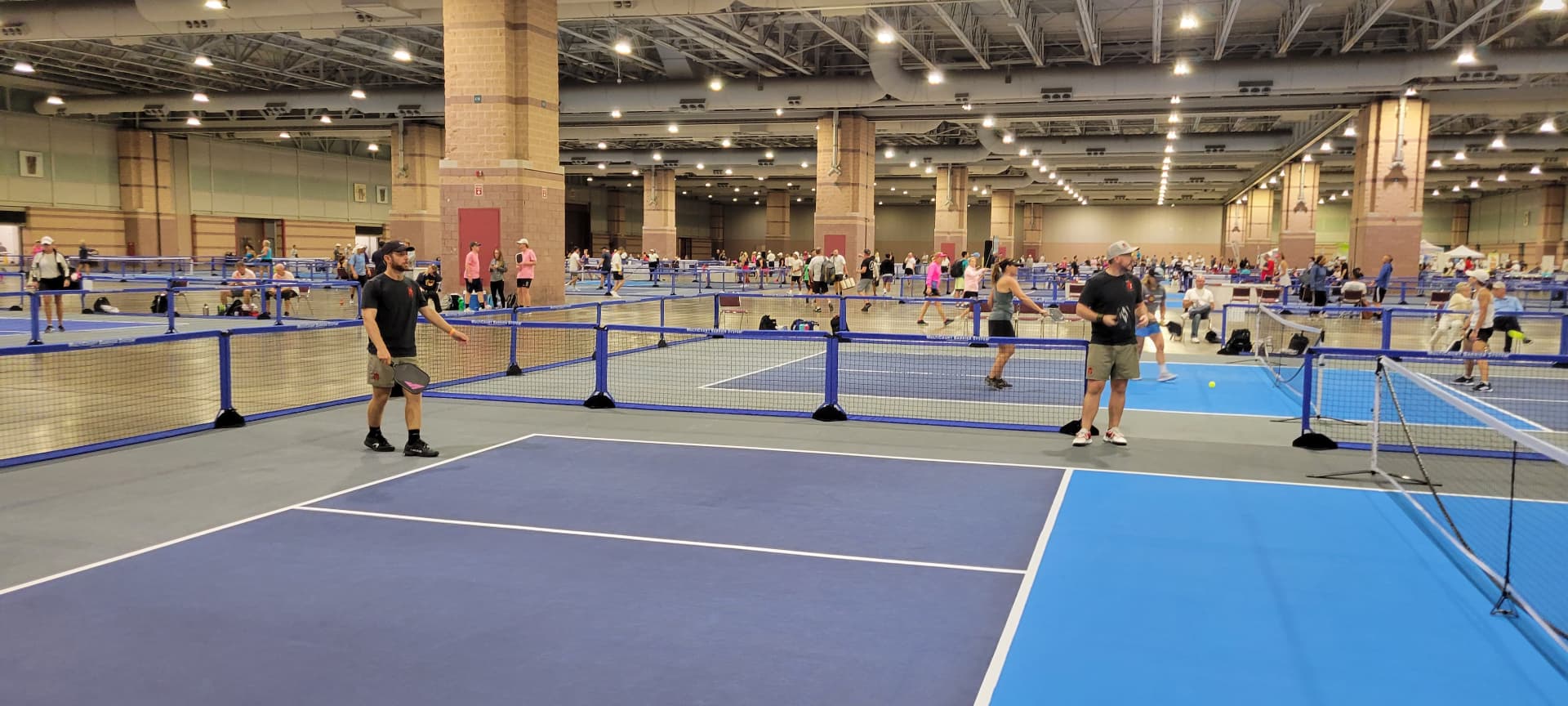
The most common indoor build. Rollout courts go down on carpet or concrete inside a standard load-in window, including venues with union labor rules.
Hotel ballrooms and meeting rooms
A controlled, weather-proof court for a conference breakout, gala reception, or indoor team-building afternoon — ceiling height is the check, not the floor.
Hotel lawns, resort greens, and campus quads
Grass and turf take a PickleDeck subfloor so the court sits level and plays true instead of following the ground.
Parking lots, plazas, and garage decks
Asphalt and concrete are the easiest outdoor surfaces — a direct install, as long as the pad is reasonably flat and drains.
Rooftops and unused decks
A true rooftop usually needs a subfloor to level the deck and protect the waterproofing membrane. The venue confirms weight limits before we commit the build.
Existing tennis or sport courts
Rollout courts sit on top of an existing hard surface and come off without modifying it — useful at clubs, campuses, and hotels that already have a court they don't want to convert.
The footprint that actually matters
USA Pickleball's official court specifications are straightforward. The playing lines measure 20 feet wide by 44 feet long — the same rectangle for singles and doubles. The non-volley zone (the kitchen) is bound by a line 7 feet from the net on each side. The net is 36 inches tall at the sidelines and 34 inches at the center. Those are the lines. They are not the space you need to hold.
The USA Pickleball Rule Book, as published on USA Pickleball's court-construction guidance, recommends a minimum total playing surface of 30 feet by 60 feet, with 34 feet by 64 feet preferred. The extra room beyond the 20 × 44 lines is run-off so players can chase a ball without hitting a wall, a booth, or the next court. Outdoors, courts should be oriented north–south so players are not staring into morning or late-afternoon sun. On grass, a ball will not bounce on the turf itself — that is why a subfloor goes down first.
Who books a pickleball court rental for an event
The same activation, scoped to a different outcome. A corporate off-site wants everyone playing. A trade-show booth wants dwell time and a line. A festival wants a crowd that can see the court from the path. Tell us the outcome and we size the build to that — not to a generic court count.
Corporate Events & Team Building
Turnkey pickleball corporate events for company off-sites, client entertainment, team-building days, and conference activations — courts delivered, built, staffed, and removed so your team just shows up and plays.
Explore
Trade Shows & Conferences
A branded pickleball court draws crowds, creates dwell time at your booth, and turns a conference into an experience. We handle exhibitor logistics, load-in windows, and union rules.
Explore
Festivals & Community Events
Pop-up courts on streets, lots, and parks for city festivals and public days — no permanent surface change.
Explore
Brand & Experiential Marketing
Fully branded courts for product launches, sponsorships, and consumer campaigns — the interactive centerpiece.
Explore
The same offer also covers hotel and resort amenity days, university orientation and homecoming, country-club member tournaments, nonprofit fundraisers, employee wellness days, wedding-weekend welcome parties, and resident events at active-adult and multifamily communities. Those are the same turnkey rental — bring pickleball to the event, quoted by city and venue.
What is included — and what is not
A turnkey rental is a project, not an hourly court. The foundation is the same on every quote: the court system, the logistics, and a court host. Programming, branding, and extras are scoped to the event so you are not paying for a tournament format you do not need, or skipping the staff that would have made a booth actually work.
On every activation
Regulation playing lines (20 ft × 44 ft) installed at your venue — indoor or outdoor — with nets and posts set by the crew.
Freight, load-in, install, and full removal on one invoice. Your team does not assemble anything.
A shared set of demo paddles so first-time players can walk up, plus balls matched to an indoor or outdoor surface.
Someone who welcomes players, explains the basics, and keeps rotations moving — the difference between a court that plays and a court that sits empty.
Guests can find the court and get on it without your operations team running a help desk.
Optional, scoped to the event
Beginner-friendly instruction so non-athletes join in, not just the office regulars. Optional add-on.
A pro player for exhibitions, clinics, and photos — a headline draw for VIPs and crowds. Optional add-on.
Round-robins, brackets, and formats scaled to your guest count. Optional add-on.
Courts, nets, and signage wrapped in your brand for a content-ready activation. Optional add-on.
Branded paddles, apparel, and prizes guests take home. Optional add-on.
What you do notget, and should not expect from this offer: a self-serve pile of equipment dropped at the dock for your AV team to figure out. A facility buyout at someone else's rec center. A permanent court poured into the property. And we will not quote a number on this page. Cost questions go to the cost guide, then to a real quote.
Indoor vs. outdoor
The court is the same rollout system either way. What changes is everything around it. Indoor is the call when the event cannot gamble on weather — a conference, a gala, a winter off-site, anything already inside a convention center or ballroom. You get climate control, consistent lighting for photos, and a contained crowd. The constraints are room size, load-in rules, and overhead clearance for lobs and serves.
Outdoor is the call when visibility is the point: a festival path, a campus day, a resort lawn, a downtown plaza, a rooftop. Passersby see it and walk over. You usually have more room for courts and spectators. You also have weather, sun, and wind to plan for — a tent, an indoor backup, or a rain date, decided early rather than the morning of. Daytime activations use natural light; evening play needs portable lighting.
Surface is the other split. Indoors, rollout courts go over carpet or hard flooring without damaging the venue. Outdoors, asphalt and concrete install directly; grass, turf, and most rooftop decks need the subfloor. If you are still choosing the venue, lock indoor vs. outdoor and the surface before you lock court count — those two decisions shape the build more than headcount does.
Staffing is what makes it an activation
An unstaffed court at an event reads as rental equipment. A staffed court reads as an experience. That is why a court host is part of the base build, not an upsell you have to remember to add. The host welcomes players, teaches the handful of rules a first-timer needs, and keeps rotations moving so the court does not sit empty between groups.
Other roles get added when the format needs them. A referee or scorekeeper matters once you are running a real bracket — a company tournament with bragging rights on the line — because a court host is not necessarily equipped to call faults across simultaneous games. An instructor or pro runs clinics and "play with a pro" sessions; that is a different skill than hosting, and it is the draw for VIPs. Trade-show booths add a lead-capture staffer so the person teaching the game is not also scanning badges. On a multi-court build, an activation lead is the single point of contact with your venue's operations team.
If budget is tight, cut a court before you cut the person running it. One well-hosted court cycling guests through short rallies will outperform two empty ones. We will tell you that on the quote rather than over-building the floor.
Branding, when the court is the campaign
A standard court is enough for an internal team-building day. A brand activation, a sponsor booth, or a launch wants the court itself to be the asset — custom-wrapped surface, branded nets, and signage that show up in every photo and every phone video. That production run sits on top of the standard build schedule, which is one reason branded jobs want more lead time than a plain corporate afternoon.
Branding is optional. It is also the difference between "we rented a court" and "this was our activation." If the goal is content, dwell time, or sponsor visibility, say so in the quote request so the wrap and the staffing are scoped together. A wrapped court with no host still underperforms a plain court with someone running the line.
Ready to bring pickleball to the event?
Date, city, venue if you have one, and what you want the court to do. We come back with an itemized quote — usually within 24 hours.
Get a QuoteHow booking works, and how far out to lock it
Treat this like AV or catering, not a last-minute add-on. Courts, staff, and trucks are scheduled against a specific date. Four to eight weeks is the comfortable window for most single- or multi-court corporate and trade-show activations. Eight to twelve weeks or more is the safer window for a multi-court build, custom branding, or a date during a busy convention week. Two to four weeks is still very workable for a standard build. Under two weeks is often still possible — especially a single court — with less flexibility on branding and add-ons. Ask. Do not assume a tight timeline rules it out.
What you send to get an accurate quote: event date and city (or venue), indoor or outdoor and the surface if you know it, roughly how many courts or your expected headcount, whether you want clinics or a tournament format, and whether the venue needs a certificate of insurance. With those, we can usually return a real number in 24 hours instead of a range that changes later. You do not need a locked floor plan on day one.
What you provide on event day is access at the agreed load-in time, plus any venue paperwork already in motion. The crew handles the rest. If weather, headcount, or venue changes, flag it as soon as you know — earlier changes are easier to absorb than a morning-of surprise.
Work already delivered by the partner network
These are real projects fulfilled by Pickleball Management Group, attributed to that partner network — not claimed as workThe Pickleball Events Co. executed alone. They are the proof that a rollout court can go where a poured court cannot.
USA Pickleball Indoor Championships
Atlantic City Convention Center, NJ
25 rollout courts installed on the convention floor — the scale reference point for what a single indoor build can carry.
US Open Pickleball Championships
Naples, FL
A pop-up court activation that included a court built directly on grass using the PickleDeck subfloor system — a build many thought couldn't be done.
Hawaii Convention Center
Honolulu, HI
Indoor court installation and an inaugural tournament that drew more than 3,500 players and spectators.
HonorHealth Charity Activation
Scottsdale, AZ
Eight rollout courts installed flawlessly on top of a parking garage for a standout charity event.
Cities we serve most often
We quote U.S. events by city — not a 50-state coverage claim. The metros below are the markets we run activations in most often, each with its own local page for venue-level detail. If your event is not on the list, tell us the city anyway.
Want to own the courts instead of booking an event?
If you run a venue, community, club, or campus and want rollout courts of your own — permanent or semi-permanent — that is a separate offer. We design and install those through the same partner network.
See court installationPricing questions — how much a one-day corporate court runs versus a multi-day festival build, what drives the number, how a turnkey activation compares to renting time at a local facility — belong on pickleball court rental cost. We do not post a starting-at figure here. Request the quote and get the real number.
Frequently asked questions
Is this a court rental or a full service?
A full service. We are not a self-serve court rental — we bring professional rollout courts and event staff to your venue, install them, run the activation, and remove everything afterward. You handle nothing but showing up. If you want to own courts rather than book an event, see our court installation service.
What does a pickleball court rental for an event cost?
Every activation is quoted individually. Court count, days on-site, staffing, travel, surface, and branding all move the number, and we return clear, upfront pricing — usually within 24 hours. For the price drivers and how a turnkey activation is priced versus renting court time at a facility, see our pickleball court rental cost guide.
Where can you set up the courts?
Almost anywhere the event already is — convention floors, ballrooms, hotel lawns, rooftops, parking lots, and company campuses. Rollout courts install indoors and outdoors. Grass, turf, and most rooftop decks use a subfloor system so the court plays true; asphalt, concrete, and ballroom carpet typically take a direct install.
Do you cover my city?
We quote U.S. events by city. The metros listed on this page are where we work most often. Tell us the city in your quote request and we will say whether we can staff it — we do not claim coverage in all 50 states.
How far in advance should I book?
As early as you can, especially around major convention weeks. Four to eight weeks is comfortable for most single- or multi-court builds. Eight to twelve weeks or more is safer for multi-court builds, custom branding, or a busy convention week. Shorter timelines are often still possible — ask.
Can you install on grass or a rooftop?
Yes. Grass, turf, and most rooftop decks use the PickleDeck subfloor system so the court sits level and plays true. Asphalt, concrete, and ballroom carpet typically take a direct install with no extra base. Our fulfillment partner network has built a grass court at the US Open Pickleball Championships in Naples and eight rollout courts on a parking garage in Scottsdale.
I want to buy or install courts, not rent them for one event. Is that you?
Yes — but that is a different offer. Permanent and semi-permanent courts for properties, HOAs, clubs, resorts, and homeowners live on our pickleball court installation page. This page is for booking a turnkey event activation that comes down after your date.
Bring pickleball to your event.
Tell us your date, city, and headcount — we deliver, build, staff, and tear down, and quote it in 24 hours.
Get a Quote