Event Logistics · Day-Of Timing
Pickleball court setup and teardown timeline for a one-day event
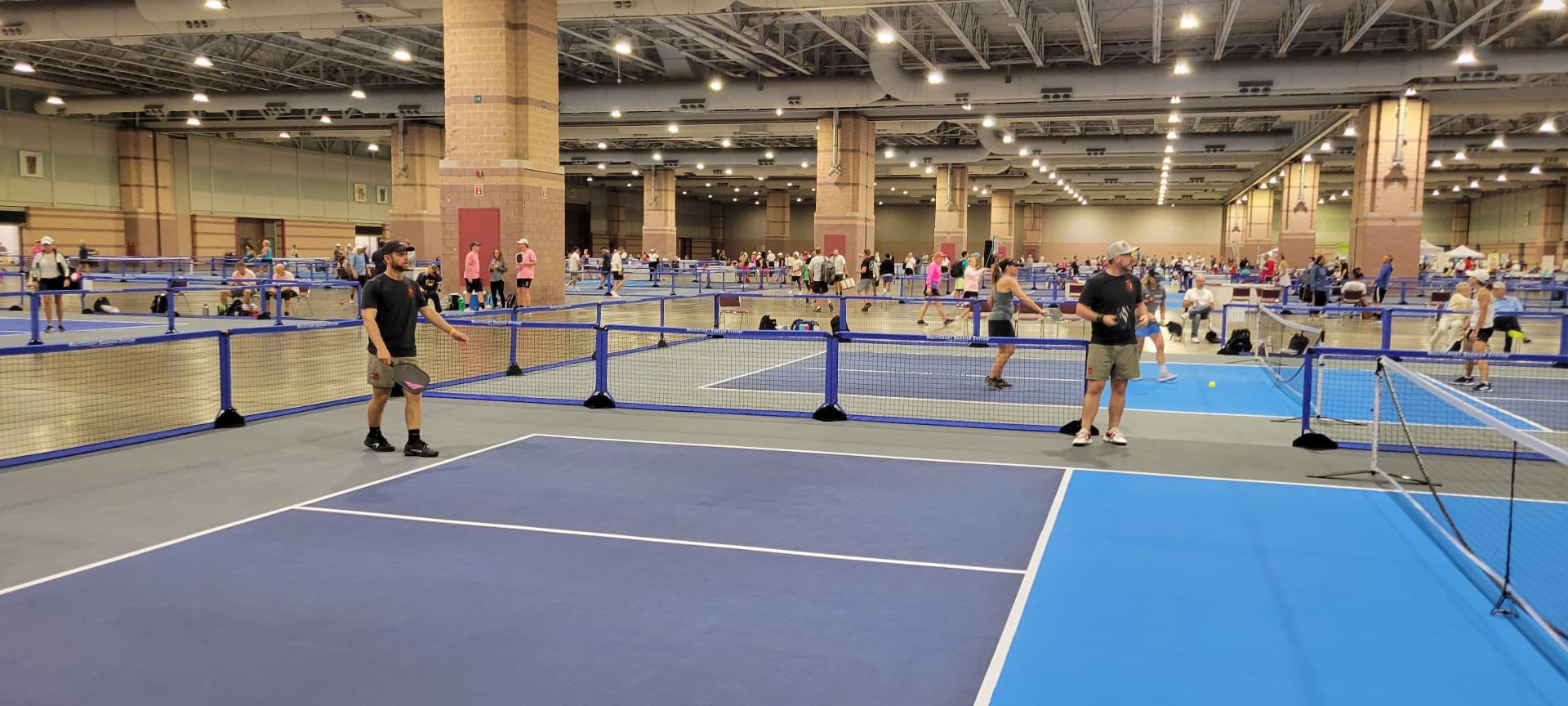
A single rollout court on a hard surface builds in about 45–75 minutes with a two-person crew and tears down in roughly half that time. Grass or uneven surfaces needing a subfloor system take 2–4x longer per court. Multi-court trade-show builds typically load in overnight and tear down the same night the show closes — a window that's usually tighter than the build itself.
Why the build clock matters more than planners expect
Most of the time pressure in a pickleball activation isn't the event itself — it's the two hours on either side of it. Venues sell you a load-in window, and if the build runs long, something gets cut: a branding pass, a walkthrough, or worse, the start of your event. Knowing roughly how long a build actually takes, and what stretches it, is what keeps the schedule you agree to on paper matching the one that happens on-site.
What actually slows a build down
A hard, flat surface — a ballroom floor, asphalt lot, or convention carpet — is the fast case. Grass, gravel, or anything uneven needs a subfloor system leveled and locked panel by panel, which is the single biggest time multiplier on a build.
A two-person crew is the workable minimum for a standard rollout court. Add a second crew and courts go up in parallel rather than in sequence — it doesn't cut labor-hours, but it cuts the clock time you actually care about.
Custom-wrapped courts and printed boundary graphics need to be squared up precisely so lines and logos land straight. Budget extra time versus a plain court — rushing this is where branded builds look sloppy in photos.
Loading dock distance, freight elevators, stairs, and how close a truck can actually park to the install site all eat time before a single panel goes down. Ask about this before you build the schedule, not the morning of.
Convention floors often have dozens of exhibitors moving in during the same window. A shared dock and a shared freight elevator slow everyone, including you — factor in queueing time, not just build time.
Sample schedule: a one- or two-court corporate event
On a hard surface with a dedicated load-in window and no shared dock:
| Time | What happens |
|---|---|
| 7:00–8:30 AM | Load-in and court build (1–2 courts, hard surface). Panels down, boundary lines set, nets and posts up. |
| 8:30–9:00 AM | Paddle and ball station setup, staff walkthrough, quick line check. |
| 9:00 AM–3:00 PM | Event runs — open play, clinics, or a tournament bracket. |
| 3:00–4:00 PM | Teardown: nets and posts down, panels and lines pulled, equipment staged for load-out. |
| 4:00–4:30 PM | Truck loaded, site cleared and walked for damage sign-off. |
Not sure what window your venue needs?
Tell us your venue and court count — we'll coordinate load-in directly with their operations team.
Sample schedule: a multi-court trade show or conference build
On a shared convention floor with 6–10 courts and standard union or venue labor rules — see our trade show booth activation guide if you're building inside a single exhibitor footprint rather than a full show-floor program:
| Time | What happens |
|---|---|
| Day before, 6:00–11:00 PM | Overnight load-in for a 6–10 court trade-show or conference build, after the exhibit hall clears for the day. |
| 7:00–8:00 AM (show day 1) | Final walkthrough, branding and signage check, staff briefing before doors open. |
| Show hours, day 1–2 (or more) | Courts run continuously — staffed clinics, booth traffic, or a scheduled tournament block. |
| After close, final day | Full teardown, usually required same night per venue contract — budget 2–4 hours for a multi-court pull with a full crew. |
Every venue's rules differ — some release the floor faster, some hold to a strict same-night teardown clause. We confirm the exact window with your venue before the schedule is final.
Mistakes that blow up a build schedule
- Assuming a court build fits in the same one-hour window as a standard booth build — a rollout court with branding and a subfloor takes meaningfully longer than a pop-up banner stand.
- Not confirming whether teardown has to happen the same night. Many convention contracts require the floor cleared before the venue releases it, which changes your staffing plan for the last day.
- Booking a load-in window before checking dock access, freight elevator size, and whether other exhibitors share the same slot.
- Skipping a weather contingency for outdoor builds — wind and rain don't just delay play, they can delay or halt the build itself. Our weather contingency guide covers the backup options worth reserving in advance.
- Treating build time as fixed regardless of court count. Time scales with courts unless crew size scales with it too.
The schedule above assumes a court count and surface you've already settled on — if you're still working those out, the space and dimensions guide covers footprint, and indoor vs. outdoor covers how surface changes the build. Lock the build window in early: our booking lead-time guide covers when to start that conversation with your venue, and the cost guide shows how crew size and build complexity factor into your quote. Confirm circuits and cable-run access during the same load-in conversation — the power and lighting guide covers what to ask for, which matters most on a shared convention floor in a market like Houston, where dock access and freight elevators are split across a full show floor. This page covers the crew's build clock — for the guest-facing schedule once the court is up, see our event run of show template.