Event Planning · Food & Beverage
Catering and food & beverage planning for pickleball events
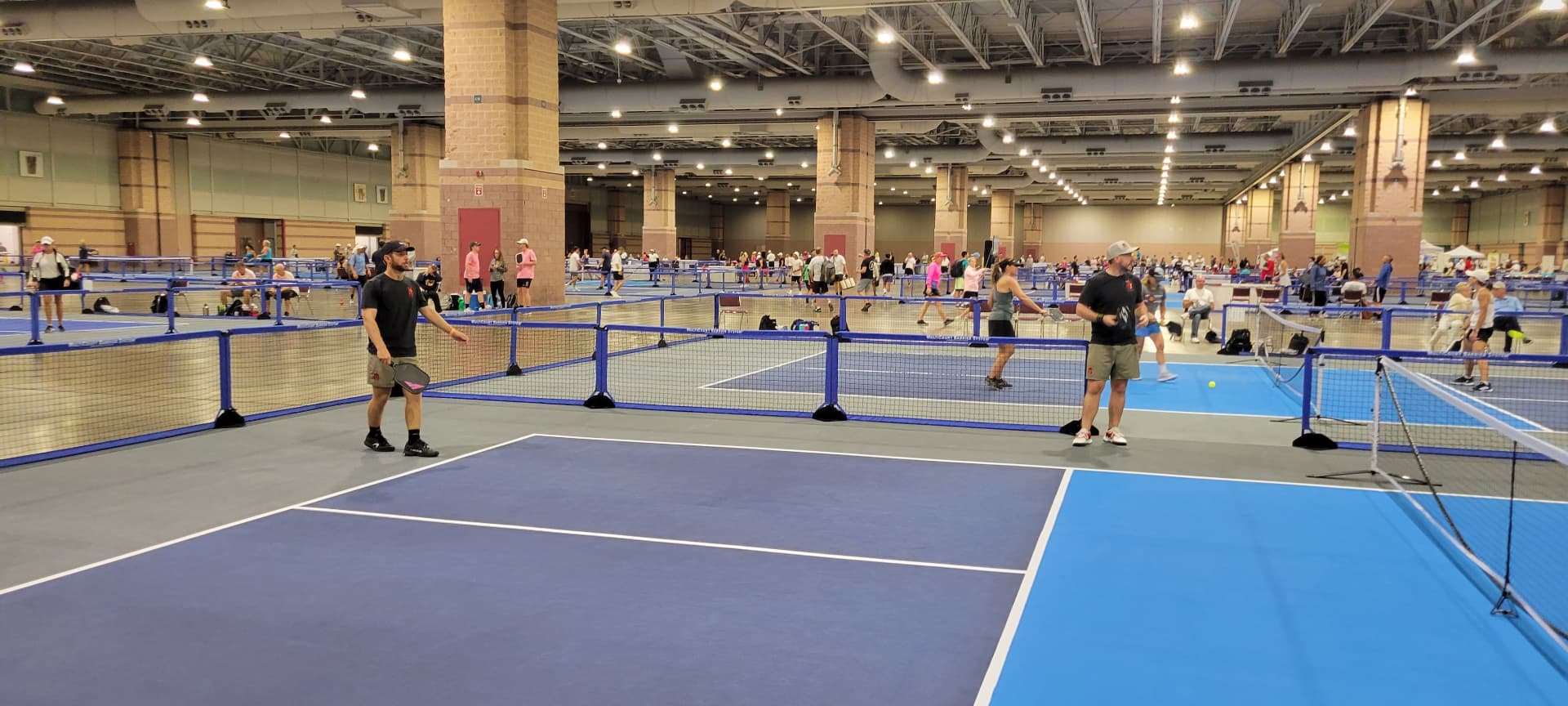
Catering for a pickleball event is less about the menu than about rhythm and space. Guests rotate on and off the courts, so the best food is something they can eat standing up in a few minutes, served beside the courts but outside the zone where balls and players move. Schedule the main meal and the full bar around play blocks rather than during them, keep hydration separate from the bar, and make sure your caterer is holding food at safe temperatures outdoors. We build and staff the courts; your venue or caterer handles the food. The planning works best when both are on the same run of show from the start.
Why F&B planning is different with courts on site
At a standard reception, food and drink are the program. At a pickleball activation, the courts are the program and food service has to fit around them. That changes three things. First, guests are moving: a typical attendee plays a few games, steps off to watch or eat, and comes back, so a long seated meal pulls people away from the courts at exactly the wrong moment. Second, the courts and their run-off space take up a large, fixed piece of the floor plan, which leaves less room for buffet lines and bar queues than a planner used to a ballroom might expect. Third, players get hot and thirsty in a way a cocktail-hour crowd does not, so water and electrolyte drinks are a safety item, not a beverage-menu line.
None of this makes catering harder, but it does mean the caterer needs to see the court layout and the play schedule before they finalize the menu and service style.
Matching the menu format to the event
| Event type | Format that tends to fit | Why |
|---|---|---|
| After-work happy hour | Passed appetizers or small-plate stations plus a bar | Guests rotate on and off court; food they can eat standing up keeps the courts full. |
| Half-day corporate offsite or team day | Breakfast or coffee service at arrival, boxed or buffet lunch between play blocks | Schedule the main meal after a play block, not before the first one. |
| Tournament or bracket | Grab-and-go items and a continuous snack and hydration point | Players eat between rounds on their own timing; a sit-down meal stalls the bracket. |
| Client entertainment / hospitality | Chef-attended stations and a premium bar in a lounge area beside the courts | Many guests will watch more than they play, so the lounge is part of the experience. |
| Community, family, or resident event | Food trucks or a simple buffet; non-alcoholic options front and center | Long, open-ended windows suit trucks; confirm vendor permits with the venue. |
These are planning patterns, not rules. A gala with a pickleball lounge can still run a plated dinner; it just runs it as a separate block from open play.
For an after-work format, our company happy hour guide covers how play and socializing usually split. For client-facing programs where the lounge matters as much as the courts, see client entertainment and hospitality.
Layout: where food and drinks go relative to the courts
The court footprint is fixed once we confirm it with your venue, so the F&B layout fits around it. A few principles hold at almost every site:
- ✓Keep buffet lines, bar queues, and high-top tables outside the court and its run-off space. Players chase balls past the lines, and a crowded sideline is how guests get bumped.
- ✓Keep food and drinks off the playing surface. Spills make court surfaces slippery, and a sticky patch on a court is a safety problem for the rest of the event.
- ✓Put food within sight of the courts so guests who step off to eat can still follow the games and get back on quickly.
- ✓Use shatterproof drinkware near the courts. A stray ball into a tray of glassware is an avoidable mess.
- ✓Separate the hydration point from the bar, ideally at the sideline, so players do not queue behind cocktail orders for water.
- ✓Plan trash and recycling stations near the food, not at the courts, so cups and plates do not end up on court edges.
We map court placement, power, and access during the site assessment. Sharing that plan with your caterer early lets them place stations, prep areas, and service paths without colliding with our load-in.
Planning courts around a catered event?
Send us your venue, headcount, and timeline. We'll propose a court footprint and schedule your caterer can plan around.
Timing food service in the run of show
The most common F&B mistake at a pickleball event is serving the main meal at the wrong moment. A heavy lunch right before the first play block leaves guests sluggish and reluctant to get on court. A full bar opening at the same time as a clinic means the clinic loses half its audience. A simple sequence works for most corporate formats:
- Arrival: coffee, water, and light bites while guests check in and our staff run a quick intro or clinic.
- First play block: courts open; hydration at the sideline; snacks available but not the main meal.
- Main meal: after the first block, served as its own window so the courts can be reset or run as open play for those who want it.
- Second block or finals: competitive play, a bracket final, or open play.
- Bar and social close: full bar service and dessert once the competitive play is done.
Our run-of-show template has a blank version of this structure, and the event format guide explains how round robin, bracket, and open play change how long each block runs.
Food safety when you are serving outdoors
Many pickleball activations happen on lawns, plazas, rooftops, and parking areas, which means food sits outside longer than it would in a banquet kitchen. Your caterer is responsible for food safety, but it helps to know the baseline so you can ask the right questions. The FDA Food Code, which most state and local food codes are built on, calls for holding time/temperature control for safety foods, such as cooked proteins, dairy, and cut produce, at 41°F or below when cold and 135°F or above when hot. A caterer can instead use time as the control, holding food for up to 4 hours after it leaves temperature control under written procedures, and then serving or discarding it.
In practice, for a summer lawn event, that means asking the caterer how hot and cold items will be held, whether they will use chafers, ice wells, or refrigerated units, and how long items will sit out. Temporary and outdoor events can also require a separate health permit depending on the jurisdiction and the venue. Ask your caterer and venue what applies; we cover the court side of permitting in our permits and permissions guide.
Hydration is a separate line item
Water for players should not depend on the bar or the buffet. Players need it at the sideline, cold, and in volume, especially on warm days. Plan it with the courts, not the menu: one hydration point per court or every couple of courts, with ice and cups restocked through the day. Our heat safety and hydration guide has the planning benchmarks and heat-index thresholds.
Alcohol and bar service
Bar service is common at corporate and client pickleball events and usually comes through the venue's license or a licensed caterer or bartending service. A few practical points: open the full bar after competitive play rather than before it, keep non-alcoholic options at least as visible as the cocktails, and keep drinks off the courts. Check your venue's alcohol policy and talk to your insurer about whether you need host liquor liability coverage. For how court-side coverage and certificates of insurance usually work, see our insurance and liability guide.
In-house catering, outside caterer, or a venue built for play
If your venue has in-house catering, the decision is mostly made for you, and our job is to fit the courts around the venue's service plan. If the venue allows outside caterers, you get more control over menu and service style but take on more coordination: deliveries, prep space, power for warming equipment, and load-out timing all need to work alongside our court load-in and teardown. Planners who want a dedicated space with courts and room for food service can look at our private pickleball event space options.
Either way, the vendor coordination checklist in our event vendor checklist is a good place to line up load-in windows, power, and contacts for everyone working the event.
Dietary needs, allergens, and labeling
Collect dietary restrictions and allergies at registration, not the week before, and pass them to the caterer with the final headcount. At a standing, grazing-style event, guests serve themselves without a server to ask, so clear labels on every station and tray do the job a server would do at a seated dinner. Ask the caterer to keep allergen-friendly items physically separate, with their own utensils, rather than at the end of the same buffet line. For tournament formats, it also helps to include a few higher-carbohydrate, easy-to-digest options for players who want to eat between rounds without feeling heavy on court, and to make sure there is something substantial for guests who skip the courts entirely and treat the event as a reception.
What to send your caterer, and what to send us
To your caterer
- The court layout and footprint once confirmed
- The play schedule and when each meal or bar window opens
- Expected split of players vs. spectators
- Indoor or outdoor, and the weather backup plan
- Our load-in and teardown windows
To us
- Where catering stations, bars, and prep areas will sit
- Caterer delivery and setup times
- Any power the caterer needs from the same circuits
- The headcount and how many guests you expect to play
- Your venue contact and any venue rules on food near the courts
Pricing for the courts themselves depends on court count, surface, staffing, and logistics rather than on the menu; our activation cost guide explains what drives the number, and every event is quoted individually.