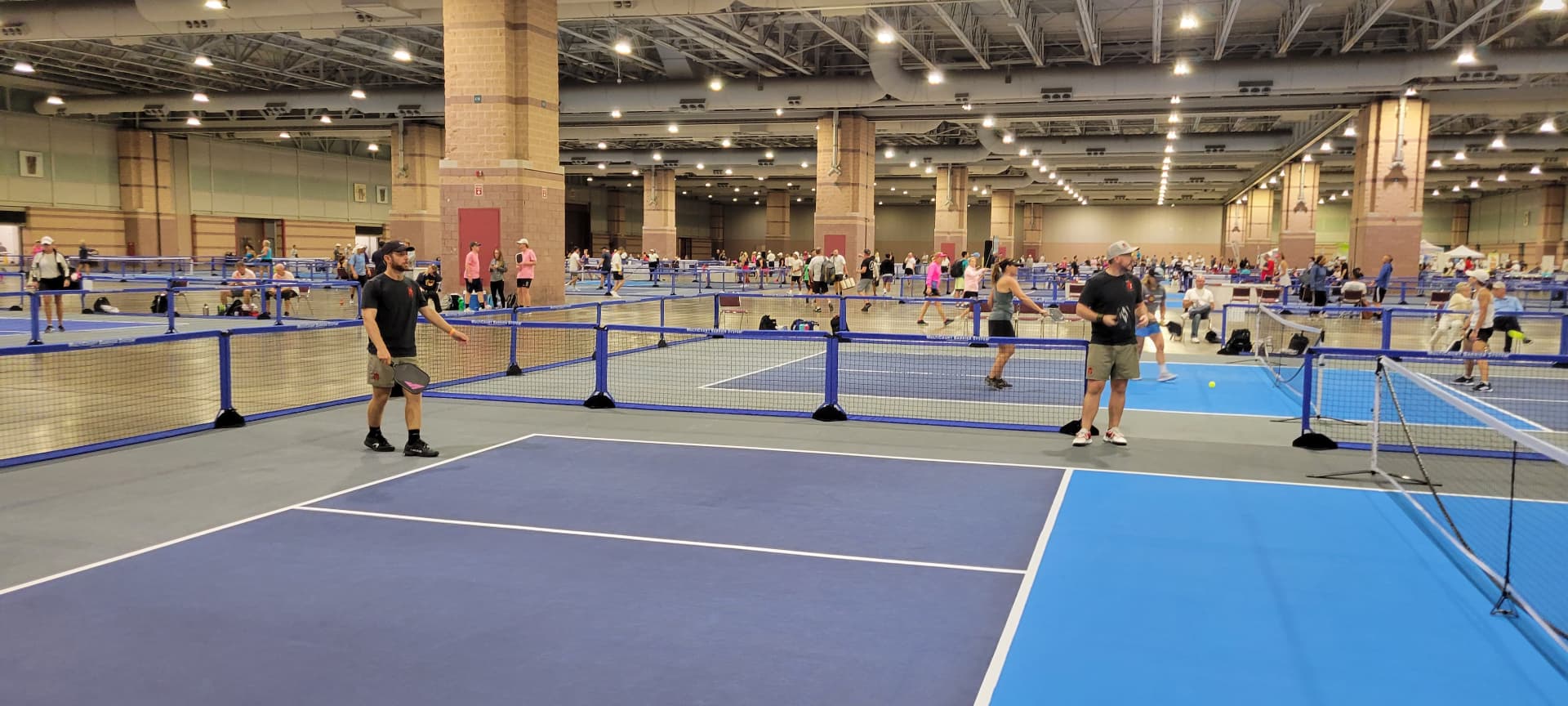
Comparison
Pickleball vs. other corporate team-building activities
Against the usual shortlist — escape rooms, cornhole, axe throwing, bocce, and volunteer projects — pickleball's real edge is scaling to mid-size and large groups while staying playable for people who have never held a paddle. It costs more than a set of cornhole boards and needs more floor space than an escape room, and it isn't the right call for a very small group or a values-driven brief. The honest comparison below covers group size, inclusivity, venue needs, weather risk, and cost tier for each option.
The activities corporate planners actually compare
No single activity wins on every dimension — the right pick depends on headcount, venue, and budget more than which one is trendiest this year.
| Activity | Group size | Inclusivity | Venue needs | Weather | Cost tier |
|---|---|---|---|---|---|
| Pickleball (turnkey courts) | Scales well — add courts for larger groups | High — playable in minutes at any fitness level | Needs 20x44 ft per court; indoor or outdoor with a subfloor | Outdoor builds need a rain plan; indoor is weatherproof | Mid to high — priced per court, day, and staffing |
| Cornhole / lawn games | Weak past 30–40 without many boards | High — almost no skill floor | Any flat outdoor or indoor space | Outdoor-only unless brought inside; wind affects bags | Low — equipment rental only, light or no staffing |
| Escape rooms | Caps at 6–10 per room; doesn't scale to large groups without buying out a whole venue | Favors puzzle-solvers; can sideline quieter participants | Fixed commercial venue — you go to it, it doesn't come to you | None — always indoors | Per-person pricing that adds up fast at scale |
| Axe throwing | Limited by lane count, similar constraint to courts | Age and sobriety restrictions; not everyone wants to throw a blade | Licensed venue or a mobile unit with heavier insurance requirements | Indoor venues are standard; mobile outdoor units need dry conditions | Mid — per-person or per-lane, plus liability considerations |
| Bocce | Similar court-based scaling to pickleball, slower pace per court | High — very low skill floor, low physical demand | Needs a long flat lane; less commercial portable-court infrastructure exists | Outdoor-leaning; fewer indoor/subfloor options in the market | Low to mid — simpler equipment, less common as a staffed turnkey build |
| Volunteer / CSR projects | Scales to almost any size with enough project stations | High, values-driven rather than skill-driven | Off-site nonprofit partner or a build-a-bike/assembly format on-site | Depends entirely on the project type | Varies widely — often bundled with a donation or supply cost |
What's actually driving the shift in corporate engagement budgets
The category as a whole is growing, not shrinking — research on corporate team-building spend puts the market in the low double-digit billions with a high-single-digit annual growth rate, and a large majority of companies report they're increasing rather than cutting engagement-program investment. Two trends inside that number matter for choosing an activity specifically: purpose-driven formats like volunteer projects have become one of the strongest-growing categories, sometimes the entire reason for a gathering rather than an add-on, and planners are generally trending toward fewer, higher-impact blocks instead of a long checklist of lower-effort options.
That second trend is the real argument for a staffed, structured activity like pickleball over a purely self-serve one like cornhole: a single well-run block that most of the group participates in tends to read better in a post-event recap than five smaller stations, even if the smaller stations cost less individually.
Where each option actually falls short
Escape rooms build real collaborative problem-solving in a small group, but the format doesn't scale — a company of 100 needs ten simultaneous rooms, priced per person, at a fixed commercial venue you have to travel to rather than one that comes to you. Cornhole and other lawn games are inexpensive and need almost no staffing, which makes them a fine complementary station, but they rarely carry an entire event as the headline activity. Axe throwing comes with real liability overhead — age restrictions, sobriety requirements, and heavier insurance — that HR and legal teams sometimes flag late in planning. Bocce shares pickleball's low skill floor and court-based structure but has far less commercial turnkey infrastructure behind it, so a staffed, branded bocce build is harder to source at scale than a pickleball one. Volunteer and CSR projects serve a genuinely different goal — values and purpose rather than competition — and are worth running as their own category rather than as a substitute for a physical, competitive activity.
Weighing pickleball against another option?
Tell us your headcount, venue, and goal — we'll tell you honestly whether a court is the right fit before you commit a budget line to it.
Where pickleball wins
- A group that spans very different ages and fitness levels and needs one activity everyone can actually play together, not spectate.
- An event that wants a genuine "program highlight" moment — a branded, photogenic, staffed centerpiece rather than a background activity.
- A headcount in the dozens to low hundreds, where court count can scale with the group instead of hitting a hard venue cap.
- A multi-day program (retreat, incentive trip, trade show) that needs the same activity available as a drop-in option across several days.
Where it doesn't
- A very small group (under 8–10 people) where a single shared-table activity is simpler to run and doesn't need a court build at all.
- An indoor-only venue with no space for a 20x44 ft footprint and no interest in a scaled-down paddle-skills version.
- A short window (under 45 minutes) where a build/teardown and a rules explanation eat too much of the available time.
- A program where the stated goal is values or purpose-driven engagement — a volunteer or CSR project fits that brief more directly than a sport does.
Being honest about the second list matters more than the sales pitch on the first — a court built for a 12-person leadership huddle in a hotel meeting room is the wrong build, and we'd rather say so on the quote call than sell a footprint that doesn't fit the room.
How to actually decide
Start with headcount and venue, not the activity list. If the group is under a dozen people or the room can't fit a 20x44 ft footprint, a court-based activity is the wrong tool regardless of how it compares on paper — an escape room, a trivia format, or a tabletop activity will fit better. If the group is large enough that per-person pricing (escape rooms, some axe-throwing venues) would get expensive fast, a build priced by court count and staffing, like pickleball or bocce, usually wins on cost at scale. If the stated goal is values-driven rather than competitive, run a volunteer project instead of forcing a sport into that brief. And if the honest answer is "we want one memorable, inclusive, photogenic block that most of the room actually plays," that's the specific case pickleball is built for — see our corporate tournament guide for how to structure it, or our guide to adding pickleball to an event for formats beyond a full bracket.
Two more specific comparisons are worth a look if you're this deep into deciding: our golf outing alternative guide covers the trade-offs against a half-day round specifically, and our pickleball vs. padel comparison covers the other racquet sport that comes up in the same conversation. If the deciding factor is proving the spend was worth it afterward, our team-building ROI guide covers what the engagement research actually supports and how to measure your own event rather than quoting a generic industry stat. And if weather is the variable holding up a decision between an indoor escape room and an outdoor activity, our weather contingency guide covers how an outdoor build gets a rain-day plan built in from the start.