Event Logistics · Power & Lighting
Pickleball event power requirements and court lighting for events
The court itself needs no power at all— it's a mechanical build. What needs electricity is everything around it: scoreboards, PA and music, phone-charging stations, and evening lighting. One or two standard 20-amp circuits usually cover the first group as planning guidance. Lighting towers for evening play are a much bigger, separate load — often 3,000–7,000 watts per tower in common planning ranges — and are the main reason an outdoor site needs a quiet, GFCI-protected generator (or a confirmed dedicated venue feed). Final circuit and code calls belong to venue operations and a licensed electrician — this page is planner guidance, not an electrical engineering stamp.
This guide is for corporate planners, festival producers, hotel and resort event teams, and brand activation managers who need clear pickleball event power requirements before they lock a site plan. It covers what actually draws power versus what does not, plain-language circuit math, indoor outlets versus outdoor generators, daytime ambient light versus evening towers, glow and night sessions, cable ramps and ADA path conflicts, staging power separate from scoreboards, weather and wet-condition thinking, load-in coordination, venue questions to ask ops, a planning checklist before you request a quote, and how power and lighting sit inside honest activation cost framing. Ranges below are planning guidance — not a claim that we measured every vendor's gear on every site.
What actually needs power
Start with an inventory of powered add-ons, not with the court. The rollout surface and net are mechanical. Electricity shows up for the experience layer around the play rectangle — announcing, scoring, guest comfort, and visibility after dusk.
The most common draw. A wireless or wired scoreboard plus a small PA for announcing and music typically pulls under 5 amps combined — light, but it still needs a dedicated circuit, not a shared strip already feeding catering or AV.
For anything running into dusk or evening, portable lighting towers are their own, much bigger load — often 3,000–7,000 watts per tower depending on size (planning ranges). This is the one item that regularly needs a generator, not a wall outlet. Running an evening or glow session specifically adds UV-reactive equipment on top of the lighting itself.
A branded charging station is a popular add-on and a light draw, but it multiplies fast with a few devices plugged in at once — worth its own circuit rather than daisy-chained off the scoreboard.
For outdoor summer activations, misting fans keep players and staff comfortable but draw more than people expect — factor them in separately if you're already close to a circuit's limit.
What doesn't need power
Knowing what stays unpowered keeps quotes honest and prevents oversizing generators for a daytime build that only needs a scoreboard and a mic.
- The court and net themselves — a rollout court is a mechanical build, not an electrical one.
- Daytime outdoor play with no scoreboard, PA, or amplified sound.
- A basic branded banner or signage with no lighting built in.
- Paddle and ball stations — these are just tables.
- Spectator seating, fencing, and windscreens when they are passive equipment with no LEDs or powered branding.
Circuit math for planners (120V, amps, watts)
You do not need to design a panel to brief a vendor. You do need enough vocabulary to spot when a venue's "you can use that outlet" answer is not the same as capacity. Use the relationships below as a ceiling check, then hand final assignments to venue ops and a licensed electrician when the property requires one.
Watts ≈ volts × amps (at 120V)
On a standard US event circuit, think in round numbers: a 20-amp, 120-volt circuit is roughly 2,400 watts of capacity on paper. You do not load a circuit to 100% for an outdoor temporary run — leave headroom for startup surge and shared loads. Planners use this as a ceiling check, not as a substitute for a licensed electrician.
Scoreboard + PA usually fit one circuit
A wireless scoreboard, small PA, and light staff charging together often sit well under 15 amps — one dedicated 20-amp circuit covers one or two courts' worth of that gear. The failure mode is sharing that circuit with catering warmers, general-session AV, or a neighboring booth.
Lighting towers are a different math problem
Portable towers in the 3,000–7,000 W planning band per unit blow past a single wall outlet quickly. Evening play is usually generator territory (or a venue-supplied dedicated feed confirmed in writing), not "we'll find an outlet on the plaza."
GFCI and wet-location thinking outdoors
Any outdoor temporary power near foot traffic, misting, or weather exposure should be GFCI-protected. That is a venue ops / electrician call on final hardware — planners should put GFCI on the site-assessment checklist so it is not improvised at load-in.
Practical takeaway: if your daytime build is scoreboard + PA + light charging, plan for a dedicated 20-amp circuit and confirm it is not shared. If your schedule includes evening lighting towers, treat power as a first-class line on the site assessment — not a footnote after the court diagram looks finished.
Not sure what your venue can supply?
Tell us your venue, court count, and whether the schedule runs into evening — we'll scope power and lighting into the build before load-in.
Request a power-aware event quote
Share city, dates, venue type, court count, and whether you need evening lighting or a generator. Clear pricing within 24 hours — no invented electrical add-on fee schedule.
Indoor venue outlets vs outdoor generators
Indoor and outdoor builds fail for different reasons. Indoors, the failure is usually a shared circuit. Outdoors, the failure is usually assuming power exists near the court when it does not — or bringing a loud construction generator that wrecks the guest experience.
Indoor venue outlets
Indoors, power usually exists — the question is whether the circuit you are handed is already loaded with catering, general-session AV, or a neighboring exhibitor. Confirm dedicated circuits with venue operations before load-in, the same way you confirm a load-in window. Ask which panel and breaker, not just "is there an outlet near the court."
Outdoor generators — prefer quiet inverters
When building power is not near the court, size a generator to the actual load (scoreboard, PA, lighting), not to the court itself, which needs none. A quiet inverter generator is strongly preferred near guests — construction-style generators are loud enough to undercut the experience you are building. Put generator placement on the site diagram so exhaust and noise do not sit next to spectator seating.
GFCI and cable routing outdoors
Outdoor temporary power should be GFCI-protected given rain and foot-traffic exposure. Route cables away from the primary guest approach when you can; where a crossing is unavoidable, use rated cable ramps — not tape — especially on ADA paths.
Confirm power the same way you confirm a load-in window. Outdoors, with no building power nearby, a quiet inverter generator sized to your actual load — not the court, which needs none — covers scoreboards, PA, and, if you are running into the evening, lighting towers. Our weather contingency guide covers the related call on when wet conditions actually stop play and how that intersects with temporary outdoor power.
Evening lighting towers vs daytime ambient
Lighting is a schedule decision first and an equipment decision second. Daytime outdoor play rarely needs towers. The moment the program crosses dusk, lighting becomes a power problem and a safety problem at the same time.
Daytime ambient — usually nothing extra
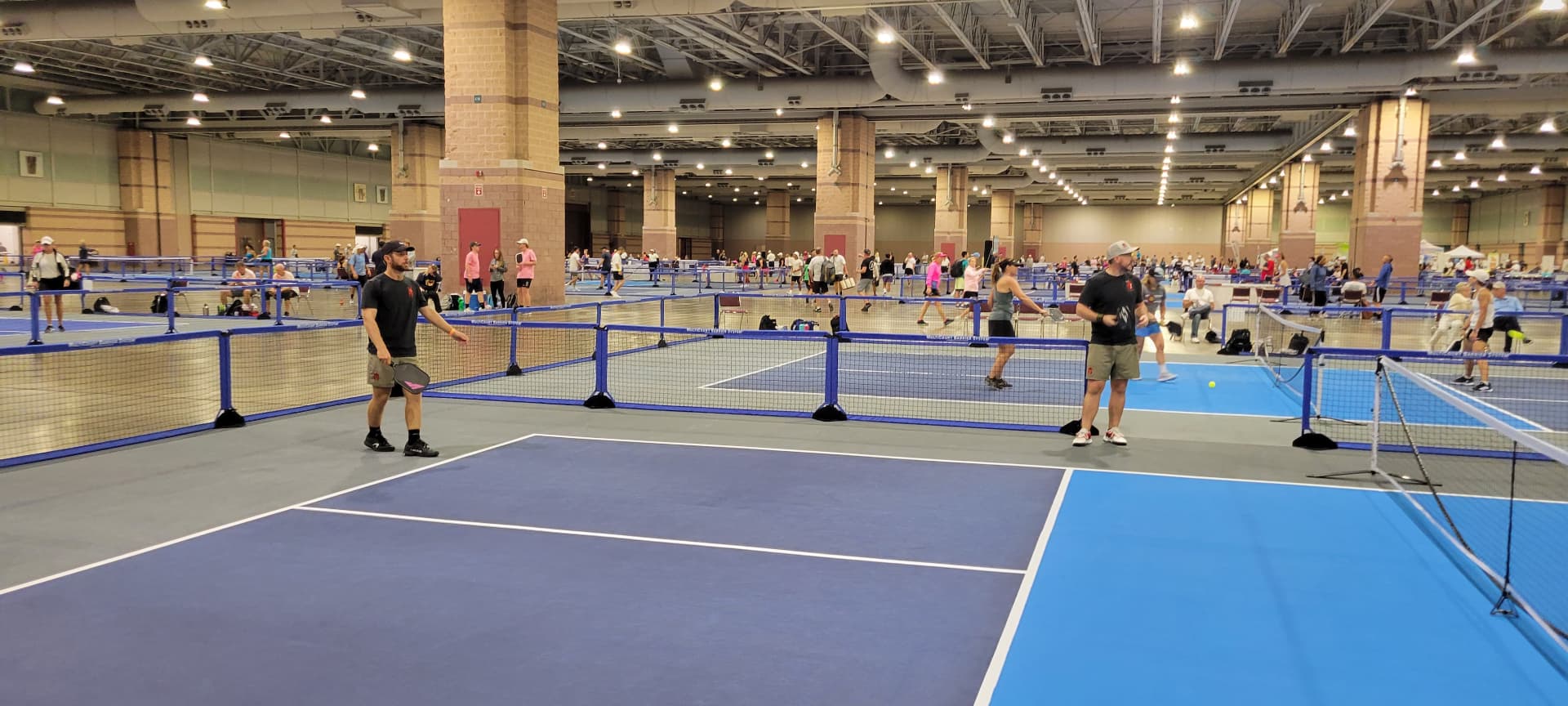
Daytime outdoor activations use ambient light. You do not need towers for a 10am–4pm corporate field day unless the court sits under heavy shade that makes play unsafe. Indoor ballrooms and convention halls are different: house lighting may be enough for casual play, but exhibition matches and camera-facing moments often need supplemental fixtures planned with the venue.
Evening and night — plan towers early
Anything that runs past dusk needs portable lighting towers sized for play — not just decorative uplighting. Towers are the main reason outdoor evening builds need a generator or a confirmed dedicated feed. Lock lighting the moment the schedule crosses into evening, not when the sun starts dropping on event day.
Glow / night sessions add a layer
Glow-in-the-dark or UV-reactive sessions add specialty lighting and ball/paddle kits on top of general illumination. Treat glow as its own programming layer with its own power and safety brief — see our glow-in-the-dark pickleball for events guide for format details.
Staging, emcee power, cable ramps, and ADA path conflicts
Power planning is also guest-flow planning. Cables, platforms, and towers compete for the same edges of the court as spectators, photographers, and accessible routes. Design those edges once — on the site diagram — instead of negotiating them after fences are staked.
Keep emcee / staging power separate from scoreboard
A raised platform for an exhibition match, emcee, or awards moment needs its own footprint outside the court's recommended play area and its own power run — not a cord shared with the scoreboard. Shared strips are how you lose the scoreboard mid-match when someone plugs in an awards laptop.
Cable ramps on walkways and ADA paths
Any cable crossing a walkway, aisle, or accessible route needs a rated cable ramp, not tape. Most venues require it as a load-in condition; skipping it is a trip hazard and a liability problem. Coordinate cable paths with your ADA layout so power runs do not break the accessible route.
Place staging outside the play rectangle
Staging, PA, and lighting towers sit outside the 30 × 60 ft recommended court area (plus run-off). Put them on the site diagram early so you are not compressing spectator aisles or ADA paths to make room for a tower on load-in day.
A raised platform for an exhibition match, an emcee, or an awards moment needs its own footprint outside the court's 30 × 60 ft recommended area and its own power run. Any cable crossing a walkway or ADA path needs a rated cable ramp — see the ADA accessibility guide for path design and the insurance and liability guide for how trip-hazard risk gets allocated between vendor and venue.
Weather, wet conditions, and temporary outdoor power
Rain and damp surfaces change both playability and electrical safety. Outdoor temporary power should be planned with GFCI protection and a clear stop rule: who can shut down temporary electrical when conditions make it unsafe, and how that message reaches the court crew. Do not treat a plastic cover over a generator as a weather plan.
Put wet-condition electrical rules next to play-stop rules in your pickleball event weather contingency plan. Venue rules and a licensed electrician (when the property requires one) own the final call — planners own making sure the question was asked before guests arrive.
Load-in coordination: power with the court timeline
Electrical is easiest when it lands in the same sequence as fencing, subfloor, and net posts — not after photo walls and spectator chairs have already claimed every outlet path. Align generator delivery, cable ramps, and tower placement with your court setup and teardown timeline so crews are not dragging live runs across finished guest aisles.
If the site is complex — rooftop, plaza with limited vehicle access, indoor ballroom with protected floors — raise power in the same conversation as flooring and access. A short pickleball event site assessment that includes outlet locations, cable crossings, and evening lighting needs prevents most day-of improvisation.
Site assessment questions to ask venue ops
Bring these to the venue walkthrough. Written answers beat hallway assurances. Escalate unclear amp or GFCI answers to the venue electrician rather than guessing on load-in day.
- Which outlets or panels are reserved for the pickleball footprint — and are they already shared with catering or AV?
- Is there a written amp budget per circuit for temporary exhibitors, or do we need venue electrician coordination?
- For outdoor sites: is building power within a practical cable run, or should we plan a quiet inverter generator?
- Where can a generator sit for noise, exhaust, and guest flow without blocking ADA routes?
- Does the venue require GFCI, cable ramps, and a specific tape/ramp standard on all walkway crossings?
- If the schedule runs past dusk: who supplies lighting towers, and is power for them generator-fed or house-fed?
- Who is the on-call electrician or ops contact during load-in if a breaker trips?
- Are wet-weather rules documented for temporary outdoor power (and who calls a stop)?
Capture the answers on the same diagram you use for court placement. Power that is not on the drawing tends to become someone's extension-cord improvisation at 7am.
Planning checklist before you get a quote
Run this before you freeze the site plan or send an RFP. It is a planner checklist, not an electrical inspection.
- Confirm whether the activation is daytime-only or crosses into evening — evening triggers lighting and usually generator planning.
- List every powered item: scoreboard, PA/mics, charging station, misting fans, lighting towers, staging/emcee, specialty glow gear.
- Ask venue ops for dedicated circuit assignments in writing; do not assume "an outlet nearby" means capacity.
- For outdoor sites without nearby power, size a quiet inverter generator to the actual wattage load and place it on the site diagram.
- Require GFCI protection for outdoor temporary power and rated cable ramps on every walkway or ADA crossing.
- Separate staging/emcee power from scoreboard and court-side staff charging.
- Cross-check cable routes against the accessible path and insurance brief so trip hazards are designed out.
- Align power load-in with the court setup and teardown timeline so electrical is not improvised after fences go up.
- Put wet-weather stop rules next to temporary power in the same contingency plan.
- Request a quote with venue type, court count, schedule (day vs evening), and known power constraints so the build is scoped honestly.
How power and lighting sit in overall activation cost
Our confirmed planning band for a turnkey pickleball activation: a single-court one-day build typically begins around $10,000; multi-court or multi-day programs move into the mid-five and six figuresdepending on court count, staffing, city, brand wrap, and site complexity. That is how we price events — by activation scope — not by inventing a fixed "electrical package" dollar add-on on this page.
Power and lighting affect cost when the site needs generators, evening towers, extra cable protection, or additional crew time to stage safely. Daytime indoor builds with a dedicated venue circuit often absorb scoreboard and PA inside the base activation. Outdoor evening builds with towers and a quiet inverter are a different scope — we flag that when your schedule and venue require it. We do not invent amp-by-amp fee schedules or claim measured on-site ratings for every possible lighting tower.
For broader rental cost drivers, see our pickleball court rental cost guide. Then request a quote against the venue and schedule you actually have — indoor ballroom, hotel lawn, or plaza — with power and lighting notes included up front.
Disclaimer: planner guidance, not an electrical stamp
This page is high-level planning guidance for temporary pickleball event power and lighting. It is not an electrical engineering specification, not a code compliance certificate, and not a substitute for venue rules or a licensed electrician. Amp and watt figures (including 20-amp circuit language and 3,000–7,000 W tower planning ranges) are general planning guidance — not a claim that every device was measured on your site. Electrical code, venue operations requirements, GFCI and cable standards, and final circuit assignments belong to the venue and qualified electrical professionals. Pickleball Events Co scopes activations and coordinates with your venue; compliance and final electrical calls remain with venue ops and licensed electricians when required.
Putting it together before you book
Inventory what actually needs power. Confirm dedicated indoor circuits or size a quiet outdoor generator. Decide whether the schedule crosses dusk — and if it does, plan lighting towers early. Separate staging power from the scoreboard. Put cable ramps on every walkway and ADA crossing. Align electrical with weather stop rules and the setup timeline. Ask venue ops the hard questions in writing during the site assessment. Then lock the plan before load-in — power is far cheaper as a drawing revision than as a mid-match outage.
When you are ready, request a quote with city, dates, venue type, court count, day-versus-evening schedule, and any known power constraints. We will come back with a scoped build — including generators or towers when the site needs them — not a generic package and not an electrical stamp.