Event Planning · Weather & Risk
Weather contingency planning for outdoor pickleball events
A real weather plan for an outdoor pickleball activation is one of three reserved options — a tented court, a confirmed indoor swap space at the same venue, or a flexible rain date — decided and booked up front, not the morning of your event. Lightning is the only true hard stop (most operators follow the 30-30 rule); heavy rain and high wind are usually a pause or a safety call on tents and signage, not an automatic cancellation.
Why this has to be a decision before event day
An outdoor court with no backup plan is one bad forecast away from a cancelled activation — and the frustrating part is that the fix isn't expensive or complicated if it happens early. Tents need to be reserved and staked, not summoned; an indoor swap room needs to actually be blocked on the venue's calendar, not assumed to be sitting empty; a rain date needs the venue and your attendees to have that flexibility built in from the invite. None of that works if the first conversation about weather happens when the forecast turns bad three days out.
The three real backup options
Keeps the outdoor setting — visibility, foot traffic, the lawn or plaza you picked for a reason — while covering players from rain and sun. It does nothing for lightning or high wind (a staked tent in a real gust becomes its own hazard), and it needs its own lead time to reserve, permit, and stake down. Not a fix for every scenario, but the best option when the outdoor setting is the point.
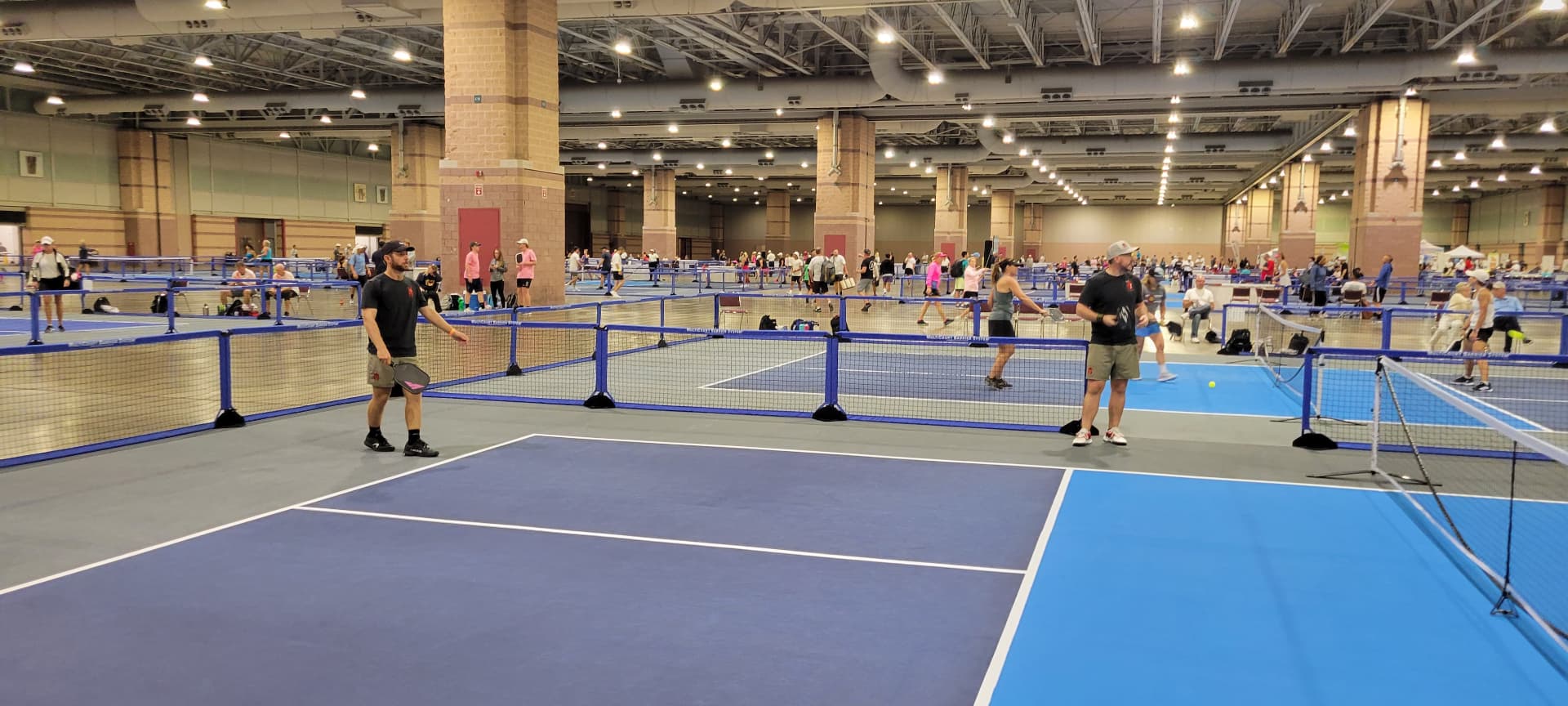
The most reliable option, but only if it's a real reserved room — an overflow ballroom, an expo hall bay, a lobby with the ceiling height to clear a court — not a hope that "we'll figure something out." This has to be confirmed with the venue and blocked on their calendar when you book, the same way the outdoor space is.
Works well for a standalone outdoor day — a festival, a resort weekend, a community event — where the date itself can move. It's rarely realistic for a trade show or conference tied to a single show day; in that case a tent or indoor swap is the only real option.
Not every event needs all three. A single afternoon lawn activation in a dry-season market may only need an informal rain-date understanding; a multi-day festival build or a sponsor-branded activation with VIPs flown in usually justifies the cost of a full tent or a confirmed indoor room. Match the backup to what's actually at stake, not to what sounds most thorough on paper. A single-court company summer picnic is a good example of the low end of that spectrum — an informal rain-date understanding is usually enough, since there's no bracket schedule or sponsor to protect.
What actually stops play
Not all bad weather is equal, and treating it that way leads to either needless cancellations or a genuinely unsafe call:
The one hard stop, no judgment call. Most outdoor-event operators use some version of the 30-30 rule: if the gap between a lightning flash and the thunder is under 30 seconds, clear the court and shelter everyone, and don't resume until 30 minutes after the last strike. Play doesn't restart on a hunch that the storm has passed.
A wet rollout surface is a slip risk on the kind of lateral movement pickleball demands, so play stops well before the panels themselves are damaged. Light rain that beads and drains is often just a pause — court gets toweled or squeegeed and play resumes. Standing water is the real trigger, not the fact that it's raining.
The court tiles themselves aren't going anywhere, but tents, pop-up nets, signage, and branded banners are. Many outdoor-event vendors treat sustained wind in the roughly 20–25 mph range as the point where a staked tent and lightweight signage need to come down or be reinforced — worth confirming with whoever's supplying your tent, since rental-grade structures vary.
Rarely a stop-play issue, but it changes how you run the day: shorter rotations, mandatory water breaks, shade for the sideline, and staff watching for anyone who looks off rather than pushing through a bracket on schedule.
This is exactly why some markets warrant a firmer backup plan than others. In a place like Denver, where fast-moving summer afternoon thunderstorms are routine, planners who build a tent or an indoor swap into the plan from the start rarely lose the day; the ones who don't are the ones scrambling at 2 p.m. when the sky turns. A market like Seattle cuts the other way — the summer stretch runs reliably dry, but any outdoor date outside that window should treat an indoor swap space as the default plan, not the backup. Tampa and the rest of the Gulf Coast run their own predictable pattern — near-daily summer afternoon storms and a real hurricane season from June through November — so an outdoor build there should treat an indoor or tented backup as standard practice, not an add-on reserved for a bad forecast. Kansas City and Columbus share a classic Midwest pattern — humid, storm-prone summers with real severe-weather risk — so an outdoor build across either metro should have an indoor swap or tented option locked in before the date, not sourced same-day.
Building an outdoor event with real weather exposure?
Tell us your venue and date — we'll scope a realistic backup option into the quote, not bolt it on later.
Who makes the call, and when
Name the decision-maker before the event, not during it. For a staffed activation, that's usually our on-site lead coordinating directly with your venue's operations team — checking the forecast the morning of, then again at a fixed point before doors (two hours out is typical), rather than waiting to react once guests are already arriving. The worst version of a weather call isn't bad weather — it's three people disagreeing about what to do about it in front of your guests.
Build it into the quote, not the week-of scramble
- Treating "we'll move it inside if it rains" as a plan without ever confirming a specific room with the venue — by the time you need it, that space is booked for something else.
- Assuming a tent solves everything. A tent handles rain and sun; it does not handle lightning or real wind, and an under-anchored tent in a gust is more dangerous than no tent at all.
- Deciding go/no-go informally, in the moment, with no one clearly in charge — the worst version of a rain call is three people disagreeing about it as guests start arriving.
- Skipping the conversation with sponsors or leadership about what a delay or move-indoors means for their moment on the court — decide that before the day, not while it's raining.
- Not building the backup into the original quote and timeline, then trying to source a tent or a reserved room a week out, when both cost more and may not be available.
Weather is one input into the bigger indoor-vs-outdoor call — our indoor vs. outdoor guide covers the rest of that decision. Once you know your setup, the cost guide shows how a tent or backup room factors into your quote, and our booking lead-time guide covers when to lock a rain date or indoor swap alongside your court reservation. If your venue also has insurance requirements, see our insurance and liability guide for what to sort out at the same time. Building on a public street or park where a rain-date change could affect your permit? See our event permits guide for how that plays into a public-space approval. Extreme heat deserves its own plan rather than a single bullet point — our heat safety and hydration planning guide covers hydration stations, format adjustments, and who calls a heat-related pause.