Event Planning · Format Comparison
Pickleball as a corporate golf outing alternative
Swapping a golf outing for a pickleball activation mainly changes three things: time (about 1.5–3 hours instead of a half-day-plus), who actually enjoys it (a low skill floor instead of a handicap gap that leaves beginners on the cart), and cost structure (priced per event around courts and staffing, not per-golfer greens fees and carts). It is not a universal replacement — golf still wins for client entertainment built around a serious golfer or a long, unhurried day — but for a general company or team outing, pickleball typically gets more of the guest list genuinely engaged.
Why companies are looking past the annual golf outing
Corporate outing menus have cycled through roughly the same short list for years — golf, Topgolf, escape rooms, axe throwing — and teams that repeat the same format year after year tend to see engagement fade by the third or fourth round. Golf outing complaints cluster around a few specific things: the day is long, the skill gap between regular golfers and everyone else is real, and a rained-out shotgun start with a course booking already paid for is a genuinely bad Tuesday.
None of that means golf is a bad activity. It means golf is a specific activity, built for a specific kind of day. Not every company outing needs that day. Planners who are rewriting the annual calendar — especially after hybrid work made full-day offs harder to justify — are looking for something that still feels premium, still photographs well, and still creates shared stories, without requiring a five-hour commitment and a course tee sheet.
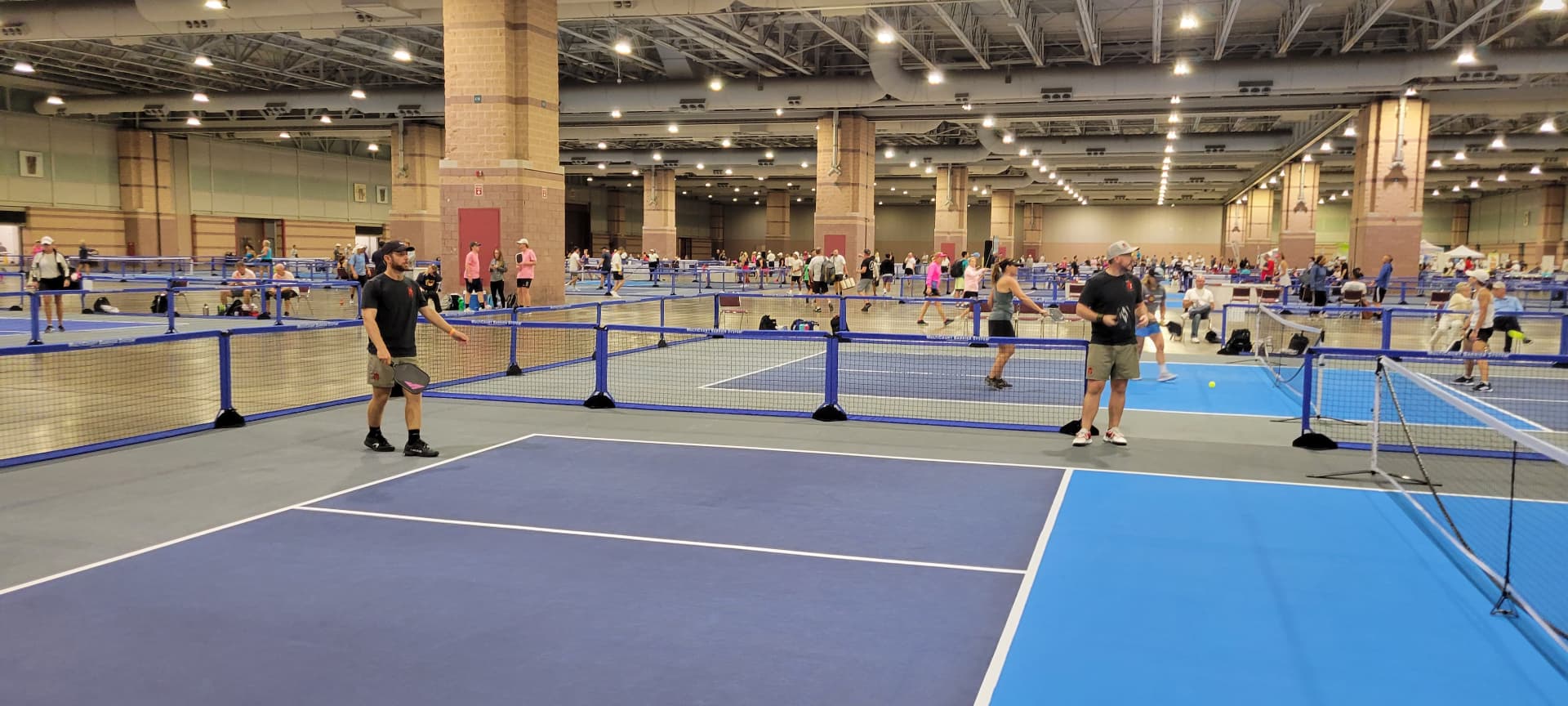
Pickleball landed in that gap because it is social by default (doubles play keeps four people in the same conversation), quick to learn, and flexible on venue. You can put a true-playing court on a hotel lawn, a ballroom floor with the right subfloor, a parking lot, or a campus quad. That venue flexibility is the quiet advantage over golf: you are not locked to a course that may already be booked, and you can often design an indoor weather backup into the same event plan.
What actually changes when you make the swap
A golf outing is a half-day-plus once you count the shotgun start, 18 holes, and lunch or awards — often five hours or more. A pickleball activation typically runs 1.5 to 3 hours, which fits inside a single afternoon block without taking the whole day.
Golf has a real skill floor. A foursome with one strong golfer and three beginners is a slow, frustrating round. Pickleball's underhand serve and shorter court mean most guests are rallying within minutes, so a mixed-experience group does not sort into who is enjoying the day and who is faking it.
Golf outings scale per player — greens fees, carts, and range time multiply with headcount, and a course buyout for a large group adds up fast. A turnkey pickleball activation is priced per event around court count, staffing, and days on-site, so a bigger guest list does not automatically mean a proportionally bigger bill.
An outdoor golf round has real rainout risk and depends on a course with an open tee-time block, often booked months ahead. A rollout pickleball court installs indoors or outdoors — hotel lawn, ballroom, parking deck, or company campus — which gives you more venue options and a straightforward weather backup.
The inclusion shift is usually the one leadership notices first on the day. When beginners are rallying inside the first ten minutes, the room feels different than a golf day where half the invite list is quietly hoping nobody asks their handicap. That does not make pickleball \"easier\" in a pejorative sense — competitive players still get a real game — it means the floor and the ceiling can share the same court block without one group waiting out the other.
Weighing golf against a pickleball outing?
Tell us your guest count, city, and goals — we will tell you straight whether it is a good swap for your group, or whether a hybrid day is the smarter call.
Inclusion, skill mix, and who gets left out
Golf is not exclusionary by intent, but it is exclusionary by mechanics. If you did not grow up around courses, or you do not play enough to keep a pace of play that does not frustrate a foursome, an \"optional\" golf outing is optional in name only — opting out can read as opting out of the networking block that matters. Pickleball compresses that problem. A five-minute rules clinic covers serve, scoring, and the kitchen line. Doubles keeps conversation alive between points. Rotating partners mix departments without forcing a full-day cart marriage.
- Most adults can learn a legal serve and a kitchen rule in under ten minutes — the barrier to entry is real participation, not a handicap.
- Mixed-skill teams and rotating partners keep ringers from dominating every point while beginners sit out.
- Wheelchair and adaptive play can be planned into the layout when you flag it at quote time, rather than bolted on day-of.
- Attire is closer to smart-casual athletic than golf-course dress codes, which lowers the "I do not own the right shoes" drop-off.
- Spectators still get a good view from the sideline — the court is small enough that non-players stay part of the room.
If your brief is diversity, equity, and belonging — or simply \"we want more than the same twelve people who always play golf\" — design the format for beginners first. Seed early pools so first-timers are not crushed by club players in round one. Keep scoring light and staffed. Save any elimination bracket for a short finale people can cheer, not a three-hour grind after the social goal is already met. Our corporate tournament playbook covers how to keep competitive energy without benching half the room.
When golf still wins
A clean swap is not always the right answer. Be honest about the brief before you kill the tee times.
- Client entertainment where the client is a serious golfer and the round itself, not the shared activity, is the point of the invitation.
- A culture where golf still carries real prestige or networking weight — some industries and regions close more relationships on the back nine than anywhere else.
- An executive group that specifically requested golf, where swapping it out reads as a downgrade rather than a fresh idea.
- You have the budget and lead time to book a full course, and a long, unhurried day is actually the goal rather than a constraint to work around.
In those cases, pickleball is often better as a parallel track or a different calendar slot — a summer picnic station, a sales kickoff icebreaker, or a conference networking reception — rather than a forced replacement for a golf day that still serves a specific relationship goal. See client entertainment and hospitality when the audience is external and the conversation quality matters as much as the activity.
How to actually make the swap (or run a hybrid)
Gauge appetite before you commit
Run a quick, informal poll. Some teams have burned out on the annual golf outing after years of the same format. Others have not. Do not assume either way — especially if a few senior leaders treat the day as sacred.
Offer a hybrid when needed
If a handful of executives or clients specifically want golf, run a smaller golf group in parallel with pickleball for everyone else. Regroup for dinner or awards so nobody feels banished to the "fun" track.
Pick a venue that does not need a course
A hotel lawn, company campus, rooftop, or event space near the office keeps logistics simpler than sourcing tee times for a large group. Confirm load-in, power, and a flat pad before you lock the invite list.
Size courts to headcount on purpose
One court per roughly 8–12 players keeps waits short for a half-day block. Under-courting is how corporate energy dies — phones come out, and the outing starts to feel like standing in line.
Court count is the biggest experience lever and one of the biggest cost levers. Use how many courts you need as a planning check before marketing an open invite to the whole company. Under-courting a large headcount turns a premium activation into a waiting line with paddles.
Sample afternoon timeline (about 2.5 hours)
This is a common shape for a company outing that replaces a morning-to-afternoon golf block with a tighter social competition. Adjust for dinner, awards, or a keynote that has to start on the hour.
- 0:00–0:20Check-in, paddle handout, five-minute rules clinic for first-timers
- 0:20–0:40Warm-up rallies and a coached "how to play" round on each court
- 0:40–1:40Round-robin or rotating partner play — staff keep scoring and rotations moving
- 1:40–2:10Optional short finale bracket or skills challenge while others spectate
- 2:10–2:30Awards or team photo, then hand off to dinner, drinks, or close
If the brief is lighter — one station among several at a field day or picnic — you do not need a full tournament arc. See pickleball for corporate field days and company summer picnic activations for station-style formats. If what people miss about the 19th hole is drinks and conversation more than competition, a shorter after-work happy hour court may be the better swap than a half-day outing.
Cost planning without fake greens-fee math
Golf budgets are usually built per player. Pickleball budgets for a turnkey activation are usually built per event: how many courts, how many staff, how many days on site, and whether you need indoor flooring protection, branding, or a multi-city tour. Those are different shapes, which is why a head-to-head \"per person\" comparison can mislead if you force it.
For honest planning ranges on our side: a single-court one-day activation typically begins around $10,000. Multi-court and multi-day programs move into the mid-five and six figuresdepending on scope, city, and staffing. We do not publish invented golf greens-fee averages here — course pricing varies too widely by market and season to freeze a number into this page as if it were current. If you have last year's golf invoice, bring it to the quote conversation and we can compare apples to apples against a court plan sized to the same guest list.
For more activation cost context, see our pickleball court rental cost guide. For a fixed number against your date and venue, use the quote form below.
What a turnkey golf-swap activation usually includes
- Court surfaces, nets, paddles, and balls delivered, built, and removed on your timeline
- On-court hosts who teach beginners, rotate players, and keep the block on schedule
- A format matched to your goal — social open play, light competition, or a short tournament finale
- Site assessment notes for grass, rooftop, parking lot, or indoor flooring so the pad is actually playable
- Weather contingency conversation early — indoor swap, tent coverage, or a hold date when the venue allows it
You are not renting a net and hoping HR can run a bracket. The point of a turnkey build is that your team owns the guest experience — invitations, catering, awards messaging — while court ops stay on the vendor. That split is what makes a 2.5-hour block feel polished instead of improvised.
Pickleball vs padel and other outing shortlists
If golf is not the only other option on the table, decide deliberately. Pickleball vs padel for corporate events covers the enclosure, cost, and learning-curve differences when another racquet sport is in the mix. Pickleball vs escape rooms, cornhole, axe throwing, and volunteer days covers the rest of the usual shortlist when the question is broader than \"golf or not.\"
Bottom line for most planners: keep golf when the relationship mechanic is golf. Swap or hybridize when the goal is company-wide energy, shorter time away from work, and a higher share of the invite list actually playing. Then size the courts, staff the rotations, and plan weather like an adult — not like a hope.