Data · Updated September 2026
Pickleball statistics for events & brands (2026)
Event planners, sponsors, and brand marketers need current, citable numbers— not recycled headlines from two seasons ago. According to the Sports & Fitness Industry Association (SFIA) 2026 Pickleball Single Sport Report / Topline, 24.3 million Americans played pickleball in 2025, participation is up roughly 479% since about 4.2 million players in 2020, and the sport has been the fastest-growing in the United States for five consecutive years. This page consolidates the figures you can put in an RFP or sponsor deck, with sources, and explains what they mean for trade shows, conferences, corporate events, and campus activations.
Why planners and brands need current numbers
A pitch deck that still says "four years as the fastest-growing sport" is already out of date relative to the SFIA 2026 release. Procurement teams, brand legal reviewers, and association sponsors increasingly ask where a growth claim comes from. Putting the primary association name, the year of the report, and a working link in the brief is the difference between a slide that survives review and one that gets pulled. The same discipline applies when you compare formats — for example pickleball vs. padel for corporate events — because footprint, learning curve, and portability claims should be as honest as participation claims.
Current numbers also change how you staff and size a court. A sport with a large casual cohort behaves differently on a show floor than a sport dominated by weekly regulars. That is why this guide pairs the headline SFIA figures with practical implications for activations, not just a chart dump. If you are still deciding whether a court belongs in the program at all, start with how to add pickleball to your event and come back here when you need citation-ready language for stakeholders.
Five consecutive years as the fastest-growing U.S. sport, plus 22.8% year-over-year growth into 2025, means you are not pitching a fad that peaked two seasons ago. The SFIA 2026 Single Sport Report is the primary source planners and sponsors expect you to cite.
16.8 million casual players (1–7 times per year) versus 7.48 million core players (8+) tells you most of the addressable audience at a trade show or conference has tried the game a few times — or not at all. Staff for walk-ups, not only for regulars.
Ages 13–24 now post the highest participation rate of any age segment, and women are 42.9% of players (up from 38.6% in 2020). That matters for campus welcome weeks, consumer brand activations, and mixed-age corporate off-sites alike.
A court manufactures the two things booths and receptions compete hardest for: people stopping, and people staying. That is why planners pair the SFIA headline with a turnkey activation rather than another step-and-repeat.
Headline participation and growth
The core SFIA story for 2025–2026 is straightforward: 24.3 million Americans played pickleball in 2025, up from roughly 4.2 million in 2020 — more than fivefold, about +479%. Year-over-year growth into 2025 was about +22.8%, or roughly 4.5 million net new players. Over three years (2022 to 2025), participation grew about +171.8%. And across that arc, SFIA describes pickleball as the fastest-growing sport in the United States for five consecutive years — update any leftover copy that still says four.
Primary announcement: SFIA releases 2026 Pickleball Single Sport Report. Secondary corroboration with the same headline figures: Rec Management on the ongoing participation surge. SFIA's ongoing U.S. pickleball participation overview remains a useful research landing page when it is current. Treat The Dink, Prism, and similar outlets as secondary industry coverage — useful for awareness, not as a substitute for naming SFIA.
growth from ~4.2M players in 2020 — more than fivefold in five years
Source: SFIA / Rec Managementyear-over-year growth — about 4.5 million net new players in 2025
Source: SFIA via Rec ManagementCasual vs. core — what the split means for activations
SFIA breaks participants into casual players (about 16.8 million people who play 1–7 times per year) and core players (about 7.48 million who play 8+ times per year). Casual players are the majority. That single fact should drive format decisions more than the raw 24.3 million headline.
At a trade show booth or conference lounge, most people who stop at the court will be curious, rusty, or brand-new. A staffed 60–90 second walkthrough, soft capped rallies, and clear rotation beat an unstaffed open-play pad every time. Core players will still find the court — and they often become helpful ambassadors — but designing only for them leaves the larger casual audience watching from the edge. Our trade show booth activation guide covers the daytime, lead-capture version of that build.
At a corporate off-site, wellness day, or holiday party, the same split argues against a full tournament bracket unless the brief explicitly wants competition. Most employees are casual or first-time players; they need a safe first rally more than a scored heat. See team-building ROI, corporate field days, and corporate holiday parties for format choices that match a mixed-skill room. If leadership does want brackets and standings, that is a different product: the corporate tournament guide.
Demographics: youth lead and women's share rises
Two demographic updates matter as much as the growth rate for anyone scoping audience fit. First, ages 13–24 now post the highest participation rate of any age segment in the SFIA data set. That overturns the stale assumption that pickleball is only a retiree pastime and is the cleanest one-line case for campus orientation, student welcome weeks, and youth-leaning consumer brands.
Second, women account for 42.9% of players, up from 38.6% in 2020. The trend line is useful in sponsor decks that ask whether the activation skews too male or too narrow. It does not authorize inventing household-income bands, ethnicity splits, or "average player spend" claims the report does not publish — stay inside what SFIA actually measured.
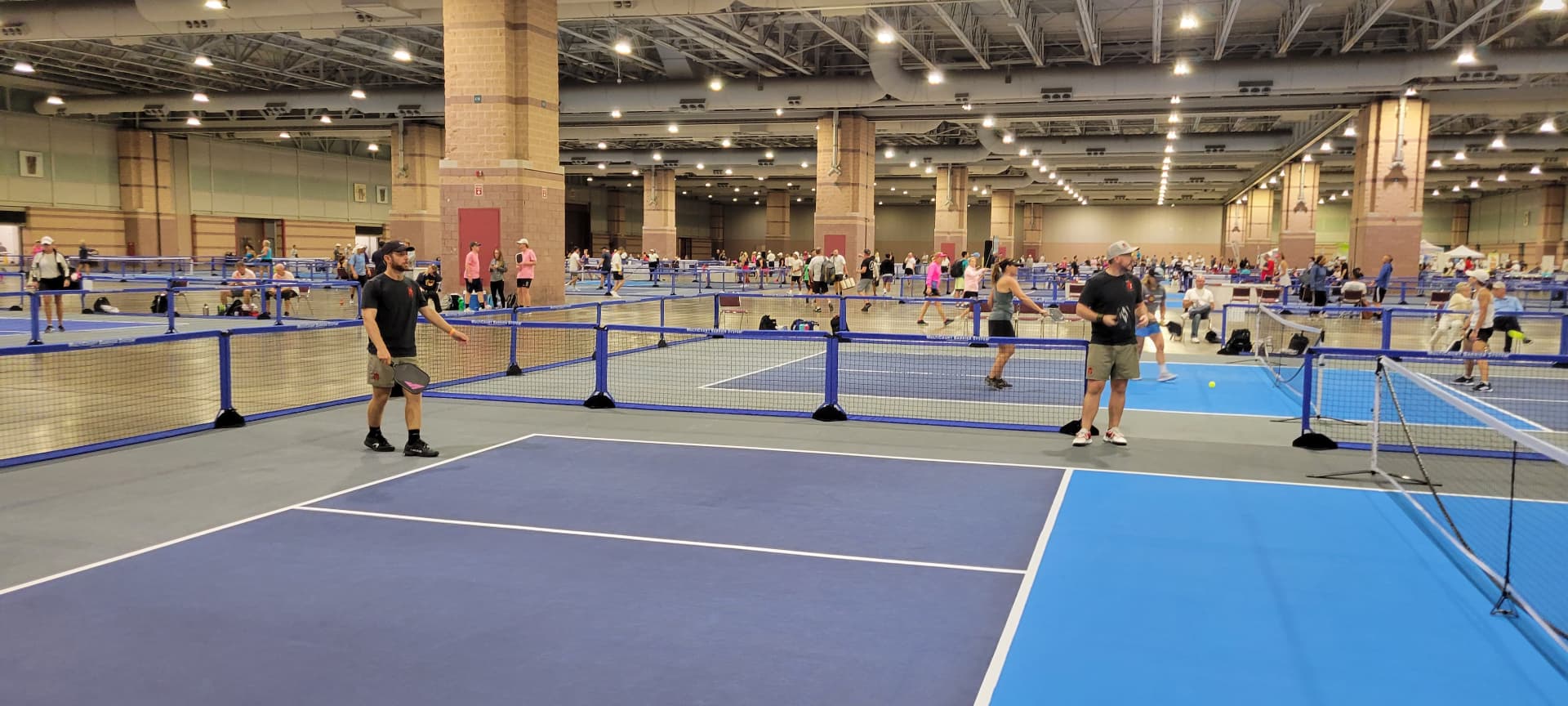
Practically, a court at a conference, trade-show floor, company off-site, or university event now reads as mainstream across interns and executives alike. Campus-specific programming lives in pickleball for college orientation and welcome week; broader company programming sits under corporate events and employee wellness days.
Putting the numbers on a court?
Tell us your date, city, and event type — we'll scope a turnkey activation sized to your audience, not a generic court count. Clear quotes usually within 24 hours.
Why it matters for trade shows, conferences, corporate, and campus
Participation growth explains reach. Format explains whether that reach turns into dwell time. A category with 24 million players and a large casual majority is efficient at drawing a crowd only when the activation is staffed, visible, and optional — not when it is a quiet prop in a back foyer.
Use 24.3 million players and five years of growth to justify a court on the show floor or at a welcome reception. Casual players dominate the mix, so staff a short walkthrough and keep rotations capped — the goal is dwell time and conversation, not a scored bracket. See our trade show booth activation and conference networking reception playbooks.
The same SFIA numbers support an HR or marketing case for a participatory format over another seated dinner. Pair participation data with engagement context carefully (Gallup's State of the Global Workplace has tracked low engagement for years, with roughly one in five employees worldwide reporting they are genuinely engaged). Then scope a staffed court for the actual window you have.
Ages 13–24 posting the highest participation rate is the campus argument in one line. Orientation and welcome-week builds work when the court sits in the social flow and stays beginner-friendly — not when it assumes athletic wear and prior play.
Conference welcome parties and evening mixers are a different build than a show-floor booth: cocktail attire, short social windows, and icebreaking over badge scans. Details live in pickleball for conference networking receptions. Sponsor measurement without inventing ROI math is covered in sponsor activation ROI.
Engagement context belongs in the same conversation carefully. Gallup's State of the Global Workplace research has tracked engagement challenges for several years, with roughly one in five employees worldwide reporting they are genuinely engaged at work. That gap is part of why HR and marketing teams look for shared, physical formats — and it is not a license to invent Gallup percentages beyond what the research reports. Pair engagement context with SFIA participation data; do not conflate the two sources.
How to use these stats in an RFP or sponsor deck
Honest framing beats inflation. Stakeholders can check SFIA in minutes; a rounded-up claim or a fake "average activation ROI" damages trust faster than a missing slide. Use the checklist below when you write the brief, and keep price talk in a separate section that points to a real quote.
- Cite the Sports & Fitness Industry Association (SFIA) 2026 Pickleball Single Sport Report / Topline by name — do not paraphrase into "industry analysts say" without a link.
- Lead with 24.3 million players in 2025 and five consecutive years as the fastest-growing U.S. sport; add +22.8% YoY and ~4.5 million net new players when you need year-over-year momentum.
- Use the casual (16.8M) vs core (7.48M) split to justify staffing and format: most guests will be casual or first-timers, so budget for hosts, not only nets and paddles.
- Include women at 42.9% and the 13–24 participation-rate lead when the brief asks for demographic fit — do not invent household income, ethnicity, or "average spend" figures you cannot source.
- Separate participation claims from price claims. Quote activation cost from your vendor; do not invent a "typical ROI" percentage or fabricate booth-scan conversion rates.
- Keep secondary coverage (Rec Management, The Dink, Prism, and similar) labeled as secondary corroboration of the SFIA release — not as the primary research.
For a full vendor brief template, see how to write an RFP for a pickleball event. If indoor vs outdoor or footprint is still open, pair the stats with indoor vs. outdoor court rental before you lock court count.
Planning ranges (quote-only pricing)
Participation statistics do not set your budget — venue rules, court count, staffing, travel, surface, and branding do. For planning conversations, a single-court, one-day turnkey activation typically begins around $10,000. Multi-court or multi-day builds move into the mid-five and six figures depending on those variables and on union or freight requirements at the venue. Every event is quoted individually — usually within 24 hours — once you share date, city, venue type, and rough headcount.
Do not invent a "typical cost per attendee" or a guaranteed lead volume from the SFIA numbers. Participation explains why people recognize the sport; pricing belongs in a vendor quote. Broader rental framing: pickleball court rental cost.
Related playbooks on this site
Use these statistics alongside the activation playbooks that match your event type: trade show booth activation, conference networking reception, corporate tournament, sponsor activation ROI, team-building ROI, corporate field days, corporate holiday parties, college orientation and welcome week, and how to add pickleball to your event. Vertical overviews: corporate events, employee wellness days, university and college events.
The Pickleball Events Co. delivers professional pickleball courts nationwide for trade shows, conferences, corporate off-sites, campus programs, and brand activations — set up, staffed, and removed so your team stays focused on the guest experience. Ready for numbers on your date and city? Get a clear quote — usually within 24 hours.
Sources
- SFIA — Releases 2026 Pickleball Single Sport Report (primary announcement for the 2026 single-sport / topline figures cited above).
- SFIA — U.S. pickleball participation overview (research landing page; confirm it remains current when you cite).
- Rec Management — Pickleball sees ongoing surge in participation (secondary coverage of SFIA figures including YoY and multi-year growth).
- Gallup — State of the Global Workplace (engagement context only; roughly one in five employees worldwide reporting genuine engagement — do not invent additional Gallup metrics).
- Secondary industry coverage (The Dink, Prism, and similar) may corroborate SFIA headlines; attribute clearly and prefer the SFIA release as the primary citation in RFPs and sponsor decks.
Figures on this page are from the Sports & Fitness Industry Association (SFIA) 2026 Pickleball Single Sport Report / Topline and linked secondary coverage, plus Gallup's State of the Global Workplace research where noted. Feel free to cite this page with a link — and verify primary sources before a high-stakes deck goes final. Updated September 8, 2026.