Hotels & Resorts
Pickleball for hotels and resorts
Hotels and resorts use temporary roll-out pickleball courts for guest-experience pop-ups, wedding and group-travel weekends, conference evening socials, and soft-brand amenity demos — without pouring a permanent court. Pickleball Events Co delivers, builds, staffs, and removes professional event courts nationwide. That is a different product from permanent amenity construction: we are the activation and rental layer hospitality teams book when the programming needs to land for a weekend, a meeting block, or a seasonal trial, then leave cleanly.
Why hospitality teams are asking for courts now
Pickleball has moved from niche recreation into mainstream guest programming. Properties that already sell tennis, padel, or fitness packages hear the same request from meeting planners, wedding couples, and leisure guests: is there something active the whole group can do together without a handicap or a tee time? A staffed temporary court answers that request on the property's calendar, not on a five-year capital plan.
Public hospitality moves reinforce the demand signal even when they are not our bookings. For example, Sandals Resorts partners with USA Pickleball as Official All-Inclusive Resorts and promotes pickleball programming for guests on its public pickleball page — an industry illustration of all-inclusive and resort brands treating the sport as guest experience, not a one-off novelty. Cite that as market context. Do not read it as a Pickleball Events Co client claim; Sandals is not presented here as our customer, and we do not invent hotel logos or occupancy outcomes to sell the format.
The practical upside for a general manager or hotel sales director is flexibility. You can put a court on a lawn for a peak weekend, a buyout, or a media stay, measure whether guests actually play, and decide later whether a permanent amenity belongs in the master plan. That is a very different risk profile from committing hardscape before demand is proven.
What temporary event courts do for a property
A staffed court on the lawn or terrace gives arriving groups and leisure guests a shared activity within minutes — something that photographs well and works for mixed ages and fitness levels, without asking the property to commit capital to permanent sport infrastructure.
Rehearsal dinners, welcome receptions, and buyout weekends often need one memorable block that fits the property's existing F&B plan. A temporary court slots into that plan for a day or a weekend and leaves when the group does.
Meeting planners booking room blocks want a networking reception guests actually participate in. A lit court with open play and short clinics keeps people circulating longer than a standing cocktail hour alone.
Some properties want to see whether pickleball programming draws guests before committing to a permanent court. A pop-up weekend or seasonal block answers that question with real play data — without a construction project.
Permanent amenity courts vs temporary event activations
This distinction matters more than any other line on this page. A permanent amenity court is capital work — grading, surfacing, fencing, lighting, and ongoing recreation staffing that stays on the property year-round. A temporary event activation is what we sell: professional roll-out courts brought in for a defined window, programmed with clinics and open play, then removed so the lawn, terrace, or ballroom returns to its normal use.
Roll-out courts can support pop-up programming, F&B takeovers beside the play area, group-travel highlights, wedding weekends, and conference socials. They are not a substitute for a poured permanent amenity if your ownership group has already decided to own sport infrastructure. They are the right tool when you need hospitality programming now, a seasonal trial, or a group-specific experience that should not permanently reshape the grounds. Our permanent court vs event rental guide walks through that decision in more detail, and our recurring programming for venues guide covers properties that want a standing seasonal cadence without committing to permanent hardscape.
Common hotel and resort formats
Guest-experience pop-ups
A weekend or multi-day lawn activation during peak season, a soft opening, or a brand campaign week — open play windows, short clinics, and equipment on hand so walk-up guests can join without a reservation system.
Group travel and wedding weekends
Welcome mixers, morning clinics before a ceremony, or a friendly tournament for the wedding party and guests. Works on event lawns, parking courtyards, and tennis courts that aren't otherwise scheduled.
Conference and meeting evening socials
After the last breakout, a staffed court adjacent to the reception or on a terrace gives attendees something active between sessions — useful for association meetings and corporate room blocks that already book your meeting space.
Soft-brand amenity demos
Sales tours, media stays, and ownership visits sometimes need a live demo of what "pickleball on property" could feel like. A temporary build shows the programming without pretending a permanent court already exists.
Scoping a hotel or resort activation?
Share dates, footprint photos, and whether this is a guest pop-up, wedding weekend, or conference social — we'll scope a turnkey build that fits the property, not a generic picnic layout.
What planners and GMs need to think through
A full court needs a clear rectangle roughly the size of a tennis doubles alley plus runoff — exact dimensions depend on fencing and spectator buffer. Asphalt, concrete, and existing sport courts are the simplest. Grass, pavers, and uneven lots usually need a subfloor so the roll-out surface plays true. Ask us to walk the site; "it looks flat" is not the same as playable.
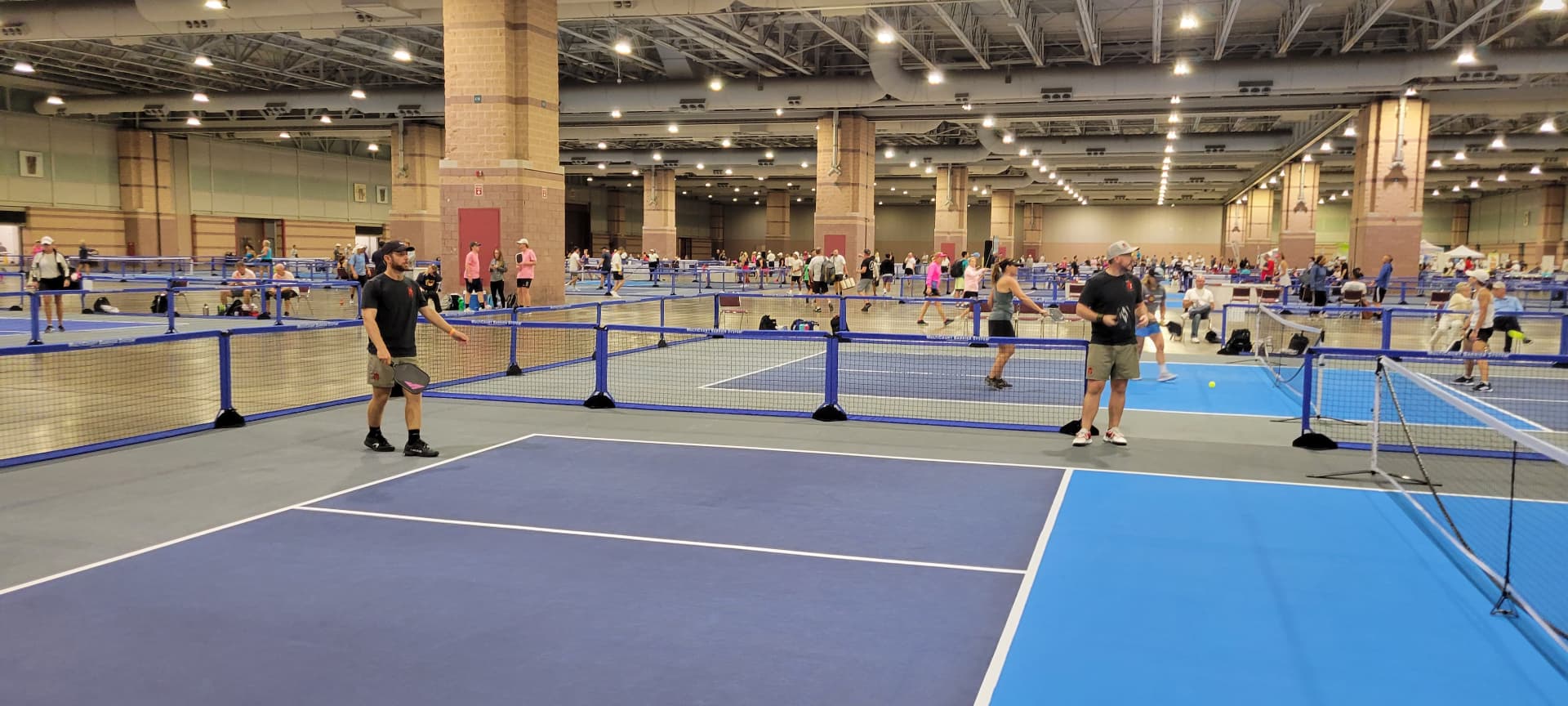
Outdoor lawns and terraces are the most common hospitality asks. Ballrooms, exhibit halls, and covered porte-cochère areas work when weather or noise rules push the build inside — ceiling height, HVAC, and load-in paths matter more than branding. There is no single best answer; it depends on the property and the dates.
Turnkey means we deliver courts, nets, paddles, balls, and on-site staff who run clinics, rotate play, and keep first-timers from standing awkwardly on the sideline. Hotel recreation teams can co-host; they do not need to become pickleball operators overnight.
Open play windows, 20-minute intro clinics, mixer doubles, and short social brackets tend to fit guest and group calendars better than long elimination tournaments. Wedding parties and conference attendees rarely want a three-hour competitive day.
Pickleball generates distinctive paddle noise. Beachfront, residential-adjacent, and courtyard properties should plan hours, orientation, and buffers early — especially for evening socials. We will not invent a "quiet court" claim; we will help you place and schedule the build honestly.
Lead time depends on court count, travel distance, custom branding, and whether the property needs a site visit first. Peak wedding and conference seasons book earlier. If your date is firm, ask sooner rather than assuming a last-minute lawn is always available.
Space, surface, and footprint reality
Hospitality sites rarely look like a dedicated tennis complex. You might have a wedding lawn that slopes toward the ocean, a porte-cochère with columns, a parking court that doubles as overflow banquet space, or a rooftop with weight limits. Roll-out courts can work in many of those places, but only after someone honest about sport surfaces has looked at grade, runoff, delivery access, and guest circulation.
Our surface and subfloor requirements guide explains what grass, pavers, carpet, and hardscape typically need. Our court dimensions for events guide covers the footprint math so sales and engineering are not arguing from memory. If the activation may move indoors for weather, pair that with our indoor vs outdoor rental guide.
Programming that fits guests, not athletes
Most hotel and resort players are not tournament athletes. They are wedding guests in boat shoes, conference attendees after a long day of sessions, or leisure guests who played once at a public park. Programming should assume mixed ability: short intro clinics, rotation-based doubles, and open play windows where staff keep the energy moving. Elimination brackets that strand half the group at a bar after twenty minutes usually work against hospitality goals.
Pairing the court with F&B is often the difference between a cute photo and a full activation. A welcome drink station, a light stations menu, or a late-afternoon mixer beside the court gives non-players a reason to stay in the footprint and keeps the social energy from collapsing when someone sits out a game. Wedding planners and DMCs already think this way; hotel banquet teams usually do too once the court is treated as a reception element rather than a remote sport add-on.
For conference hotels, the strongest slot is often the evening networking reception — after exhibits close, before dinner, or as a post-dinner social. That pattern overlaps with our conference networking reception guide. When the booking comes through a destination management company or incentive house rather than the property's own sales team, see our incentive travel and DMC programs guide.
Noise, neighbors, and quiet hours
Paddle impact is sharp and recognizable. Beach resorts with villas close to the lawn, urban hotels with courtyard rooms, and properties under municipal quiet-hour rules should treat noise as a planning input, not an afterthought. Orientation, hours of play, court count, and distance from sleeping rooms all matter. We will not promise that pickleball is silent, and we will not invent a decibel guarantee for your specific site.
Honest planning looks like this: share quiet hours and neighbor constraints early, walk the preferred footprint, and decide whether evening play belongs outdoors, indoors, or not at all. Our noise levels and neighbor considerations guide covers the questions property teams should ask before confirming a terrace or courtyard build.
Staffing, equipment, and what the hotel team still owns
A turnkey hospitality activation typically includes delivery, install, nets and surface, paddles and balls, on-site staff for clinics and rotations, and teardown. The hotel still owns guest communications, room-block coordination, banquet and beverage service, security rules, and any internal approvals from ownership or brand standards. Recreation or spa teams can co-host clinics if that fits your labor model; they should not be expected to become a full pickleball operations department for a three-day pop-up.
Branding is optional but common: property logo on barriers, a group sponsor wrap for a corporate buyout, or clean unbranded courts when the experience itself is the point. Custom wraps add production lead time. Flag branding needs when you request a quote rather than on the day before load-in.
For staffing models and what different headcounts usually require, see our event staffing guide. For a private lawn, rooftop, or reserved outdoor space checklist, our private event space guide is the companion read.
Lead time, seasons, and booking honesty
There is no single universal lead-time number that fits every resort, every court count, and every travel distance. Peak wedding months, major conference seasons, and holiday leisure weekends fill earlier. Custom branding and multi-court builds need more runway than a simple one-court open-play afternoon. Weather contingencies matter outdoors — especially coastal and mountain properties — and should be named in the plan rather than hoped away.
We publish practical booking guidance in our how far in advance to book guide and weather planning notes in our weather contingency plan. Cost depends on court count, days on site, staffing, travel, and branding scope; we do not invent hospitality-only price tiers or ROI percentages on this page. When you are ready for numbers grounded in your dates and footprint, request a quote.
Who this page is for
Resort general managers evaluating guest programming. Hotel sales teams packaging group and wedding proposals. Meeting planners holding room blocks who want an evening social that is not another silent auction or karaoke setup. Destination management companies placing activities into property buyouts. Brand and experiential teams soft-launching a hospitality partnership. If your question is really about client entertainment off-property at a private club or rooftop, our client entertainment and hospitality guide is the closer match. If your question is a consumer brand pop-up that happens to land at a hotel plaza, start with brand activations and product launches.
What we will not do on this page: invent occupancy lifts, claim named hotel chains as clients without a real engagement, publish fake case studies, or pretend temporary roll-out courts are the same product as permanent amenity construction. Hospitality teams can tell the difference — and so can search engines and AI citation systems that reward grounded, specific writing over marketing fog.
A sample weekend shape (illustrative, not a promise)
One workable pattern for a mid-size resort buyout looks like this: Friday afternoon install on an event lawn with a short soft-open clinic for early arrivals; Saturday morning open play and intro clinics before ceremony or meeting blocks; Saturday evening mixer beside F&B with lighting if play runs past dusk; Sunday morning casual doubles for stragglers; midday teardown so banquet and housekeeping reclaim the space. That shape is illustrative. Your property may need fewer hours, an indoor rain plan, or a single evening only. Ask us to map the build to your actual banquet diagram rather than forcing a template.
Another pattern: a conference hotel holds a two-hour post-exhibit reception on a terrace with one or two courts, open play, and a pro circulating for quick tips. Attendees rotate in and out while the beverage station stays adjacent. No bracket, no medals, no three-hour commitment — just a reason for people who do not already know each other to talk. That is often enough for the sales team packaging the room block.