Brand & Experiential Marketing
Pickleball for brand activations and product launches
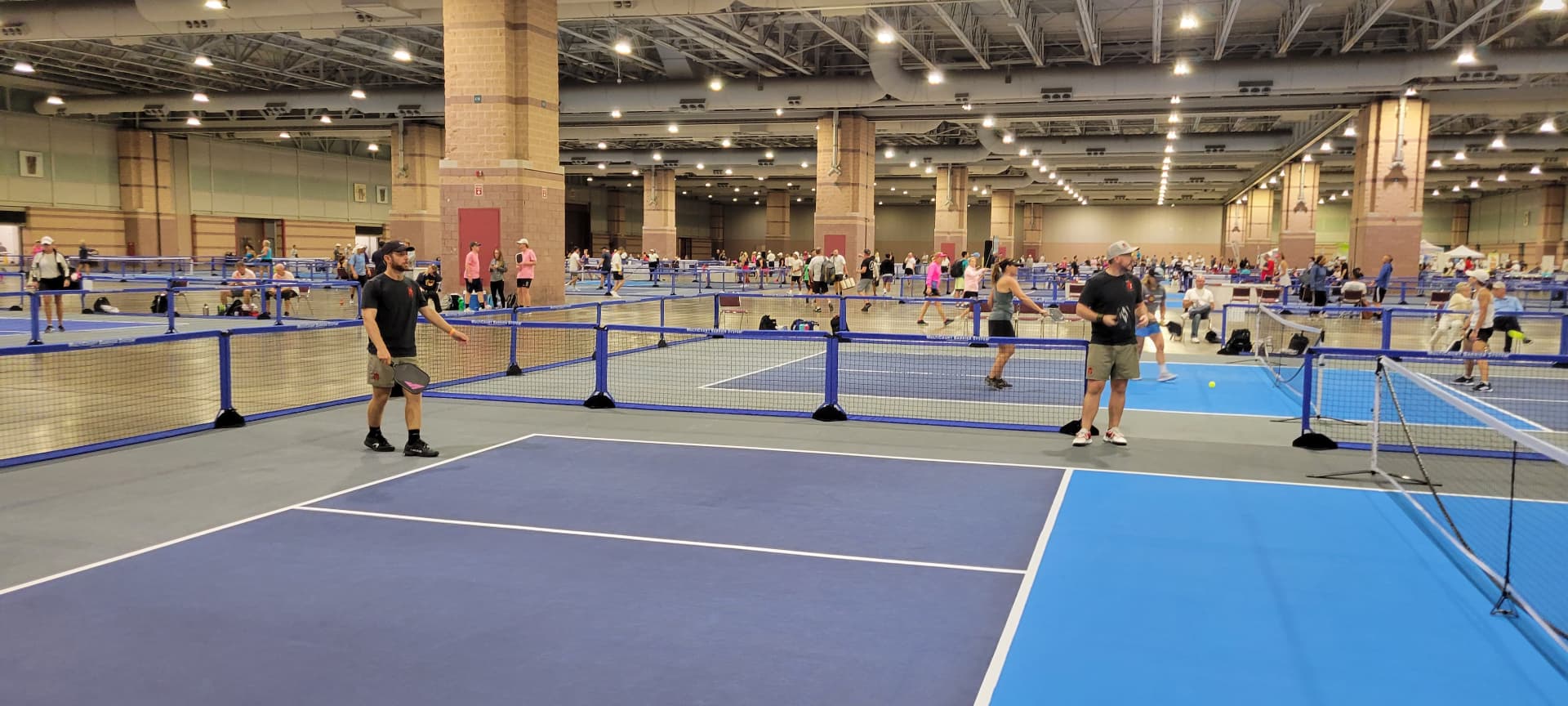
A fully branded pickleball court — wrapped in your campaign or product identity, staffed, and structured for engagement — turns a product launch or consumer campaign into something people participate in rather than walk past. It installs on a plaza, retail lot, parking area, or inside an existing festival or event footprint, and it's built, run, and removed for you on a schedule that fits your launch date.
Why brands are booking experiential over another banner
Experiential and event marketing budgets have been growing steadily rather than getting cut. Industry surveys like EventTrack have found the large majority of consumer marketers planning to increase event marketing spend year over year, with experiential now commonly cited as representing somewhere between 10% and 30% of total marketing budgets at companies that use it seriously — up from a much smaller share a decade ago. The reasoning marketers give is consistent: a banner or a sampling table gets glanced at, but a live, participatory activation gets remembered, photographed, and talked about, and that word-of-mouth and content value is difficult to replicate with a static booth.
Pickleball fits that brief in a specific way most activation concepts don't: it's genuinely playable by someone in work clothes after thirty seconds of instruction, which is rare for a "sport" activation, and it's currently one of the fastest-growing recreational activities in the country, so the format itself already has cultural momentum a brand can borrow rather than manufacture.
What a branded court does that other activations don't
A branded banner gets glanced at. A branded court gets played on — and a person who just rallied on your court under your logo remembers the brand differently than someone who walked past a step-and-repeat.
Every rally is a photo and video moment that happens on its own — you don't need to hire a content crew to manufacture something worth posting, because the activity itself generates it.
Unlike a demo booth that needs staff to actively pull people in, a live rally draws spectators on its own, and spectators become the next group of players. The activation keeps working without constant sales-floor energy from your team.
A branded court works as one activation inside a larger festival or trade show footprint, or as the entire pop-up for a single-day launch event in a parking lot, plaza, or retail frontage.
Common formats
Product launch pop-up
A single-day or weekend activation in a plaza, retail lot, or event space built entirely around the launch — courts, branding, and staff structured as the centerpiece rather than an add-on to something else.
Campaign tour stop
One stop on a multi-city consumer campaign, with courts, branding, and staffing kept consistent from city to city so the activation looks and runs the same everywhere it lands. See our multi-city activation guide for how that consistency gets managed.
Retail or mall activation
A court set up outside a flagship store or in a mall common area to draw foot traffic during a launch week or seasonal campaign — built to complement, not compete with, in-store traffic.
Sponsorship inside someone else's event
Your brand's court set up inside a festival, sporting event, or conference you're sponsoring — a way to convert a logo placement into an activity people actually remember interacting with.
Planning a launch or campaign activation?
Tell us your date, city, and site — we'll scope a branded build that fits the campaign, not just the checklist.
What goes into a branded build
Full branding on the playing surface, net, and surrounding barriers — not a sticker on a folding table.
On-brand event staff running the activation, not a generic rental-company crew in plain polos.
Quick-turn rally formats, mini-clinics, or a bracket keep dwell time up and turn a walk-up crowd into a full activation loop rather than a few minutes of casual hitting.
Branded paddles, swag, and a lead-capture moment (QR code, sign-up sheet, app download) folded into the natural pause between games.
Where it installs
Plazas, closed streets, parking lots, retail frontage, and grass event lawns all work — rollout courts install directly on asphalt, concrete, and carpet, and take a subfloor system underneath on grass, pavers, or an uneven lot to keep the surface level. Our surface and subfloor guide covers what your specific site needs, and our court dimensions guide covers the footprint math so you can confirm the space before you commit to a location. Launching in partnership with a shopping center or a downtown retail corridor specifically? Our shopping centers and downtown districts guide covers that property-side angle, including how it differs from a one-off product launch. If the launch is tied to a physical property opening — a new store, a model unit, a development — our property launch guide covers that specific angle in more depth.
Measuring whether it worked
A branded activation should be measured against the goals it was built for — dwell time, content generated, leads captured, or social reach — not vague "brand awareness." Our sponsor activation ROI guide covers how to set those metrics up before build day rather than trying to reconstruct them afterward, and our event marketing guide covers the branded-build options and giveaway structures that tend to perform best for lead capture specifically.
Booking a trade show or conference activation instead
If your activation is happening on a trade show or conference show floor rather than a standalone pop-up, the logistics are different enough — exhibitor rules, union labor, load-in windows — that it's worth reading our trade show booth activation guide alongside this one. And if the activation is one piece of a larger festival or public event you're sponsoring, our festivals and street fairs guide covers that setting specifically. Launching around a game day instead — a stadium tailgate lot, fan zone, or halftime moment — see our sporting events and fan activations guide for the timing and footprint constraints unique to that setting.
Budget and booking timeline
Branded builds price the same way any turnkey activation does — court count, days on-site, staffing, travel, and the scope of custom branding — and typically land toward the higher end of a standard build because of the wrap and giveaway elements. Our cost guide covers typical ranges. Launch dates tend to be fixed and non-negotiable, so book earlier than you would for a flexible corporate event — see our booking timeline guide for how much lead time custom branding adds to production.
Custom branding is the line item that most often gets underestimated on a launch timeline. Wrapping a court, net, and surrounding signage in campaign creative is a production job on top of the event build — art files need to be finalized, printed, and applied to the equipment before it ever leaves the warehouse, and that lead time sits upstream of delivery and install. Agencies and brand teams who loop us in as soon as the launch date and creative direction are locked, rather than waiting until the site and staffing are the only open questions, tend to get a cleaner build with fewer rushed change orders in the final week.
Working with an agency of record
Most of our brand-activation bookings come through an experiential or brand agency managing the campaign on a client's behalf, not the brand directly. That works the same way our DMC bookings do: the agency gets a single point of contact, pricing it can build into its own client-facing budget, and a build that shows up execution-ready so the agency's on-site team can focus on the parts only they can run — press, influencer coordination, client hosting — instead of also managing court logistics. If your agency is running the activation as one stop on a broader campaign with other vendors already in place, we plug into that plan rather than asking to restructure it.