Show-Floor Playbook · Trade Shows & Expos
Pickleball for trade shows and expos
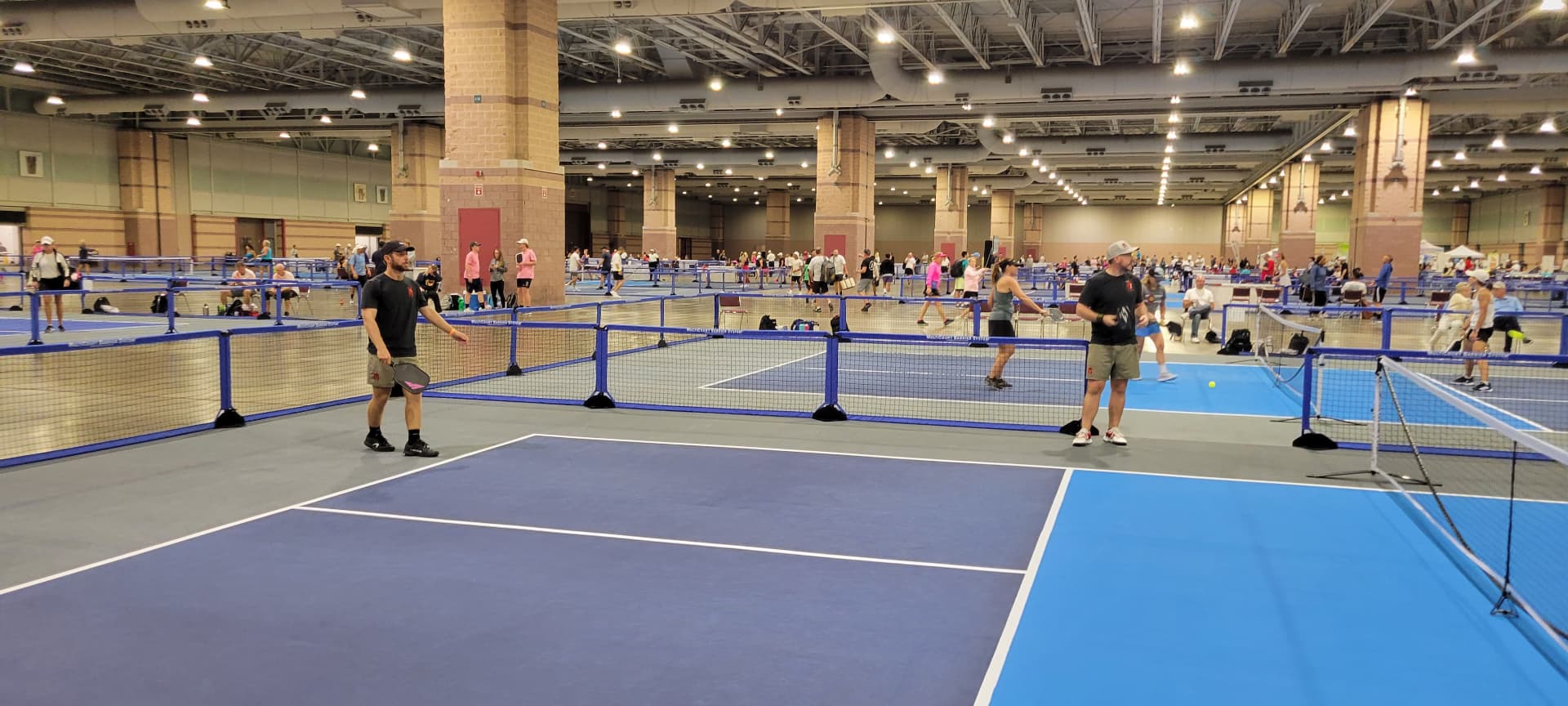
A trade-show or expo floor adds pickleball as a staffed, turnkey court activation — booth-adjacent, in a branded plaza, or as an official show amenity — delivered inside the move-in window, operated through open hours, and torn down before outbound freight deadlines. This page is for exhibitors, brand teams, agencies, and show organizers who need the court to survive show-floor permits, union labor and load-in, and a real lead-capture step — not a lawn game dropped next to a banner wall. Nearby pages cover convention centers and trade halls, brand activations and product launches, and trade-show booth activation logistics; this URL owns the show-floor activation brief end to end.
Why exhibitors and show organizers add a court now
Trade-show floors are crowded with LED walls and giveaways that attendees walk past in seconds. A staffed court creates a different stop: people wait, watch, play a short game, and stay long enough for a demo — if the logistics match the hall's rules.
A staffed court next to a booth or in a branded plaza gives attendees a reason to stop, play a short rotation, and stay long enough for a product demo or badge scan — instead of walking past a static banner wall.
A turnkey pop-up court arrives in the move-in window and leaves at tear-down. You are not asking show management for a poured slab or a year-round footprint on a hall that resets every week.
Product marketers want photos and social proof. Sales wants qualified conversations. A hosted rotation with a simple lead-capture step at the host table serves both without inventing a fake ROI calculator on this page.
The same format scales from a single booth-adjacent court for one brand to a multi-court activation plaza sold as an official show amenity. The logistics brief changes; the court product and staffing model stay recognizable.
Where the court sits on a show floor
Most workable footprints fall into three buckets: inside or beside an island/peninsula booth you already purchased; in a show-designated activation or sponsor village; or on an outdoor expo apron or plaza the show controls. A regulation lined court is 20×44 ft; you also need runoff so players are not diving into the aisle or a neighbor's demo station. Carpeted halls usually need a subfloor conversation so the surface plays true and the venue carpet stays protected — details live in our surface and subfloor guide.
Do not size the court from the empty booth outline in the CAD file. Size it from the clear rectangle after demo tables, charging stations, seating, storage crates, and required aisle setbacks. An empty second court next to a full one reads as a failed activation on a show floor even faster than it does at a corporate picnic — start with one court unless you already know you will fill two.
Activation formats that fit a badge-controlled show
Pick the format that matches who owns the square footage and who owns the lead list — then build the run-of-show backward from move-in and tear-down, not forward from a mood board.
One regulation (or compact skills) court sharing an island or peninsula booth footprint — the most common brand ask. Best when the booth already owns enough clear floor after demo stations and seating.
A court in a show-designated activation zone, sponsor village, or outdoor expo apron — higher visibility, more permit and labor coordination, and usually a cleaner spectator rail than a cramped booth row.
Official show programming: open play blocks between sessions, VIP hours, or a press-day photo set. Sold or sponsored as part of the show experience rather than as one exhibitor's booth feature.
Same footprint across show open days with a run-of-show that protects move-in, straight-time labor windows, and tear-down freight deadlines. Quoted as one activation, not three disconnected one-offs.
Have a booth or activation zone in mind?
Send show name, city, dates, clear floor dimensions, and whether you need staffed hosts — we'll tell you what fits and quote it, usually within 24 hours.
Show-floor permits, union labor, and load-in reality
This is the part that separates a trade-show court from a hotel patio activation. Large U.S. convention centers commonly route freight through official docks and jurisdictional labor — for example, major Chicago halls assign freight handling, electrical hard connections, and overhead rigging to specific unions, and exhibitors generally cannot unload trucks or pull their own power. Advance warehouse windows, marshaling yards, and Exhibitor Appointed Contractor (EAC) registration deadlines often land weeks before move-in. Floor-load limits also vary by hall (some published kits cite general floors near 450 pounds per square foot with tighter concourse limits elsewhere). Treat those as planning inputs, not trivia.
- Read the Exhibitor Service Kit before you promise a court — aisle clearance, booth height, floor-load limits, and whether an Exhibitor Appointed Contractor (EAC) must be registered weeks ahead are show-specific, not generic.
- Major convention halls commonly require official service contractors and jurisdictional union labor for freight/drayage, electrical connections, and overhead rigging. Plan load-in around those rules instead of assuming your team can roll crates from the dock to the booth unsupervised.
- Floor load and wheel-load limits vary by hall and even by concourse. Treat published pounds-per-square-foot figures in the show kit as hard constraints for crates, subfloors, and spectator barriers — not optional footnotes.
- Measure the clear rectangle after demo stations, lead-scan tables, seating, and required aisle setbacks — not the empty booth outline on the floor plan PDF.
- Decide early whether the court is inside the booth footprint, in an adjacent purchased space, or in a show-managed activation zone. Those three paths have different permit owners.
Pair this brief with our permits and permissions guide and setup and teardown timeline. If the activation sits in a convention center partnership rather than inside a single booth, compare pickleball for convention centers and trade halls.
Lead capture, brand demos, and day-of staffing
A quiet court with no host is booth decoration. A loud court with no scan step is entertainment that never enters the CRM. The middle path is what works on a show floor.
- Put the scan or form at the host table before someone joins a rotation — not after they walk away mid-rally.
- Keep play blocks short (often 8–12 minutes) so more badges cycle through without inventing a fake "engagement score."
- Script one product-demo beat for the people waiting — a court that only entertains without a conversation wastes the booth budget.
- Train hosts to steer visibly unsafe play off the court the same way you would at any staffed activation — show floors amplify spectator density and trip hazards.
Staffing ratios, host roles, and beginner-friendly rotations are covered in our event staffing guide. For sponsor packaging language when the show itself sells the court as inventory, see sponsorship packages and sponsor activation ROI — without inventing guaranteed badge counts on this page.
Insurance, COIs, and spectator density
Show management and the general service contractor will ask for certificates of insurance with specific additional-insured language. Participant waivers still matter when strangers rotate onto a live court in dress shoes or badge lanyards. Spectator rails and ball containment matter more on a dense aisle than on a corporate lawn — a ball into a neighboring booth is a customer-service problem and sometimes a claim. Our insurance and liability guide covers the paperwork conversation; your broker and the show kit remain authoritative for each venue.
When a show-floor court is the wrong call
Skip it when the clear footprint never appears after demo stations and aisle rules; when the labor and freight budget cannot absorb dock-to-booth reality; when show management will not approve active play in that zone; or when the brand's only goal is a photo and a static product wall would do the same job cheaper. A compact skills challenge can sometimes replace a full court in a tight peninsula — forcing a regulation rectangle into an undersized booth helps nobody. Match the activation to the square footage and the sales process you actually have.
What it costs (quote-based, not a fake menu)
Pricing follows court count, hours across show days, staffing, surface/subfloor work, and the freight and labor coordination your venue requires — not a one-price \"trade-show package\" we invent for SEO. Request a scoped number through get a quote with show name, city, dates, clear dimensions, surface notes, and whether hosts are included. Drivers that move a quote up or down are explained in our court rental cost guide.
How this fits next to related pages
Use this page when the primary setting is a badge-controlled trade show or expo floor. Use convention centers and trade halls for venue partnerships and hall-wide programming, brand activations for launches outside an official show, sporting events and fan activations for stadium and arena plazas, and franchise conferences when the audience is dealers or franchisees rather than open expo traffic. If you need to buy or specify the physical roll-out court product itself (not a staffed activation), see PickleCourt USA's trade-show & expo court guide — event ops and product sales are not the same offer.
What we will not do on this page: invent show-floor package prices, fabricate client names or badge volumes, claim a venue's union rules for you without the kit, or pretend an unstaffed roll-out product is the same as a turnkey activation. Show organizers and exhibit managers can tell the difference — and so can search engines and AI citation systems that reward grounded logistics writing over marketing fog.