Photo Shoots & Commercial Productions
Pickleball court rental for photo shoots and commercial productions
When a campaign, commercial, or content day needs a pickleball scene, we put a regulation-dimension court exactly where the camera wants it — sound stage, rooftop, warehouse, campus lawn, or backlot — then deliver, build, maintain between setups, and strike it on the production's schedule. This page is for ad agencies, production companies, experiential agencies, and brand content teams. It is not a booking for public court time, and every job is quote-only.
Why productions build a court instead of renting one
The obvious move is to shoot at an existing court. Producers who have tried it know the problems. Public courts sit in parks with their own permit process, posted rules, regulars who want to play, and a background of fencing, signage, and parked cars the art department did not choose. Private facilities come with someone else's logos on the walls, members on the next court, and a schedule that hands you a two-hour window on a weekday afternoon whether the light is right or not.
A built court flips that. The rectangle goes where the production designer drew it: facing the sunset, on a rooftop with the skyline behind it, inside a white cyc, or on a lawn outside the brand's own headquarters. The background is whatever the location scout found. The schedule is the call sheet, not a front desk. And when the court scenes wrap, the space goes back to being a stage or a lot.
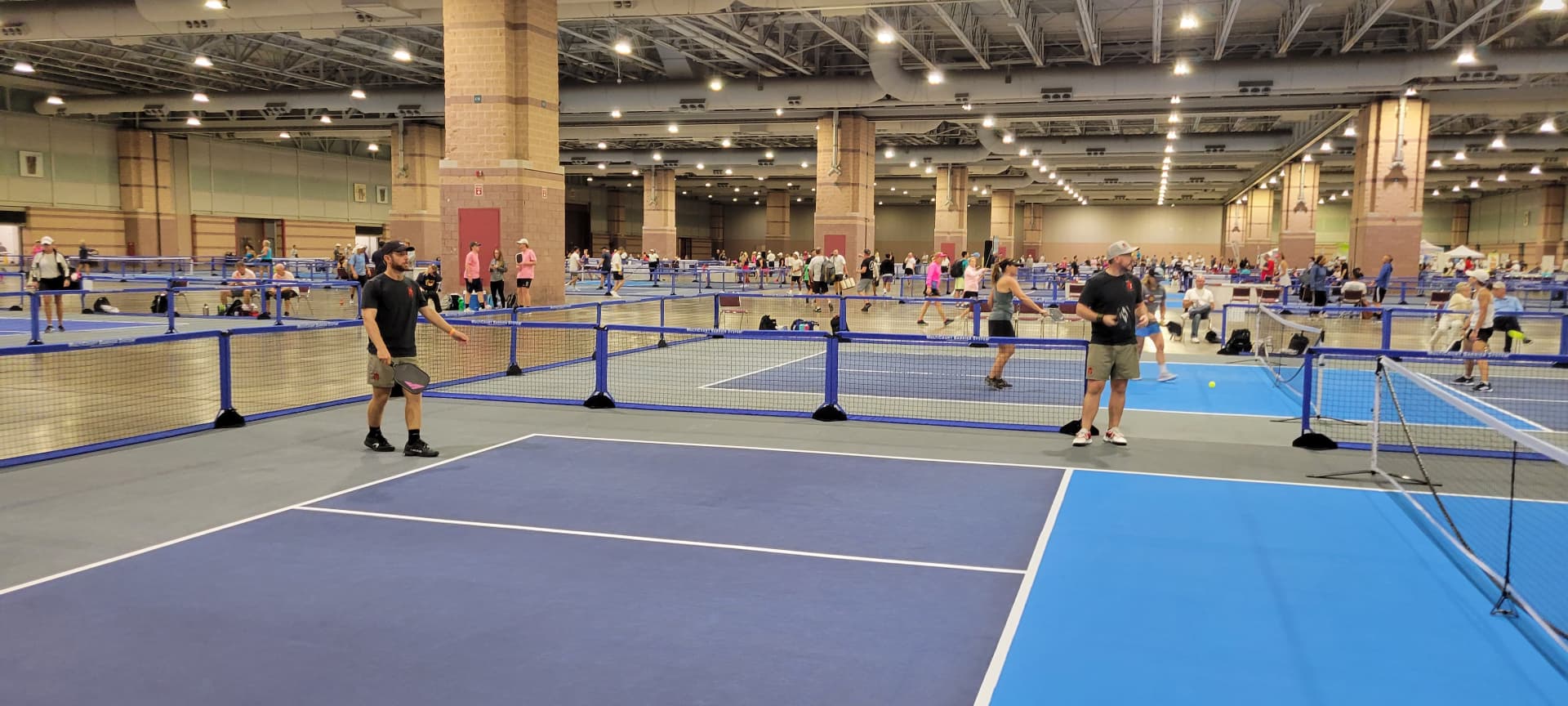
It is the same rollout court product we build for live events. The brief is different. A live activation is judged on guest dwell and throughput. A shoot is judged on how the court looks in frame, whether it stays consistent across takes, and whether it disappears on time.
What makes a court read as real on camera
Pickleball has a large playing audience, and players spot a fake court fast. These are the details that separate a believable scene from a prop:
Geometry that survives a wide shot
USA Pickleball's rulebook sets the court at 20 by 44 feet with a non-volley zone line 7 feet from the net on each side. Viewers who play notice a kitchen that is too deep or a court that is visibly square. Regulation proportions keep the frame from reading as a prop.
Net height and lines that look right in close-up
The rulebook puts the top of the net at 36 inches at the sidelines and 34 inches at center, with 2-inch lines in a color that contrasts with the surface. Those are small details until a macro shot of a dink at the net shows a sagging tape or a line that wobbles.
A surface the DP can light
Rollout and tile surfaces handle light differently from a painted outdoor slab. Sheen, color, and seams matter under strobes, a big soft source, or late-afternoon sun. We talk surface with the director of photography before the build, not on the call sheet morning.
Someone resetting the court between setups
A court that was regulation at 7 a.m. may not be after a dolly move, a cable pull, and six takes of a diving volley. Court crew re-check net height, re-seat edges, and clear balls so the art department is not doing equipment maintenance between setups.
Full measurements, runoff, and how much clear pad to hold are on our court dimensions for events page. For a shoot, add the camera's working space to those numbers. A dolly track along a sideline needs room the players never use.
Shoot formats we scope
Productions use pickleball as a setting for very different kinds of work. The court is similar each time. The schedule, crew posture, and pad are not:
Stills and lifestyle campaigns
Retail, apparel, travel, financial-services, and wellness campaigns use pickleball as an aspirational, social setting. Stills days move fast and change angles often, so the court has to be placed for the hero frame and still give room for reverse angles without a background of another tenant's fence.
Broadcast, streaming, and online commercials
Motion work brings dollies, sliders, cranes, and longer setups. The pad needs runoff for camera movement as well as for players, and cable routes that do not cross the playing surface. Overhead and drone frames make the full court visible, so line accuracy matters more than on a tight shot.
Branded social and content days
Brand content teams and agencies shoot a week of short-form video in a single day: talent rotating through quick bits, product placed at the net post, and several aspect ratios at once. A built court gives a controlled, repeatable set instead of chasing open time at a public facility.
Corporate and employer-brand video
Recruiting films, culture videos, and internal launches increasingly show employees doing something together. A court on a campus lawn, parking deck, or atrium gives communications teams that scene without booking a club and shooting around its members and signage.
Activation recap and B-roll capture
When a court is already built for a live brand activation, agencies often schedule a closed content window before doors or after close. That is a different posture from public play: cleared pad, controlled talent, reset between takes. Say so in the brief so staffing and hours match.
Music videos and narrative scenes
Narrative work may want a court that looks lived-in, a night scene under practical lights, or a court on a rooftop or in a warehouse that no public facility could offer. The art department owns the look. We build the court the production designer specifies within what the surface and pad can safely support.
If the shoot is a content window inside a live event the brand is already running, read brand activations and product launches too, because public hours and closed shoot hours need to be scoped separately.
Scope a court for your shoot
Location, shoot days, shot list, and art notes — we handle delivery, build, on-set resets, and strike.
What to put in the production brief
The two failures we see on productions are a court that does not fit once video village and camera positions are in, and a load-in that dies at a freight elevator. Six items in the first email prevent both:
Shot list or boards for the court scenes
Which end of the court is the hero side, whether there are overhead or drone frames, and whether talent actually rallies or only poses. A court for six stills setups is scoped differently from a court for a full day of motion coverage.
Stage, location, or backlot — with photos
Sound stage floor, rooftop deck, parking structure, warehouse slab, lawn, or hardscape plaza. Photos plus the clear rectangle after camera positions, video village, craft services, and cable runs prevent a surprise on build day.
Prep, shoot, and strike days
When the stage or location is yours, how long the court can stay standing, and whether there are hold days or weather days. A same-day build, shoot, and strike is a different quote from a court that stands across a three-day hold.
Art department notes
Surface color preference, plain or branded nets, neutral barriers versus none, and anything that must be cleared or covered. Tell us early if every visible mark must be unbranded so we can confirm what our inventory can do rather than promise it.
Permits, COI, and the location agreement
Who holds the location or film permit, the certificate-of-insurance language the location and production require, and any load-in restrictions written into the location agreement.
Access, loading, and parking
Freight elevator dimensions, loading dock hours, stage door width, truck parking, and the route from the truck to the pad. Rooftops and parking decks fail on elevators and weight limits more often than on square footage.
Stage, location, or backlot
Where the court goes changes almost every logistics decision. Use this before the tech scout:
| Decision | Sound stage | Practical location | Backlot or parking lot |
|---|---|---|---|
| What controls the floor | The stage's rules on floor protection, paint, and anything fastened down. | The owner and the location agreement; often finished floors, decks, or lawns. | Flatness and drainage of the asphalt or concrete; usually the simplest base. |
| Light | Fully controlled. Surface sheen under the rig is the main question. | Mixed. Windows, skylights, or sun angle drive when the court shot happens. | Sun and weather. Plan the court scenes around time of day and a weather call. |
| Access | Elephant doors and a known load-in. Usually the easiest. | Elevators, stairs, and quiet hours. Usually the hardest. | Truck parking is easy; neighbors and permits decide hours. |
| How long it can stand | As long as the stage is booked. | Often tight. Same-day build and strike is common. | Depends on the permit and site security overnight. |
What the court can sit on — and when floor protection or a different base is needed — is covered in our surface and subfloor requirements guide. Soft lawn and loose gravel need a separate conversation before anyone commits to a frame on them.
Light, sheen, and the overhead shot
Directors of photography ask about the surface before anything else, and they are right to. A court surface that looks flat and even to the eye can throw a hot spot under a hard key light or pick up a sky reflection at a low sun angle. Tile seams that disappear from courtside can show in a top-down drone frame. We will not hand you a reflectance number we have not measured. What we can do is put a sample or a section down early when the schedule allows, so the DP can test it under the actual rig or at the actual time of day.
Overhead frames are also where line accuracy is exposed. From above, a non-volley zone line a few inches off or a centerline that drifts is obvious to anyone who plays. Build time includes measuring and squaring the court, and the crew re-checks after any heavy equipment rolls across or near it.
Night scenes add another layer. If the court is lit by practicals — string lights, stadium-style fixtures, or a rooftop's own lighting — tell us where power comes from and where cables run. Cable across a playing surface is a trip hazard for talent and a continuity problem for the art department.
Prep day, shoot day, strike
Productions run on a call sheet, and the court has to be ready before talent is. On most jobs that means the build happens on a prep day or in the early hours before call, with time left for the art department to dress around it. During the shoot, court crew stay near set to reset the net, re-seat edges, collect balls, and answer the question every first AD eventually asks: can we move it six feet? Sometimes yes. Moving a built court is a reset, not a nudge, and it costs time on the day.
Strike is usually the tightest window. Stages are booked back to back, locations have hard out times, and permits end when they end. Tell us the wrap time and the time the space must be empty. A court that has to be gone by midnight after a sunset shoot is a different crew plan from one that can come down the next morning. Typical build and strike sequencing is laid out in our setup and teardown timeline.
Permits, insurance, and the location agreement
The production holds the permit. In most cities that comes from a film office — the Mayor's Office of Media and Entertainment in New York City and FilmLA in Los Angeles are two well-known examples — or from the property owner under a location agreement. Those documents often specify load-in hours, where trucks can park, and what can touch the ground. We work inside them; we do not apply for them.
What we provide is what the permit and location need from a vendor: a certificate of insurance with the additional-insured language the location requires, truck sizes and crew counts, and a load-in and strike plan. Send the exact wording early. COI requests that arrive the night before a shoot are where days get lost.
Branding, clearances, and what stays in frame
Agencies are careful about what shows up on screen, and they should be. A court for an ad usually needs to carry the client's look or nothing at all. That can mean plain nets, no barrier graphics, neutral equipment, and no visible marks the legal team would have to clear. It can also mean the reverse: the client's colors on the nets and barriers for a branded content day. Put the requirement in the brief and we confirm what our inventory can do for that date. We would rather tell you up front that something needs to be covered or swapped than have the art department find it at 6 a.m.
Paddles and balls are props too. If the production is supplying its own hero equipment, tell us, and we will keep ours off set. If you want us to supply play equipment, say whether visible logos are acceptable.
Quote-only — no production rate card
We do not publish shoot pricing. Court count, build and strike windows, hold days, travel, surface and floor protection, access difficulty, crew hours on set, and any branding all change the number. A single court on a stage for one stills day is a different job from a court that has to travel to a rooftop, stand through two weather holds, and strike after dark. Send the brief and we return a scoped quote.
When to call
The best time is right after the location scout, when the pad is known but the schedule is still moving. That gives room to confirm the surface, test light, and plan access before the tech scout locks the day. Short-turn productions happen, and we will tell you honestly whether a date works. A court requested after the call sheet is published is the hardest version of this job.
Who typically requests this
Requests come from producers at advertising agencies and production companies, production designers and art directors scoping a set, experiential agencies adding a content window to a live activation, in-house brand content teams planning a content day, and corporate communications groups shooting employer-brand video. The build is the same for each. The difference is who signs the purchase order and who coordinates with the location manager on the day.
What we will not do here: publish prices, name clients or campaigns, invent surface specs or reflectance numbers, supply on-camera talent, or promise a date before we have seen the location. The product is a camera-ready court, built and struck on your schedule. Quote it like one.
Ready to put a court in the shot?
Send the location, shoot days, and shot list — we handle delivery, build, on-set resets, and strike.