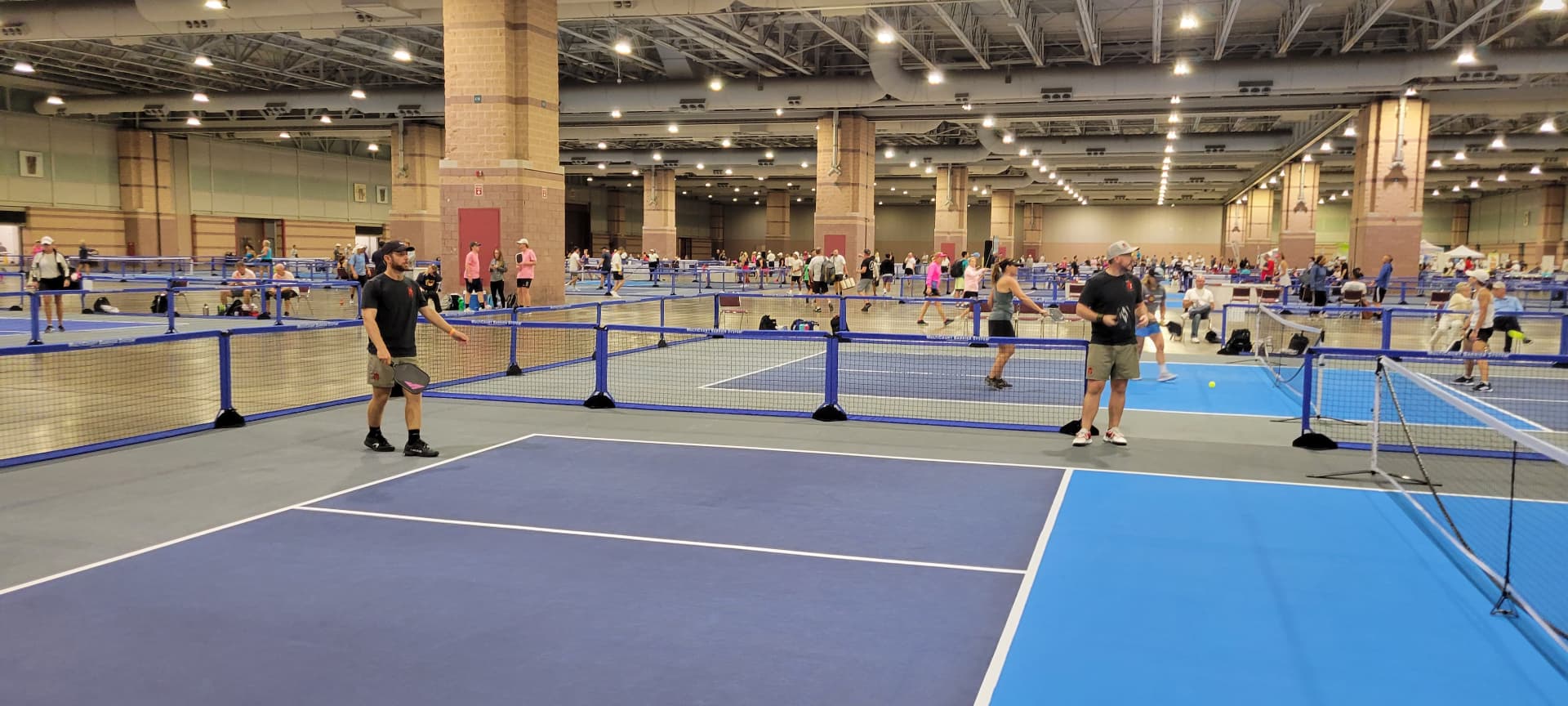
Client Entertainment & Hospitality
Pickleball for client entertainment and corporate hospitality
Client entertainment built around pickleball works best with a small, curated guest list, a hosted format — a pro clinic or open doubles rather than an elimination bracket — and a premium setting like a hotel rooftop, private club, or reserved hospitality footprint. It differs from an internal team event mainly in scale and tone: fewer guests, more staff attention per person, and a format built around relationship time rather than maximum participation.
Why it's showing up in corporate hospitality plans
Corporate hospitality has been drifting away from passive entertainment for a few years now — industry coverage of 2026 hospitality trends points to interactive, personalized, hands-on experiences replacing the standard dinner-and-a-show format, with companies increasingly choosing formats guests actually participate in over ones they just watch. Marquee sporting and entertainment events continue to pull real corporate spending toward hospitality and sponsorship packages, and confidence in the broader hospitality and leisure sector heading into 2026 is high, with a large majority of operators reporting optimism about the year ahead. None of that is about pickleball specifically, but it explains why an interactive, photogenic activity that guests can actually do — rather than sit through — keeps showing up as an upgrade over the traditional box seats or steakhouse dinner.
The appeal is practical, too. A pickleball clinic gives your relationship owners forty-five minutes of genuine, unscripted time with a client that a dinner table rarely produces in the same way — there's a shared activity to talk about, a natural icebreaker for clients who don't know each other yet, and none of the forced-conversation feeling of assigned seating.
What changes versus an internal team event
Client entertainment is built around a dozen or fewer key relationships, not maximum headcount. The activation is scoped for depth of experience per guest, not volume — one or two courts with a higher staff-to-guest ratio, not a full bracket.
A bracket that eliminates half the field after one game works for an internal outing where everyone still has to show up Monday. It reads differently with a client — a coached rally, a doubles game with a pro, or casual open play keeps the afternoon relationship-focused instead of turning into a contest someone has to lose.
Internal events can run on a company lawn with minimal dressing. Client-facing hospitality usually pairs the court with catering, a private venue, or a premium setting — a hotel rooftop, a private club, a stadium footprint — because the setting is part of what signals the relationship matters.
For an internal tournament, staff run brackets and keep games moving. For client entertainment, staff also manage the social choreography — making sure a nervous first-time player isn't left standing alone, and that your team's relationship owners get real one-on-one time with the client rather than just refereeing a game.
Where this shows up
Sponsor hospitality at a sporting event or festival
A branded court adjacent to a suite or hospitality tent gives clients something to do between innings or sets, rather than just eating and watching — see our sporting events program for how this pairs with a broader fan activation.
A standalone client day
A dedicated afternoon built entirely around a small client group — courts, a pro clinic, and a meal — works as a relationship-deepening alternative to the traditional steak dinner or box seats, especially for clients who've already sat through enough of those.
A trade show or conference VIP add-on
Alongside a broader booth activation, a private court block reserved for top accounts and prospects turns a public trade-show footprint into something that also works for closer one-on-one time.
Planning a client entertainment day?
Tell us your guest list size and venue — we'll scope a hosted format built around relationship time, not a bracket.
Pickleball, golf, or both
The comparison to golf comes up constantly in client entertainment, and the honest answer is that it depends on the client. Golf's slower pace and long stretches between shots are genuinely good for one-on-one relationship-building with a serious golfer — that hasn't changed. Pickleball is faster, more social, and better suited to a broader client group you want mingling and energized rather than locked into a single four-hour conversation with one contact. Our golf outing alternative guide breaks down the full comparison, including the common middle ground of running a smaller golf group alongside a pickleball activation for everyone else — a pattern that works just as well for client days as it does for internal outings.
Pairing it with a broader activation or sponsorship
Client entertainment often sits alongside a bigger footprint rather than standing entirely on its own — a hospitality court next to a trade show booth, or a reserved block within a broader sponsor activation where you're also tracking activation ROI for the public-facing side of the event. The metrics differ — client entertainment is measured in relationships deepened, not leads captured — but the build often shares the same court, staff, and date. If the setting is a private club rather than a public venue, our country clubs and private clubs program covers how that changes the logistics, and our private event space guide covers what a rooftop, ballroom, or reserved outdoor space needs to host a court well. Promoting the day to clients ahead of time is its own lever on turnout — our event marketing guide covers what actually gets an invite opened and RSVP'd. When the hospitality is booked as part of a multi-day incentive trip rather than a standalone client day — often sourced through a destination management company — see our incentive travel and DMC programs guide for how the build and booking process change for that format.
A sample hosted format for a small client group
For a dozen or fewer guests, the format that tends to work best isn't a bracket at all. Guests arrive to a welcome drink and a five-minute intro from a pro — not a lecture, just enough that nobody feels lost. Then everyone rotates through short, coached doubles games, mixed so clients play alongside your team rather than against a wall of unfamiliar faces, with a staffer quietly managing rotations so no pairing goes on too long or gets awkward. The pro plays a few points with each group along the way — a moment most guests remember and photograph. The afternoon closes with food and drinks courtside rather than a formal sit-down, so conversations that started on the court can keep going instead of resetting at assigned seats. The whole thing runs 90 minutes to two hours — long enough to matter, short enough that it doesn't become the whole day.
What to have your team think through before booking
A few questions are worth answering before you get a quote, because they change the build more than most planners expect. First: is this a stand-alone client day, or does it need to fit inside a bigger sponsorship or conference footprint — the staffing and branding are different for a private, invite-only afternoon than for a hospitality add-on inside a public event. Second: how many of your own people need to be freed up to host rather than play, since the relationship owners on your team should be circulating and talking, not stuck refereeing a game. Third: does the guest list include people who will genuinely never have picked up a paddle — if so, build in more coaching time up front so the first ten minutes don't feel like a skills test in front of a client you're trying to impress. None of these are hard problems, but naming them before the date is set makes the actual event day go a lot smoother.