Event Planning · Format Comparison
Pickleball vs. padel for a corporate event: which should you book?
For most one-day corporate events, trade shows, and brand activations, pickleball is the better fit: it is learnable in minutes, installs as a portable rollout court almost anywhere, and moves more guests through each court. Padel is a walled, enclosed-court sport played in doubles — a strong choice for a longer-term or seasonal installation, or a crowd that already plays racquet sports and wants a real game rather than an easy intro — but it is a bigger, less portable structure and a poor match for a single event day that has to go up and come down on a run-of-show clock.
Why planners keep comparing the two
Both sports are having a cultural moment, both look great in photos, and both show up in the same RFP conversations when a brand wants something more active than a lounge and less tired than another putting green. That overlap is exactly why the comparison gets muddy. Planners see a paddle, a net, and a crowd having fun — and assume the logistics are interchangeable. They are not.
The decision is less \"which sport is cooler\" and more \"which court can your venue, budget, and timeline actually support.\" A padel court that needs walls is a construction problem. A pickleball court that needs lines, a net, and a true-playing surface is an event-production problem. Those are different vendors, different lead times, and different failure modes on show day.
We build turnkey pickleball activations, not padel enclosures. That bias is worth stating up front. The rest of this page is still the honest comparison we give planners on sales calls: when padel is the better idea, when pickleball is, and what \"better\" means when the metric is guest participation rather than novelty.
The core differences
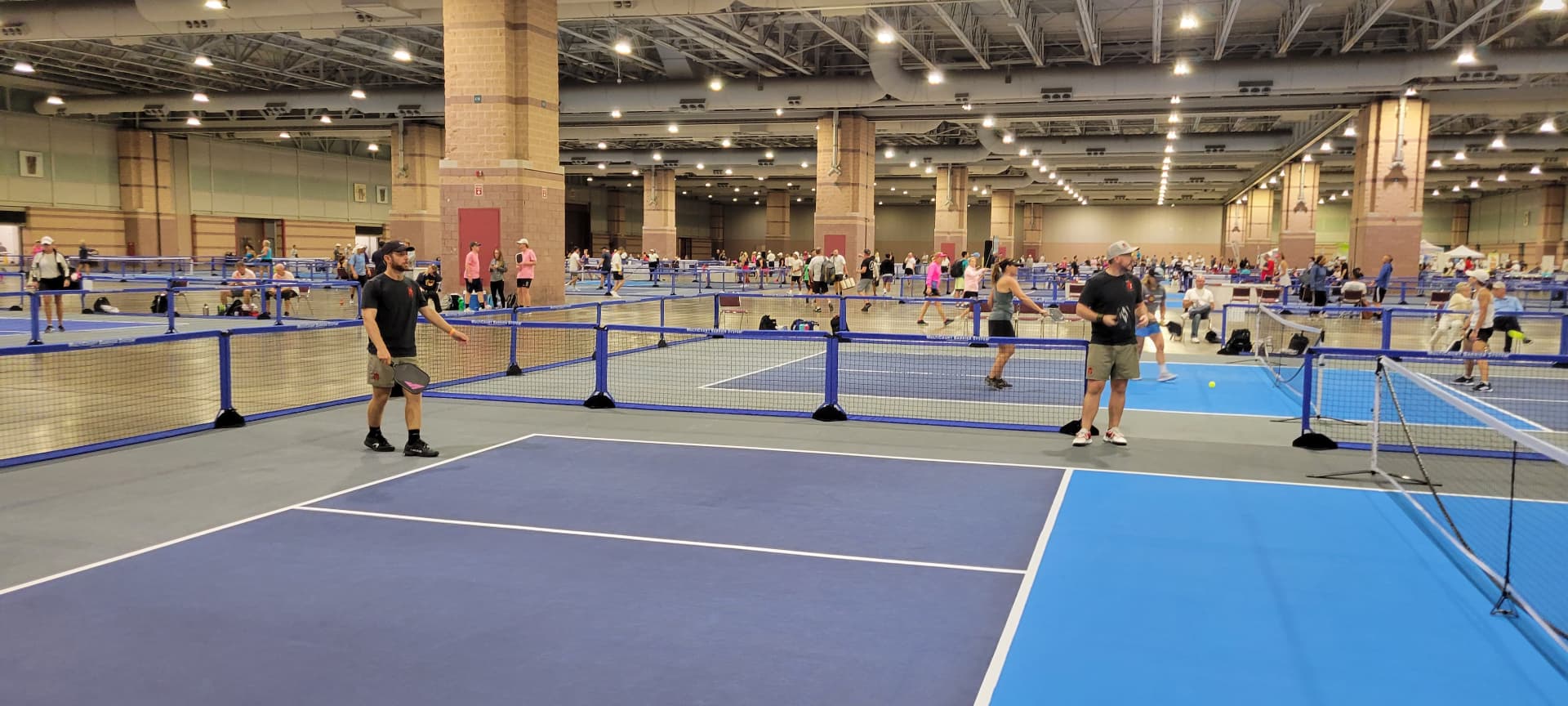
Pickleball plays on an open 20 × 44 ft court — lines, a net, and open air (or open room). Padel plays inside an enclosed court with glass or mesh panels around a footprint near 66 × 33 ft, where the ball can legally rebound off the walls. That enclosure is the whole sport — and the whole logistics problem for a one-day event.
Pickleball runs singles or doubles, so a court can host 2 to 4 people at once and still rotate a large guest list. Padel is doubles only, capping each court at 4 players and making it harder to move a trade-show or offsite crowd through quickly without building multiple full enclosures.
Pickleball rollout courts are built for event days — delivered, installed, and struck on a schedule that matches your run of show. A true padel court is a fixed or semi-permanent structure with panels and posts. Most vendors treat that as a multi-day build, not a same-day pop-up and teardown.
Pickleball's underhand serve and shorter court make most first-timers rally within a few minutes with light coaching. Padel's wall play and angles take longer to click, so a one-off corporate crowd spends more of a short session learning than playing — unless the room already knows racquet sports.
Portability is the quiet deal-breaker. See our court dimensions and space guide for how a rollout pickleball court fits a venue, and our indoor vs outdoor rental guide when weather or flooring protection is part of the brief.
Not sure which format fits your event?
Tell us your venue, guest count, and format goals — we will tell you straight if pickleball is the right call, and scope the build if it is.
Footprint, venue ops, and what actually fits
Most failed format choices are footprint mistakes dressed up as brand decisions. Walk the space — or send a floor plan — before you fall in love with either sport.
Playing surface vs enclosed volume
A pickleball playing surface is 20 × 44 ft. You still need runoff and spectator clearance, but the playable pad is open. A padel court's enclosed footprint runs around 66 × 33 ft, and because it is a structure rather than lines on a surface, you also need room for panel install, doors, and safe circulation outside the glass.
What venues actually allow
Hotels, convention centers, and corporate campuses are used to temporary sports floors, dance floors, and stage builds. A rollout pickleball court fits that temporary-use pattern. A walled padel cage often triggers a different conversation with venue ops — weight, anchoring, glass handling, and overnight security — that a same-day activation rarely has time for.
Booth and ballroom math
On a trade-show floor, every extra foot of enclosure is a foot you are not using for brand walls, lead capture, or lounge. Multiple open pickleball courts can often fit where a single padel enclosure would consume the whole booth. Indoors, a ballroom can take several rollout courts with the right subfloor; a padel build is closer to installing a room inside the room.
If court count is still fuzzy, use how many courts you need as a planning check before marketing an open invite. Under-courting a large headcount turns a premium activation into a waiting line with paddles.
When padel makes more sense
Padel is not \"worse pickleball.\" It is a different product with a different install profile. Be honest when the brief matches it.
- Your guest list already plays tennis, squash, or padel and wants a structured game, not an intro clinic.
- You are building a longer-term or seasonal installation — resort, club, or corporate campus — where the enclosed structure earns its footprint over weeks or months, not one afternoon.
- Differentiation matters more than throughput: padel is still newer to many U.S. corporate crowds, so it can stand out precisely because fewer people have tried it.
- Your venue has the extra footprint and a multi-day build window a fixed enclosure needs — and you are willing to pay for that structural install.
In those cases, hire a padel specialist and budget for structure. Trying to force a one-day padel pop-up because the sport is trendy is how you get an incomplete cage, a delayed doors open, and a guest list standing around watching installers.
When pickleball makes more sense
- You want the highest share of guests actually playing, not watching — the low learning curve is the point of a one-day activation.
- It is a single-day build: trade show booth, conference networking block, offsite, or launch, where the court must go up and come down on your event's clock.
- Space is tight or irregular — ballroom, booth footprint, rooftop, parking deck — where an open court fits shapes an enclosed structure cannot.
- You want more courts for the same footprint so a large guest list rotates through without a long spectator line.
That list is most of the corporate calendar: corporate tournaments, brand activations and product launches, conference networking blocks, offsites, and field days. The format wins because it matches the day you already have — not because it is trying to become a permanent amenity.
Cost structure — without invented padel price tags
Comparison pages love fake dollar bands. Here is the honest version.
- Pickleball activations are typically priced per event around court count, staffing, equipment, and days on site — not per-player greens fees.
- For planning, a single-court one-day pickleball activation typically begins around $10,000; multi-court or multi-day programs move into the mid-five and six figures depending on scope, city, and staffing.
- Padel event pricing is not something we invent for comparison: enclosed-court builds vary widely by whether the structure is temporary or semi-permanent, how many days the install takes, and what the venue charges for structural work. Treat any "padel costs X" claim without a vendor quote as marketing, not a budget.
- The honest planner question is rarely "which sport is cheaper in the abstract." It is "which format can we install, staff, and clear on our run of show without burning the budget on structure."
For pickleball planning ranges and what drives them, see our activation cost guide. For a start-to-finish planning walkthrough once you have chosen the format, see how to add pickleball to your event. Comparing court sports against a completely different outing tradition — the annual golf day? See our golf outing alternative guide.
Request a pickleball quote
Share guest count, city, venue type, and whether you are deciding between padel and pickleball. We will say if an open-court activation is the right tool — and scope courts and staffing if it is.
Why we build pickleball, not padel, for events
We get this question most from planners who have seen padel at a resort or club and want the same energy at a one-day event. The honest answer is that a padel court's fixed enclosure fights against everything that makes a turnkey activation work: same-day install, teardown that clears the space by the next morning, and a footprint that fits a booth, a ballroom, or a rooftop rather than needing a dedicated structural build. Pickleball's rollout system solves for exactly those constraints, which is why it has become the default activation format at corporate events, trade shows, and brand launches — not because padel is a worse sport, but because it is a worse fit for a single event day.
If your brief is truly a permanent or seasonal padel amenity, we will say so and point you toward builders who do that work. Stretching our event product into a fake padel offering would be the wrong kind of honesty.
A practical decision framework
Start with the day, not the trend
If the brief is one afternoon of high participation, photographable energy, and a clean teardown, pickleball is usually the better tool. If the brief is a permanent amenity or a multi-week residency, padel can earn its structure. Do not book either format because it is having a moment on social — book the one that matches the day you actually have.
Audit who is on the invite list
A room of tennis-club regulars and squash players may love padel. A mixed corporate invite list — sales, ops, partners, plus-ones — usually needs the lower skill floor. Ask who has to feel successful in the first ten minutes. That answer decides more than any trend chart.
Price the install you can finish
A beautiful padel court that is still going up while doors open is a failed activation. Same for under-courting a pickleball block so half the room waits with phones out. Scope court count, staffing, and teardown against the real clock — then request a quote against that scope, not against a vibes-based budget number.
Still torn after that filter? Send both a pickleball quote request and a padel vendor quote against the same floor plan and the same doors-open time. The side-by-side usually ends the debate faster than another round of trend articles.