Event Planning · Vendor Vetting
What to ask a pickleball court rental company before you book
Before you sign with any pickleball event vendor, confirm five things: they can produce a certificate of insurance without friction, they've installed on your specific surface before, staffing is clearly included or itemized rather than assumed, their weather and cancellation policy is in writing, and the quote is broken out by line item rather than a single bundled number. A vendor who answers all five cleanly is running a real activation business, not renting out equipment and hoping it works out.
The 8 questions that actually separate vendors
Most pickleball event vendors sound similar on a sales call. These are the questions that surface the difference between an experienced operator and someone learning on your event.
A vendor with real coverage produces this without treating it as a special request. If they hesitate, stall, or ask why you need it, that's your answer. See the insurance and liability guide for what a COI should actually say.
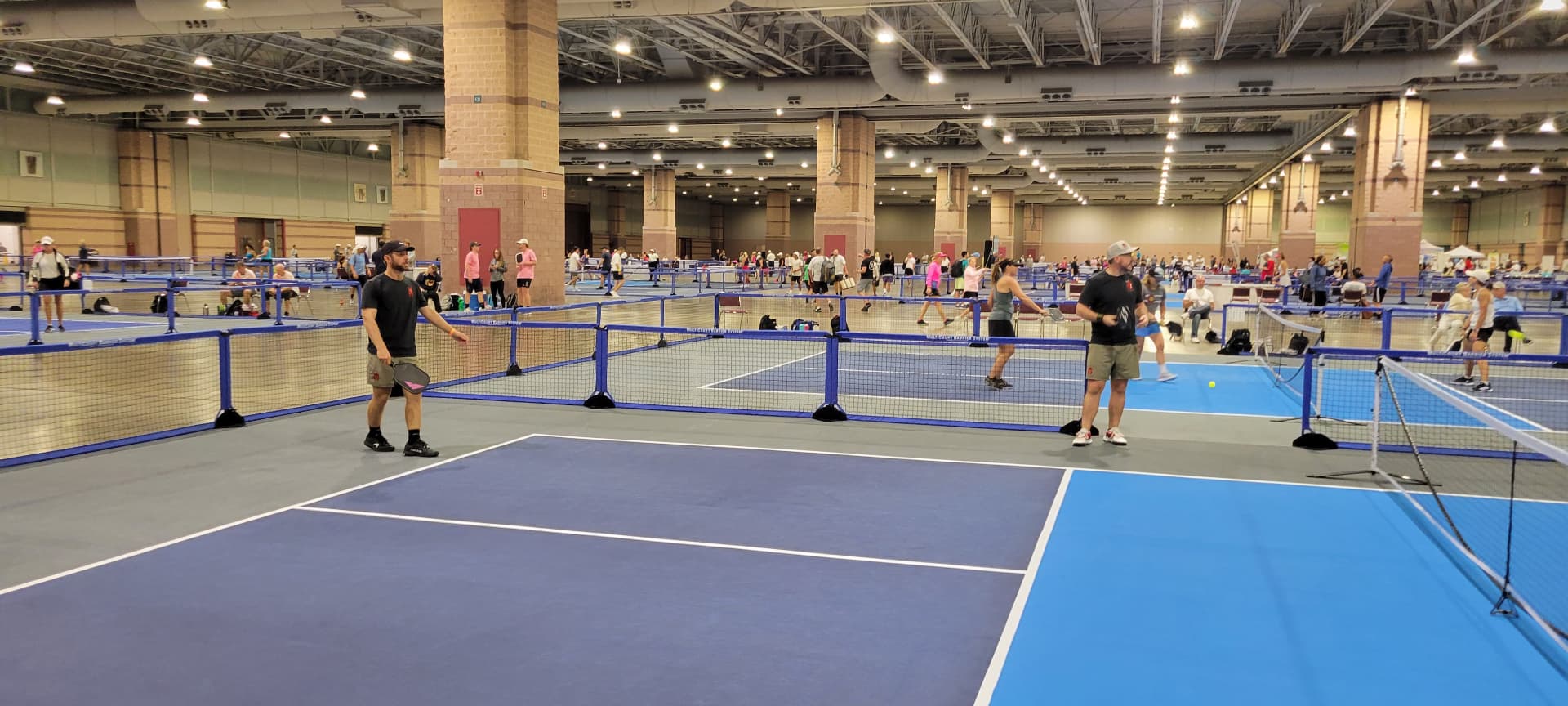
Grass, a rooftop, a parking garage, and a convention floor all install differently, and some need a subfloor system underneath the court — the surface and subfloor guide covers which. A vendor who's never built on your surface is learning on your event.
Ask exactly who shows up — a court host, a referee, an instructor — and whether that's part of the base quote or billed separately. The staffing guide breaks down the roles and ratios so you know what to expect on the roster.
Ask this before you need it, not the morning of a forecast — the weather contingency guide covers what a real backup plan includes, and our cancellation and rescheduling policy guide covers deposit and refund terms if the event itself changes.
A vendor who quotes the same lead time regardless of court count or season either hasn't thought it through or is padding the number. Real answers vary by scope.
Not disqualifying either way, but worth knowing. A subcontracted build adds a layer between you and the crew actually installing your court, which matters if something needs to change on-site. See our equipment checklist for exactly what should be on-site regardless of who owns it.
Court count, days, staffing, travel, surface work, and branding should each show up as their own line, not get bundled into one number you can't audit. See the cost guide for what a fully broken-out quote covers.
Not a testimonial page — an actual event, ideally one close to your format and scale. A vendor with real experience will have one on hand without scrambling.
Run this checklist against us.
Ask us any question on this list when you request a quote — insurance, staffing, and surface answers come with the pricing, not after it.
Red flags that predict a bad build day
- No certificate of insurance on file, or a vague answer about "getting one together" when asked directly.
- A single flat price with no breakdown by court count, days, or staffing — you can't tell what you're actually paying for or negotiate any of it.
- No mention of staffing until you ask, or an assumption that your own team will run the courts.
- Can't describe how they'd handle rain, wind, or a delayed load-in beyond "we'll figure it out."
- Photos that are all stock or borrowed rather than their own installs — a real vendor has their own event photography.
- Reluctance to name the actual surface systems or court brand they install, when asked a direct equipment question.
What a professional quote should include
Use this as a checklist against any quote you receive — if a section is missing, ask for it before you compare price.
| Line item | What it should tell you |
|---|---|
| Court count and layout | How many courts, and roughly how much footprint each one needs at your venue. |
| Build and teardown windows | When crews arrive, how long install takes, and when the space is handed back. |
| Staffing roster | Who's on-site, in what roles, for how many hours. |
| Surface plan | Whether your venue's surface needs a subfloor system, and who's confirming that before load-in. |
| Insurance terms | Confirmation a COI naming your venue as additional insured is standard, not a special request. |
| Cancellation and weather terms | What happens if the event moves, shortens, or gets rained out. |
A facility booking vs. a real activation vendor
Some outfits that answer a "pickleball rental" search are set up to rent courts at their own facility, not to build a portable court at your venue. Nothing wrong with that business — it just isn't the same product as a turnkey activation, and the two get compared on price as if they were. If a vendor can't clearly describe delivering courts, staff, and equipment to yourvenue and running the full build and teardown there, they're quoting a different service than the one you're asking about.
The fastest way to tell the difference on a call: ask where the courts physically go. A real activation vendor answers with your venue's name. A facility rental answers with theirs.
Once a vendor clears this list, the remaining planning questions are about your event, not theirs — how many courts you actually need by format, whether indoor or outdoor fits your venue, and how far ahead to book so you're not compressing the timeline. For a full walkthrough of planning an activation start to finish, see the event playbook. If your build is on public property, ask your vendor whether they've handled that paperwork before too — see our event permits guide for what a public-space activation typically requires beyond insurance. Sourcing multiple vendors through procurement? Our guide on writing an RFP for a pickleball activation covers how to fold most of this checklist directly into the RFP itself, and our ADA accessibility guide covers a question worth adding to the list if inclusive access matters for your event. One more question worth asking every vendor: what does their site assessment process actually look like — a real operator checks access, power, and surface before finalizing a number, rather than pricing off a floor plan alone. Once you've picked a vendor, this checklist becomes a signature-day checklist too — see our event rental contract guide for the scope-of-work and insurance language that should show up in writing, not just in the sales call.