Nonprofit & Charity Events
Pickleball for nonprofit fundraisers and charity galas
A pickleball fundraiser raises real money when it's built around sponsorship tiers and peer-to-peer giving, not entry fees alone — with a round-robin format that keeps every donor playing (and spending) for the whole event instead of a bracket that knocks half the field out in the first hour. Nonprofits are already running this as a flagship annual event nationwide; the format is proven, and the logistics — courts, staff, and a tournament that actually works for non-athletes — are what make it land.
Why it works for a fundraiser specifically
Charity pickleball tournaments are a real, growing category — nonprofits nationwide run them as flagship annual events, and dedicated organizations like Dink For Cause exist specifically to help causes raise money through the sport. This isn't a novelty pitch to your board; it's a format donors already recognize.
The biggest dollars in a pickleball fundraiser rarely come from registration. They come from sponsorships, peer-to-peer fundraising pages (each player raising money from their own network before the event, the same mechanic as a charity walk or run), and on-site giving — entry fees are just the floor.
A round-robin with skill divisions keeps every player on a court for most of the day, instead of a single-elimination bracket that knocks half the field out in the first hour. Donors who paid to play — and brought their checkbook — stay engaged the whole event instead of leaving after one loss.
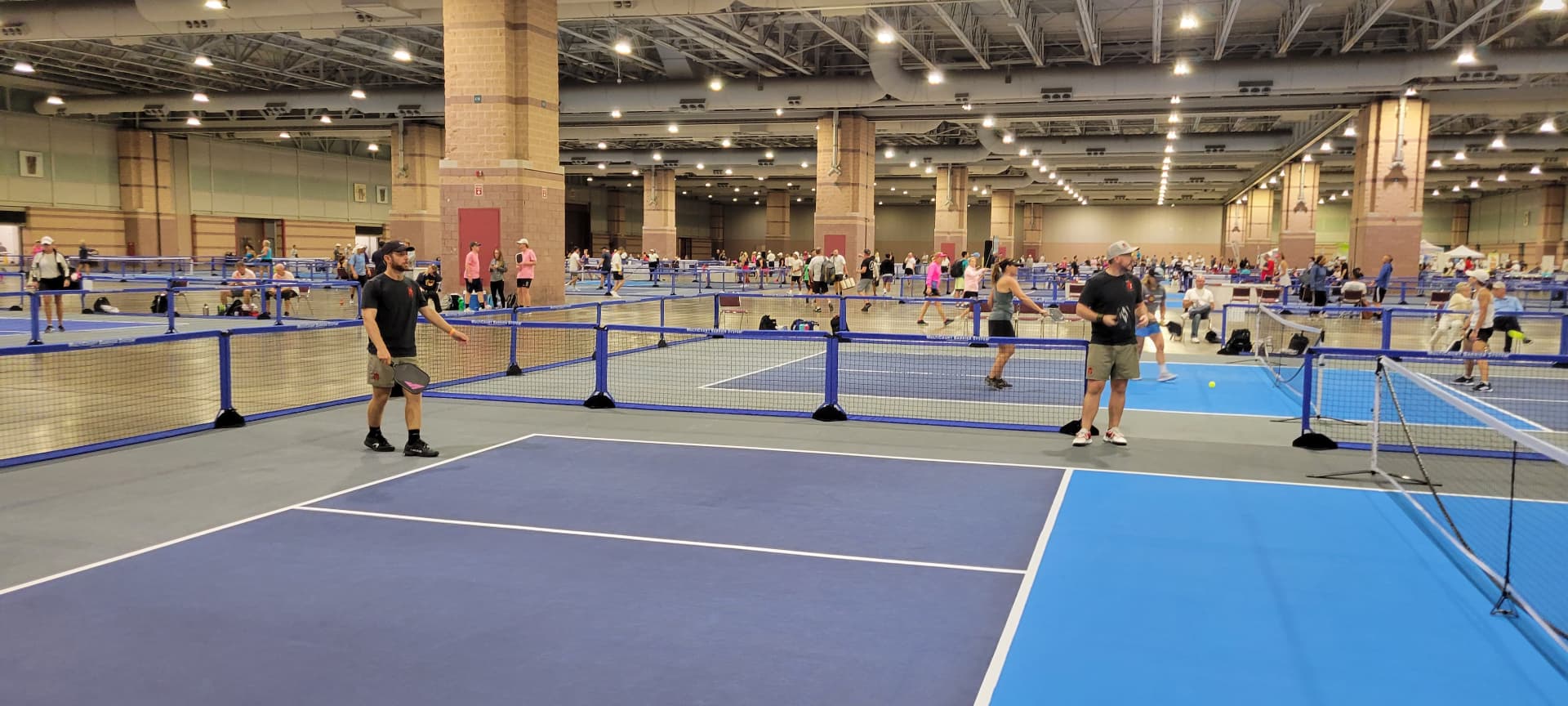
A branded court is a far more visible sponsor placement than a step-and-repeat or a table at a gala dinner — a company's name and colors are on the court itself, in every photo, for the entire event.
Sponsorship: where the real money comes from
Entry fees rarely cover the cost of running a tournament, let alone net a meaningful gift for the cause. The revenue that makes a pickleball fundraiser worth doing comes from selling sponsorship inventory before the event, structured in tiers so both a major donor and a small local business have a clear way to buy in. For the full mechanics of building a prospectus, pricing tiers, and pitching sponsors, see our dedicated guide to selling pickleball event sponsorships.
Naming rights on the event and the court itself — logo on the net, signage, and the tournament name ("[Sponsor] Cup for [Cause]"). Typically the largest single check on the event's revenue sheet.
One sponsor per court if you're running multiple — a lower price point than title sponsorship that lets mid-size local businesses buy in, and it fills sponsor inventory fast if you're running four or more courts.
Paddles, balls, water, food and beverage, or prizes donated instead of cash — reduces your hard costs and gives smaller local businesses a way to participate without writing a check.
Instead of (or in addition to) a flat entry fee, require each player or team to raise a minimum from their own network before the event — the peer-to-peer model that drives most of the revenue in charity walks and runs, adapted to a tournament.
Running the day so donors stay and give
- Pair the court with your check-in and registration table so the tournament reads as the centerpiece of the event, not a side activity happening away from the gala itself.
- Run a 10–15 minute beginner clinic before brackets start — a meaningful share of donors who buy in to play a charity tournament have never picked up a paddle, and a quick walkthrough keeps the format welcoming instead of intimidating.
- Skill divisions (beginner, intermediate, advanced) matter more here than at a corporate event — donors are paying to have a good time, not to get run off the court by the one ringer in the room.
- Build in a rain or heat contingency before you sell a single sponsorship — an outdoor date with no fallback plan is the single most common regret nonprofit event chairs report after their first tournament.
- Schedule photo and video capture deliberately — a branded court mid-rally, donors laughing, and a title sponsor's logo in frame is exactly the content a nonprofit needs for next year's ask and its annual report.
Planning a charity tournament?
Tell us your venue, headcount, and date — we'll scope a build sized to your fundraising goal, not just a headcount.
Mistakes that quietly cost nonprofits money
It's the default format for a competitive tournament, but it's the wrong one for a fundraiser — losing players go home (or worse, leave before the silent auction closes) instead of staying to spend money. A round robin or pool play keeps everyone on-site.
The tournaments that raise the most pair court time with the rest of a gala's revenue mechanics — a silent auction, a paddle raise, sponsor recognition from a stage — rather than running the pickleball as a separate, disconnected activity.
A single title sponsor and a stack of unsold court sponsorships leaves real money on the table. Price tiers so a $2,500 local business and a $25,000 regional bank both have a clear way to buy in.
Most venues — and most nonprofit boards — will ask about liability coverage for a physical activity involving donors. Settle this before you promote ticket sales, not after.
What a typical event looks like
Community-organized charity pickleball tournaments — the kind run by a local foundation using volunteers and a facility's existing courts — generally cost somewhere in the low thousands to put on, covering court time or permits, prizes, food, and printed materials, with sponsorships and peer-to-peer giving carrying most of the actual fundraising. A turnkey activation is a different scale of build: it's for a nonprofit whose gala venue has no courts at all — a hotel ballroom, a country club lawn, a downtown event space — and needs the courts, nets, staff, and full tournament run brought in and managed on one invoice. Both are the same underlying format; the difference is whether you already have a place to play or need one built from scratch.
Real organizations have built entire missions around this model — Dink For Cause exists specifically to run charity pickleball tournaments for causes across the country, and local nonprofit tournaments benefiting everything from sickle cell research to kinship-family support have become recurring annual fixtures on their community calendars. None of that is hypothetical; it's the same format nonprofits are already using, just scaled to whatever your venue and guest list look like.
Where this fits, and where it doesn't
If your event needs a structured bracket with real standings rather than casual round robin, our corporate tournament guide covers the court-count math and scheduling that applies just as well to a charity bracket. Measuring the actual return on a sponsor's investment — impressions, leads, or dollars raised per sponsor tier — is covered in more depth in our sponsor activation ROI guide. And if your gala runs into the evening, our glow-in-the-dark pickleball guide covers the lighting setup for a court that stays lively after dark, which pairs well with a live auction closing later in the night.
For the practical basics — how much space a court needs, whether to build indoors or out, and what insurance a venue will expect — see our court dimensions guide, indoor vs. outdoor guide, and insurance and liability guide. Before you sign with a vendor, our vendor checklist covers the questions that separate a real turnkey build from a facility just renting out court time. And for the full cost picture across formats and scales, our cost guide breaks down what drives pricing up or down.