Event Playbook · Fitness Clubs & Gyms
Pickleball for fitness clubs and gyms
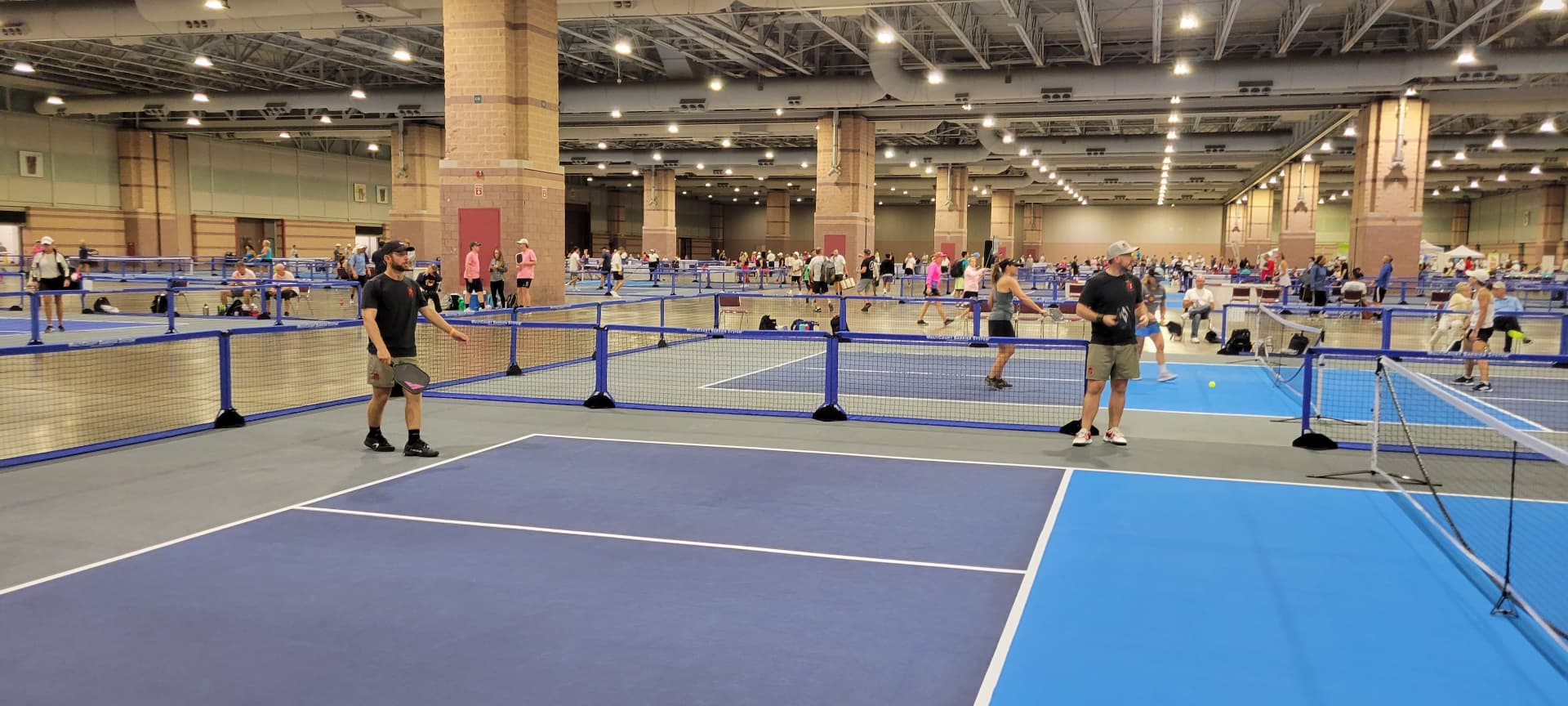
A turnkey pickleball activation gives a fitness club or gym a physical, social member or prospect event — typically as a member appreciation night, an open-house demo block, a corporate partnership evening, or an intro clinic that tests demand before any capital conversation. Courts are delivered, built, staffed, and removedso general managers and membership directors do not become equipment operators. Rollout courts install indoors on studio or multipurpose floors, or outdoors on a patio, rooftop, or temporary pad when the property allows — so the activation sits in the club's social flow, not on a remote lot members never find.
Why club operators add a court for a night (not a permanent pour)
Fitness clubs compete on programming density and community feel. The formal product — classes, trainers, floor equipment — gets people through the door. The informal moments — member nights, guest weekends, employer wellness evenings — determine whether members renew and whether prospects remember the brand after a free pass. A staffed pickleball court is one practical way to create those informal minutes on purpose, without rewriting the class grid or committing square footage to a permanent amenity before you know demand.
GMs and amenity managers already juggle AV for nutrition talks, kids' events, and trainer showcases. The value of a turnkey court package is that it arrives as a production vendor: freight, floor protection, staffing, paddles, balls, nets, and teardown are in one scope. That is the same operating model clubs already use for other experiential vendors — not a DIY kit dropped next to the free weights.
Clubs already sell classes, trainers, and locker rooms. What keeps a membership sticky is social proof — evenings when members meet each other and associate the brand with something they enjoyed. A staffed pickleball night gives the membership team a concrete event to promote on the app and at the front desk without inventing a new class format.
Prospect tours and free-guest weekends convert better when visitors do something memorable. A short hosted court block lets prospects play for a few minutes, take a photo, and leave with the club name attached to a real experience — stronger than a smoothie coupon alone.
Many clubs sell corporate membership blocks or host employer wellness evenings. A turnkey court package arrives as a production vendor: freight, floor protection, paddles, nets, staffing, and teardown in one scope — so the GM stays in membership and programming, not equipment logistics.
Boutique studios and big-box clubs both draw members who will never join a competitive league. Pickleball's low skill floor lets first-timers rotate with regulars in the same hosted block — useful when the goal is community and trial, not crowning a club champion.
Where a court fits the club calendar
Do not copy a daytime corporate tournament into a Friday peak class changeover and hope for the best. Pick the member or prospect window first, then choose a format that respects attire, childcare hours, noise near yoga rooms, and the rest of the amenity calendar.
Run a staffed court for 90–150 minutes on a weeknight or Saturday morning. Short hosted rotations beat a scored bracket — members arrive in workout clothes or jeans and want to try the sport, not wait through a tournament. Pair with a simple check-in at the desk so membership can track attendance.
Put the court where prospects already walk: lobby plaza, outdoor patio, or studio overflow floor. Keep sessions short and beginner-friendly so a guest can try a rally before their tour or after a free class. Photo and staff introductions matter more than scorekeeping.
When a local employer buys a block of memberships or sponsors a wellness evening, package the court as the experiential centerpiece. Brand hierarchy stays club-first with optional partner presence on a net band or backdrop. This sits closer to a happy-hour activation than a full corporate tournament.
A 20–30 minute staffed clinic, then hosted open play, works for clubs that want to seed a recurring interest group without committing to permanent courts yet. Good for testing demand before any capital conversation about pouring or converting space.
Boutique gyms and urban clubs often lack a dedicated court footprint. Rollout courts install on rooftops, outdoor patios, studio floors with protection, or a temporary parking-lot pad when the property allows. Indoor studio or lobby-adjacent installs are the weather-proof default.
If the brief is closer to an after-work mixer than a full member-appreciation production, compare our company happy hour guide. If leadership wants scored heats and a winner for an employer group, that is a different product — see corporate pickleball tournament. Country clubs and private clubs share some amenity politics but a different membership model — see pickleball for country clubs and private clubs. Hotels and resorts that want amenity programming without a permanent pour are covered in pickleball for hotels and resorts. Active-adult and 55+ communities with amenity calendars are in active adult and 55+ communities.
Planning a member night or open house?
Tell us the club address, dates, and approximate concurrent players — we'll scope courts, staffing, and branding that fit the member or prospect window, not take over peak class hours.
What to do (and what to skip) when you brief the activation
Do
- Scope court count to concurrent players in the event window — not total membership headcount. A 2,000-member club does not need four courts if only 24–40 people will rotate through a two-hour night.
- Site the court on the social edge of the club: patio, plaza, or studio overflow — not blocking the check-in desk, class entry, or locker corridor.
- Brief staff to run a two-minute beginner walkthrough every rotation. Many members have never played; that intro keeps the format from stalling.
- Decide branding (club wrap vs co-branded employer partner) when you lock the date so print and freight lead times do not collide with other amenity events.
- Loop facilities and risk early on floor protection, freight path, noise near yoga or childcare rooms, and outdoor plaza permissions.
Don't
- Do not drop a full bracket into a busy class changeover or lobby peak hour.
- Do not treat this as a permanent-court sales pitch — temporary activations test demand and drive events; capital builds are a separate decision.
- Do not invent published per-member pricing on the flyer; quote the activation as a turnkey line item with court count and staffing clear.
- Do not leave the court unstaffed. Unhosted open play at a membership event turns into equipment chaos and uneven wait times fast.
- Do not site the court so far from the social core that only the already-athletic members find it.
Logistics club operators ask about first
The sport is the easy part. The hard parts are freight, floor protection, noise near quiet rooms, and making sure the court does not fight the desk, the class door, or childcare pickup. Treat the activation like any other production vendor on the amenity calendar.
Fitness clubs already protect floors for specialty events. Confirm clear dimensions for the playing area plus sideline buffer, freight path from the dock or curb, and whether the court sits on rubber gym flooring, concrete, patio pavers, or an outdoor pad. USA Pickleball defines the regulation playing area as 20×44 feet; recommended minimum total play area is about 30×60 feet, with a preferred envelope around 34×64 feet when space allows.
Member nights and open houses often lock onto existing amenity calendars weeks ahead. Book the court activation as soon as the date and footprint are firm — ideally a few weeks out — so load-in, staffing, and any partner brand production clear other events (kids' night, nutrition seminar, trainer showcase).
Expect facilities or the landlord to ask for a certificate of insurance naming the club or property. Build that into the vendor checklist alongside floor protection and teardown windows. Treat the court like any other experiential vendor the club already books.
Give the front desk a simple script: where the court is, who is staffing it, and whether guests need a day pass. If the night is members-only, say so on the app push. If guests are welcome, decide check-in and waiver flow before doors open.
Deeper references: court dimensions for events, indoor vs outdoor rental, event staffing, surface and subfloor requirements, and how far in advance to book. Space math from USA Pickleball's construction guidance (regulation playing area 20×44; recommended minimum total play area about 30×60, preferred about 34×64) is also summarized in our dimensions guide — always confirm the live property drawings with facilities.
Membership size to court count
One court supports four players at a time. Member-night and open-house throughput comes from short hosted rotations, not from matching court count to every name in the membership database. Size to the concurrent players you want active during the window — not the full club headcount on the CRM export.
Usually 1 court with strong hosting. Throughput comes from short rallies and a clear queue — not from covering every member at once.
1–2 courts for a member night or open house is a common working range when pickleball is one of several evening options. Scale only if you want a simultaneous tournament feel or a large corporate block.
Same single-court package rotating across locations keeps the brand experience consistent without each site inventing its own DIY kit. Ask for multi-date scoping when you brief.
For a fuller sizing walkthrough, see how many pickleball courts you need. Format choices (round robin vs bracket vs open play) live in event format options.
Temporary activation vs permanent amenity courts
Clubs sometimes ask whether a one-night activation is a distraction from pouring permanent courts. They solve different problems. A temporary, staffed night answers: will members and prospects show up for this, and does our calendar have room for it? A permanent amenity answers: will we dedicate square footage, staffing, and maintenance budget year-round? Many operators use the temporary path first — gather attendance and feedback — then decide. When you are ready to compare paths side by side, read permanent court vs event rental. This page stays on the event-activation side: deliver, staff, remove.
Open houses, free-guest weekends, and prospect conversion
Prospect events fail when the guest only walks the floor and leaves with a rate card. A short hosted court block gives the sales team a reason to linger with a guest after a tour or free class — five minutes of play, a photo, a staff intro — without forcing a hard close on the court itself. Keep brand hierarchy club-first. If a local employer or drink sponsor wants presence, keep it secondary on a net band or backdrop so the guest still remembers which gym they visited. For brand-activation briefs that sit outside a membership club, see brand activations and product launches.
Corporate partnership and employer wellness nights
Clubs that sell corporate membership blocks often need a night that feels like hospitality, not another Zoom wellness webinar. A staffed court is a concrete unit the B2B sales team can put on a proposal: date, window, court count, and optional co-brand. Keep the format inclusive — short rotations, beginner walkthroughs — so the employer's mixed-fitness workforce can join. Pure competitive brackets belong in a different brief; start with corporate pickleball tournament only when the buyer explicitly wants scored heats.
Indoor studio vs outdoor patio and rooftop
Outdoor patio and rooftop installs look strong in membership marketing photos and keep ball noise out of concurrent classes — but they add weather contingency, surface assessment, and sometimes landlord or municipal permissions. Indoor studio, multipurpose, or lobby-adjacent installs are the weather-proof default and usually easier to lock with facilities. Hybrid plans work well: primary indoor court for the must-run member window, optional outdoor court if the patio and forecast cooperate. Compare surface and contingency planning in indoor vs outdoor rental, surface and subfloor requirements, and weather contingency planning.
Pricing honesty for club and amenity buyers
We quote turnkey activations as a scoped line item — not a fake per-member menu. A single-court, one-day activation typically begins around $10,000. Multi-court and multi-day builds move into the mid-five and six figures, depending on court count, staffing hours, partner brand production, travel, and venue rules. Compare the drivers that move a quote up or down in our pickleball court rental cost guide, then request a quote with club address, dates, and concurrent-player target.
Boutique studios vs multi-location fitness brands
A single boutique studio often needs one court and a tight membership ops brief. Multi-location brands sometimes want the same look across markets — same wrap standards, same staffing model, same run-of-show — without each GM inventing a DIY kit. Portable packages support both: a one-night local install, or a scoped multi-date plan when the brand calendar already includes regional member weeks. If the brief is literally a multi-city tour, start with national multi-city activation tour. Apartment and multifamily amenity events share some logistics with residential clubs — see apartment and multifamily resident events.
How to brief us (what we need in the first email)
A clean first brief shortens quote turnaround. Send the items below and we can usually return a scoped option set quickly — without forcing you through a vague discovery call first.
- Club name, address, and whether the activation is indoor studio/multipurpose, lobby-adjacent, outdoor patio/rooftop, or temporary parking-lot pad.
- Event date(s), the exact member or prospect window(s), and whether peak class changeovers must stay clear of the court.
- Approximate concurrent players you want active (not total membership headcount).
- Whether this is members-only, open-house/guest-friendly, a corporate partnership night, or a mix.
- Brand standards: club-only wrap vs co-branded employer or sponsor presence.
- Whether this is a one-location night or includes additional sites on the same brand calendar.
For a general add-pickleball framework that is not club-specific, see how to add pickleball to your event. Run-of-show timing templates live in event run-of-show template. If procurement needs a formal RFP, use how to write an RFP for a pickleball event.
What success looks like after the member night
The court is a means, not the KPI. Club-event success shows up in attendance, guest-to-tour conversion, membership feedback, and whether the B2B team leaves with a partner story. Use the activation the same way — collect photo and video assets for the app and email, note which member cohorts mixed on court, and give sales a concrete open-house anecdote. For measurement frames that stay honest when a partner is involved, our sponsor activation ROI guide outlines what is realistic to track without inventing vanity metrics.