Corporate Events · After-Work
Pickleball for company happy hour
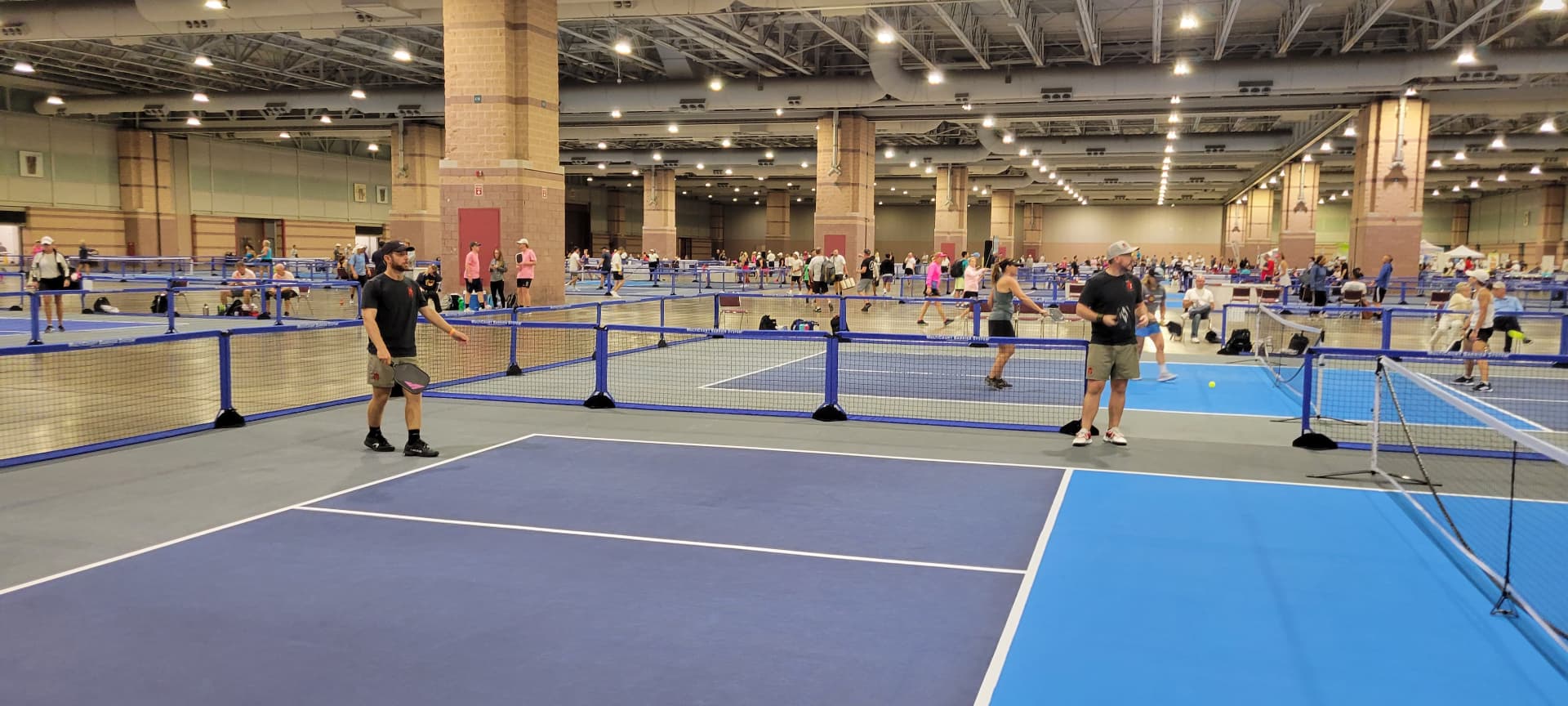
A pickleball happy hour is a 2–3 hour after-work build — one or two staffed courts running casual, rotating rallies at your office, a rooftop, or a nearby brewery patio, paired with the drinks and snacks of a normal happy hour. It's lighter and cheaper than a full corporate event, works well as a recurring monthly or quarterly series rather than a one-off, and mixes departments in a way that standing around a bar tab usually doesn't.
Why this beats a standard happy hour
A standard happy hour clusters people who already sit together. A court forces rotation — you're paired with whoever's up next, not just your own team — which does more for cross-department familiarity than an open bar by itself.
Studies on workplace social time consistently link informal team activities to measurably higher productivity and lower voluntary turnover — the effect isn't huge from one evening, but it compounds when the habit is regular rather than a once-a-year gesture.
A happy-hour build runs 2–3 hours instead of a full-day activation, which keeps both the staffing footprint and the cost lower than a tournament or field day — useful if you want something recurring rather than a single annual splurge.
The court doesn't replace drinks and snacks — it gives people a reason to put the drink down for ten minutes and talk to someone new, then head back to the bar. The two work in rotation, not competition.
Formats that work
One or two courts on an office rooftop, patio, or courtyard — the lowest-lift version, since you're not booking an outside venue at all.
Run the happy hour at a local brewery or taproom with a pop-up court in their lot or patio — the venue gets foot traffic, your team gets drinks and a court in one stop. See our brewery and entertainment venue work for how that side of the booking works.
Rather than a single one-off, some companies run this as a standing after-work series — same format, rotating month to month, which is where the team-familiarity effect compounds the most.
The same format works externally — a lighter, more social alternative to a dinner or a golf outing when you're building relationships with clients rather than just your own team.
Booking the brewery or taproom format specifically? Our pickleball for breweries and taprooms guide covers patio and lot logistics, staffing for a crowd holding drinks, and the insurance considerations that come with alcohol on-site.
What it costs
A happy hour follows the same underlying pricing logic as any turnkey build — see the full cost guide for the complete list of drivers — but the shorter window and lighter staffing keep it well below a full-day corporate event.
| Scope | What drives the price |
|---|---|
| One court · office rooftop or patio · 2–3 hours | Lower than a full-day activation — ask for a happy-hour rate |
| Two courts · larger headcount · 2–3 hours | Scales with court count, not guest count |
| Recurring monthly or quarterly series | Quoted as a standing rate, typically lower per event than four separate one-off bookings |
Guest count doesn't move the price the way it does for catering — a court supports a rotating stream of players over a couple of hours whether 30 or 150 people show up, so the number that actually matters to your quote is court count and hours, not headcount. That's worth knowing before you over-order courts to "make sure everyone gets a turn" — one well-staffed court with good rotation usually keeps more people playing over the course of the evening than two under-staffed ones.
Getting the logistics right
- Keep it to one or two courts for a typical office headcount — a happy hour isn't trying to run everyone through a bracket, just keep a rotation of casual games going for a couple of hours.
- Staff runs quick, informal rallies and mixes up pairings rather than letting cliques form on one court for the whole evening — that rotation is most of the point.
- Plan the court near the bar or lounge area, not in a separate room — people should be able to wander over mid-conversation, not have to choose the court over the crowd.
- If it runs past sunset, add lighting or go with glow paddles and balls rather than ending the activity when the sun does — see our night-play equipment guide for what that setup needs.
Planning your next after-work event?
Tell us your headcount, city, and venue — we'll scope a court and staffing that fits a couple of hours, not a full day.
One-off vs. recurring — which to book
A single happy hour is a fine way to test the format — low commitment, easy to schedule around an existing after-work tradition. But the research on informal team socializing points the same direction our own repeat clients do: the payoff compounds with repetition. A monthly or quarterly series builds the kind of cross-team familiarity a single night can only start. If your budget only supports one booking a year, it's worth asking whether that budget is better spent on four smaller happy hours than one bigger event — smaller and more frequent usually beats bigger and rarer for this specific goal.
That said, a recurring series isn't the right call for every team. If the goal is a single big, memorable moment — a milestone, an anniversary, a one-time thank-you — a bigger one-off build makes more sense than splitting the same budget across several smaller nights. Match the format to the goal rather than defaulting to whichever one worked for the last company you heard about.
Which teams get the most out of this
This format tends to land best with teams that already have some kind of after-work social habit — a standing Thursday happy hour, a monthly team lunch, a Friday wind-down — and want to make one of those occasions more memorable rather than inventing a new tradition from scratch. If your team has no existing social rhythm at all, a single pickleball happy hour probably won't create one on its own; it works better as an upgrade to a habit that's already there than as the seed of a new one.
Distributed and hybrid teams get a smaller version of the benefit, since the court only reaches whoever's in the building or willing to come in that evening. It's still worth running for the people who do show up, but don't expect it to substitute for whatever your company does to keep remote employees connected — that's a separate problem a single after-work event isn't built to solve.
Timing matters more than most planners think. Late spring through early fall gives you daylight and decent weather for an outdoor build without needing lighting; a winter happy hour usually means booking an indoor space or planning for glow paddles and string lighting if you want to stay outside after dark. Either works — it's just worth deciding before you pick a date, not after.
Where this fits, and where it doesn't
A happy hour is the shortest, most casual format we build — a lighter cousin of our company summer picnic and corporate field day guides, both of which run longer and add more structured programming. If the goal is a specific recognition occasion rather than a standing social habit, see our Employee Appreciation Day guide instead. And if you're weighing this against a golf outing or another traditional client-entertainment format, our golf outing alternative guide covers that comparison directly.
Booking at a brewery, taproom, or outside venue rather than your own office? Confirm their insurance requirements early — our insurance and liability guide covers what most venues ask for before load-in. And if you want the internal case for why this line item is worth the recurring budget, our team-building ROI guide covers what the research actually supports.