Pickleball Event Ideas for Planners, Agencies & Venues (2026)
By The Pickleball Events Co. team · Updated
The short answer
Start from what the client wants the event to do, then pick the concept. For team culture, run an onboarding clinic or a department cup. For client hospitality, a clinic and mixer with host-and-client pairs, or a pickleball outing in place of golf. For conferences, courts at the welcome reception, a booth skills challenge or morning open play. For brands, a product-launch court, a festival pop-up or a glow-in-the-dark night session. For venues, a resort weekend tournament or a league night. For a cause, a charity tournament or a rally-for-a-cause challenge. Every one of them runs on a temporary court we deliver, build, staff and remove.
Who this list is for
This page is written for people who plan events for someone else: agencies, destination management companies, incentive and meeting planners, in-house event teams, and venues that program their own space. You probably already know pickleball is popular. The harder question is what to actually put in the proposal, and how it changes the run of show, the floor plan and the budget.
Popularity is real and broad. The Sports & Fitness Industry Association's 2026 Pickleball Single Sport Report counts 24.3 million Americans who played in 2025, up from 4.2 million in 2020. Women made up 42.9% of players, and people aged 13 to 24 had the highest participation rate of any age group. For a planner, that mix means two things at once: a good share of any corporate crowd has played, and a large share has not. The concepts below are built for that split. See our pickleball statistics page for more of the participation data.
What decides which idea fits
- The client's goal: participation, conversation, rivalry, traffic, repeat visits or money raised
- Headcount and how firm it is, because one court plays four people at a time
- The time window and what guests will be wearing
- Space: about 30 × 60 ft per court for an event build, indoors or out
- Season and weather exposure for outdoor builds
- Staffing: coaches, court hosts and scorekeepers, depending on the concept
Quick-pick table
| Idea | Best fit | Category |
|---|---|---|
| Onboarding clinic day | New-hire cohorts, culture days, return-to-office pushes | Team and culture events |
| Department cup | Offsites and sales kickoffs that want rivalry | Team and culture events |
| Wellness-day drop-in courts | Benefits fairs, wellness weeks, open campus days | Team and culture events |
| Summer picnic or field-day court | Family-friendly company picnics and field days | Team and culture events |
| Client appreciation clinic and mixer | Account teams, wealth managers, agencies hosting clients | Client and hospitality events |
| Golf-outing alternative | Groups where only a few people golf | Client and hospitality events |
| Play-with-a-pro session | VIP tiers, top-client programs, incentive winners | Client and hospitality events |
| Welcome-reception courts | Opening night of a conference or association meeting | Conference and trade-show programming |
| Booth skills challenge | Exhibitors who need traffic and lead capture | Conference and trade-show programming |
| Morning open play at a multi-day meeting | Three-day conferences, user summits, annual meetings | Conference and trade-show programming |
| Product-launch court | Consumer brands, sporting goods, beverage and lifestyle launches | Brand activations and public events |
| Festival or street-fair pop-up | City festivals, downtown districts, sponsor villages | Brand activations and public events |
| Glow-in-the-dark night session | Evening activations, after-parties, resort nights | Brand activations and public events |
| Resort weekend tournament | Hotels and resorts filling shoulder-season weekends | Venue programming |
| League night at a brewery or taproom | Breweries, taprooms, entertainment venues | Venue programming |
| Charity tournament | Nonprofits, foundations, corporate CSR teams | Fundraising and giving back |
| Rally-for-a-cause challenge | Volunteer days, sales meetings with a CSR element | Fundraising and giving back |
Team and culture events
Briefs here are about people who already work together. The measure of success is participation and mixing, not who wins, so favor concepts that put first-timers on court quickly.
1. Onboarding clinic day
Best fit: New-hire cohorts, culture days, return-to-office pushes
A short coached clinic followed by games with partners drawn at random. New hires learn a game together instead of sitting through another icebreaker, and the random draw pairs them with people outside their team. It works because pickleball is quick to learn: the serve is underhand and most beginners are rallying within a session.
More detail: onboarding and culture days
2. Department cup
Best fit: Offsites and sales kickoffs that want rivalry
Departments or regions compete as squads with captains, a running scoreboard and a trophy. Leaders get a real role setting lineups. Mix departments inside squads if the brief is breaking silos; keep them intact if it is building pride.
More detail: team-building formats compared
3. Wellness-day drop-in courts
Best fit: Benefits fairs, wellness weeks, open campus days
Courts open for drop-in play on a timed rotation while the rest of the wellness program runs alongside. Low commitment, no sign-up stress, and easy to staff with a court host who keeps games moving and loans paddles.
More detail: wellness days and benefits fairs
4. Summer picnic or field-day court
Best fit: Family-friendly company picnics and field days
One or two courts as an anchor attraction among lawn games, food and kids' activities. Plan for children and adults sharing courts, which means junior-friendly balls and paddles and a host who manages who is up next.
More detail: company summer picnics
Client and hospitality events
Here the client is the guest. The court is a reason for a relaxed conversation, so comfort, pacing and a polished build matter more than competition.
5. Client appreciation clinic and mixer
Best fit: Account teams, wealth managers, agencies hosting clients
A clinic for mixed host-and-client pairs, then short social games, then food. Pairing a host with a client on the same side of the net is the point: it turns the court into a conversation, not a contest.
More detail: client entertainment and hospitality
6. Golf-outing alternative
Best fit: Groups where only a few people golf
A half-day pickleball outing replaces the five-hour round. More guests can take part, it fits in a hotel parking area or lawn, and it ends with the same reception. Useful when the invite list has a wide age and ability spread.
More detail: pickleball as a golf-outing alternative
7. Play-with-a-pro session
Best fit: VIP tiers, top-client programs, incentive winners
A teaching pro runs a small-group session for a short guest list, then plays a few points with each group. Scope the pro's role and time in writing, and keep groups small so every guest gets court time.
Conference and trade-show programming
Attendees are in business clothes, on a schedule and walking past. Concepts here need short windows, a visible draw and fast turnover.
8. Welcome-reception courts
Best fit: Opening night of a conference or association meeting
Courts beside the reception space give people something to do in the first awkward hour. Keep games short and casual, have paddles ready, and put the bar where spectators can watch.
More detail: conference networking receptions
9. Booth skills challenge
Best fit: Exhibitors who need traffic and lead capture
A half court or full court in the booth with a 60-second challenge: serves to targets, a dink count, a reaction volley. Scores go on a leaderboard and entries are scanned, so the activity feeds the sales team's lead list.
More detail: trade-show booth activations
10. Morning open play at a multi-day meeting
Best fit: Three-day conferences, user summits, annual meetings
Courts open before general sessions and at lunch, with a court host and a sign-up sheet. It gives attendees a recurring reason to meet outside the session rooms, and it fills dead time in the agenda.
More detail: multi-day conference programming
Pitching one of these to a client?
Send the date, city, venue, headcount and the concept you like. We'll come back with court count, a floor-plan footprint and a written scope you can drop into your proposal. White-label is available for agencies.
Get a QuoteBrand activations and public events
The audience is the public or a target customer, and the court is a stage for the brand. Visibility, photos and lead capture drive the design.
11. Product-launch court
Best fit: Consumer brands, sporting goods, beverage and lifestyle launches
A branded court in a high-traffic spot where people try the product as part of play: a new paddle, a drink, an apparel line. Pair it with content capture and a reason to share.
More detail: brand activations and product launches
12. Festival or street-fair pop-up
Best fit: City festivals, downtown districts, sponsor villages
Courts as a free attraction within a larger event, often sponsor-funded. Expect a steady stream of walk-ups who have never played; short games and a visible queue system keep it fair.
More detail: city festivals and street fairs
13. Glow-in-the-dark night session
Best fit: Evening activations, after-parties, resort nights
UV-reactive lines, glowing balls and controlled lighting turn an ordinary court into a night event. It needs real planning around power and darkness, so check the venue early.
More detail: glow-in-the-dark pickleball for events
Venue programming
For hotels, breweries, shopping centers and clubs, the goal is repeat visits. Recurring concepts beat one-off spectacles here.
14. Resort weekend tournament
Best fit: Hotels and resorts filling shoulder-season weekends
A guest tournament over a weekend, with a clinic on day one and a bracket on day two. It gives the property something to market and a reason for groups to book together.
More detail: hotels and resorts
15. League night at a brewery or taproom
Best fit: Breweries, taprooms, entertainment venues
A weekly social league on a temporary or seasonal court, with teams that come back every week and stay for food and drinks. Waivers and alcohol policy need to be settled before the first night.
More detail: breweries and taprooms
Fundraising and giving back
Any concept above can carry a cause. These are the two that are built around one.
16. Charity tournament
Best fit: Nonprofits, foundations, corporate CSR teams
Teams pay an entry fee or raise pledges, with sponsor-branded courts and a short bracket. Decide early whether the format rewards fundraising or play, and agree donation mechanics in writing.
More detail: nonprofit fundraisers and charity galas
17. Rally-for-a-cause challenge
Best fit: Volunteer days, sales meetings with a CSR element
Every rally of a set length, or every point scored across all courts, triggers a donation the company has already committed to. Non-players become counters and cheerleaders, so the whole group has a role.
Space, courts and timing: the planning math
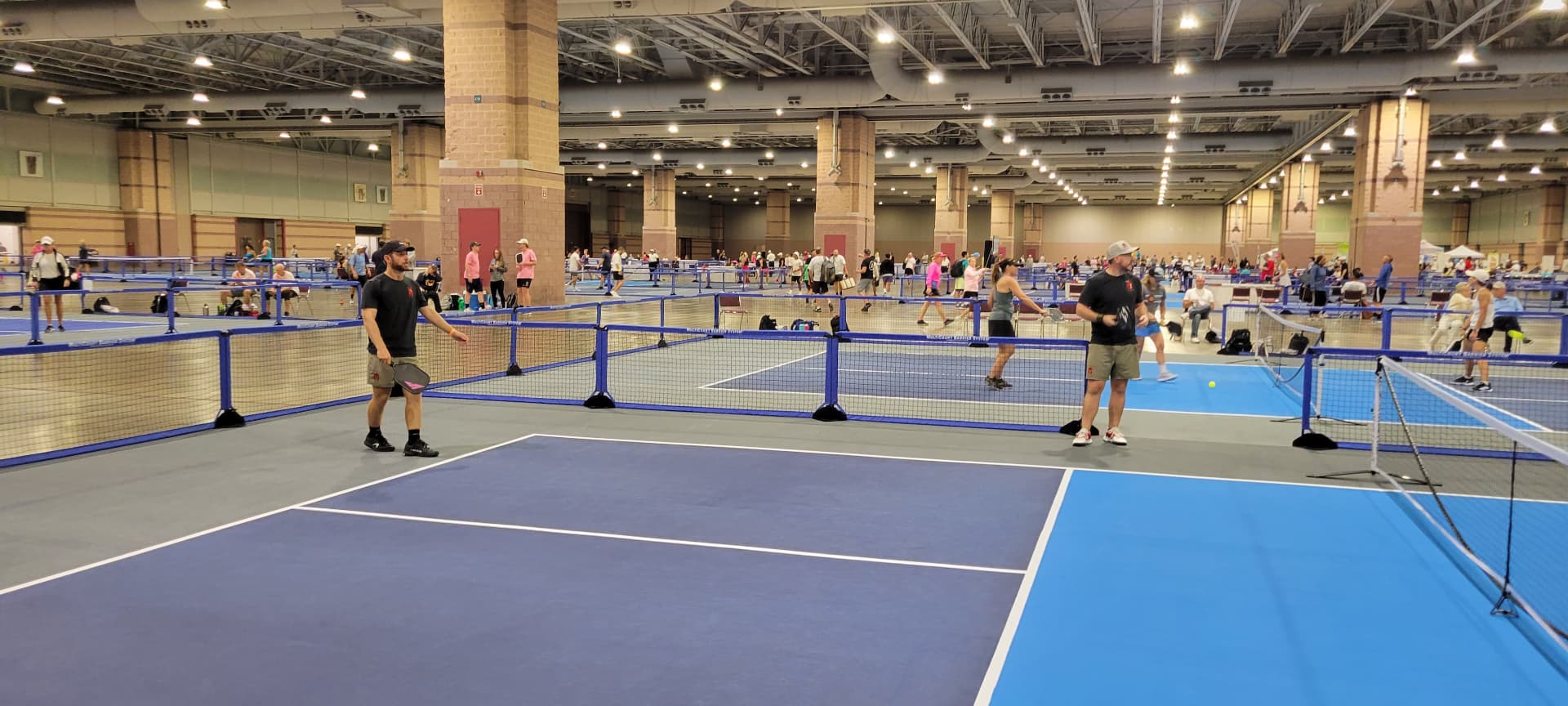
Every idea above starts with the same unit. A pickleball court is 20 feet wide by 44 feet long under USA Pickleball rules, the same for singles and doubles. An event build needs room around the lines for safe play, spectators and circulation, so plan about 30 by 60 feet per court, roughly 1,800 square feet. That footprint is what you check against a ballroom, a parking area, a lawn or an exhibit-hall booth. Our court dimensions for events guide shows how that translates to common venue types.
Headcount sets the court count. Doubles puts four people on a court; the rest are waiting. For drop-in concepts such as wellness days and festival pop-ups, waiting is fine as long as there is a visible queue and something to watch. For structured concepts like a department cup, long waits kill the energy, so add courts, shorten games or add a skills station. Our court-count guide works through the numbers by headcount and time window.
Time matters in two places: on the day and before it. On the day, build and teardown windows have to fit the venue's load-in schedule, which is often tighter in hotels and convention centers than outdoors. Before the day, branded courts and custom signage need lead time for artwork approval and production. See the setup and teardown timeline for typical sequences.
Staffing by concept
The right staff is what separates an event people enjoy from a court nobody uses. Clinics need coaches who can teach a nervous beginner quickly. Drop-in and open-play concepts need court hosts who keep a fair rotation and hand out paddles. Tournaments and cups need scorekeepers and someone owning the schedule. Booth challenges need a host who can run the challenge and capture the lead in under two minutes. When you compare vendors, ask who runs the concept on the day, not only who delivers the court. Our event staffing guide lists the roles.
Mistakes that sink good ideas
- Choosing a competitive bracket for a group that is mostly beginners. Half the room is done after one game.
- Sizing the venue to the 20 × 44 ft lines instead of the roughly 30 × 60 ft event footprint.
- Planning a full-game concept for guests in conference attire. A skills challenge or short clinic fits better.
- Leaving waivers, insurance and the venue's certificate-of-insurance requirements until the last week. See our insurance and liability guide.
- No weather plan for an outdoor build. Decide the rain call and the backup space when you book.
- Forgetting the spectators. Seating, shade, drinks and a view of the court keep non-players part of the event.
Send us the brief
Share the date, city, venue, headcount and the idea you want to run. We'll recommend court count and format, and send a written scope.
Related: how to add pickleball to your event · incentive travel and DMC programs · white-label for event agencies · pickleball court rental cost
Sources: SFIA, 2026 Pickleball Single Sport Report release (June 4, 2026); USA Pickleball rules summary (court dimensions). Accessed October 26, 2026.