Corporate Events · Seasonal
Pickleball for a company summer picnic
By the The Pickleball Events Co. team · Updated · Originally published
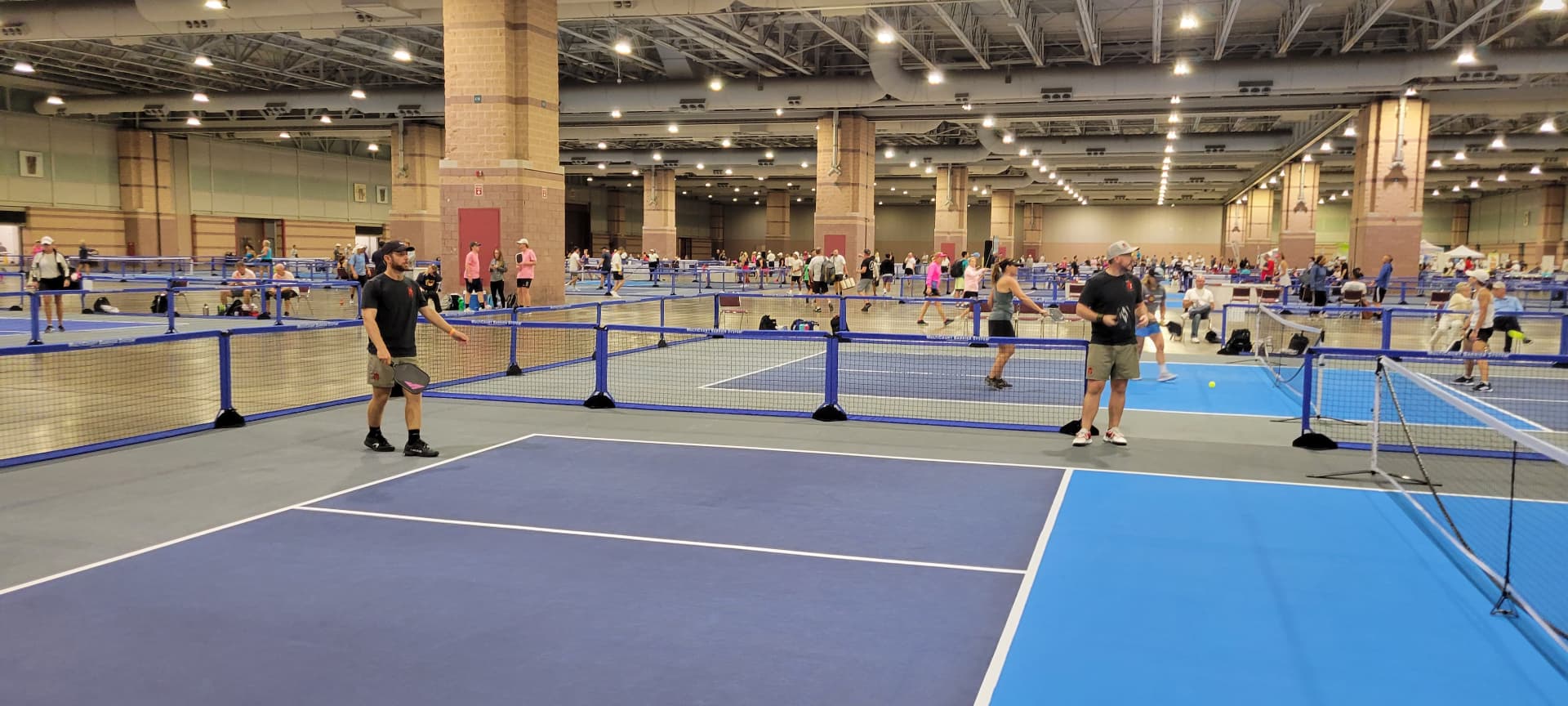
At a company summer picnic, pickleball works best as a self-serve activity zone running continuous open play — not a scheduled bracket — so people can walk up between food, conversation, and the other activities on their own time. One staffed court is usually enough for a picnic-scale crowd, positioned near shade and the buffet rather than competing with them, and paced for a mix of coworkers, plus-ones, and sometimes kids.
Why a picnic needs a different format than a field day
The same court hardware can serve a field day, a tournament, or a picnic — but the programming has to match how people actually move through the day. Force a bracket onto a picnic and you fight the social rhythm the event was designed for.
Unlike a field day built around timed stations, a picnic is usually a loose, all-day open house — people arrive whenever, eat whenever, and wander between activities on their own clock. A court that runs continuous open play fits that rhythm; a scheduled bracket fights it.
A picnic often includes plus-ones, kids, and people who'd never sign up for a competitive tournament. A court anyone can walk up to for five minutes works better than a format that assumes everyone opted into a full game.
A picnic's center of gravity is the food line and the shaded seating, not the activities. A single well-placed court draws people over between plates, rather than pulling the whole crowd away from the tables the way a big scheduled event would.
Picnic attendance is staggered, not simultaneous. One staffed court that stays busy looks intentional. A second empty court next to it reads as overbuild — save the second court for a field day or tournament where the headcount actually fills it.
Where it fits alongside the rest of the picnic
Treat pickleball as one station in a zone mix, not the headline act. The goal is more \"I wandered over and played for ten minutes\" than \"I blocked two hours for a tournament.\"
- Low-pressure lawn games — cornhole, giant Jenga, bocce — work as easy walk-up stations because there's no commitment and no learning curve. A staffed pickleball court fits that same logic once rotations stay short and coaching stays light.
- A volleyball tournament or Office Olympics bracket can give the picnic a competitive spine if you want one. Keep pickleball as open play beside it unless a group specifically asks for a light bracket later in the afternoon.
- The moments people remember are often unplanned — a spontaneous rally between two coworkers who've never met draws a crowd the way a scheduled station rarely does. Staff who mix strangers into the same game create those moments on purpose.
- Photo booths and branded backdrops are a picnic staple for a reason: they give people something to do without deciding to do it. A court next to one, or with a quick photo beat after a short rally, works the same way.
Planning this year's picnic?
Tell us your venue, rough headcount, and whether kids or plus-ones are invited — we'll scope a court that fits the day without taking it over.
Placement: near food and shade, not across the field
Most picnic failures with a court are layout failures, not format failures. If walking to the court feels like a side trip, people stay in the shade with a plate and never come back.
- Put the court where people already circulate — within a short walk of food, shade, and bathrooms — not across a parking lot or down a hill from the pavilion.
- Leave a spectator buffer. Picnic crowds stand and watch; if the only standing room blocks the path to the buffet, the court creates friction instead of energy.
- Confirm the surface before the date locks. Grass and uneven ground need a subfloor under a rollout court to play true; paved lots and sport pads install more simply. See the surface and subfloor guide before promising a venue that can't support play.
- Keep water and shade at the court, not "somewhere on the lawn." Summer picnic energy drops fast in direct heat, and a court people can step away from easily gets more repeat visits.
Surface details — what grass, gravel, and pavement each need — are covered in our surface and subfloor guide. If you are still choosing between an outdoor lawn and a pavilion, our indoor vs. outdoor guide and venue selection guide help you decide before the catering deposit is nonrefundable.
Family, plus-ones, and mixed skill levels
Summer picnics are where \"employees only\" often becomes \"employees plus people who have never held a paddle.\" That is a feature if you plan for it — and a source of awkward court hogging if you don't.
- Tell the activation team in advance if kids or plus-ones are invited. Staff can run a shorter, slower walkthrough for younger or first-time players without turning the court into a kids-only space.
- Pickleball's low skill floor is why it works for mixed-age picnics — most kids and non-athletic adults are rallying within a few minutes with light coaching. Keep paddles and balls sized for mixed play rather than tournament gear only.
- Set a simple rule for ages and supervision so parents aren't guessing. A clear "kids with an adult on court" line prevents awkward moments without a long policy document.
- If the picnic serves alcohol, treat the court like any physical activity next to a bar: staff should not put visibly intoxicated guests into live play, and waivers matter more than at a dry office field day.
Staffing is what keeps mixed groups comfortable. A host who runs short rotations and coaches lightly does more for picnic energy than a silent net sitting on the lawn — see our event staffing guide for roles and ratios, and our insurance and liability guide if alcohol is part of the picnic.
Heat, weather, and keeping play comfortable
A July or August picnic on an open lawn is a different physical environment than a spring field day. Direct sun, asphalt heat, and midday humidity will empty a court faster than any programming mistake. Build water and shade into the footprint from the start, shorten rotations when the heat index climbs, and decide in advance what \"pause play\" looks like so staff are not improvising in front of guests.
For the full checklist, use our heat safety and hydration planning guide. If storms or extreme heat could force a backup plan the same afternoon, pair it with our weather contingency guide.
Day-of run of show (picnic edition)
- Arrive early enough for build and a quiet test rally before guests show up — picnic food trucks and catering often claim the best flat space first if you don't stake the footprint.
- Open with continuous open play, not a kickoff speech. Guests arrive in waves; a court that is already "on" when the first people walk over outperforms a delayed official start.
- Staff rotate players in short windows so beginners aren't trapped in a long game and confident players don't monopolize the court for an hour.
- Have a heat plan: shorten rotations, force water breaks, and know when to pause play if the afternoon turns brutal. Link the court to shade and hydration from the first layout sketch, not as an afterthought.
- Tear-down timing should match park or campus rules. Many picnic venues want the lawn clear before evening events or sprinkler cycles — put that in the run-of-show, not the night-before text thread.
For a printable sequence you can hand to an ops lead, see our run-of-show template and setup and teardown timeline. Picnic venues are often parks or campuses with hard end times — build those into the quote, not the day-of scramble.
What it costs for a picnic-scale build
Pricing follows the same drivers as any turnkey activation: court count, hours on-site, staffing, and whether the surface needs a subfloor. A single-court, one-day activation typically begins around $10,000; multi-court or multi-day builds move into mid-five figures and beyond depending on scope. A picnic rarely needs the high end of that range if you stick to one staffed open-play court near the main footprint. For the full breakdown of what moves a quote, see our activation cost guide and court-count guide.
When a picnic court is the wrong call
Skip a full court if the venue cannot clear a regulation footprint plus runoff without blocking food service or ADA paths. Skip a bracket if the invite already promises a casual family afternoon — you will spend the day herding people who did not opt into competition. And if what you really want is a structured multi-station day with scores and departments, you are planning a field day, not a picnic — use the corporate field day guide instead of forcing picnic branding onto a tournament build.
If the goal is a smaller, more frequent social format rather than one big annual lawn day, compare notes with our company happy hour guide. If leadership wants a real competitive finale, our corporate tournament guide is the right playbook. For the ROI conversation behind any of these formats, see team-building ROI.