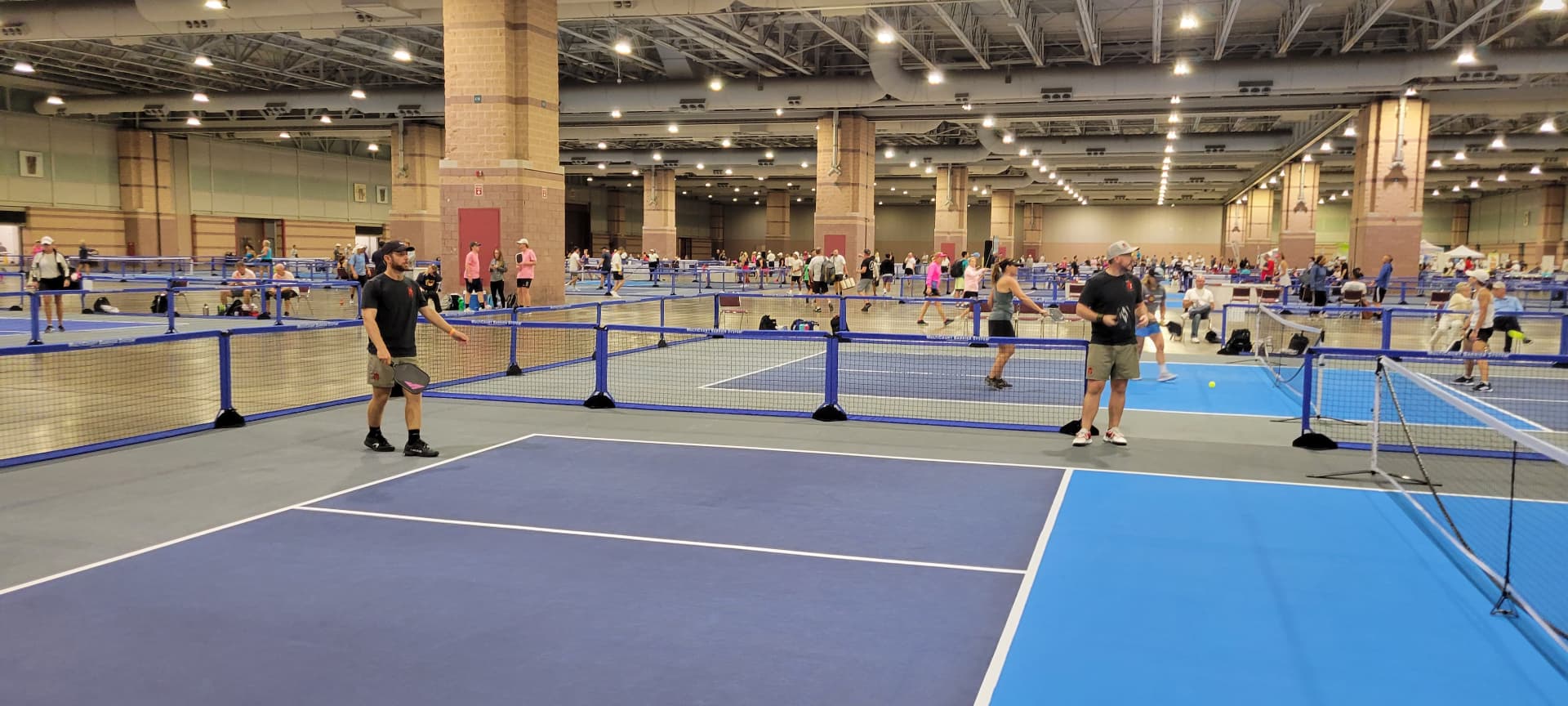
Festivals & Community Events
Pickleball for city festivals and street fairs
A turnkey pickleball activation gives a downtown street fest, city festival, or community day a watchable, playable centerpiece that doesn't require any permanent change to the site. Rollout courts install on a closed street, a parking lot, or a park lawn and come down the same day — booked and staffed the same way as any other festival vendor, priced by court count and footprint rather than attendance.
Why festival organizers are adding a court
Cities have been running full downtown pickleball street festivals for a few years now, not just a single booth at an existing event. Louisville's Downtown Pickleball Street Fest, produced by the Louisville Downtown Partnership, has closed E. Main Street for competitive play, open play, food trucks, and a wellness expo for three years running. CityPickle and the Times Square Alliance turned Times Square Plaza into a free public pickleball venue for five straight days. Davenport, Iowa closed a stretch of West 3rd Street downtown for the Urban Pickleball Classic, combining courts with live music and a full street-fair footprint. Pittsburgh's Picklesburgh has run for multiple summers as a dedicated festival built entirely around the sport. None of that is a coincidence — it's downtown organizations and city departments recognizing that pickleball draws a crowd that skews younger and more active than a typical street-fair audience, without needing a headline musical act or a beer garden to do it.
Not every event needs to be pickleball-branded top to bottom the way those flagship festivals are. Most of our festival bookings are a single activity zone inside a broader street fair, food festival, or community day — the court is one attraction among several, not the whole event. That's the more common ask, and it's the one this page is built around.
What makes it work at a festival specifically
You're not introducing an unfamiliar activity to a skeptical crowd. A large share of festival-goers have already tried pickleball or know someone who has, so a court on Main Street reads as "of course this is here" rather than a confusing novelty booth.
A closed street, a parking lot, or a grass festival field all work with rollout courts and — where the surface needs it — a subfloor system underneath. Nothing gets painted, striped, or altered, and the street reopens to traffic the same day the court comes down.
Unlike a lot of festival programming that's either a spectator stage or a hands-on booth, a pickleball court does both — a rally draws a crowd to watch, and the next open slot pulls three of those onlookers onto the court. That loop is what keeps a festival footprint busy for hours instead of minutes.
A single court works for a neighborhood block party; four to eight courts can anchor an entire festival zone. The build scales with your footprint and budget rather than forcing a fixed package.
Who typically books this
Downtown partnerships & BIDs
Business improvement districts and downtown associations booking a signature activity for an annual street fest — the kind of programming that gives a festival a reason to exist beyond food trucks and a stage, and that sponsors will actually pay to have their name on.
City parks & recreation departments
Municipal event staff adding an active, family-friendly draw to a community day, National Night Out event, or park festival, without needing to own equipment, store it, or train staff to run it year to year.
Festival & event production companies
Producers building out a multi-vendor festival footprint who need one more anchor activation to round out a site plan — booked and coordinated the same way as any other vendor on the load-in schedule.
Chambers of commerce & neighborhood associations
Groups running a smaller community festival or street fair who want a flagship activity without the liability, staffing, and equipment ownership of running it themselves.
Booking an activity for a street fest or festival?
Tell us your dates, site plan, and expected footprint — we'll scope a build that fits your closure window and budget.
The logistics that are different from a corporate build
If courts go on a closed public street, the closure and any related permits are the city's or event permit holder's responsibility, not ours — but we work off your closure plan and site map to place courts where the surface, sightlines, and load-in access actually work, and we build fast enough to fit inside a typical festival closure window.
A single festival site plan might put one court on asphalt, another on a grass median, and a third on a parking lot — each surface installs differently. See our surface and subfloor guide for what changes the build.
Festival courts get positioned so a rally is visible from the main pedestrian flow, not tucked behind a row of vendor tents — visibility is what turns foot traffic into players, and it's a site-plan conversation we have with your team before build day.
Festival crowds don't arrive as pre-formed groups the way a corporate event does. Staff run continuous walk-up open play, quick-turn mini rallies, and beginner instruction in short bursts rather than a single scheduled tournament block — built for people who wandered over from a food truck line, not registrants who signed up in advance.
Multi-day festivals need a plan for a rained-out afternoon or a heat advisory that pushes play to shaded hours. Our weather contingency guide covers how that gets scoped into a build that spans more than one day.
Sizing the footprint and the budget
Court count follows your site plan more than a formula — a single block party works fine with one or two courts, while a multi-block downtown street fest can support four to eight as a dedicated zone. If what you're actually planning is a single neighborhood's event rather than a citywide festival, see our HOA and neighborhood events guide for that smaller-scale format. If the goal is less a one-time festival and more an ongoing foot-traffic draw for a shopping center or business district, our shopping centers and downtown districts guide covers that turnkey pop-up format specifically. Our court dimensions guide covers the footprint math for streets, lots, and grass, and our cost guide breaks down what typically drives pricing at this scale — festival and multi-court builds land in the same mid-to-high-five-figure range as a large trade show, not a single corporate court.
If the event runs into the evening, our glow-in-the-dark and night play guide covers what a lit court adds to a festival that runs past dusk. And if your organization is looking for a recurring activation across a whole festival season or an annual event, not a one-off, our multi-city activation guide covers how that gets planned and staffed consistently stop to stop.
Sponsorship and funding it
A branded court is one of the more sellable line items in a festival sponsorship deck — it's visible from a distance, it photographs well for a sponsor's own marketing, and unlike a logo on a banner, people actually interact with it. Downtown partnerships and BIDs frequently use a pickleball zone as the anchor for a presenting-sponsor package rather than folding it into general festival costs. Our sponsor activation ROI guide covers how to measure whether that sponsorship spend is actually working, and our event marketing guide covers branded build options in more detail.
Booking timeline
Street closures and festival permits typically lock in months ahead of the event date, and it's worth looping us in around the same time you're finalizing your site plan rather than after — court placement affects your layout, and layout affects your permit application. See our booking timeline guide for how far ahead peak festival seasons (spring and fall, mostly) tend to fill up. Sourcing through a formal city procurement or RFP process? Our RFP guide covers how to write the request so vendor quotes come back comparable.