Venue Playbook · Coworking & Flex Offices
Pickleball for coworking spaces and flex offices
Coworking operators and flex-office landlords already spend real budget on member events — happy hours, wellness classes, networking nights. A turnkey pickleball activation gives that budget a physical draw that mixes a membership base of founders, remote employees, and small teams who otherwise share a building and nothing else. We deliver, build, staff, and remove the court for a member day, a floor launch, or a tenant-appreciation event — nationwide, quoted from a short site brief.
Why community teams are booking pickleball
Community programming isn't a nice-to-have in coworking — it's a retention tool operators already budget for. A widely cited operator survey found the vast majority of coworking spaces — over 90% by one count — already offer amenities like fitness perks and community events alongside the desk itself, and holding regular member events has become close to standard practice across the industry, specifically to keep members engaged and renewing. Pickleball fits that spend differently than a standard mixer:
A coworking membership sells desks, but it retains members with community. Operators already budget for happy hours, wellness classes, and networking nights — a court gives that budget a physical, photograph-ready centerpiece instead of another round of drinks.
A coworking floor mixes founders, remote employees of large companies, freelancers, and small teams who rarely have a shared activity. Pickleball's low skill floor means a first-time player and a member who plays weekly can rally on the same court within a few minutes.
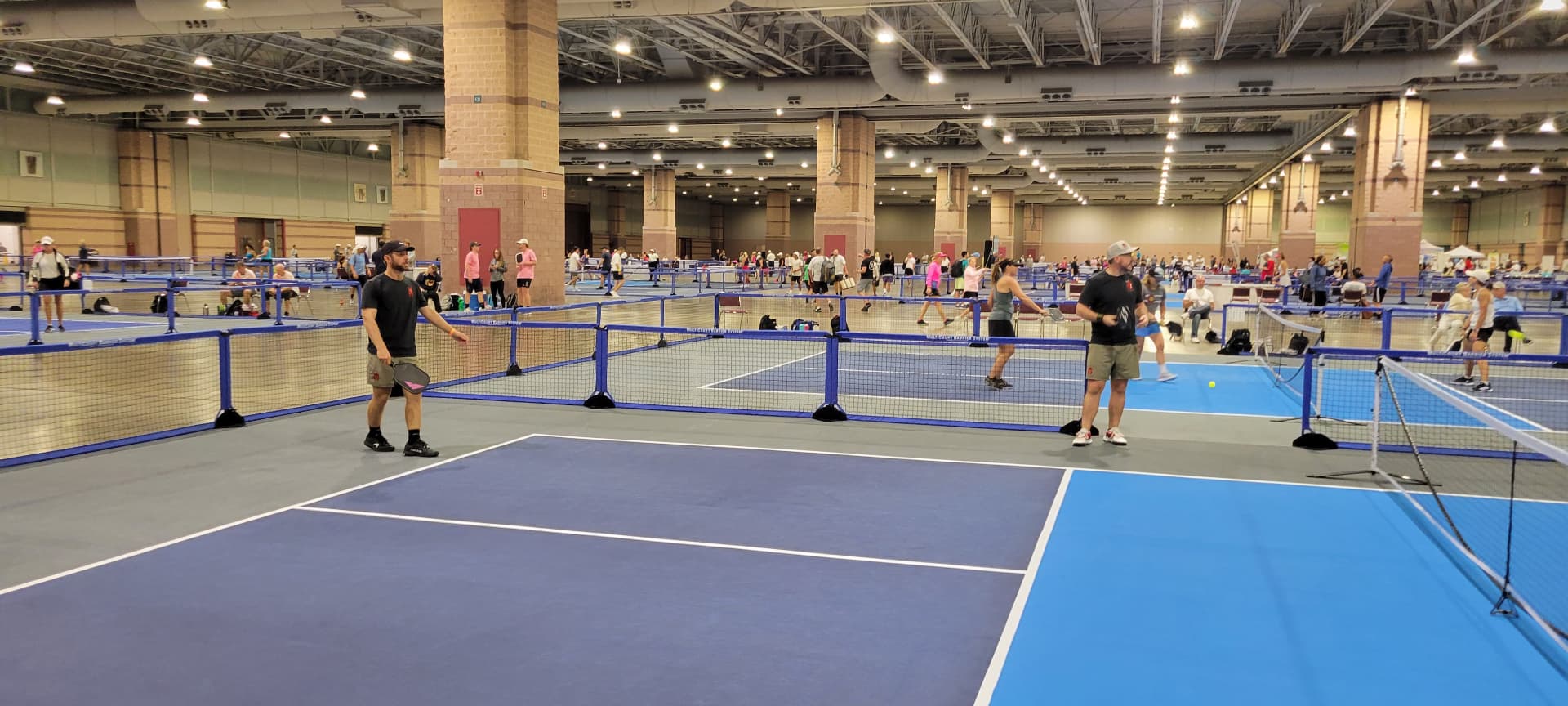
Most flex-office leases and shared amenity floors can't absorb a permanent sport court. A rollout court installs on a parking level, courtyard, rooftop deck, or even a cleared common area for the event window, then comes out — no capital project, no landlord approval for construction.
When two buildings quote similar rent per square foot, the one with a visibly active amenity program wins the tour. A branded pickleball day gives leasing and community teams real content and a real reason a prospective tenant remembers the building.
There's also a marketing dividend most operators don't plan for until after the first event: a court full of members mid-rally photographs better than a conference-room headshot wall, and community teams routinely reuse that content for leasing decks, social posts, and renewal outreach for months afterward. That's a side effect, not the reason to book one — but it's real, and it's worth telling your marketing team the date is on the calendar before the event, not after.
Where the court actually fits on a coworking floor
Coworking buildings rarely have a spare gym floor sitting empty. The realistic sites are a parking level cleared after hours, a rooftop deck or courtyard the building already uses for events, an unleased event floor, or — for smaller activations — a common area or lounge with furniture moved for the block. None of these need to become a permanent court. A rollout surface installs for the event window and comes back out, which matters in a leased building where the operator doesn't own the structure and can't authorize construction.
Surface condition decides more than square footage does. Sealed concrete parking decks and finished event floors usually take a rollout court directly; exposed rooftop membranes, uneven pavers, or carpeted common areas may need a subfloor system so the court plays true without damaging the existing surface. Full detail on what each surface needs lives in our surface and subfloor guide. Measure the clear rectangle after HVAC units, support columns, and stored furniture — not the floor's advertised square footage.
Formats that fit a membership calendar
A single afternoon or evening block for existing members — open play, a light clinic, and staff running rotation so nobody stands around waiting for a court they don't know how to join.
A coworking brand opening a new building or floor uses the court as the headline activation for a launch event — something press and prospective members actually photograph, instead of another ribbon-cutting with a folding table of branded pens.
In multi-tenant flex buildings, the property owner (not the coworking operator) books the activation to serve every tenant on the floor plate at once — a shared amenity event rather than one company's private party.
Some operators run a monthly or quarterly pickleball social as a standing community-calendar item. We recommend starting with one event before committing to a series — see below for why.
The format that fails is the one modeled on a company happy hour rather than a member day: a single department clustered around one court while the rest of the floor watches. Coworking crowds are mixed strangers, not one team that already knows each other — staff the event to rotate people through quickly, the way we cover in our company happy hour guide, adapted for a membership base instead of a single employer's guest list.
Planning a coworking or flex-office event?
Send building type, available space, and your date — we'll tell you what fits and what it costs, usually within 24 hours.
Coworking operator vs. building landlord: who books it
The buyer changes depending on the building, and it's worth naming which one you are before you send a brief. A coworking brand running its own locations — a WeWork-style operator — books the activation as member programming, paid from a community or marketing budget, and usually wants the event branded to the coworking company itself. A landlord who owns a multi-tenant flex building books it as a shared amenity for every tenant on the floor plate, typically through the property management or leasing team, and wants the event to read as a building perk rather than any one company's party.
Approval chains follow the same split. Operator-booked events usually clear through a single community manager. Landlord-booked events often need building engineering sign-off on access and load, plus a certificate of insurance before load-in — the same requirements as any other vendor working a commercial property. Put the decision-maker and approval path in the quote brief so the timeline doesn't stall a week before the event.
One event before a series
Community managers sometimes want to launch straight into a monthly pickleball social. We usually talk that down to a single event first, for a practical reason: attendance at a brand-new member activity is unpredictable, and a monthly commitment made before you know if members show up wastes budget on the second and third dates. A single well-staffed afternoon tells you the real draw — headcount, which membership tiers actually turn out, and whether the space you picked works — before you build a recurring line item into next year's community budget.
- Staffing: A member day needs enough staff to run rotation and a beginner briefing, not just drop off equipment. Our event staffing guide covers headcount by group size.
- Timing: Late-afternoon or early-evening blocks pull the most members between meetings without competing with a full workday. Lunchtime works for smaller, single-floor buildings where members don't have to travel far.
- Promotion lead time: Members join a community calendar item, not a mandatory meeting — give the event two to three weeks of visibility in the app, newsletter, or building signage rather than announcing it the week of.
- Access and noise: Confirm after-hours building access, freight or loading-dock windows, and whether ball-and-paddle noise is an issue for other tenants still working nearby.
What it costs
Coworking and flex-office activations price on the same drivers as any turnkey event: court count, hours on-site, staffing, and access complexity — not a membership-industry rate card. A single-court, one-evening member day for a mid-sized floor prices like any comparable one-day activation elsewhere; a multi-court floor launch with branding and press in the room prices closer to a brand activation. See the full cost guide for what moves a quote up or down. We don't publish a flat "coworking package" price because building access and space vary too much to make one honest.
Mistakes that undercut a coworking activation
- Booking a recurring monthly series before a single test event confirms real member turnout.
- Running it like a private company happy hour when the crowd is mixed strangers who need a rotation plan, not a bar tab.
- Assuming a rooftop deck or parking level is event-ready without checking after-hours access and load-in windows.
- Skipping landlord sign-off on a multi-tenant building because the operator assumed it was their call alone.
- Announcing the event with no lead time and getting a thin turnout that undersells the format for next time.
How to request a quote
A useful brief includes: building type (single-operator coworking vs. multi-tenant flex), who's booking (community manager vs. landlord), available space with photos and rough dimensions, event date and expected headcount, and any known access, insurance, or after-hours rules the building already enforces. We'll tell you honestly whether the space works, what format fits your membership mix, and exact pricing — usually within 24 hours.
This page is written for coworking operators, flex-office landlords, and the community and leasing teams that book member and tenant events. It isn't a consumer listing for finding a public court to drop in and play — that's a different kind of search entirely.