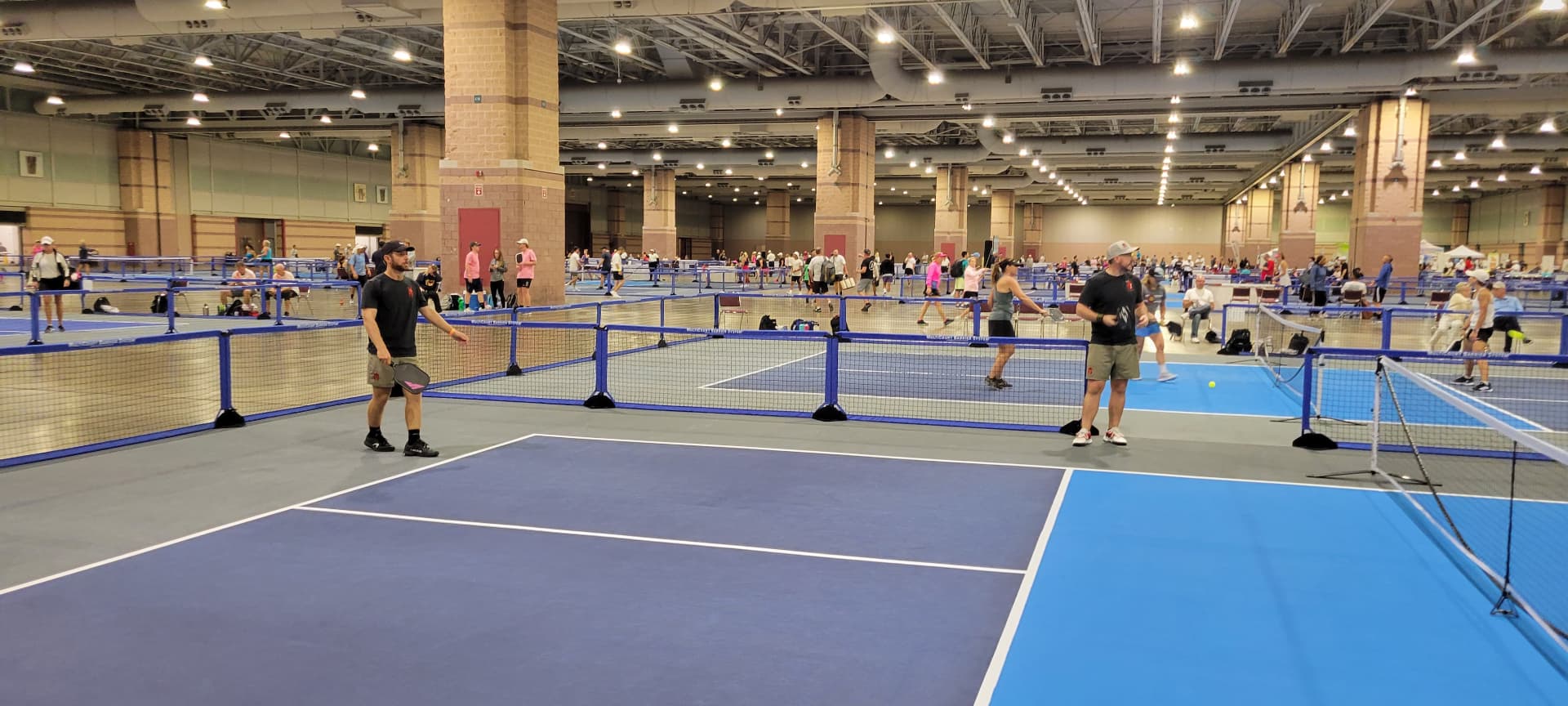
Employee Programming · Season-Long Leagues
How to start a corporate pickleball league
A corporate pickleball league is a standing, multi-week program for your own employees — regular season play, usually six to ten weeks, sometimes closing with a playoff bracket — not a single event day and not a venue's recurring programming for its guests or members. The build is different from a one-day activation: courts either stay down for the season or get delivered on a recurring cadence, staffing intensity depends on the format you pick, and pricing is quoted per season rather than per event. This page covers the formats that actually hold up past week three, the logistics questions to answer before you announce sign-ups, and how a season gets scoped and priced.
Why companies run a league instead of one big day
A single tournament day is a spike — high energy, good photos, forgotten by the next quarter. A league is a habit. The value isn't the sport; it's forty or fifty people who wouldn't otherwise cross paths showing up to the same court every week for a season. That's a harder thing to build and a more durable thing to have.
One tournament gets people talking for a week. A six-to-ten-week league gets the same 40 people back on a court every Tuesday, mixing with coworkers they'd otherwise never sit next to. Wellness programs with a recurring cadence report meaningfully lower absenteeism than one-off perks — a weekly commitment does more for culture than a single flashy event, even if the event is more photogenic.
Doubles pickleball forces rotating partners. A league that reshuffles teams every few weeks puts finance next to engineering next to sales in a low-stakes setting. That's the actual pitch to leadership — not the sport itself.
Leagues without a playoff or finale fade out by week four. Build the end date in from the start — a bracket, a company-wide finals lunch, or a traveling trophy — so the league has a visible arc instead of quietly dying on the calendar.
If what you actually want is a single afternoon with a trophy at the end, a league is the wrong product — see our corporate pickleball tournament guide instead. If the goal is a one-time wellness push rather than an ongoing program, our employee appreciation day guide covers that scale.
Three season formats, and where each one breaks
Pick the format before you announce anything. Changing formats mid-season is the fastest way to lose the group you just built.
Players or teams challenge others within a few rungs of their ranking; winners move up. Low staffing need — post rules and a standings board, check in periodically. Works well when employees can flex court time across the week rather than all showing up at once. Weakest at forcing participation; strong players tend to duck challenges.
Everyone shows up at the same window each week; partners rotate so nobody plays the same person twice in a row. Needs a host to run rotations and keep pace, but it's the most reliably social format and the easiest for beginners to walk into cold.
Teams register once, play a set schedule, standings determine seeding, then a single-elimination or double-elimination bracket closes the season. Closest to a 'real' league feel and the best fit if leadership wants a trophy moment. Requires the most staffing and scorekeeping discipline of the three.
None of these formats are wrong — they trade off staffing cost against structure. A round-robin with rotating partners is the safest default for a first season because it forces the mixing that justifies the budget line in the first place. See round robin vs bracket vs open play for the mechanics of running each format on a single day, which still apply week-to-week inside a season.
Court model: standing courts vs weekly delivery
This is the biggest cost and logistics fork in the whole plan. If your campus has a courtyard, gym floor, or underused parking area that can hold courts down for the full season, you're paying for staffed sessions on a court that's already there — closer to a recurring service than a rebuild every week. If the space has to be cleared for other use between sessions (a shared lobby, a lot that turns back into parking on weekdays), courts get delivered and struck on a recurring cadence, which is quoted like a repeat installation rather than a single build.
Neither path is wrong, but they're different asks internally. A standing court needs sign-off from facilities on a season-long footprint commitment, not just a single-day permit. A weekly delivery model needs a predictable load-in window that doesn't collide with other campus traffic every single week. Decide this before you price anything — our recurring programming guide covers the same standing-vs-delivery tradeoff from a venue's perspective (hotels, clubs, multifamily), and most of the mechanics carry over to a single employer's campus.
Scoping a season, not a single event?
Tell us your office location, employee count, and whether courts can stay down for the season — we'll return a season-scoped option, not a single-day quote multiplied by ten weeks.
What to do (and what to skip) launching a season
Do
- Cap divisions by self-rated skill (beginner / intermediate / advanced) before week one — mixing a 4.0 player against someone who's never held a paddle kills participation fast.
- Publish the full season schedule and playoff date before you open sign-ups, not after. People plan around it.
- Build in a walk-on lane for people who didn't register on time — locked rosters are the #1 reason participation plateaus below what leadership expected.
- Decide up front whether the league is single-site or needs to run at multiple offices on the same brand standard, and scope staffing accordingly.
- Loop facilities or the landlord early if courts stay down for the season — that's a different footprint commitment than a single event day.
Don't
- Don't require a full team to register before anyone can play a single match — that excludes solo sign-ups and shrinks your pool before the season starts.
- Don't run a fixed-team league with no midseason re-shuffle if cross-department mixing is the actual goal — locked teams recreate existing cliques.
- Don't skip a beginner clinic in week one. A league that opens straight into competitive play loses non-athletes by week two.
- Don't promise a rain-or-shine outdoor season without a contingency plan for the weeks it doesn't cooperate.
- Don't leave scorekeeping to memory. Even a shared spreadsheet beats verbal standings once you're past week three.
Staffing across a season, not just one day
A single event day usually gets full staffing coverage for the whole window because there's only one shot to get it right. A season changes the math — you can front-load staffing at kickoff and finals, when a host matters most for onboarding beginners and running a bracket, and run leaner in the middle weeks with a lighter check-in model or trained employee volunteers keeping score. That tiering is a legitimate way to control season cost without leaving early sessions unstaffed when new players most need a walkthrough. See our event staffing guide for role types and ratios, and scale them down for the mid-season weeks rather than the bookend ones.
Indoor, outdoor, and weather across a whole season
A single-day outdoor event can absorb one bad-weather call with a reschedule. A ten-week outdoor season will hit at least one rained-out week somewhere in the run, especially in spring or hurricane-season markets. Decide the makeup-week policy before the season starts — either a built-in bye week held in reserve or an indoor backup location on standby — rather than improvising when week four gets rained out and half the league has already made other plans. Our weather contingency guide and indoor vs outdoor rental comparison both apply directly, just multiplied by the number of weeks you're committing to.
Making the internal case (and measuring it after)
A season-long line item is a harder budget ask than a single event day, so leadership will reasonably want to know what it bought. Track sign-up count against your total headcount, week-over-week attendance retention (the number that actually tells you if it's working), and cross-department mixing if that was the pitch — not just "people seemed to like it." Our team-building ROI guide covers what the engagement research does and doesn't support, and how to build a measurement plan for your own program instead of quoting someone else's stat back to your CFO.
How to brief us (what we need in the first email)
- Office location(s) and whether the league runs at one site or multiple offices on the same season.
- Total employee headcount and a realistic sign-up estimate — not everyone who could play will.
- Whether courts can stay down for the season or need to be cleared between sessions.
- Preferred format: ladder, rotating-partner round robin, or fixed-team with playoffs.
- Season length and cadence (weekly lunch league vs biweekly after-work league).
- Indoor, outdoor, or a hybrid plan with a weather backup.
For a general framework that isn't season-specific, see how to add pickleball to your event, and for court-count math per session, see how many courts you need.