Corporate Events
Pickleball for corporate field days
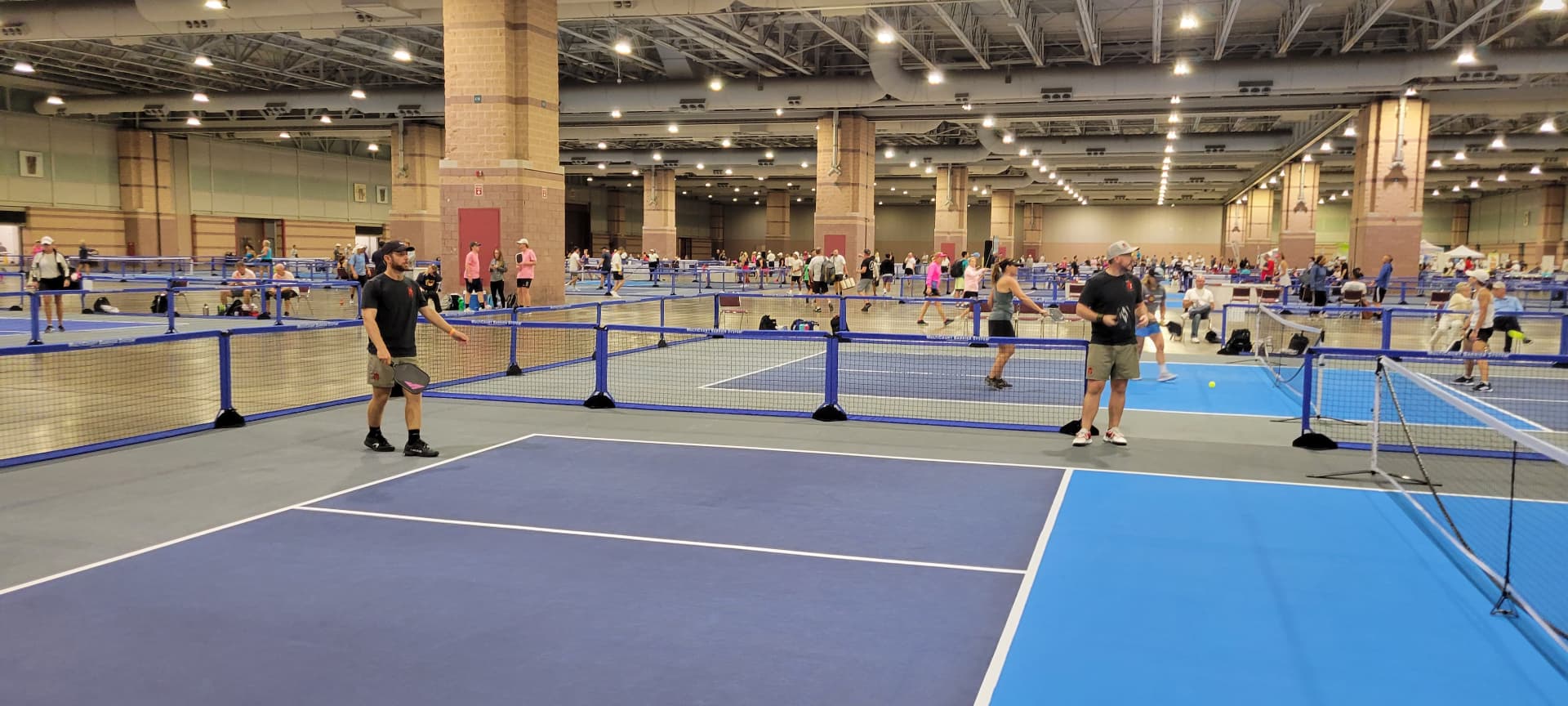
Pickleball works at a corporate field day as either one staffed station among several — running alongside cornhole, relay races, and a dunk tank — or as a department-vs-department bracketthat becomes the day's main event. Court count follows headcount and format: a single court handles a rotating station, while a full bracket needs roughly one court per 16–20 employees to keep games moving. Games are fast, the skill floor is low, and staff can run continuous rotations so no group waits long between turns.
Why it works for a field day crowd
Most employees can rally within a few minutes of coaching, but the sport still rewards actual skill — so a field day round-robin doesn't feel like a token activity for the athletic people on staff.
Games to 11 run fast. On a field day with six or eight stations competing for the same block of time, pickleball can cycle a department team through in 10–15 minutes without becoming the bottleneck other stations wait on.
A field day roster usually spans early-career staff and people 20 years into their career. Pickleball's court is small and the pace is controllable, so it doesn't sort people out by fitness level the way a relay race or tug-of-war does.
Unlike a full-day tournament build, a field day court can run as a single station — one court, staffed, positioned next to cornhole or a dunk tank — without needing to be the whole event.
Three formats, depending on how big a role you want it to play
One station among several
A single court runs continuous open play or a fast points-based mini-bracket while employees rotate through it along with other field day stations. Lowest cost, lowest logistics — this is the default for a field day with 6+ activities already planned.
Department vs. department bracket
Two to four courts run a bracket seeded by department or team, building on the same round-robin structure as a standalone corporate tournament — but scaled down to fit a 2–3 hour field day window instead of a full afternoon.
All-day open play with a leaderboard
Courts stay open the whole event; a staffer tracks quick wins on a leaderboard. Good for field days without a hard schedule, where people wander between stations rather than moving as groups.
Planning a field day?
Tell us your headcount and whether pickleball is one station or the main event — we'll scope court count and staffing to match.
Planning it right
- Headcount drives court count more than anything else at a field day, because attendance is usually near-universal and everyone shows up at once rather than trickling through a trade-show booth — see how many courts you actually need for the ratios by format.
- Confirm the grass, gravel, or lot surface at your field-day site before you commit — a park pavilion lawn plays differently than a paved lot, and outdoor grass needs a subfloor system to play true.
- Build a weather backup into the plan from the start if the field day is outdoors and seasonal — a field day date is usually locked months out, long before anyone can see the forecast.
- If pickleball is one of several stations, staff it like one — pro staff who can run quick rotations and keep the line moving matter more here than a full clinic-style instructor.
Where field day fits against the alternatives
Global employee engagement has been sliding for several years running — Gallup's State of the Global Workplace research puts roughly one in five employees worldwide as genuinely engaged at work — and a field day is one of the few company events built specifically to counter that with something physical and shared rather than another meeting. Where a field day differs from a standalone corporate pickleball tournament is scale and format: a tournament is usually the whole event, built around a bracket from the start, while a field day treats pickleball as one part of a bigger day that might also include relay races, cornhole, or a cookout. If your team wants the bracket experience without the rest of the field-day production, the tournament guide is the better starting point.
For staffing a multi-station day, see our event staffing guide for how ratios change when a court is one rotation among several rather than the day's sole focus. And if the date is outdoors and seasonal, build a plan into the schedule with our weather contingency guide before the invite goes out. If the day is really a loose, all-day company picnic rather than a stations-and-schedule field day, the format changes too — see our summer picnic guide for the open-play version of this build. And if what you're actually planning is a multi-day retreat rather than a single field-day afternoon, see our corporate retreats and offsites guide for how the format changes when it's one block inside a longer agenda instead of the whole event. And if the occasion is specifically a recognition day rather than a broader morale-and-fun event, our Employee Appreciation Day guide covers that narrower, half-day format.
Budgeting a field-day station vs. the whole event
The most common budgeting mistake we see on a field day is pricing pickleball as if it's the only line item, when really it's competing for the same day-of-event budget as tents, catering, a DJ, and t-shirts. A single staffed court as one rotation among several stations is the lightest version of a turnkey build — one truck, one crew, a shorter staffing window than an all-day tournament needs. That's worth knowing before you request quotes from multiple activity vendors and try to compare them apples to apples: a bounce house rental and a staffed pickleball court aren't priced on the same basis, so ask each vendor what's actually included (delivery, staff, teardown) rather than comparing bottom-line numbers alone.
If pickleball is the field day's main event rather than one station, the math shifts toward the same court-per-headcount planning as a standalone corporate tournament— more courts, a longer staffed window, and a heavier equipment footprint. Neither approach is wrong; they're different builds for different roles in the day, and the quote should reflect which one you're actually planning.