Event Playbook · Sporting Events & Fan Zones
Pickleball for sporting events and fan activations
A pickleball fan activation puts a turnkey court in a tailgate lot or fan-zone space before kickoff, or a scaled-down paddle-skills challengeon the concourse or at halftime, where a full court doesn't fit the footprint or the clock. Stadiums offer a captive audience of 20,000 to 80,000 fans per event, and activated formats like this generate roughly 5x more consumer recall than passive signage, per IEG research — with brands that activate across pre-game, in-game, and post-game windows seeing up to 3x higher recall than a single-moment activation.
Where pickleball actually fits on game day
Footprint and the game clock decide the format before staffing or branding matter at all — the same filter we apply to any tight venue.
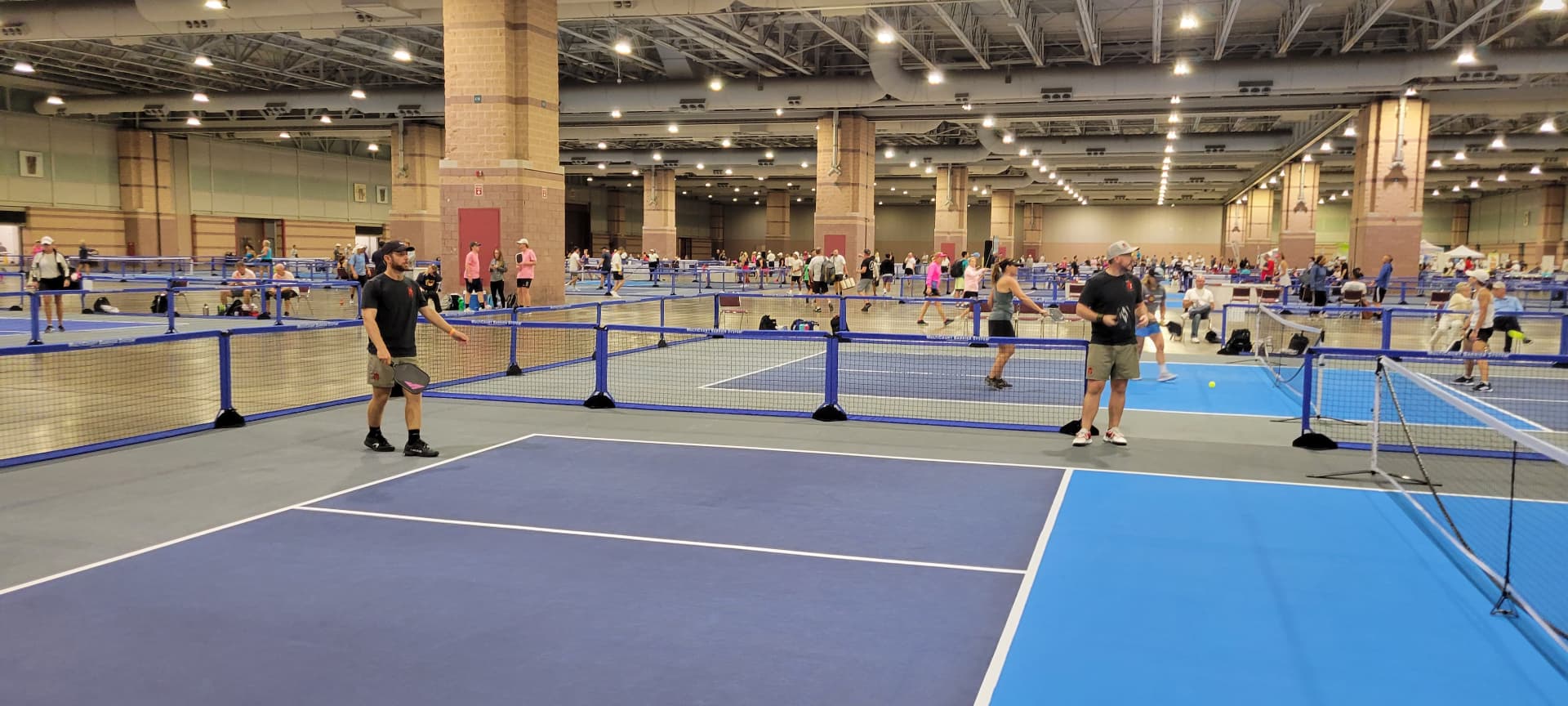
The most workable footprint — a full 20x44 ft court fits in a parking lot or grass fan-zone area with room for a crowd to gather. Runs hours before kickoff, independent of the game clock, so play isn't rushed.
Too tight and too high-traffic for a real court. This is skills-challenge territory — a paddle wall, a mini net, or a quick rally station that doesn't block the flow of fans moving between sections and concessions.
The highest-visibility placement and the most constrained. A scored rally takes minutes a halftime clock doesn't have; this slot works as a fast, staged exhibition — a pro paddler vs. a fan, or a 60-second skills contest — not a real game.
A smaller-scale, hosted format for sponsors and VIPs rather than the general crowd — closer to a client-entertainment build than a fan-zone activation. Pairs well with a separate public zone rather than replacing one.
Full dimension math for what a real court needs is in our court dimensions guide. If your event is really a trade show or convention floor rather than a stadium, the footprint math and union labor rules are different — see our trade show booth activation guide instead.
Why an interactive activation beats a static sponsor booth
Professional stadiums draw 20,000 to 80,000 fans per event, with concourse and in-seat activation reach on top of whatever happens in a dedicated fan zone — a scale no corporate campus or trade show floor comes close to.
Sports marketing activations built around street-team and interactive formats run at an estimated $1 to $3 per fan engagement, among the more cost-efficient impression types in experiential marketing.
Brands that activate across pre-game, in-game, and post-game windows see up to 3x higher brand recall than brands that only show up once. A tailgate-lot court in the morning paired with a concourse skills station later in the day covers two of those three windows on its own.
Industry research from IEG found activated sponsorships generate roughly 5x more consumer recall than passive signage or logo placement — the entire argument for putting a paddle in someone's hand instead of a banner over their head.
None of this means a court automatically outperforms every other activation type — a static banner is cheaper and requires zero staffing. The trade-off is real: a court needs more space, more labor coordination, and more lead time than a sign or a giveaway table. It earns that cost on events where fan dwell time and memorability matter more than raw impression count.
Tell us your venue and game-day schedule.
We'll scope the right zone, format, and staffing — tailgate lot, concourse, or halftime — and return pricing, usually within 24 hours.
The timing constraint most planners underestimate
Halftime looks like a perfect showcase window on a run-of-show deck, but the actual clock rarely cooperates. Halftime intermissions at most professional and college games run in the range of roughly ten to twenty minutes, and a meaningful chunk of that is already claimed by the in-house entertainment schedule, other sponsor moments, and the simple logistics of getting fans back to their seats. A real, scored pickleball rally takes several minutes on its own — long enough that trying to run one at center court usually means either cutting it short mid-point or running past the clock into the second half.
What actually works in that window is a compressed moment built for television and jumbotron pacing: a pro player rallying with a fan pulled from the crowd, a 30-to-60-second skills contest, or a quick giveaway tied to the court rather than real competitive play. Save the full games — round robins, brackets, open play — for the tailgate lot or fan-zone hours before kickoff, where there's no clock forcing an early stop.
Staffing for a crowd that moves fast
A fan-zone crowd behaves differently than a corporate guest list. People are moving toward the stadium, on a schedule they don't control, and rarely willing to wait in a long line for a ten-minute clinic. Staff need to run high-throughput formats — quick rotations, short point counts, a skills challenge that takes thirty seconds instead of a full game — so the activation processes volume instead of depth. That's a different staffing model than the clinics-and-round-robins approach that works for a corporate off-site; see our event staffing guide for how roles and ratios shift with crowd size and pace.
Lead capture, if the activation is sponsor-driven, follows the same logic we recommend for a trade show booth: put the sign-in or scan step at the entrance to the activity, not the exit, and staff it separately from whoever is running the games so the line keeps moving instead of backing up into foot traffic headed to the gates.
Sponsor-branded builds and measuring the payoff
Most fan-zone and tailgate-lot pickleball activations are sponsor-funded, which means branding and measurement both matter more than they would for an internal team event. Courts, nets, and signage can be wrapped in a sponsor's branding for a content-ready build that shows up in every photo and social post from the day. Once it's running, tie it back to a number a marketing budget review will accept — our sponsor activation ROI guide covers what to measure beyond just foot traffic. If the activation is part of a broader brand campaign rather than a single-game sponsorship, our brand activations and product launches guide covers the wider version of the same build.
When this isn't the right fit
A full bracket tournament doesn't belong inside a stadium's traffic flow on game day — the footprint, the crowd movement, and the game-day schedule all work against a multi-hour competitive format. If the goal is a real tournament tied to a team or league, run it as a separate fan-fest day in a parking lot or plaza adjacent to the venue rather than squeezing it into the hours immediately around a game. Tailgate lots with heavy alcohol consumption also carry the same liability considerations as any activation near drinking — see our insurance and liability guide before you finalize where in the lot the court goes.
It's also worth being honest about scale: a single small court in an 80,000-seat stadium's parking footprint reaches a small fraction of the total crowd. If broad reach across the entire attendance is the goal rather than a high-quality activation for whoever finds the zone, budget for staffing that can process real volume, or plan for multiple stations rather than one court doing all the work.
What it costs
Pricing follows the same core drivers as any turnkey activation — court count, hours on-site, staffing, and branding — with venue-specific additions like credentialing, security coordination, and game-day load-in windows. See our full cost guide for the underlying breakdown, then share your venue, event, and sponsor requirements so those specifics get priced in rather than guessed at.