Event Playbook · Youth Sports Complexes & Tournament Operators
Pickleball for youth sports tournaments and multi-sport complexes
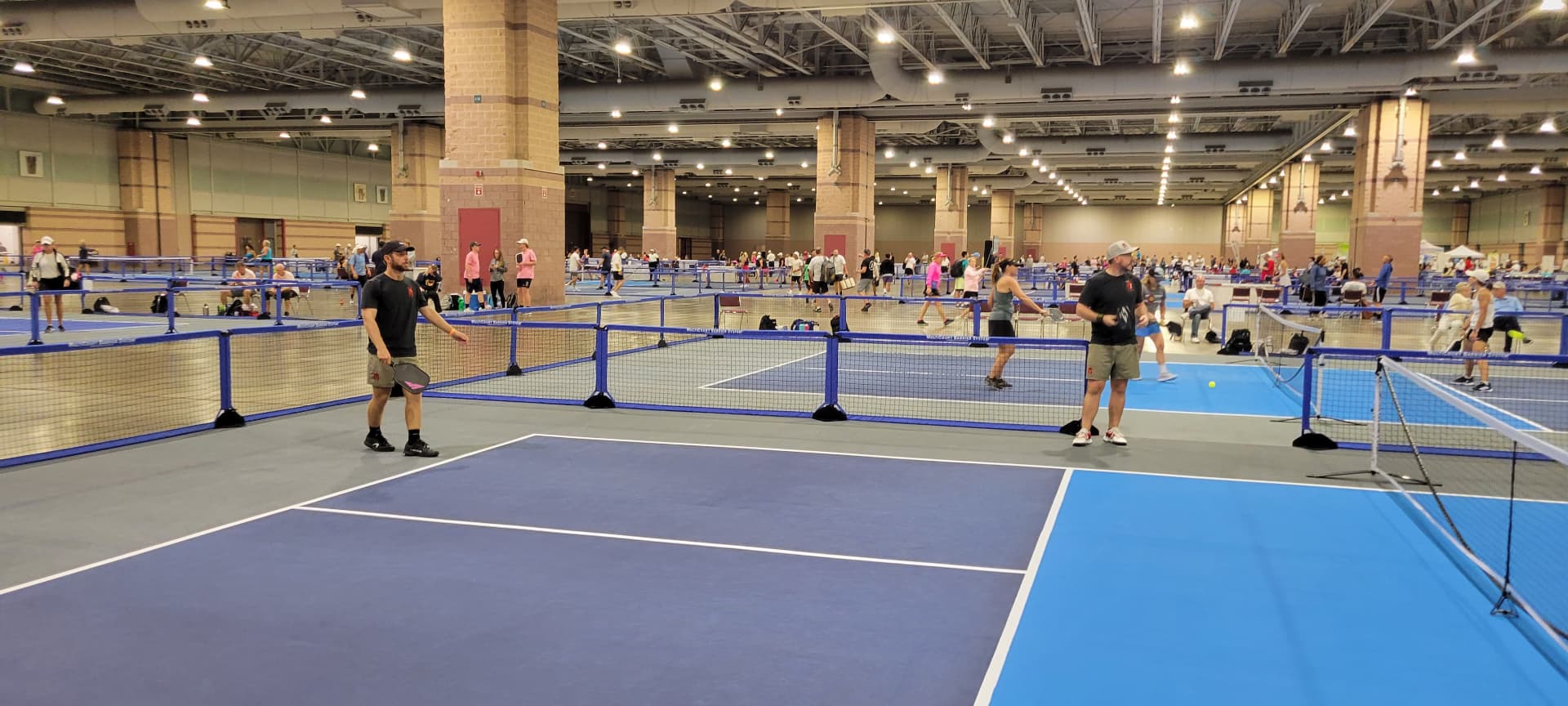
A turnkey pickleball activation gives a youth sports tournament complex two distinct options: a staffed fan-zone court that gives waiting siblings and parents something active to do between games, or a standalone youth pickleball tournament booked on its own weekend. Courts, professional staff, and teardown are handled as one line item — so complex operators and tournament directors add a new sport or a dwell-time amenity without taking on equipment or staffing themselves.
Why tournament complexes are adding pickleball
Multi-sport complexes compete on total weekend experience as much as field quality — parking, food, shade, and something for the family members who aren't currently on the field. Pickleball has become a common answer because it's cheap to staff relative to a full field, works for a wide range of ages, and — for complexes that build it as a permanent wing — can become a bookable sport in its own right.
Sports Facilities Companies, a developer behind dozens of youth multi-sport complexes nationwide, named pickleball among the sports driving new facility demand in 2026. Recent complex openings have paired pickleball wings — in some cases close to 20 courts — alongside volleyball, basketball, and indoor turf fields, treating it as a core sport, not an afterthought.
A travel-ball weekend runs on dead time — games spread across pool play, bracket delays, and long gaps between a sibling's age-group games. A staffed pickleball court gives waiting families an active option instead of another folding chair by the fence, and keeps them on-site (and spending at the concession stand) rather than driving off-property.
Complexes with open weekends between baseball, soccer, or lacrosse seasons can book a pickleball tournament as its own event — bringing in a different set of traveling families and gate or concession revenue without idle turf.
Complex operators are increasingly evaluated on total campus revenue — concessions, retail, and parking — not just field rental. An activity that keeps families on-site longer between games has a direct line to that revenue, which is why fan-zone and add-on activations get budget even when they aren't the headline sport.
Formats complex operators book most
The right format depends on whether pickleball is supporting your primary sport's weekend or standing on its own.
Set up near the main concourse or concession area during a travel-ball or club-sport tournament weekend. Staffed drop-in play and short beginner clinics keep waiting families engaged between games without requiring a bracket or a sign-up sheet.
A full pickleball tournament — age-group or skill-division brackets — booked as its own weekend event at a complex with open field time. Works well for complexes wanting to diversify beyond their anchor sport or fill a slow season.
When a complex adds a pickleball wing, an opening exhibition or community tournament introduces the courts to local leagues, schools, and families before regular bookings start — similar in spirit to a ribbon-cutting, but scaled to a commercial sports campus.
Regional youth sports organizations and league operators sometimes want a branded court as sponsor inventory — a title sponsor's name on the court and signage during a marquee tournament weekend. See our sponsorship packages guide for structuring sponsor tiers.
If your event is closer to a day-camp roster than a travel-ball weekend, compare our summer camps and youth programs guide. If the goal is a general spectator fan-zone at a larger sporting event, see sporting events and fan activations.
Planning a tournament weekend or new pickleball wing?
Tell us your complex, dates, and whether you want a fan-zone add-on or a standalone tournament — we'll scope courts and staffing to fit your calendar.
What to do (and what to skip) when you brief the activation
Do
- Site the court on the concourse or near concessions, not in an out-of-the-way lot — dwell time only helps revenue if families actually walk past it.
- Staff the court with hosts who can run quick, low-pressure rotations; most players are parents and siblings picking up a paddle for the first time, not a competitive bracket.
- Confirm surface early — asphalt, gym floor, turf, or an unused field pad each install differently, and complexes often have multiple candidate surfaces on one campus.
- Decide whether this is a standalone bookable event (its own tournament weekend) or an add-on to an existing tournament before you set staffing and marketing expectations.
- Loop in your facility's insurance and risk contact early if the complex works with outside tournament operators who bring their own COI requirements.
Don't
- Do not assume a fan-zone court needs to be full-size and permanent — a single staffed rollout court is often enough to capture idle dwell time between games.
- Do not schedule a standalone pickleball tournament on top of your peak baseball or soccer weekend without confirming parking and field-conflict logistics first.
- Do not leave the court unstaffed near young kids and paddles — a hosted rotation avoids both safety issues and long unmanaged lines.
- Do not promise permanent court construction pricing when what's being booked is a turnkey event activation — the two are different products with different cost drivers.
- Do not treat this the same as a school PE or day-camp curriculum booking — tournament-complex families are a different audience than a summer camp roster.
Logistics complex operators ask about first
Complexes already run a tight operational calendar around their anchor sport. A pickleball activation needs to fit that rhythm, not compete with it.
Complexes typically have several candidate surfaces — an unused turf pad, a gym floor, a paved concourse, or a parking area. Confirm clear dimensions plus sideline buffer for each court; USA Pickleball's construction guidance puts the regulation playing area at 20×44 feet, with a recommended minimum total play area around 30×60 feet.
Whether the court is an add-on to an existing baseball, soccer, or lacrosse weekend or a standalone pickleball event, book around the complex's primary sport calendar so parking, field turnover, and concession staffing don't conflict. Standalone weekends work best in open dates between seasons.
Complexes that host outside tournament operators are used to managing multiple vendor COIs on one campus. A turnkey pickleball activation fits that model cleanly — one certificate of insurance, one point of contact, one invoice for courts, staff, and teardown.
If a sponsor or league partner wants visibility, court wraps and signage can carry a title sponsor, the complex's own brand, or a co-brand. Decide the hierarchy when you lock the date so print production doesn't collide with load-in.
Deeper references: court dimensions for events, indoor vs. outdoor rental, insurance and liability, and event staffing.
Bracket size and dwell-time court count
A fan-zone add-on and a standalone tournament scale very differently. Size the court count to the job you're asking it to do.
One or two staffed courts near the concourse is usually enough to capture sibling and parent dwell time without competing for space with the primary sport.
Court count follows bracket size and age divisions — a multi-division youth tournament often needs 4–8 courts running concurrent pool play to keep the schedule moving.
Scale to the number of permanent courts being introduced, with staff running clinics and exhibition play across all of them for the opening crowd.
For a fuller sizing walkthrough, see how many pickleball courts you need, and for bracket structure options, see round robin vs. bracket vs. open play.
Why this matters to complex revenue, not just programming
Complex operators increasingly track total campus revenue — concessions, retail, parking — alongside field rental income. A fan-zone activity that keeps a family on-site an extra hour between games has a direct line to that revenue even though it isn't the sport generating the gate. That's part of why pickleball has shown up as a named growth category for facility developers in 2026: it's inexpensive to add relative to a new field, and it directly targets the dead time that otherwise sends families off property. A standalone pickleball tournament weekend works the same way at the campus level — it fills an open date with a new set of traveling families rather than leaving fields idle.
Pricing honesty for complex operators and tournament directors
We quote turnkey activations as a scoped line item — not a fake per-family or per-team menu. A single-court, one-day fan-zone activation typically begins around $10,000; multi-court standalone tournaments and new-wing showcase events scale up from there based on court count, staffing hours, branding, and travel. See our pickleball court rental cost guide for the full breakdown, then request a quote with your complex, dates, and format so we can return an exact number, usually within 24 hours. If you're also evaluating permanent courts as a new wing rather than an event booking, our court installation page covers that separately.
How to brief us (what we need in the first email)
A clean first brief shortens quote turnaround, especially for a fast-approaching tournament weekend.
- Complex name, city, and which surface you're considering — turf pad, gym floor, concourse, or lot.
- Event date(s) and whether pickleball is a fan-zone add-on to an existing tournament or a standalone event.
- Expected attendance and, for a standalone tournament, rough bracket size and age divisions.
- Whether you need a certificate of insurance and the language your facility's risk contact requires.
- Branding needs: complex brand only, league or sponsor co-brand.
- Any known field-conflict, parking, or concession-staffing constraints for the weekend.
Before you sign with anyone, our vendor checklist covers the questions that separate a real turnkey build from a facility renting out a truck.