Markets & Civic Events
Pickleball for farmers markets and public markets
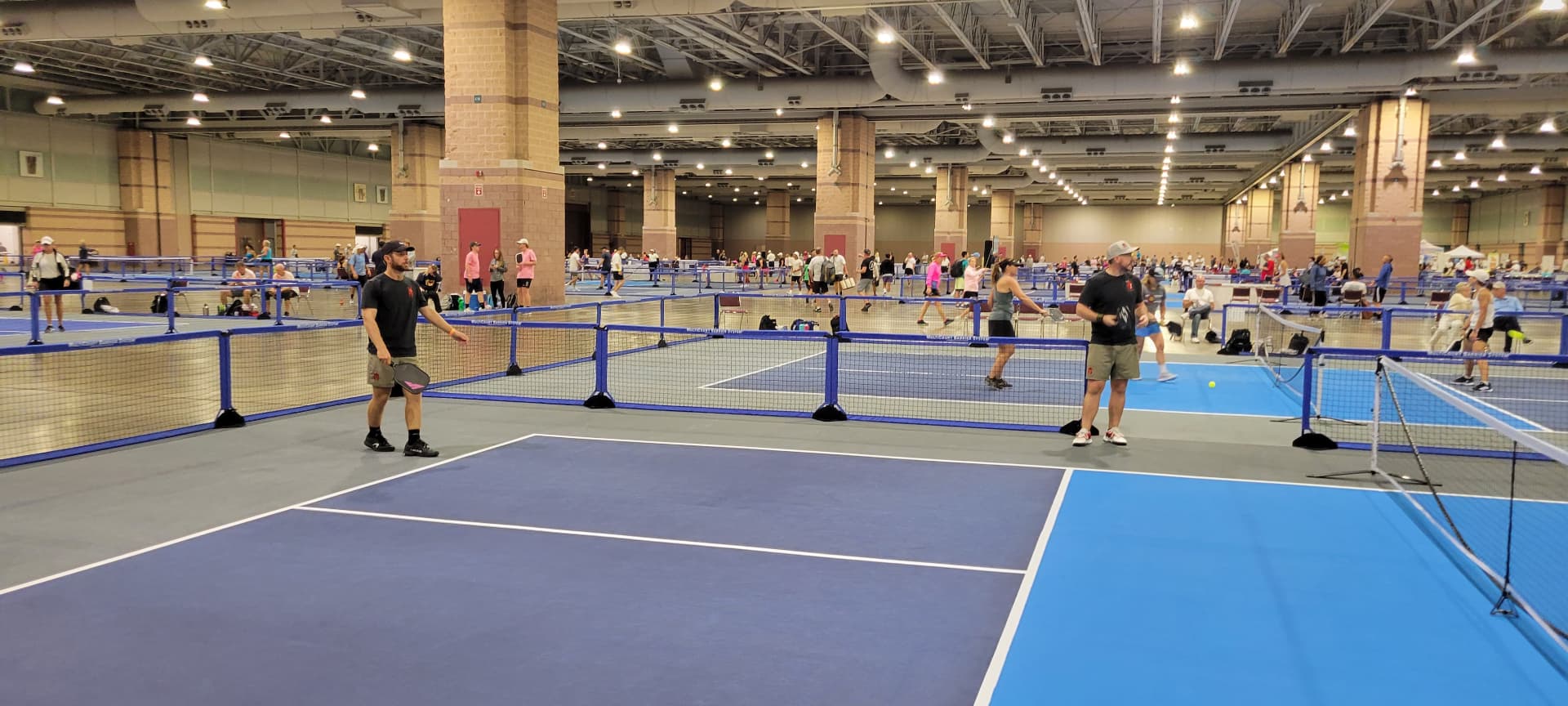
A turnkey pickleball activation gives a farmers market, public market, or municipal market day a watchable, playable centerpiece — courts delivered, built, staffed, and removed so market managers and city staff do not become equipment operators. Rollout courts install on paved plazas, closed overflow lots, and hard vendor aprons when the site allows, then clear so parking and loading reopen on schedule. This page is for market managers, municipal market programs, downtown partnerships, DMCs, and experiential agencies — not a directory of places to play.
Why market organizers add a court to a market day
Farmers markets and public markets are already proven outdoor gathering formats. The USDA Agricultural Marketing Service's last published national count of farmers market directory listings reached 8,771 markets in 2019, and AMS still maintains the Local Food Directories / National Farmers Market Directory as a public registry for market locations and hours. That scale is why city market programs, DMCs, and experiential agencies keep briefing these venues as activation pads — not because every market needs pickleball, but because the foot traffic, recurring calendar, and outdoor plaza pattern already exist.
Most of our market bookings are still the more common ask: a single activity zone inside a broader market footprint — the court is one attraction among vendor rows, not the whole event. That is the brief this page is built around. If what you are planning is a multi-block downtown street fest with stages and a festival production company, use our city festivals and street fairs guide instead — same product class, different buyer and operations constraints. Ticketed music weekends with sponsor villages belong on our music festivals and concert activations page.
Keeps shoppers on-site between vendor stops
A rally draws people from the produce line; the next open slot pulls a few of those onlookers onto the court. That loop holds foot traffic longer than a static booth — useful when market managers care about dwell time for vendors.
No permanent change to the market pad
Closed lots, paved plazas, and hard vendor aprons take a rollout court for market hours, then clear so parking, loading, and the next market day reopen on schedule. Nothing gets painted or left for Public Works to explain.
Built for walk-up families, not seeded brackets
Market guests arrive with tote bags and kids, not tournament entries. Staff run continuous open play, short beginner walkthroughs, and quick rotations so first-timers in casual shoes stay welcome.
Sells as a sponsor or presenting-partner line
A branded court photographs for a market sponsor deck and gives a municipal market program or downtown partnership something interactive to package — not only a logo on a banner over the entrance.
Program slots that match a market calendar
Market operators and municipal partners already own the vendor list, the hours, and often the sponsor relationships. What they usually lack is a participatory block that does not force parks or Public Works to store and staff sports equipment year-round. These are the slots we see most often:
Weekly or seasonal farmers market programming
Market managers and vendor associations adding a participatory anchor beside produce, prepared food, and craft rows — scoped to market hours and the pads they already control, not a remote lot shoppers will not walk to.
Municipal public markets and city market halls
Cities and downtown programs that run a year-round public market or seasonal market day and want an active draw without owning nets, storing equipment, or training seasonal staff to run the sport every weekend.
Market festival weekends and special market events
Harvest festivals, night markets, and anniversary market weekends where organizers need one more anchor activation that fits the load-in schedule like any other vendor — with a clear pad, COI language, and teardown before reopen.
Park and plaza markets run with parks & rec or BIDs
Outdoor markets that already share a plaza or park apron with civic partners. A staffed court zone sits beside the vendor grid when the site plan leaves a hard rectangle after tents and emergency lanes.
DMC and experiential agency market activations
Agencies and meeting planners packaging a market visit for a client hospitality day or brand program — the court becomes the interactive stop inside a broader market experience, not a pickleball tournament sold to consumers.
Scope a farmers market or public market activation
Dates, site plan, and market hours — we handle delivery, build, staffing, and teardown.
What to put in the brief
A useful market quote starts with pad and hours reality, not a wish-list court count. Send these six items and the first number stays honest:
Program goal in one sentence
Weekly market dwell activation, municipal market-day feature, harvest-festival weekend, or agency hospitality stop — court count and staffing posture follow the goal.
Site map with the market pad marked
Photos plus the clear rectangle after vendor tents, food trucks, loading zones, ADA paths, and emergency lanes. Soft lawn alone vs paved plaza vs mixed pads changes the subfloor conversation.
Market hours, load-in, and multi-day posture
When vendors set and strike; which hours the court is live; whether the pad stays down overnight on a multi-day market festival; rain or heat contingency preferences.
Expected guest mix and beginner share
Family daytime market vs evening night market changes host count and rotation length more than a raw attendance estimate. Say how many guests will likely be first-timers.
Who holds the permit and who is market contact
City, market association, parks & rec, BID, or private producer — and who signs the COI / vendor paperwork. Market permits stay with the permit holder; we scope the build inside that window.
Branding, power, and load-in access
Sponsor wrap needs, whether power is available near the pad, apron or alley access for load-in (not soft curb alone), and any overnight security if courts stay down between market days.
Event rental vs a permanent market or plaza court
Some cities ask whether to pour a permanent court beside the market plaza. For most weekly markets and seasonal market festivals, a temporary staffed activation is the cleaner answer — especially when the same asphalt still has to carry vendor trucks on Monday:
| Decision | Turnkey event rental | Permanent court |
|---|---|---|
| What the pad is for tomorrow | Rolls up so the lot, plaza, or apron returns to parking, loading, or the next market layout when the window ends. | A painted or poured court claims public square footage year-round — including weeks with no market. |
| Who can join | Walk-up beginners rally after a short walkthrough; mixed family and adult crowds stay welcome. | A fixed court often becomes an informal club that excludes casual market guests. |
| How it shows up in the program | Timed, staffed, and optionally branded for market hours or a festival weekend — then gone. | Becomes an amenity parks or Public Works must maintain whether or not a market uses it. |
| Who owns permits and liability posture | Market permit holder keeps site control; the activation is scoped as a staffed vendor. | Ongoing play can create recurring quiet-hour or liability questions the city did not budget for. |
If the market association or city wants a portable amenity it owns across a season of market programming — not a staffed one-weekend activation — that is a different product conversation. Pair this page with our permanent court vs event rental guide when parks and market ops are still deciding. For ongoing downtown foot-traffic programming rather than a market day, see shopping centers and downtown districts. For buying or renting the roll-out surface itself (quote-only, no invented sale prices), see PickleCourt USA's farmers market and public market pickleball court guide.
Logistics that differ from a corporate build
Corporate team-building builds assume a private guest list and a controlled pad. Farmers markets and public markets assume public walk-up traffic, vendor load-in clocks, and a site plan that changes when a food truck or tent row expands. These are the differences that most often show up in the quote:
Municipal market permits, street or lot closures, and related permissions stay with the city, market association, or event permit holder. We work off your site map and market hours to place courts where surface, sightlines, and load-in actually work.
One site plan may put a court on asphalt overflow, another on a paved plaza, and a third on a grass edge that needs a subfloor. See our surface and subfloor guide for what changes the build so the quote matches the real pads.
Market courts earn their keep when a rally is visible from the main pedestrian aisle — not tucked behind a double row of tents. Visibility is a site-plan conversation before build day.
Market crowds do not arrive as pre-formed teams. Staff run continuous open play, quick-turn mini rallies, and beginner instruction in short bursts for people who wandered over from a coffee cart.
Outdoor markets live and die by weather. A rained-out morning or a heat advisory that pushes play to shaded hours needs a plan before you sell a presenting-sponsor package. Our weather contingency guide covers how that gets scoped into a build that may span a full market season.
Market vendor packets usually set certificate-of-insurance deadlines, load-in slots, and a hard reopen time for parking or loading. Those belong in the brief early so teardown is not racing the first vendor truck onto the lot.
Footprint math stays honest: USA Pickleball sets the lined court at 20 × 44 feet, with roughly 30 × 60 feet recommended once runoff is included and 34 × 64 preferred when the pad allows. Always measure the clear rectangle after tents, barricades, food lines, and loading zones — not the empty plaza on last year's site map. Detail lives in our court dimensions for events guide. For how we walk a pad before build day, see event site assessment. Vendor and COI language often belongs beside event permits and permissions and insurance and liability.
Noise, neighbors, and evening night markets
Market plazas sit beside residences, storefronts, and quiet side streets more often than a private corporate campus does. Pickleball produces sharp ball-and-paddle impact sound that carries differently than a band or a crowd. Near a busy produce aisle it may disappear into the mix; beside apartment windows on a weekday evening market it can be intrusive. Plan placement and hours as operations questions before the run-of-show locks. Our noise levels and neighbor considerations page covers how we talk about that constraint honestly. We will not invent a certified decibel product claim for barriers or wraps. If the market runs past dusk, our glow-in-the-dark and night play guide covers what a lit court adds — still quote-scoped, not a fake night-package price.
Beginners, footwear, and programming that stays welcoming
Market activations fail socially when the "activity" only works for half the crowd. Doubles play, short rotations, and a 90-second beginner walkthrough keep less athletic guests and kids-with-parents inside the same story as the players who asked for pickleball. Hosts should invite pairs from the pedestrian aisle — not announce a seeded bracket that scares first-timers in sandals off the pad. Keep stations short and supervised so the court does not own the entire block while the market's peak shopping window is live.
Staffing ratios for open, timed walk-up formats live in our event staffing guide. For the broader how-to of adding pickleball to any event brief, see how to add pickleball to your event. Related public and plaza briefs: parks and recreation departments, chamber of commerce events, HOA and neighborhood events, and library and community center events.
Sponsorship and funding the zone
A branded court is one of the more sellable line items in a market sponsorship deck — visible from a distance, useful in a sponsor's own marketing photos, and interactive in a way a banner is not. Municipal market programs and downtown partnerships often use a pickleball zone as the anchor for a presenting-partner package rather than folding it into general market costs. Our sponsor activation ROI guide covers how to talk about whether that sponsorship spend is working, and our event marketing guide covers branded build options in more detail. We still do not invent sponsor dollar figures or guaranteed impression counts on this page.
Cost posture — quote-only, not a fake market package
Pricing follows the same model as any turnkey activation — driven by court count, hours on-site, staffing, travel to the market pad, surface or subfloor needs, multi-day overnight posture, and branding — not by estimated market attendance. See our cost guide for the factors that move a number. We do not invent a public package price for "farmers market pickleball," and we do not invent named city contracts or attendance statistics. Every live brief still gets its own quote.
Court count still follows your site plan more than a formula: a single neighborhood market often works with one court; a multi-block public-market festival can support a larger dedicated zone when the clear pads exist. If your organization wants a recurring activation across a whole market season — not a one-off — our recurring programming guide and multi-city activation guide cover how that gets planned consistently stop to stop.
Booking timeline and RFPs
Market calendars and municipal vendor packets typically lock weeks to months ahead of a season opener or a special market weekend. Loop the activation vendor in around the same time you finalize the site plan — court placement affects layout, and layout affects how vendors and ADA paths get placed. See our booking timeline guide for how far ahead peak spring and fall outdoor seasons tend to fill. If your city or market authority sources through a formal procurement or RFP process, our RFP guide covers how to write the request so vendor quotes come back comparable.
Who typically requests this
Requests come from five directions: a market manager or vendor association scoping a signature market-day activity; a municipal public-market or parks & rec lead packaging a city market day; a downtown partnership or BID tying a market activation to a presenting-partner package; a DMC or experiential agency filling a hospitality site-plan gap; and a chamber or neighborhood association running a smaller main-street market. All five get the same build class — the difference is who holds the permit, who owns the invoice, and who is the point of contact during load-in.
What we will not do on this page: invent market package prices, publish attendance statistics, name private client contracts as if they were ours, invent credentials, claim noise-decibel product ratings, invent governing-body membership numbers, or claim outcomes we cannot support. The product is a turnkey staffed court activation for farmers markets and public markets — quote it like one.
Ready to scope the market activation?
City, dates, site plan, and market hours — we handle delivery, build, staffing, and teardown.