Chambers & Business Associations
Pickleball for chamber of commerce events
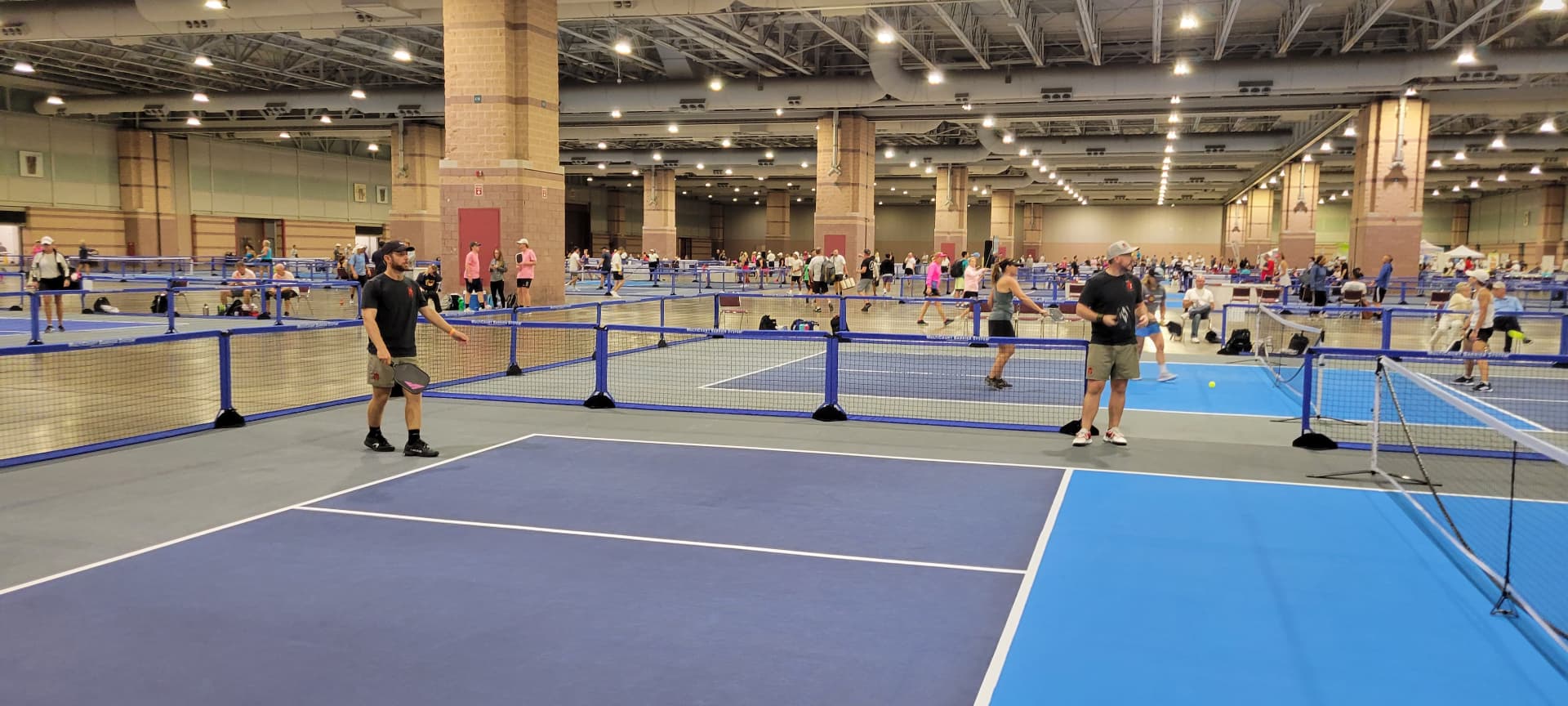
A turnkey pickleball activation gives a chamber mixer, member appreciation night, ribbon cutting, or business after-hours a physical networking block — courts delivered, built, staffed, and removed so chamber staff and planners do not become equipment operators. Rollout courts install on hotel aprons, convention pre-function floors, downtown plaza parking, and hardscape patios when the property allows — so the activation sits in the member flow, not on a remote lot. This page is for chamber executives, economic-development teams, DMCs, experiential agencies, and meeting planners — not a directory of pickleball clubs.
Why chamber events are a strong fit
Member networking that is not another standing cocktail hour
Chamber mixers and after-hours already pull owners, managers, and economic-development partners into one room. A staffed court gives those members a shared activity between name tags and sponsor tables — short rotations that mix chapters and first-time attendees without forcing a tournament bracket.
Works across fitness levels and decades of membership
Chambers draw retailers, manufacturers, nonprofits, and professional services in the same evening. A sport that is playable in the first few minutes keeps mixed ages and job functions together instead of sorting the room into athletes and spectators.
Installs on pads downtown already owns
Hotel ballroom aprons, convention-center pre-function floors, downtown plaza parking, and brewery or restaurant hardscape are hard bases — not dedicated pickleball surfaces. A rollout court with the right subfloor plays true on those pads, then clears so the property returns to its next booking.
Reads as chamber hospitality, not a carnival rental
Branded nets, hosts running short beginner clinics, and a timed open-play window photograph like a member amenity — which matters when chamber boards and economic-development directors are judged on how the evening felt for members, not only on logistics execution.
Program slots that match a chamber calendar
Chambers already own the invitation list and the downtown relationships. The activation question is which calendar slot gets a staffed court — and which pad it lands on. These are the formats we see most often when membership and events teams brief us.
Business after-hours and monthly mixers
After-hours calendars already own sponsor check-ins, raffles, and networking tables. A staffed court gives members a shared activity between the welcome remarks and the dessert line — short rotations, not a bracket that scares first-timers off the pad.
Member appreciation and annual celebration nights
Appreciation evenings need something participatory that feels current without fighting quiet-hour postings near downtown residences. A short clinic-plus-open-play window keeps members together without requiring seeded tournament play.
Ribbon cuttings and grand-opening activations
When a chamber co-hosts a ribbon cutting or downtown grand opening, a court beside the plaza or parking apron gives attendees something to do after the scissors — branded for the chamber and the member business when the brief calls for it.
Economic-development and site-visit hospitality
Economic-development teams and DMCs packaging prospect or site-selector hospitality often need a participatory block that is not another bus tour. A timed court window on a hotel apron or community-center floor keeps the group on campus.
Business-association and downtown-district events
Main-street associations, BID boards, and regional business councils share the same mixer problem as chambers. A portable court on plaza parking or a covered market pad gives those calendars a recurring hospitality option without pouring a permanent pad.
Ready to scope the chamber activation?
Chamber, pad, dates, and guest mix — we handle delivery, build, staffing, and teardown.
What to put in the quote brief
Accurate quotes follow from a clear brief — not from a published package price invented for every downtown. Send the items below and we can usually return a scoped number without a site visit for straightforward hard pads.
Program goal in one sentence
Mixer networking, member appreciation, ribbon cutting, after-hours, or economic-development hospitality — the format follows the goal. Write the outcome before you ask for a court count.
Pad photos and clear dimensions
Hotel apron, convention pre-function, downtown plaza parking, brewery patio hardscape, or community-center floor. Photos plus approximate clear rectangle after tents, stages, food lines, and emergency lanes prevent a change order the week of the event.
Event window and downtown quiet-hour adjacency
Which hours the court is live, whether residences or hotel guest rooms sit beside the pad, and whether the rectangle is exclusive or shared with food lines and sponsor booths. Quiet-hour and noise questions belong in the brief — not as a surprise the night of.
Guest mix and staffing posture
Member share, first-time guest share, VIP or sponsor share, and how many guests will likely be beginners. That drives host count more than raw RSVP count, especially when the evening also includes remarks or a raffle.
Chamber, member, and sponsor recognition
Chamber logo, member-business creative, title-sponsor wraps, or VIP-only early hour for underwriters. Flag branding lead times when the event date is locked so print does not delay load-in.
Venue COI, load-in, and apron access
Hotel convention services or plaza manager contacts, certificate of insurance requirements venues typically require, apron access (not soft lawn edge alone), overnight storage if any, emergency-lane clearance, and rain backup preference (indoor pre-function vs delayed outdoor).
Portable activation vs permanent downtown court
Some chambers eventually ask whether to pour or paint a permanent pad. For member-event calendars, a portable activation usually answers the hospitality brief without locking plaza parking or a hotel apron into a single sport. The comparison below is operational, not a price list.
| Decision | Portable chamber activation | Permanent downtown court |
|---|---|---|
| What the pad is for tomorrow | Rolls up so the hotel apron, plaza parking, or community floor returns to its next booking the next day. | A painted or poured court claims downtown square footage year-round — including weeks when the chamber calendar is quiet. |
| Who can join | Beginners rally after a short walkthrough; mixed-member nights stay together. | A fixed court often becomes an informal club that excludes casual mixer guests. |
| How it shows up in the program | Timed, staffed, and branded for one evening or ribbon-cutting window — then gone. | Becomes an amenity facilities must maintain whether or not member events use it. |
| Noise and neighbor control | Hours and placement are scoped per event against downtown residences and hotel guest rooms. | Ongoing play can create recurring quiet-hour complaints the chamber did not budget for. |
Surfaces, footprint, and downtown pads
Most chamber venues were never designed with a dedicated pickleball court in mind — which is exactly the gap a portable build fills. Hotel ballroom aprons, convention-center pre-function floors, downtown plaza parking, and brewery patio hardscape can often take a court with the right subfloor; soft lawn greens and loose gravel usually cannot without a different base conversation. Share what surrounds the play zone: tents and stages you cannot move, food lines, emergency lanes, drainage crowns that send balls downhill, and the path from the loading apron to the pad during daytime business hours. Our surface and subfloor guide covers what each site type needs. If weather is a real variable for the event date, the indoor vs. outdoor guide and weather contingency plan cover how an indoor pre-function backup gets scoped beside the primary outdoor build.
Footprint math stays honest: USA Pickleball sets the lined court at 20 × 44 feet, with roughly 30 × 60 feet recommended once runoff is included and 34 × 64 preferred for new construction when the pad allows. Always measure the clear rectangle after tents, stages, bars, and buffet lines. Detail lives in our court dimensions for events guide.
Staffing a chamber build is also a different call than staffing a single-day corporate tournament. Mixers and after-hours often run as standing drop-in windows beside other hospitality stations, so courts are usually staffed as open play with short beginner clinics rather than one seeded bracket. Our event staffing guide covers how that ratio changes for an open, timed format.
Downtown constraints: quiet hours, COI, and load-in
Chamber projects fail when event logistics treat a plaza like an empty fairground. Quiet-hour postings near downtown residences and hotel guest rooms stay real — a member photo opportunity is not a reason to ignore them. Daytime retail, valet lanes, and evening restaurant traffic often reclaim the same rectangle; say which hours the pad is exclusive. Load-in should use the apron or parking access during agreed windows when possible, not a soft lawn edge alone. Venue approval and certificate of insurance requirements hotels and plaza managers typically require belong in the brief early. See event permits and permissions and insurance and liability when the property asks for COI language before any temporary structure goes on site.
Noise, residences, and neighbor planning
Downtown chambers sit beside residences and hotel guest rooms more often than fairgrounds do. Pickleball produces sharp ball-and-paddle impact sound that carries differently than a band or a cocktail crowd. Plan placement and hours as operations questions before the invitation goes out — especially for evening after-hours and Sunday ribbon cuttings near open windows. Our noise levels and neighbor considerations page covers how we talk about that constraint honestly. We will not invent a certified decibel product claim for barriers or wraps.
Beginners, mixed members, and programming that stays welcoming
Chamber programs fail socially when the "activity" only works for half the membership. Doubles play, short rotations, and a 90-second beginner walkthrough keep less athletic owners and visiting guests inside the same evening story as the members who asked for pickleball in the first place. Hosts should invite pairs from the mixer line — not announce a seeded bracket that scares first-timers off the pad. For ribbon cuttings and appreciation nights, keep stations short and supervised so the court does not own the entire plaza for an hour.
If the evening includes a hosted VIP element beside the general activity — a sponsor-only hour before doors open to members — our client entertainment and hospitality guide covers how a hosted format differs from open play. Association annual-meeting formats that share the same hospitality brief also live on association annual meetings. Corporate field-day and retreat activations that chambers sometimes co-sponsor sit on corporate field days.
Cost posture — quote-only, not a fake chamber package
Pricing follows the same model as any turnkey activation — driven by court count, hours on-site, staffing, travel to the downtown pad, surface or subfloor needs, and branding — not by how many members RSVP. See our cost guide for the factors that move a number. We do not invent a public package price for "chamber pickleball." Chamber bookings often add chamber or member-sponsor wraps; flag that up front so it is inside the first quote rather than a change order after invitations are printed.
Chambers that want this as a recurring programming amenity across a season — not just one after-hours — should also see our recurring programming guide. Library and community-center activations that share indoor multipurpose logistics live on library and community-center events.
Who typically requests this
Requests come from four directions: a chamber executive or membership director scoping a mixer or appreciation night; an economic-development lead packaging site-visit or ribbon-cutting hospitality; a DMC or experiential agency packaging a downtown-district or business-association weekend; and a meeting planner packaging an after-hours block beside a larger conference. All four get the same build — the difference is who owns the invoice and who is the point of contact with the venue during load-in.
What we will not do on this page: invent chamber package prices, publish attendance statistics, name specific chambers or clients, invent credentials, claim noise-decibel product ratings, invent governing-body membership numbers, or claim outcomes we cannot support. The product is a turnkey staffed court activation for chamber and business-association events — quote it like one.
Ready to scope the chamber activation?
Chamber, pad, dates, and guest mix — we handle delivery, build, staffing, and teardown.