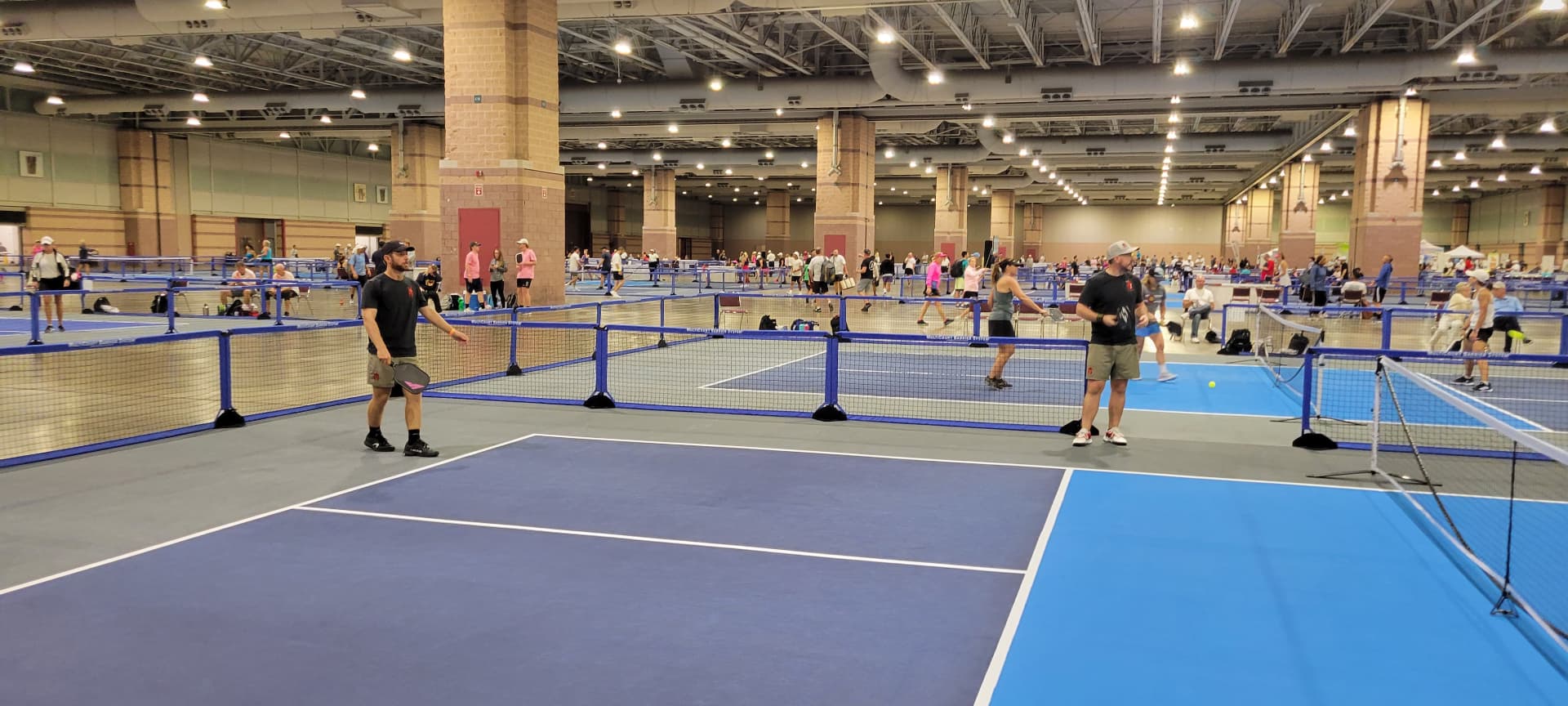
RV Parks & Campgrounds
Pickleball for RV parks and campground events
A turnkey pickleball activation gives an RV park or campground one participatory block that works across overnight guests, seasonal owners, kids-camp groups, and rally visitors — installed on an overflow lot, clubhouse multipurpose floor, pool-deck apron, or hard pad near the camp store that was never built for organized sport. Park owners, general managers, activities directors, resort-camp brands, destination management companies, and experiential agencies book it the same way as any other turnkey activation: priced by court count, hours on-site, staffing, and logistics — not by guest headcount — so it slots cleanly beside catering, pool programming, and peak-weekend parking. Request a clear quote once the weekend date and pad are real.
Why RV parks and campgrounds are adding a court for events
Parks already know how to host potlucks, pool days, and rally weekends. What many calendars still lack is a shared physical activity that pulls mixed-age guests into the same campus story without turning the overflow lot into a carnival. Peak weekends want something families remember after the welcome packet. Seasonal-owner socials want a participatory block that feels current without fighting quiet-hour postings. Kids-camp weeks want an afternoon or evening block that works for beginners and athletes in the same window. A staffed pickleball court answers that brief when the pad, hours, and noise plan are honest — not when the court is treated like a rented novelty dropped beside the playground.
This page is written for the people who actually book campground events: park owners and GMs, activities directors, resort-camp brand operators, DMCs packaging incentive or guest hospitality, and planners hired for a one-weekend rally. It is not a find-a-court consumer guide and not advice on how the public should locate open play near a campground. If you need a staffed activation on the campus you control, you are in the right place. If you want to buy or rent the court surface itself for ongoing DIY guest amenities, see PickleCourt USA's RV park and campground court guide.
Why pickleball fits an RV park event brief
RV parks and campgrounds already stage peak-weekend activities, owner socials, and rally hospitality. A staffed court gives overnight guests and seasonal owners something to do together without asking facilities to pour a permanent sport pad on the only overflow lot that still hosts holiday-weekend rigs, vendor markets, and propane deliveries.
Memorial Day through Labor Day weekends pull kids, parents, grandparents, and full-time seasonal owners onto the same campus. A sport that is playable in the first few minutes keeps mixed-age groups together instead of splitting the rec area into athletes and spectators.
Overflow gravel or asphalt lots, clubhouse multipurpose floors, pool-deck aprons, and hard pads near the camp store are hard bases — not sport surfaces. A rollout court with the right subfloor plays true on those pads, then clears so peak-weekend parking and market tents return the next morning.
Branded nets, hosts running short clinics, and a timed open-play window photograph like a resort amenity — which matters when GMs and activities directors are judged on how the weekend felt for guests and seasonal owners, not only on logistics execution.
Where it fits on the park calendar
Memorial Day / Labor Day peak weekends
The calendar spikes when every pull-through is full. A staffed court on the overflow lot or clubhouse pad gives families a shared activity between the pool and the evening social — short rotations, not a bracket that scares first-timers off the pad.
Seasonal-owner and long-stay socials
Parks with seasonal owners already run potlucks and Friday night gatherings. A timed open-play window with short clinics keeps the pad busy without requiring a seeded tournament — and gives year-round guests a reason to linger past checkout.
Rally / campground-association weekends
Association rallies and multi-park meetups already bring guests and vendors ashore. A lit or daytime court turns a standard hospitality block into something guests actually join. Keep hours honest against quiet-hour postings and sites beside the pad.
Kids camp / youth activity blocks
Youth programs and kids-camp blocks already own the daytime calendar. A supervised court gives campers and siblings a shared activity after crafts or pool time — staffed rotations, not an unstaffed free-for-all beside the playground.
Resort-camp brand guest activations
When a resort-camp brand or DMC packages a guest hospitality evening, a court gives the partner a visible activation that still fits outdoor hospitality. Brand wraps and hosts belong in the same brief as the underwriting package.
Comparing formats for energy and dwell time? See round-robin vs bracket vs open play. Youth-forward programming that shares the same supervised-activity brief can borrow from summer camps and youth programs. Municipal parks and recreation departments that run similar outdoor guest programming should see our parks and recreation page. Properties that want pickleball as a standing amenity for every group that books overnight stays should also see hotels and resorts and waterfront clubs with related apron logistics on marina and yacht-club events.
Rollout activation vs a permanent park court
Some owners ask whether they should paint lines or pour a pad instead of renting a turnkey build for one weekend. Use the table as a scoping tool — not a claim that one answer always wins. Parks that already partner with a recreation wing or keep dry storage may buy a leave-down for the season; properties whose overflow lots cycle through holiday parking, vendor markets, and propane staging usually need the reversible option.
| Lens | Staffed rollout activation | Permanent park court |
|---|---|---|
| What the pad is for tomorrow | Rolls up so the overflow lot returns to holiday-weekend parking, vendor markets, or propane staging the next day. | A painted or poured court claims park square footage year-round — including shoulder months when occupancy is thin. |
| Who can join | Beginners rally after a short walkthrough; mixed-age guest nights stay together. | A fixed court often becomes an informal club that excludes casual weekend guests. |
| How it shows up in the program | Timed, staffed, and branded for one evening or weekend — then gone. | Becomes an amenity facilities must maintain whether or not programs use it. |
| Noise and neighbor control | Hours and placement are scoped per event against quiet hours and cabin / pull-through adjacency. | Ongoing play can create recurring quiet-hour complaints the park did not budget for. |
Parks weighing buy versus rent for a seasonal amenity leave-down — not a single staffed weekend — should also read recurring programming for venues. Cost factors without invented package prices live on our court rental cost guide.
Scoping an RV park or campground activation?
Tell us the park, pad, dates, guest mix, and whether you are ownership, the GM, an activities director, a DMC, or the brand's agency. We return clear, all-in pricing for a turnkey build — usually within 24 hours — so you can put a real number in the program budget.
Get a quoteWhat to put in the park or planner brief
The fastest accurate quote comes from a short, complete brief — not a long RFP with missing surface photos. Use this checklist when ownership or the GM sources us directly, or when a DMC packages the activation under a single client-facing bill.
Program goal in one sentence
Peak-weekend guest activation, seasonal-owner social, rally hospitality, kids-camp block, or brand underwriting — the format follows the goal. Write the outcome before you ask for a court count.
Pad photos and clear dimensions
Overflow lot, clubhouse multipurpose floor, pool-deck apron, or hard pad near the camp store. Photos plus approximate clear rectangle after picnic tables, propane cages, fire rings, golf-cart paths, and any sites you would otherwise rent out prevent a change order the week of the event.
Event window and quiet-hour / site adjacency
Which hours the court is live, whether premium pull-throughs or cabins sit beside the pad, and whether the rectangle is exclusive or shared with markets and catering. Quiet-hour and noise questions belong in the brief — not as a surprise the night of.
Guest mix and staffing posture
Overnight guest share, seasonal-owner share, kids-camp share, and how many guests will likely be beginners. That drives host count more than raw headcount, especially when the evening also includes a potluck or live music.
Brand, park, and recognition moments
Park logo, resort-camp crest, rally sponsor creative, or VIP-only early hour for seasonal owners. Flag branding lead times when the weekend date is locked so print does not delay load-in.
GM, COI, and load-in rules
General-manager or activities-director contacts, municipal or lease labor rules, apron access (not soft lawn edge alone), overnight storage, certificate of insurance requirements, emergency-lane clearance, and rain backup preference (clubhouse multipurpose vs delayed outdoor).
Writing a formal vendor RFP? See how to write an RFP for a pickleball event. Still deciding how many courts the window needs? Read how many pickleball courts do you need.
Building on park terrain that was not designed for it
Almost no overflow lot was built with a dedicated pickleball court in mind — which is exactly the gap a portable build fills. Overflow gravel or asphalt, clubhouse multipurpose floors, pool-deck aprons, and hard pads near the camp store can often take a court with the right subfloor; soft lawn greens and loose gravel usually cannot without a different base conversation. Share what surrounds the play zone: picnic tables and fire rings you cannot move, propane cages, golf-cart paths, drainage crowns that send balls downhill, and the path from the loading apron to the pad. Our surface and subfloor guide covers what each site type needs. If weather is a real variable for the event date, the indoor vs. outdoor guide and weather contingency plan cover how a clubhouse multipurpose backup gets scoped beside the primary outdoor build.
Footprint math stays honest: USA Pickleball sets the lined court at 20 × 44 feet, with roughly 30 × 60 feet recommended once runoff is included and 34 × 64 preferred for new construction when the pad allows. Always measure the clear rectangle after picnic tables, propane cages, bars, and buffet lines. Detail lives in our court dimensions for events guide.
Staffing a park build is also a different call than staffing a single-day corporate tournament. Peak weekends and owner socials often run as standing drop-in windows beside other hospitality stations, so courts are usually staffed as open play with short clinics rather than one seeded bracket. Our event staffing guide covers how that ratio changes for an open, timed format.
Park constraints: quiet hours, site reclaim, and load-in
Campground projects fail when event logistics treat the park like a hotel parking lot. Quiet-hour postings and emergency lanes stay clear — a guest photo opportunity is not a reason to block them. Peak-weekend parking and seasonal markets often reclaim the same rectangle mid-week; say which hours the pad is exclusive. Load-in should use the apron or parking access road, not a soft lawn edge alone. GM approval and certificate of insurance requirements belong in the brief early. See event permits and permissions and insurance and liability when ownership asks for COI language before any temporary structure goes on a leased or franchised lot.
Noise, cabins, and quiet-hour planning
RV parks and campgrounds sit beside premium pull-throughs, cabins, and quiet loops more often than fairgrounds do. Pickleball produces sharp ball-and-paddle impact sound that carries differently than a band or a cocktail crowd. Plan placement and hours as operations questions before the invitation goes out — especially for evening owner socials and Sunday family festivals near open cabin windows. Our noise levels and neighbor considerations page covers how we talk about that constraint honestly. We will not invent a certified decibel product claim for barriers or wraps.
Guests, kids, seasonal owners, and mixed fitness levels
Park programs fail socially when the "activity" only works for half the campus. Doubles play, short rotations, and a 90-second beginner walkthrough keep less athletic guests and visiting grandparents inside the same evening story as the athletic kids who asked for pickleball in the first place. Hosts should invite pairs from the potluck line — not announce a seeded bracket that scares first-timers off the pad.
If the evening includes a hosted VIP element beside the general activity — a seasonal-owner-only hour before doors open to overnight guests — our client entertainment and hospitality guide covers how a hosted format differs from open play.
Cost posture — quote-only, not a fake campground package
Pricing follows the same model as any turnkey activation — driven by court count, hours on-site, staffing, travel to the park, surface or subfloor needs, and branding — not by how many sites are occupied that weekend. See our cost guide for the factors that move a number. We do not invent a public package price for "RV park pickleball." Park bookings often add resort-camp or rally wraps; flag that up front so it is inside the first quote rather than a change order after invitations are printed.
Parks that want this as a recurring programming amenity across a season — not just one Memorial Day weekend — should also see our recurring programming guide. City festival and street-fair activations that share apron logistics with outdoor rally weekends live on city festivals and street fairs.
Who typically requests this
Requests come from four directions: a park owner or GM scoping a peak weekend or Friday social; an activities director packaging kids-camp or seasonal-owner programming; a DMC or experiential agency packaging resort-camp guest hospitality; and a rally organizer building a hospitality block between association events. All four get the same build — the difference is who owns the invoice and who is the point of contact with the GM during load-in.
What we will not do on this page: invent campground package prices, publish attendance statistics, name specific parks or clients, invent credentials, claim noise-decibel product ratings, or claim outcomes we cannot support. The product is a turnkey staffed court activation for RV park and campground events — quote it like one.
Ready to scope the park activation?
Park, pad, dates, and guest mix — we handle delivery, build, staffing, and teardown.