Event Playbook · Casino & Gaming Resorts
Pickleball for casino and gaming resorts
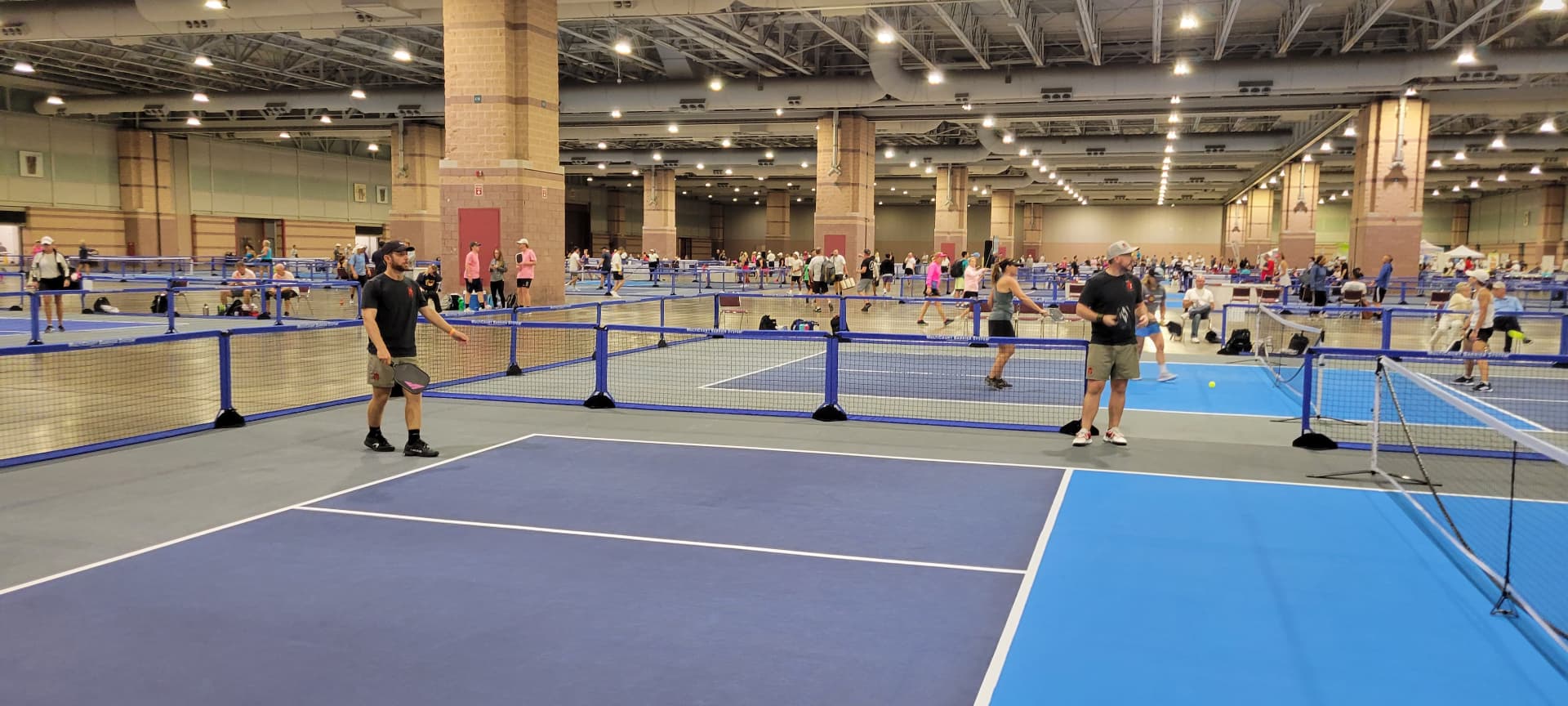
A turnkey pickleball courtgives a casino or gaming resort a non-gaming amenity that draws convention groups, families, and guests who aren't on the floor — and a bookable option for VIP host programming. Coverage of recent luxury resort renovations keeps citing a regulation pickleball court as an expected addition rather than a novelty, and that expectation now extends to destination properties with a casino attached. Courts are delivered, built, staffed, and removedon an event lawn, rooftop deck, converted tennis court, or parking structure — built around your property's security and access rules, not a generic hotel install.
Why gaming properties are adding courts
The gaming floor is table stakes — it looks similar from property to property in a given market. Everything around it is where a resort actually differentiates, and active amenities are gaining ground on the usual pool and spa mix. Resorts as varied as a Bahamas mega-resort with its own casino and mainland luxury properties undergoing renovation have added courts in the same cycle, treating them as an expected amenity rather than a marketing gimmick.
Gaming floors mostly look the same from property to property. What separates a resort in a guest's mind is everything around it — pools, F&B, spa, and increasingly, active amenities. Resort coverage of recent luxury reopenings and renovations keeps naming a regulation pickleball court as the addition, not a footnote.
Convention attendees, spouses and families on a trip built around one gambler in the party, and day-trippers all need something to do that isn't the floor. A staffed court gives the property a reason for that guest to stay on-site — and near the amenities that do generate revenue — instead of leaving for the afternoon.
Casino marketing teams already run comped experiences for top-tier players — private dinners, box seats, golf. A hosted pickleball clinic or small tournament is a lower-cost, easy-to-schedule addition to that playbook that doesn't require reserving an entire golf course.
Integrated resorts with meeting space are already booking the trade-show and conference business our convention centers and trade halls guide covers. A court on an event lawn or unused deck adds a bookable activity for that group without competing with the gaming floor for space.
Four ways gaming resorts use this
The right format depends on whether the goal is a public-facing amenity, a VIP hosting tool, a convention add-on, or all three at different times of year.
A court on an event lawn, unused tennis court, or rooftop deck that stays up for a season rather than a single weekend — staffed for scheduled clinics and open-play blocks, similar to how a resort runs its pool cabana or watersports program.
A private clinic or small invitational for top-tier players, booked through the host team the same way a golf outing or chef's table gets scheduled. Keep the format light — an hour of instruction and casual play reads as hospitality, not a competitive grind.
Groups already booked into the resort's meeting space can add a court to their agenda as a break activity or evening reception add-on. This slots into the same planning conversation as AV and catering, not a separate vendor search.
Casino resorts run later than a typical hotel, and a lit court extends the amenity into the evening instead of closing at dusk like a standard outdoor install. Pair with our glow-in-the-dark format for a nightlife-appropriate version of the activation.
Want the standard hotel and resort amenity framing without the casino-specific logistics? Start with pickleball for hotels and resorts. Ski and mountain resorts share some of the same seasonal-install logic — see pickleball for ski and mountain resorts for that comparison. For the night-play format, see glow-in-the-dark pickleball for events.
Scoping a court for your property?
Tell us the property, install site, and whether this is an amenity program, VIP host tool, or convention add-on — we'll scope courts and staffing around your security and access requirements.
Do this, skip that
Do
- Coordinate court placement with security and surveillance early — casino properties have access and camera-coverage rules that a typical hotel lawn doesn't.
- Loop in the marketing and player-development teams if VIP host programming is part of the brief; they usually own the comp budget this gets billed against.
- Site the court where it's visible from guest-traffic paths (pool deck, lobby approach) so it reads as a property amenity, not a hidden back-lot activity.
- Confirm certificate-of-insurance and vendor-registration requirements before booking — large gaming properties often have a formal vendor compliance process separate from the venue's own event team.
- Decide lighting and night-play needs up front if the property wants the court active past sunset, which is common given casino operating hours.
Don't
- Don't position the activation as tied to gambling promotions or comps without looping in legal and compliance — that's a property-specific call, not a default we make for you.
- Don't schedule loud programming (music, an emcee mic) near a table-games area or high-limit room without checking noise rules with operations first.
- Don't assume the same install plan works property-wide; tribal, regional, and Strip-style integrated resorts often have different approval chains and different departments owning the decision.
- Don't treat this as a substitute for the resort's core amenity strategy — it's an addition to the pool, spa, and F&B mix, not a replacement for any of it.
- Don't skip a site walk if the court is going on a rooftop deck or parking structure; load ratings and access paths vary a lot by property.
What's actually different about a gaming-property build
The court, install crew, and staffing model are the same ones we bring to any resort. What changes on a gaming property is everything around the build: who signs off, how our crew gets access, and when we're allowed to load in.
Casino properties run tighter access control than most hotels — expect questions about crew credentialing, delivery routes that avoid the gaming floor, and camera coverage for any area we build on. Share these requirements during the site assessment so load-in doesn't stall at the loading dock.
On integrated resorts, amenity decisions can sit with hotel operations, marketing, or player development depending on whether the primary goal is guest amenity, brand differentiation, or VIP hosting. Identifying the right owner early avoids a proposal bouncing between departments.
Golf-adjacent and resort-style casino properties often have existing tennis or bocce courts that convert well; urban and riverboat-style properties more often need a rooftop, parking structure, or event-lawn install with a subfloor. Both are routine — the difference shows up in build time, not feasibility.
Properties that never close sometimes prefer overnight or early-morning load-in windows to avoid guest-traffic conflicts, unlike a hotel that can build during a quiet weekday afternoon. Confirm the preferred window with operations rather than assuming standard daytime access.
Deeper references: site assessment, surface and subfloor requirements, and insurance and liability.
Sizing the install to your property type
Court count follows the goal, not the property's overall size. A property chasing a public amenity story needs different court count than one running a private VIP host program.
One court, staffed for scheduled clinics and open-play blocks, is a common entry point to test guest demand before any larger commitment.
Two or more courts support both an amenity-program install and a bookable add-on for convention and meeting groups without the two uses competing for time.
A consistent single-court package rolled out across several properties keeps the guest experience and staffing model the same brand to brand — see our multi-city activation tour guide if this is a coordinated multi-property rollout.
For general court-count math, see how many pickleball courts you need and court dimensions for events.
Temporary test vs. a seasonal or permanent build
Some properties want to test guest demand with a temporary weekend install before committing to a season-long or permanent amenity. That's a reasonable first step — it answers whether guests actually use the court before facilities and ownership sign off on dedicating square footage to it year-round. When you're ready to compare a one-off activation against a permanent build, our permanent court vs. event rental guide lays out the tradeoffs. This page stays on the activation side: deliver, staff, remove, or extend seasonally.
Branding on a property with its own visual identity
Integrated resorts almost always have strict brand guidelines for anything visible to guests. Court wraps, net bands, and signage can carry your property's brand standards rather than a generic pickleball look — plan for a brand-review pass with your marketing team before print production locks, since that approval step often takes longer on a large hospitality brand than on a standalone venue.
Pricing honesty for gaming-property buyers
Turnkey activations are quoted as a scoped line item — court count, days on-site, staffing, surface, and branding — the same drivers as any resort build, plus time for security coordination and vendor-compliance review where a property requires it. We don't publish a separate gaming-industry price menu; every property is quoted individually. Compare the general cost drivers in our pickleball court rental cost guide, then request a quote with property address, install site, and program goals.
How to brief us (what we need in the first email)
A clean first brief matters more here than at most venues, since it usually needs to move through more than one internal department before approval.
- Property name, address, and proposed install site — event lawn, rooftop deck, converted tennis court, or parking structure.
- Primary goal: public amenity program, VIP host tool, convention/meeting-group add-on, or a mix.
- Which department is sponsoring the request — operations, marketing, or player development — so the proposal routes correctly.
- Whether a vendor-compliance or procurement process applies, and who owns that on your side.
- Preferred load-in window, given any 24-hour operating constraints.
- Brand requirements: property wrap standards, and whether a sponsor or partner brand needs secondary placement.
For a general framework on adding pickleball to any event or property, see how to add pickleball to your event. If your rollout spans multiple properties under one gaming company, see national multi-city activation tour.