Best Pop-Up Pickleball Equipment for Company Events (2026): Court Lines, Balls, Nets & Loaner Paddles Compared
By The Pickleball Events Co. team · Updated
The short answer
A good pop-up package is a surface that suits the venue, lines(a throw-down kit like Franklin's for social play, 2-inch tape for anything competitive), a portable regulation net per court, one approved ball model that matches the venue (Franklin X-40 or Onix Dura Fast 40 outdoors; Franklin X-26 or Onix Fuse Indoor indoors), and numbered loaner paddles. The equipment is the easy part; the surface and the staff decide whether the day works. Disclosure: The Pickleball Events Co. is our company and we rent staffed pop-up courts. We aren't affiliated with any brand on this page and nobody paid to be included.
Who this is for
This guide is for event agencies, DMCs, incentive planners and in-house corporate event teams who are putting pickleball into a program (a sales kickoff, a field day, a hospitality suite, a conference reception) and need to know what a pop-up equipment package should contain, whether they buy it, rent it, or check a vendor's quote against it. It isn't a guide to the best paddle for your own game. Every product fact below comes from the manufacturer's own page, and court dimensions come from USA Pickleball's official rulebook, checked on the date above.
How we compared
- Does the item work on the actual surface: hotel ballroom carpet over a sport floor, a gym, a plaza, a parking deck?
- Is it close enough to regulation that regular players won't notice it's a pop-up (USA Pickleball's 20 x 44 ft court, 2-inch lines, 36 in / 34 in net)?
- What does the venue allow on its floor, and who removes it?
- How fast does it set up and strike, since load-in windows are short?
- Does it survive dozens of guests, some of whom have never held a paddle?
- Specs and claims only from the manufacturer's own page or USA Pickleball, checked on the date above.
No star ratings, no invented test scores and no prices: retail prices change weekly and a planner's cost is usually a package quote anyway. Pick by venue and format using the tables below.
Comparison table
| Item | Type | Best for | Surface | Key facts (from maker) | Watch out for |
|---|---|---|---|---|---|
| Franklin Pickleball Court Marker Kit | Temporary lines | Fast corner-and-junction marking when tape isn't allowed | Hard, flat surfaces (gym floors, sport courts, smooth pavement) | 4 L-shaped + 8 T-shaped flexible markers; wipe-clean material; portable | Marks points, not continuous lines, so in/out calls are by eye |
| 2-inch court or gym-floor tape | Temporary lines | Competitive play and anything with a bracket | Hard floors and pavement where the venue approves the tape product | USA Pickleball's rulebook calls for lines 2 inches wide in a contrasting color | Venue approval, removal labor and residue; poor adhesion on dusty or wet pavement |
| Franklin X-40 (outdoor ball) | Balls | Outdoor events, especially if anyone on the guest list plays tournaments | Outdoor hard courts and pavement | 40 machine-drilled holes; seamless one-piece polyethylene; USA Pickleball approved for outdoor tournament play | It's a firm outdoor ball; it plays differently indoors |
| Onix Dura Fast 40 (outdoor ball) | Balls | Outdoor groups of experienced players who already use it | Outdoor hard courts | 40 holes in a large-and-small pattern; roto-molded hollow design; Onix markets it as its fastest ball | A fast ball makes long rallies harder for first-timers |
| Franklin X-26 (indoor ball) | Balls | Gyms, ballrooms on sport flooring, and convention-hall courts | Indoor court surfaces | 26 holes; two-piece construction with beveled holes; USA Pickleball approved for indoor tournament play | Don't take an indoor ball outside; it's built for a different surface |
| Onix Fuse Indoor (indoor ball) | Balls | Indoor events where some guests play both indoors and outdoors | Indoor court surfaces | Precision-drilled holes; seam welding Onix says resists splitting; meets USA Pickleball requirements for indoor tournament play | Same rule as any indoor ball: indoors only |
Grouped by category, not ranked by score. Facts as stated on each manufacturer's page and the USA Pickleball rulebook on October 29, 2026.
The picks, one by one
1. Franklin Pickleball Court Marker Kit
Best for: Fast corner-and-junction marking when tape isn't allowed
Franklin's court marker kit is a set of flat, flexible throw-down pieces: four L-shaped corners and eight T-shaped junction pieces, per Franklin's product page, in a bright color, wipe-clean, and light enough to carry from court to court. You set the corners and the T's where the non-volley zone lines and centerline meet the sidelines and baselines, and you have a court outline in minutes without putting anything sticky on the floor.
That last point is why it belongs in a planner's kit. Plenty of venues (hotel ballrooms with fresh finishes, school gyms, some exhibit halls) won't allow tape, or will only allow a specific product that someone has to source and remove. A throw-down kit needs no approval beyond 'can we put things on the floor.'
The honest limit is that it marks points, not lines. For a mixer where the goal is fun and rotation, that's fine; players eyeball the kitchen line between the T's. For a tournament finale with a prize on the line, players will argue about balls that land between markers. Use it for social formats, tape or painted lines for anything competitive.
2. 2-inch court or gym-floor tape
Best for: Competitive play and anything with a bracket
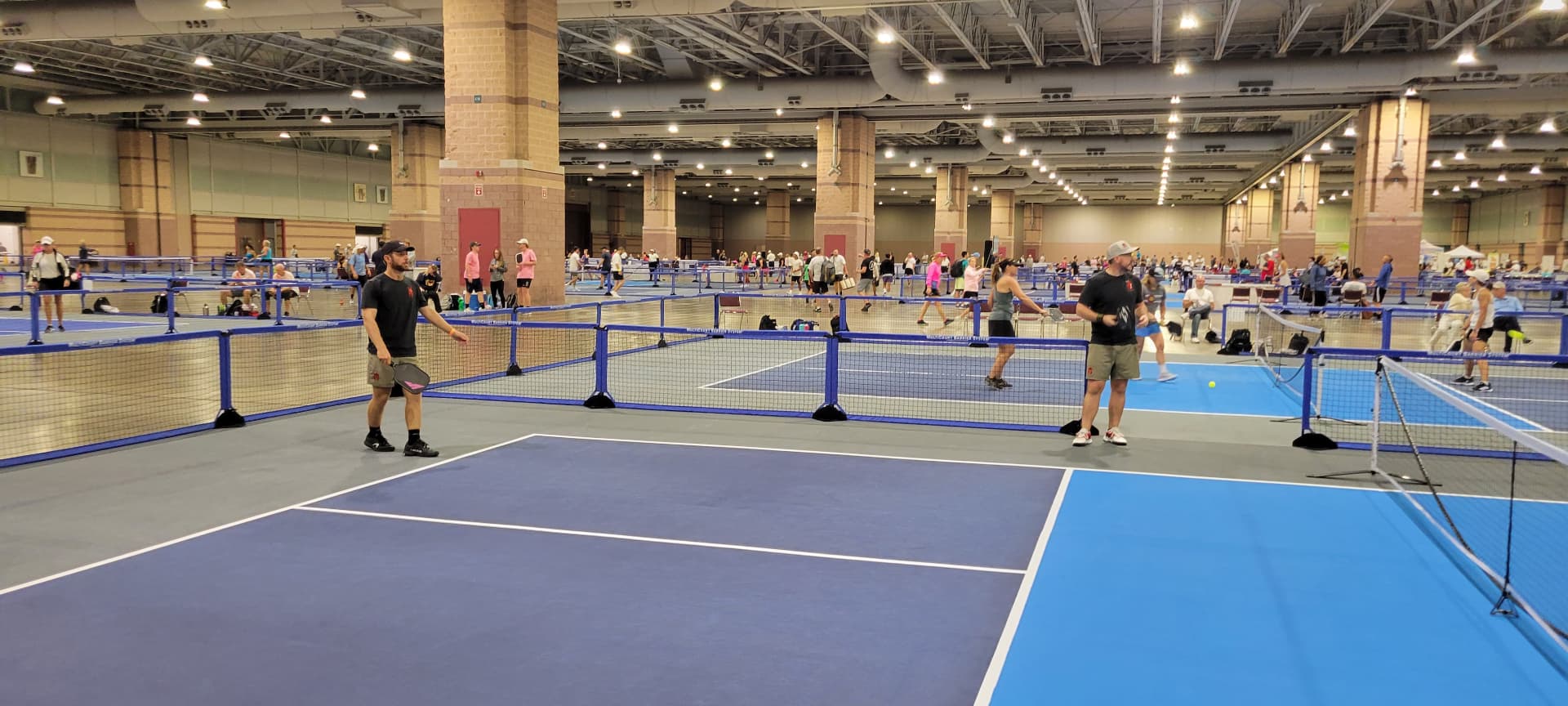
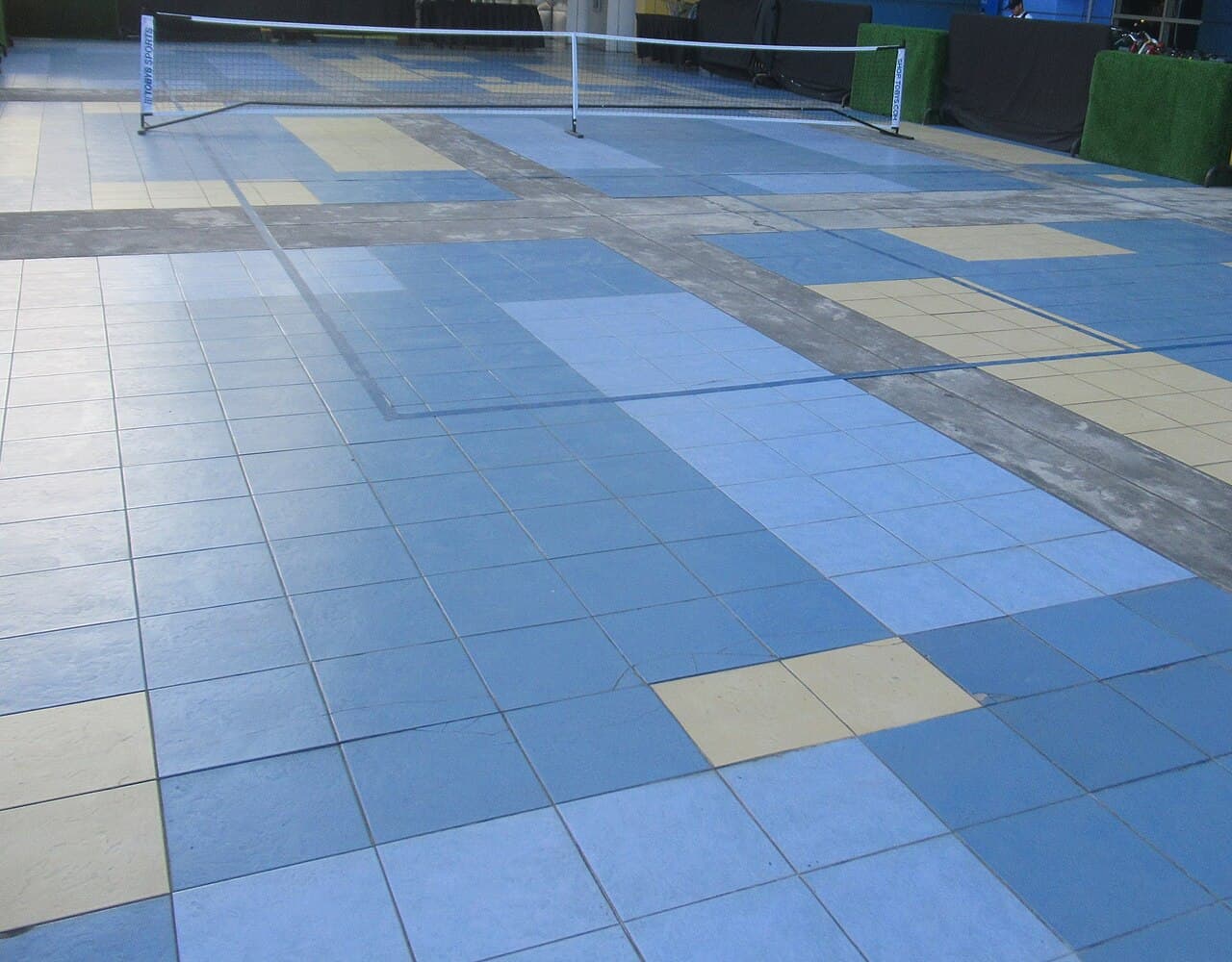
Taped lines are what most pop-up courts we see actually use, including the one in the photo above. They give you continuous boundaries, a clear non-volley zone and real in/out calls. USA Pickleball's official rulebook says lines should be 2 inches wide and the same color, contrasting with the playing surface, on a 20 x 44 ft court with a 7 ft non-volley zone on each side of the net. Match that and nobody on court will notice they're playing on a temporary build.
We're deliberately not naming a 'best tape brand' here, because the right product depends on the floor, and the venue usually decides. A ballroom's facilities team may specify a residue-free product and insist on removing it themselves. Outdoors, adhesion depends on the pavement being clean and dry. Two questions to settle at the site walk: which tape the venue allows, and who pulls it up afterward (and on whose clock). Our site assessment guide covers the rest of that walk-through.
3. Franklin X-40 (outdoor ball)
Best for: Outdoor events, especially if anyone on the guest list plays tournaments
Franklin describes the X-40 as a 40-hole, machine-drilled outdoor ball with a seamless one-piece polyethylene build, approved by USA Pickleball for outdoor tournament play and named the official ball of USA Pickleball and the US Open Pickleball Championships. Franklin sells it in packs up to 100, which matters when you're stocking six courts and a spare bucket.
For a company event, the reason to pick a recognized tournament ball isn't performance. It's that the regular players in the group (there are always a few) will know it, and the beginners won't notice. Bring enough that you aren't chasing balls between rounds; a few per court plus spares for cracks and balls that go over the fence is a sensible floor.
4. Onix Dura Fast 40 (outdoor ball)
Best for: Outdoor groups of experienced players who already use it
Onix's Dura Fast 40 uses a roto-molded hollow design with a mix of large and small holes, which Onix says gives a true flight outdoors. Onix markets it as the fastest ball in the sport and says it's used in more pro tournaments than any other ball; treat those as the maker's claims. It comes in several colors.
That speed is the thing to think about for a corporate group. Experienced players like a fast, lively ball. A room full of first-timers will have shorter rallies with it. If the brief is a beginner-heavy mixer, we'd lean toward whichever approved ball the group's regular players already use, and keep the fastest ball for a competitive finale.
5. Franklin X-26 (indoor ball)
Best for: Gyms, ballrooms on sport flooring, and convention-hall courts
Indoor balls have fewer, larger holes and are designed for indoor surfaces. Franklin's X-26 has 26 holes, a two-piece construction and beveled holes, and Franklin says it's USA Pickleball approved for indoor tournament play. It's sold in packs up to 100.
The common mistake on indoor company events is ordering 'pickleballs' and getting an outdoor ball, which skids and bounces differently on a gym floor or sport tile. If the event is indoors, specify an indoor ball in the equipment list, in writing.
6. Onix Fuse Indoor (indoor ball)
Best for: Indoor events where some guests play both indoors and outdoors
Onix's Fuse Indoor has precision-drilled holes and seam welding that Onix says improves durability and resists splitting, and Onix says it meets USA Pickleball requirements for indoor tournament play. Onix positions it as creating consistency between indoor and outdoor play, which is a reasonable tiebreaker if the client's regular players split time between the two.
Between the X-26 and the Fuse Indoor, there's no reason to agonize. Both are approved indoor balls from established makers. Pick one, order enough, and keep balls of a single model on all courts so every court plays the same.
Nets: use a portable regulation system
The net is the one item guests judge the whole build by. A sagging backyard net reads as a picnic game; a taut regulation net reads as a real court. USA Pickleball's rulebook sets the net at 36 inches at the sidelines and 34 inches at the center, with posts placed so they sit roughly a foot outside each sideline. When you compare portable systems, check that the maker states regulation height and how the center height is held, and test it again after the first hour of play.
Portable nets are a deep category of their own (frame weight, wheels, center posts, ballast for wind), so we don't duplicate that comparison here. Our sister site compares the Onix, SwiftNet and Douglas portable systems in detail in its guide to the best portable pickleball nets and post systems. For events, add one spare net to the package; a bent leg at load-in shouldn't cost you a court.
In partnership with PickleCourt USA.
Loaner paddles: what to specify
We don't name a single best paddle for events, because a loaner fleet has different needs from a personal paddle, and models change every season. Specify these instead:
- One model for the whole fleet. Nobody fights over the "good" paddle, and every court plays the same.
- A mid-weight, forgiving paddle. Most guests are beginners; a very light or very stiff paddle is harder to control.
- Approved models if the format is competitive. USA Pickleball publishes an approved paddle list; it matters for a bracket with a trophy, not for a mixer.
- Numbered and counted. Number every paddle, count them out and back, and keep a spare tub.
- Wiped between sessions. Grips get sweaty at outdoor summer events; bring wipes and a few replacement overgrips.
- Enough for the queue. Four per court in play is the floor; guests waiting to rotate in will want one in their hands.
What a complete pop-up package covers
| Item | What to specify | Planner note |
|---|---|---|
| Court surface | A flat, non-slip surface sized for the footprint (about 30 x 60 ft per court for a comfortable event layout) | On carpet or grass, a sport-tile or roll-out surface is the package; lines and nets come second |
| Lines | Throw-down markers for social play; 2-inch taped lines for competitive play | Settle the venue's tape rules at the site walk |
| Nets | One portable regulation net per court plus a spare | 36 in at the sidelines, 34 in at center; posts about 12 in outside each sideline |
| Balls | Indoor or outdoor ball to match the venue, one model on every court | Several per court plus a spare bucket |
| Paddles | Loaner paddles for every guest likely to be on court at once, plus spares | One model, numbered, wiped between sessions |
| People | A court host for every couple of courts and one person running the rotation | Equipment doesn't explain the kitchen rule; people do |
Our equipment rental checklist turns this into a line-by-line list you can paste into a vendor brief, and the surface and subfloor requirements guide covers carpet, grass, decks and parking lots.
Match the kit to the brief
Ballroom reception, mostly beginners.Surface first: a ballroom carpet isn't a court, so the package needs a sport surface laid over it. Throw-down markers if the venue won't allow tape, indoor balls, one model of mid-weight paddle and plenty of court hosts.
Outdoor field day on a parking lot. Clean, dry pavement takes tape well, outdoor balls, portable nets with ballast for wind, and shade and water near the courts. Our heat safety guide covers the rest.
Sales kickoff tournament with a trophy. Taped 2-inch lines, a regulation net per court, one tournament-approved ball model, approved paddles and a scoring app. See our scoring and bracket apps comparison.
Trade-show booth with one demo court. Footprint decides everything. Our trade show booth activation guide covers booth math and shortened demo courts.
Mistakes we see on pop-up builds
The wrong ball. An outdoor ball on a gym floor, or the reverse. Write "indoor" or "outdoor" into the equipment line, not just "pickleballs."
Lines without a removal plan. Tape that leaves residue on a ballroom floor becomes a damage charge. Agree on the product and the removal crew before load-in.
Mixed equipment across courts. Different nets, balls and paddles on each court make some courts feel better than others and cause queues at the "good" court.
No spares. Balls crack, a net leg bends, a paddle edge chips. One spare net, a spare bucket of balls and a tub of spare paddles cost little compared with a dead court.
Equipment without people. The kit doesn't teach the two-bounce rule or keep the rotation moving. Plan staff with the same care; our event staffing guide lists the roles.
Want the whole package, staffed?
Send the date, city, venue, headcount and surface. We'll spec the court surface, lines, nets, balls and loaner paddles, bring court hosts, set up and strike, and quote it in writing. White-label for agencies is available.
Related: pickleball court rental for events · how many courts do you need · court dimensions for events · corporate pickleball event companies compared
Sources: Franklin Pickleball Court Marker Kit; Franklin X-40 Outdoor Pickleballs; Franklin X-26 Indoor Pickleballs; Onix Dura Fast 40; Onix Fuse Indoor; USA Pickleball Official Rulebook; USA Pickleball approved ball list. Accessed October 29, 2026.