Best Battery PA Speakers for Emcees at Pickleball Events (2026): Runtime, Mics & Weather Compared
By The Pickleball Events Co. team · Updated
The short answer
For court calls, bracket updates and an awards moment at an outdoor company pickleball event, pick on runtime at outdoor volume and how the emcee gets a wireless mic. The Bose S1 Pro+ is the lightest (14.4 lb) with docking wireless transmitters. The JBL EON ONE Compact ducks music automatically when someone talks. The Electro-Voice EVERSE 8 is the only one rated for light rain (IP43, on battery with its cover). The Yamaha STAGEPAS 200BTR is the loudest single box, and the Anchor Audio Liberty 3 has four wireless mics and speaker-to-speaker linking built in.
Disclosure: The Pickleball Events Co. is our company and we run staffed pickleball events. We aren't affiliated with any brand here, we don't earn commissions on them, and nobody paid to be included.
Who this is for
Event agencies, DMCs, incentive planners and in-house teams running pickleball on a lawn, a parking deck, a rooftop or a hotel terrace. Most company pickleball events need a voice more than they need music: someone calling the next match to court 3, explaining the format to 60 people who have never played, thanking a sponsor, and running a five-minute awards moment. On an indoor ballroom build the venue's house sound usually covers that. Outdoors, there is often no house sound and no convenient outlet, which is why battery-powered PA speakers end up on almost every outdoor run of show. This page compares the speakers themselves. For where power and staging go on the site plan, see our power and lighting guide.
How we compared
- Battery runtime as the maker states it, including the conditions behind the number
- How an emcee gets a wireless mic: built-in receiver, docking transmitter, or a separate system
- Voice features that help non-audio staff: speech presets, ducking, feedback suppression
- Weight and handling, since someone carries it from the truck across a lawn or garage deck
- Published weather protection, because outdoor show courts often have no tent
- Expansion: a second speaker for a large site, by cable or wireless link
Every fact below comes from the maker's own product page, spec sheet, flyer or owner's manual, read on November 23, 2026. We haven't tested these speakers side by side and we don't invent ratings or reprint prices, which change by retailer and bundle. Where a maker's documents disagree with each other, we say so in the entry instead of picking a number. Output figures are each maker's own and aren't all measured the same way, so treat them as a rough guide to headroom, not a ranking.
Comparison table
| Speaker | Battery runtime (maker) | Output | Weight | Mics | Weather | Watch out for |
|---|---|---|---|---|---|---|
| Bose S1 Pro+ | Up to 11 hours (Bose test: music at a talk-over volume, indoors) | 109 dB calculated max SPL at 1 m; 120° x 50° coverage | 14.4 lb (6.5 kg) | 3-channel mixer; optional Bose wireless mic/line transmitters dock and charge in the speaker | No ingress rating listed; operating range -4 °F to 113 °F | Bose's own sizing note says audiences up to 50; charge time listed as 5 hours on the store page and up to 4 hours in the manual |
| JBL EON ONE Compact | Up to 12 hours; swappable battery; 2.5-hour charge | 112 dB (JBL figure); 8-inch woofer | 17.6 lb (8 kg) | 4-channel mixer, 2 mic preamps with phantom power; no built-in wireless receiver | No ingress rating listed | Wireless mics need a separate receiver (JBL sells a cable to power an AKG wireless system from the speaker's USB) |
| Electro-Voice EVERSE 8 | 12+ hours at about 95 dB average; 6+ hours at maximum output | 121 dB max SPL at 1 m (pink noise); 100° x 100° coverage | 16.8 lb (7.6 kg) on the spec page; 16.6 lb on the 2022 flyer | 4-channel mixer with feedback suppression and ducking; no built-in wireless receiver | IP43 (splashes and light rain) on battery with the supplied input cover | IP43 applies only on battery or Bluetooth with the cover in place, not with cables plugged in |
| Yamaha STAGEPAS 200BTR | Maximum 10 hours; 8 hours continuous at 1/16 power; about 4-hour charge | 125 dB SPL peak at 1 m (pink noise); 90° x 90° coverage | 27.6 lb (12.5 kg) with battery | 5-channel mixer (3 mono mic/line + 1 stereo); SPEECH mode; no built-in wireless receiver | No ingress rating listed; fanless (natural convection) | Yamaha's US and Korean spec pages list different power-consumption figures for the same model |
| Anchor Audio Liberty 3 | 7+ hours at 85% volume (manual v1.6); about 5-hour recharge | 123 dB max SPL at 1 m at rated power; 200 W RMS | About 44 lb (20 kg) | Hub and Link models pair up to 4 Anchor Series 3 wireless mics (1.9 GHz DECT, about 300 ft line of sight) plus 2 wired | No ingress rating listed; max operating temperature 40 °C (104 °F) | Only Anchor Series 3 mics pair; manual and mic spec sheet disagree on mic battery life and battery chemistry wording |
Facts as stated on each maker's pages and documents on November 23, 2026.
Quick picks by job
| If you need | Start with | Why |
|---|---|---|
| One show court, light load-in, simple wireless mic | Bose S1 Pro+ | 14.4 lb; transmitters dock and charge in the speaker; sized for about 50 listeners |
| Emcee talking over a playlist all day | JBL EON ONE Compact | Automatic ducking, up to 12 hours, swappable battery |
| Uncertain forecast, no tent at the show court | Electro-Voice EVERSE 8 | IP43 on battery with the input cover; 12+ h at about 95 dB |
| Loudest single box for a large lawn | Yamaha STAGEPAS 200BTR | 125 dB peak; SPEECH mode; 27.6 lb |
| Several speakers and up to four wireless mics, no cable runs | Anchor Audio Liberty 3 | Built-in DECT mic receiver and speaker-to-speaker link; 44 lb |
The speakers, one by one
1. Bose S1 Pro+
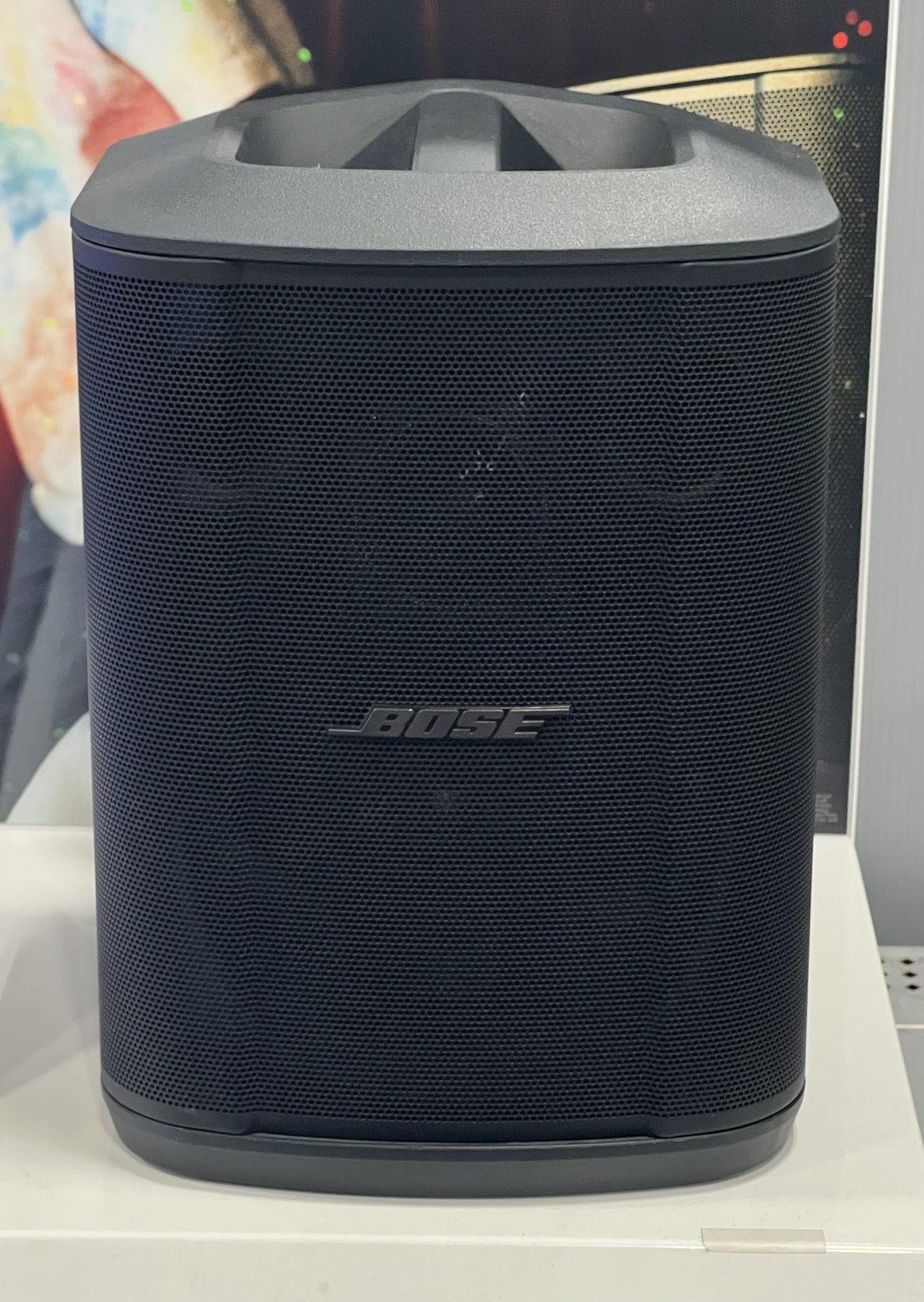
The S1 Pro+ is the lightest speaker in this comparison and the easiest one to hand to a staff member who is not an audio person. Bose Professional lists a net weight of 14.4 pounds, a 6-inch woofer with three 2.25-inch tweeters, a 35 mm stand flange for a speaker pole, and a calculated maximum of 109 dB at one meter with 120 degrees of horizontal coverage. The built-in three-channel mixer has ToneMatch presets, reverb and EQ, and Bluetooth streaming for a walk-on playlist.
What makes it emcee-friendly is the wireless option. Bose sells wireless transmitters that plug into a wired XLR microphone or an instrument and then dock in the back of the speaker to charge, so there is no separate receiver to lose. Read the transmitter runtime carefully: the S1 Pro+ owner's guide says a transmitter lasts up to 5 hours with typical use, while the Bose Professional product page says the transmitters play up to 4 hours. Either way, a mic transmitter will run out well before the speaker's battery does on an all-day tournament, so plan a midday swap or a wired backup mic.
Bose's 11-hour battery figure comes with a footnote. The spec sheet says it was measured playing music from a streaming playlist at room temperature at a volume you can talk over indoors, and that a singer performing indoors for up to 100 people can expect five hours or more at performance volume. Bose's store page sizes the speaker for audiences up to 50. For a single show court with a crowd along one sideline, that is usually enough; for a 12-court lawn with a bracket desk at one end, it is not the speaker to cover the whole site.
2. JBL EON ONE Compact
JBL built the EON ONE Compact with presenters and fitness instructors in mind, and two features on its product page matter for a pickleball emcee. The first is ducking: when the mixer detects speech on a mic channel, it automatically lowers the background music, so a bracket call isn't buried under the playlist. The second is the battery. JBL lists up to 12 hours of playtime from a tool-free, swappable battery that recharges in 2.5 hours, and the speaker can charge while it is in use. Extra batteries are sold separately, which is the simplest way to cover a long day.
The speaker weighs 17.6 pounds and carries a four-channel mixer with two XLR/TRS combo inputs, a hi-Z guitar input and a 3.5 mm aux input. Phantom power supports condenser mics, there are two USB ports for charging a phone or tablet, and a built-in tilting tablet stand holds the device running the bracket app or the JBL Pro Connect control app. JBL says up to four units can receive the same Bluetooth stream from the app, which is useful when you want low-volume music at check-in and at the courts without running cable.
There is no wireless microphone receiver inside the speaker. For a roaming emcee you add a wireless mic system and plug its receiver into one of the combo inputs. JBL sells an accessory cable that powers an AKG wireless system from the speaker's USB port, so the receiver doesn't need its own outlet. JBL's spec sheets on the page are dated November 2020; the 112 dB output claim is JBL's own and isn't presented in the same measured-SPL format as the other makers here, so compare it loosely.
3. Electro-Voice EVERSE 8
The EVERSE 8 is the only speaker in this group with a published weather rating. Electro-Voice says the polypropylene enclosure meets IP43, water resistant for splashes and light rain, when it runs on battery power and streams over Bluetooth with the supplied weatherized cover over the input panel. That condition is the fine print to read. Once you plug a wired mic into the back with the cover open, the IP43 claim no longer applies, and EV recommends its accessory slipcover in wet or damp conditions. It is still the speaker to bring when the forecast is uncertain and the show court has no tent.
It is also the most honest battery spec here. Electro-Voice gives two numbers instead of one: more than 12 hours at about 95 dB average with typical program material, and more than six hours at maximum output before the limiter indicates. The battery is an 86.4 Wh lithium-ion pack removed with tool-free screws, and EV notes that phantom power, USB charging and the 12-volt DC output all shorten runtime. That 12-volt output is designed to power accessories such as a wireless mic receiver.
The four-channel mixer, which EV says is powered by Dynacord, includes feedback suppression and ducking, both useful when an emcee walks toward the speaker with a live mic. Max SPL is 121 dB at one meter with 100 by 100 degree coverage. One small discrepancy: the current spec page lists a net weight of 16.8 pounds (7.6 kg), while the August 2022 product flyer lists 16.6 pounds for the same 7.6 kg. The kilogram figure matches, so treat it as roughly 17 pounds.
4. Yamaha STAGEPAS 200BTR
Yamaha's STAGEPAS 200BTR is the battery version of the STAGEPAS 200, and Yamaha's launch announcement called it the first Yamaha Pro Audio product with a high-capacity rechargeable lithium-ion battery. The spec page lists a 79.92 Wh BTR-STP200 pack, a maximum of 10 hours of operation, eight hours continuous at one-sixteenth power, and roughly four hours to charge. The battery is sold separately too, so a second pack is the easy way to stretch a long day.
This is the loudest and heaviest single speaker in the comparison. Yamaha lists a peak of 125 dB SPL at one meter, measured with pink noise, from an 8-inch coaxial driver with a compression tweeter, and 90 by 90 degree coverage. It weighs 27.6 pounds with the battery. The five-channel mixer takes three mono mic or line inputs plus one stereo line input, and the output section has SPEECH, MUSIC and CLUB modes, which helps a non-technical staffer get intelligible voice quickly. There is a monitor and link output for adding a second speaker, Bluetooth 5.0 streaming, and a STAGEPAS Controller app.
Flag before you rely on runtime math: Yamaha's US spec page lists power consumption of 20 W idle and 39 W at one-eighth power, while Yamaha Korea's product page lists 10 W idle and 20 W at one-eighth power for the STAGEPAS 200BTR. We haven't been able to resolve which is current, so use Yamaha's stated operating times rather than calculating your own from watt-hours.
5. Anchor Audio Liberty 3
The Liberty 3 is a different kind of product: a public-address speaker built for speech at outdoor ceremonies, schools and corporate events, with wireless microphones built in rather than added on. Anchor's owner's manual says the Hub and Link models link up to four Anchor Series 3 wireless microphones, handheld or belt pack, on the 1.9 GHz DECT band with a range of about 300 feet line of sight, plus two wired mic inputs. The AnchorFlex models can also stream wirelessly to companion Liberty 3 speakers, which Anchor says works at 300-plus feet, so you can put one speaker at the show court and one at the far end of the lawn without a cable between them.
It is a big, wheeled-cart-class speaker. Anchor lists about 44 pounds, a 10-inch woofer with a compression driver, 200 watts RMS and a maximum of 123 dB at one meter. The power system is two 12.8-volt, 10.2 Ah LiFePO4 batteries that take about five hours to recharge fully, and the v1.6 manual says the batteries give seven-plus hours of playtime at 85 percent volume. The manual describes the same batteries as lithium-ion in one section and lists them as lithium iron phosphate (LiFePO4) in the specifications, which is technically a type of lithium-ion; the newer 2025 manual uses the LiFePO4 part number.
Two discrepancies to know before you plan mic batteries. Anchor's WH-LINK handheld mic page says two AA batteries last about 6 to 8 hours, while the Liberty 3 owner's manual says the handheld and belt pack mics last 8 to 10 hours of continuous use. Plan on the lower number and pack spare AAs, which Anchor itself recommends. And only Anchor Series 3 microphones work with AnchorLink 3; your existing wireless mics won't pair with it.
Wireless mics: the part that usually fails
The speaker is only half of an emcee setup. The other half is the microphone, and it has its own failure points: a handheld can run out of AA batteries during the semifinals, a cable can get yanked across a court, or a borrowed mic kit may not pair. Three checks cover most of it.
Know how the mic connects.The Anchor Liberty 3 has the receiver built in and pairs only with Anchor Series 3 mics. Bose's S1 Pro+ transmitters turn a wired mic into a wireless one and charge in the speaker. The JBL, Electro-Voice and Yamaha speakers take a separate wireless system plugged into a mic input; JBL and Electro-Voice both offer a way to power that receiver from the speaker (a USB-powered cable for AKG systems on the JBL, a 12-volt DC output on the EVERSE 8).
Check the frequency on older kits.The FCC says wireless mics that operate in the 600 MHz service band, 617 to 652 MHz and 663 to 698 MHz, had to stop operating by July 13, 2020, and selling them for US use is now prohibited. A rental closet or an old conference-room kit can still contain them. The Anchor system runs on 1.9 GHz DECT and Bose's transmitters pair directly with the speaker, so neither uses those frequencies.
Plan mic batteries separately from speaker batteries.Bose quotes up to 5 hours for a transmitter in the owner's guide (4 hours on the product page). Anchor quotes 6 to 8 hours on its mic page and 8 to 10 in its speaker manual. A seven-hour event day outlasts all of those figures, so swap mic batteries at lunch and keep a wired mic plugged in as a backup.
How many speakers, and where
| Site | Speaker setup | Mics | Note |
|---|---|---|---|
| Office lobby, rooftop or single court (under ~50 guests) | One compact battery PA on a stand at the net post line | One wireless handheld plus one wired backup | Point it away from neighboring windows; see our noise guide |
| Lawn or lot with 4 to 8 courts | One speaker at the bracket desk, one at the far courts | One handheld for the emcee, one for the tournament director | Link speakers by cable, Bluetooth multi-speaker, or a wireless link product |
| Awards moment or exhibition match | Main speaker beside the stage, angled at the crowd, not the players | Handheld for the presenter, a second mic for a guest pro | Keep staging power separate from scoring power |
| Festival or public plaza | Venue or production company sound, with your PA as backup | Coordinate frequencies with the venue's audio lead | Amplified sound often needs its own permit |
These are starting points, not rules. Keep speakers and stands outside the court run-off space and away from the path players take to chase a lob. Aim the speaker at the crowd rather than across the courts, so players hear the call without getting blasted mid-rally. A speaker on a pole at head height carries a voice farther than the same speaker on the grass. Amplified sound is also what neighbors complain about, more than paddle noise; our noise and neighbor guide and permits guide cover sound permits and quiet hours.
Mistakes we see with event sound
Trusting the headline runtime. Battery figures are measured at moderate volume. Electro-Voice's own numbers show runtime roughly halving at maximum output, and outdoor events push volume up. Bring a second battery or an outlet plan.
Music over the emcee. If the playlist and the mic share one speaker, someone has to ride the music volume. Ducking (JBL, Electro-Voice) or a SPEECH preset (Yamaha) does it for you.
One speaker for a twelve-court lawn. A voice that is clear at the bracket desk is unintelligible 60 yards away. Add a second speaker at the far courts rather than turning one up.
No owner for the gear. Name the person who charges the speaker the night before, carries spare mic batteries, and packs the charger. It is the same person who calls the end of play.
Rain with the cables plugged in. Even the IP43-rated EVERSE 8 is only rated with its input cover closed. Keep speakers under a tent edge and route cables so water doesn't run down them into the panel.
Want courts, sound and an emcee plan in one quote?
Send the date, city, venue, headcount and format. We'll spec the courts, the PA and mics, staff the day and quote it in writing.
Related: power and lighting · run-of-show template · pop-up canopies compared · equipment rental checklist
Sources: Bose Professional S1 Pro+, Bose S1 Pro+ store page and owner's guide; JBL EON ONE Compact; Electro-Voice EVERSE 8 and 2022 flyer; Yamaha STAGEPAS 200 specs, BTR-STP200 battery and Yamaha Korea STAGEPAS 200BTR; Anchor Liberty 3 manual (2025), manual v1.6 and WH-LINK mic; FCC wireless microphones. Accessed November 23, 2026.