Best Event-Day Pickleball Court Accessories (2026): Scorekeepers, Ball Hoppers & Paddle Racks Compared
By The Pickleball Events Co. team · Updated
The short answer
Nets, balls and paddles get the attention, but three small items decide whether courts stay full: a scorekeeperwhere the score matters (Putterman's clamp-on flip board outdoors, OnCourt OffCourt's PickleScore on a table indoors), ball pickup and storage (a hopper such as the PickleHopper 60 or Tourna Ballport on court, a Gamma EZ Travel Cart at the station), and a queuefor open play (GoSports' clip-on rack, Boomer's 45D or MAK's Paddle Q, or a virtual paddle rack when there's no fence). Disclosure: The Pickleball Events Co. is our company and we run staffed pickleball events. We aren't affiliated with any brand here and nobody paid to be included.
Who this is for
Event agencies, DMCs, incentive planners and in-house teams putting pickleball into a program, and anyone checking an event vendor's equipment list. Our pop-up equipment comparison covers the core kit (court lines, balls, nets, loaner paddles). This page covers the accessories around the court that most quotes leave off, and that court hosts end up improvising on the day: something to show the score, something to clear and hold balls, and something to manage who plays next.
How we compared
- Does it set up and strike in minutes, without tools, holes or anything the venue would object to?
- Does it work on the actual site: a chain-link fence outdoors, a bare ballroom wall, a gym with no fence at all?
- Can a first-time guest understand it without a host explaining it?
- Does it keep courts full, by speeding up rotations, ball cleanup or score disputes?
- Will it survive a day of guests who aren't careful with it, and pack flat into a van?
- Every spec from the maker's own product page, checked on the date above. No prices, ratings or reviews reprinted.
These are grouped by job, not ranked by score. We haven't invented test results, and we don't reprint prices because they change; every maker page is linked so you can check current pricing yourself.
Comparison table
| Product | Type | Best for | Key facts (from maker) | Watch out for |
|---|---|---|---|---|
| Putterman Athletics Flip Style Scoreboard | Scorekeeper | Outdoor courts where the score needs to be readable from the sideline and the stands | Metal T-frame; 4 x 8 in poly number cards; pre-marked Home & Away panels; swiveling frame; clamp-on bracket included | Home/Away panels suit two teams; doubles players still call the server number aloud |
| OnCourt OffCourt PickleScore | Scorekeeper | Table-top or fence-hung scoring at receptions, hospitality suites and indoor events | Pickleball-specific; about the size of a notebook; sits on a table or hangs on a fence; readable from both sides | Small format: readable courtside, not from a grandstand |
| OnCourt OffCourt PickleHopper 60 | Ball pickup | Clinics and warm-up stations where a coach feeds balls and guests help clean up | 60-ball capacity; EZ Glide Bar (7 mm) at the base for pickup; no-tool assembly with grip knobs; picks up all pickleball types | No wheels; you carry it between courts |
| Tourna Pickleball Ballport with wheels | Ball pickup | Light, wheeled pickup for hosts who move between courts | Holds 40 to 50 balls; 4.5 lb (maker says 50% lighter than similar hoppers); wheels; locking handles; stands 33.5 in high | Polypropylene build and smaller capacity than wire carts |
| Gamma EZ Travel Cart XD 150 | Ball cart | The central equipment station: one cart holding the event's ball supply | Holds 120 pickleballs (150 tennis balls); 35.5 in tall, 16 x 16 in; two locking swivel wheels; collapses into its carry case in under 15 seconds; removable bag | A transport cart, not a pick-up basket; balls go in by hand or from a hopper |
| Franklin Rolling Pickleball Hopper | Ball pickup + transport | One piece that picks up, holds and transports, for smaller events with one equipment person | Press-down pickup bag on an extending handle; holds over 100 pickleballs; wheels and shoulder straps; accessory and paddle pockets | Soft bag on a frame; capacity stated as 'over 100' |
| GoSports Pickleball Paddle Rack (holds 8) | Paddle rack | Open-play blocks at outdoor events with chain-link fences | Holds 8 paddles upright; numbered slots for 'next up'; 2 carabiners for chain-link or included bolts and wingnuts; powder-coated steel | Needs a chain-link fence or a fixed mount; indoor ballrooms rarely have one |
| Boomer 45D Paddle Rack | Paddle rack | Tidy, compact queue on a fence where several racks run in a row | Holds 4 paddles at 45 degrees so all are visible; magnetic 'Next-Up' marker for use with two or more racks; 14 ga steel, powder coated; fence-mount hardware; 15.75 x 5.5 x 6.5 in, 4 lb 5 oz | Four paddles per rack, so you need several; designed as a permanent install |
| MAK Pickleball Paddle Q | Paddle queue | A showcase open-play court where guests need the rotation explained at a glance | Up to 11 paddles; paddles rotate down to the next-in-play position; whiteboard and integrated ball caddy; hooks to move it or permanent install; 30 x 24 in, 10 lb; made in the USA; lifetime warranty on defects | Bigger and heavier than a simple rack; one per court |
Facts as stated on each maker's product page on November 10, 2026.
Quick picks by job
| If you need | Start with | Why |
|---|---|---|
| Score visible from the stands | Putterman Flip Style Scoreboard | Large 4 x 8 in cards, swivels, clamps to a post |
| Score at a table or fence, indoors | OnCourt OffCourt PickleScore | Notebook-size, reads from both sides |
| Clinic cleanup | OnCourt OffCourt PickleHopper 60 | 60 balls, glide-bar pickup |
| Light, wheeled pickup a volunteer can roll | Tourna Ballport | 4.5 lb, wheels, 40-50 balls |
| The event's ball supply in one place | Gamma EZ Travel Cart XD 150 | 120 pickleballs, locking wheels, packs into its case |
| One item for a small event | Franklin Rolling Hopper | Picks up, holds 100+, rolls |
| Open-play queue on a fence, removable | GoSports Paddle Rack | 8 numbered slots, carabiner mount |
| Recurring league at the same club | Boomer 45D | 4 visible paddles per rack, Next-Up marker |
| Featured open-play court | MAK Paddle Q | Self-staging 11 paddles plus a whiteboard |
The picks, one by one
1. Putterman Athletics Flip Style Scoreboard
Best for: Outdoor courts where the score needs to be readable from the sideline and the stands
Putterman describes this as a courtside flip scoreboard on a sturdy metal T-frame built for outdoor use, with large 4 x 8 inch poly number cards, pre-marked Home and Away panels, and a T-frame that swivels so players and spectators on either side can read it. It ships with the frame, a full set of number cards and a clamp-on bracket, which is the detail that matters for a pop-up: you clamp it to a net post or fence and it's done.
No batteries, no app, nothing to charge between sessions. For a sales-kickoff bracket or a team cup, a visible score on every court ends the 'wait, what's the score?' conversation and gives the people watching something to follow. Putterman pitches it for tennis, pickleball, schools and parks, so expect a generic board, not a pickleball-specific one.
The thing a two-panel board can't show is the third number in doubles side-out scoring (whether the serving team is on its first or second server). That's fine; players announce it anyway. If your format uses a scoring app for the bracket, the flip board is still useful as the on-court display, with the court host entering the final into the app.
2. OnCourt OffCourt PickleScore
Best for: Table-top or fence-hung scoring at receptions, hospitality suites and indoor events
OnCourt OffCourt sells tennis and pickleball training aids, and the PickleScore is its pickleball scorekeeper. The company describes it as portable and about the size of a notebook, usable sitting on a table or hanging on a fence, and viewable from both sides. That two-sided read is the point: the players on both ends and the guests watching from the side all see the same numbers.
Its size is the trade-off. A notebook-sized scorer is right for a ballroom court where everyone is within a few yards, or a fence line at an outdoor field day. For a showcase court with bleachers or a finale people watch from across a plaza, a larger board like Putterman's (or a facility electronic board) reads better. OnCourt OffCourt publishes an instruction sheet on the product page, which is handy for briefing volunteer scorekeepers.
3. OnCourt OffCourt PickleHopper 60
Best for: Clinics and warm-up stations where a coach feeds balls and guests help clean up
Every event with a clinic or a skills station ends the same way: balls everywhere. A hopper you press down over balls turns that into a thirty-second job and gives guests something to do between rotations. OnCourt OffCourt's PickleHopper 60 holds 60 balls and uses what the maker calls an EZ Glide Bar, a 7 mm bar at the bottom that moves as you press so balls pop in without forcing. Assembly is tool-free with grip knobs, and the maker says it picks up all types of pickleballs, indoor and outdoor.
The maker's 'easiest ball pick-up in the world' line is marketing; what's verifiable is the capacity and the mechanism. For a planner, 60 balls is roughly a clinic's worth for one coach. It's a carried basket, not a cart, so for a multi-court program pair it with a wheeled cart at the equipment station.
4. Tourna Pickleball Ballport with wheels
Best for: Light, wheeled pickup for hosts who move between courts
Tourna's Ballport is a wheeled pickleball caddy that the maker says weighs 4.5 lb, which it claims is about half the weight of other hoppers with similar capacity. It's made of reinforced polypropylene, holds 40 to 50 balls (the product URL says 50 indoor or 45 outdoor), and stands 33.5 inches tall so a host or coach can reach in without bending.
Two details make it event-friendly. Tourna says its patented locking system holds the handles in the up and down positions, so the legs don't fold out and dump the balls mid-session. And it has wheels, so one court host can roll it between courts. It's the one we'd hand a volunteer. A light plastic caddy won't take the abuse of daily club use the way a steel basket does, but for a handful of events a year that's rarely the limit.
5. Gamma EZ Travel Cart XD 150
Best for: The central equipment station: one cart holding the event's ball supply
Gamma's EZ Travel Cart XD is a wheeled cart with a nylon ball bag that clips into the top. Gamma lists a capacity of 120 pickleballs, a height of 35.5 inches and a 16 x 16 inch footprint, with two locking swivel wheels, a patented cross brace under the bag and reinforced aluminum sleeves at the wheel inserts. It collapses and stores in its own carrying case in under 15 seconds, per Gamma, and the bag comes off to use as a standalone ball bag.
On an event, this is the equipment-station cart: it holds the day's spare balls next to the check-in table, rolls to a court that needs a refill, and packs flat into the van at strike. Gamma calls it a light-duty cart; it's built for teaching pros moving across a court, which is close to how an event uses it. It doesn't pick balls up off the ground, so pair it with a hopper or two.
6. Franklin Rolling Pickleball Hopper
Best for: One piece that picks up, holds and transports, for smaller events with one equipment person
Franklin's Rolling Pickleball Hopper is a hybrid: you extend the handle and press the bag down over balls on the court to collect them, and the same bag holds over 100 pickleballs on wheels, with shoulder straps and pockets for paddles and gear. Franklin pitches it for training, casual play and organizing a tournament.
For a small company event (two or three courts, one equipment person) that hybrid is useful: one item instead of a hopper and a cart. For bigger programs, splitting the jobs between a cart at the station and hoppers on court usually moves faster, because pickup and storage can happen at the same time.
7. GoSports Pickleball Paddle Rack (holds 8)
Best for: Open-play blocks at outdoor events with chain-link fences
A paddle rack is the oldest open-play queue there is: you put your paddle in the next slot, and when a court opens the next four paddles go on. GoSports' rack holds eight paddles upright with numbered slots so players can see their place in line. It clips onto chain-link with two included carabiners, or bolts on with the included hardware, and GoSports says no tools are needed. It's powder-coated steel.
The carabiner mount is why it suits events: clip it on at load-in, unclip it at strike, no holes in anybody's fence. Eight slots is two games' worth of waiting players, about right for one or two courts in an open-play block. On a hotel ballroom build there's usually no fence, so plan a stanchion, a table or a virtual queue instead.
8. Boomer 45D Paddle Rack
Best for: Tidy, compact queue on a fence where several racks run in a row
Boomer's 45D holds four paddles at a 45-degree angle so every paddle stays visible, and comes with a magnetic 'Next-Up' marker meant for runs of two or more racks: each rack is one game, and the marker shows which game goes on next. Boomer lists heavy-duty 14 gauge steel with a weather-proof powder coat, no sharp corners, fence-mount hardware, and dimensions of 15.75 x 5.5 x 6.5 inches at 4 lb 5 oz.
Boomer markets it as 'a permanent upgrade for the life of your courts', so it's really a venue product. It earns a place here for recurring programs (a monthly company league at the same club) where the rack can stay. For a one-day event the GoSports clip-on rack is the easier fit.
9. MAK Pickleball Paddle Q
Best for: A showcase open-play court where guests need the rotation explained at a glance
MAK's Paddle Q is a paddle rack that does the staging for you: you clip your paddle into the next free clip and it moves down to the lowest, next-in-play position. It stages up to 11 paddles, adds a whiteboard for court information such as level of play, and has a built-in ball caddy. MAK says it can be permanently installed at one court or hung on hooks and moved, and lists it at 30 x 24 inches and 10 lb, made in the USA from aluminum and stainless steel with a powder-coated finish and a lifetime warranty against defects.
The whiteboard is the underrated part for events. Write 'Beginners' on court 1 and 'Competitive' on court 4, and the self-sorting that makes open play work at a company event happens without a host explaining it every ten minutes. It's a lot of hardware for a one-off, so it fits recurring programs or a single featured court.
When there's no fence: virtual paddle racks
Physical racks assume a chain-link fence. Ballrooms, gyms, exhibit halls and rooftop builds rarely have one. Two software options replace the rack with a screen. PaddleStack describes itself as a virtual paddle rack for open play: players join the queue in an app or at a courtside tablet kiosk, get called by text, push alert or a spoken announcement, and the organizer sets the rotation (winners stay, rotate partners or balance by rating) from one iPad and casts the live queue to a TV. Dink+ Paddle Rack works similarly: players scan a QR code to join with no account required, a courtside TV shows every court and who is up next, and separate queues can run for beginner, intermediate and challenge courts. Dink+ says Paddle Rack is part of its Facility tier.
For a corporate audience, the QR join is the useful part. Guests already have their phones out, and nobody has to explain stacking etiquette. The trade-off is one more thing that needs Wi-Fi, a screen and power, so confirm all three at the site assessment. For brackets and round robins rather than open play, see our scoring and bracket apps comparison.
Match the accessories to the format
| Event | Scoring | Balls | Queue |
|---|---|---|---|
| 2 courts, social mixer | None, or one PickleScore for a finale | Franklin Rolling Hopper or one Tourna Ballport | One GoSports rack if outdoors; otherwise host-run rotation |
| 4 courts, team cup or bracket | One flip scorekeeper per court | Gamma cart at the station + two hoppers | Bracket app or a whiteboard; paddle racks only for an open-play block |
| 6+ courts, field day with open play | Flip scorekeepers on bracket courts | Gamma cart + a hopper per two courts | Racks on the fence, or a virtual queue on a courtside TV |
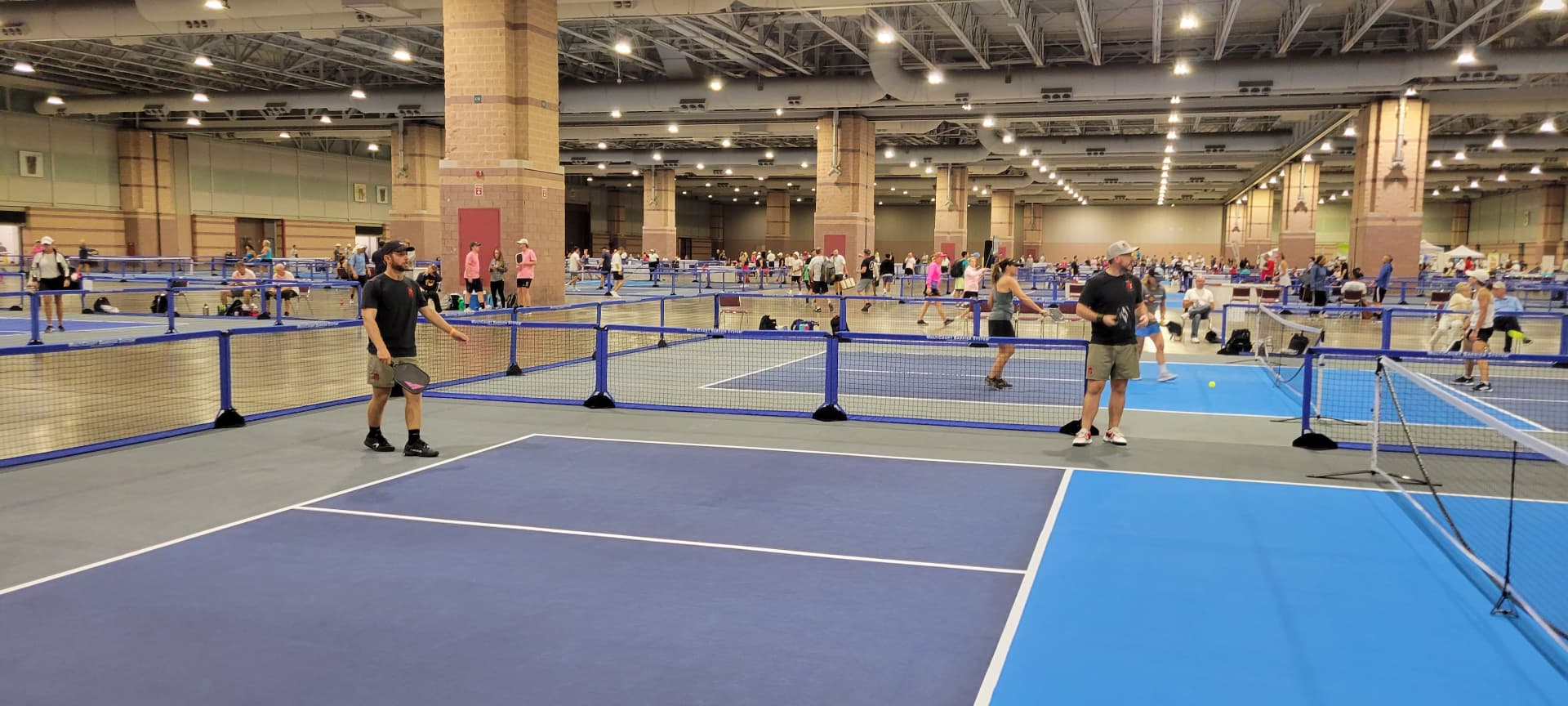
| Indoor ballroom or convention hall | PickleScore on a table at each court | Tourna Ballport (wheels on hard floor) | Stanchion and table, or a virtual queue; no fence to clip to |
The format decides most of this. A team cup needs scores and almost no queue; an open-play block needs a queue and almost no scores. Our guide to team-building formats explains which formats need scorekeepers and which run themselves.
Mistakes we see with court accessories
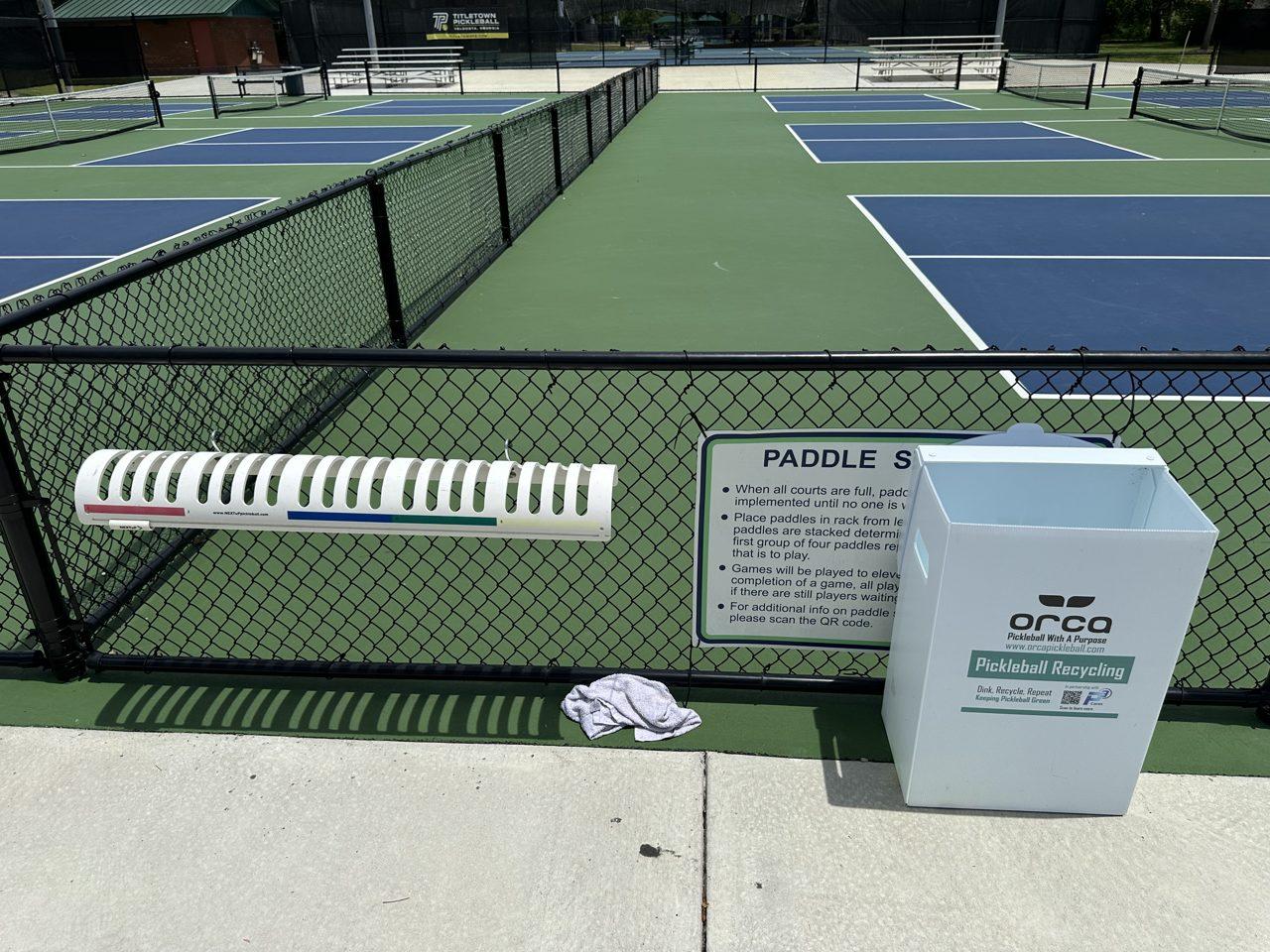
A rack with no rules posted. The facility in our photo posts its stacking rules on a sign next to the rack. Do the same: four paddles go on when a court opens, games to 11, and what happens when nobody is waiting. Guests who've never seen a paddle rack will otherwise drop paddles on the ground or hand them to a friend.
Ball cleanup with no tool. Without a hopper, a host spends the break bending over for balls instead of running the next rotation. One hopper per two courts is a reasonable rule of thumb for clinics.
Scoreboards that nobody can read. A small table scorer is fine at a reception court and useless for a final people watch from 40 feet away. Size the scoreboard to the audience, not the court.
Assuming a fence. Clip-on racks and clamp-on scoreboards need something to attach to. If the venue is a ballroom, write the alternative (tables, stanchions, a screen) into the plan.
No strike plan. Small accessories are what goes missing at load-out. Count racks, scorers and hoppers out and back, the same way you count paddles.
Want courts, accessories and court hosts in one quote?
Send the date, city, venue, headcount and format. We'll spec the courts, the scoring, ball and queue setup that fits it, staff the day and quote it in writing. White-label for agencies is available.
Related: equipment rental checklist · ball machines for event booths · event staffing · run-of-show template
Building permanent courts after the event? Our sister site compares fixed facility scoreboards in its guide to pickleball court scoreboards for facilities.
In partnership with PickleCourt USA.
Sources: Putterman Flip Style Scoreboard; OnCourt OffCourt PickleScore; OnCourt OffCourt PickleHopper 60; Tourna Pickleball Ballport; Gamma EZ Travel Cart XD 150; Franklin Rolling Pickleball Hopper; GoSports Pickleball Paddle Rack; Boomer 45D Paddle Rack; MAK Pickleball Paddle Q; PaddleStack; Dink+ Paddle Rack. Accessed November 10, 2026.