Best Pickleball Ball Machines for Event Booths and Demo Stations (2026): Lobster, Tutor and Spinshot Compared
By The Pickleball Events Co. team · Updated
The short answer
For a trade-show booth or plaza activation without easy power, start with Lobster's the pickle (125 balls, battery rated 2–4 hours, remote included). If the host needs to change settings guest to guest, the Pickleball Tutor Spin or Plus with a wireless remote and electronic elevation is the flexible choice. For a clinic-style station where preset drills are the show, the Spinshot Playerand its Drill Maker app fit best. Whatever you pick, containment netting and a trained host with the remote matter more than the machine. Disclosure: The Pickleball Events Co. is our company; we build staffed pickleball activations and can add a ball-machine station to a quote. We aren't affiliated with any maker on this page and nobody paid to be included.
Who this is for
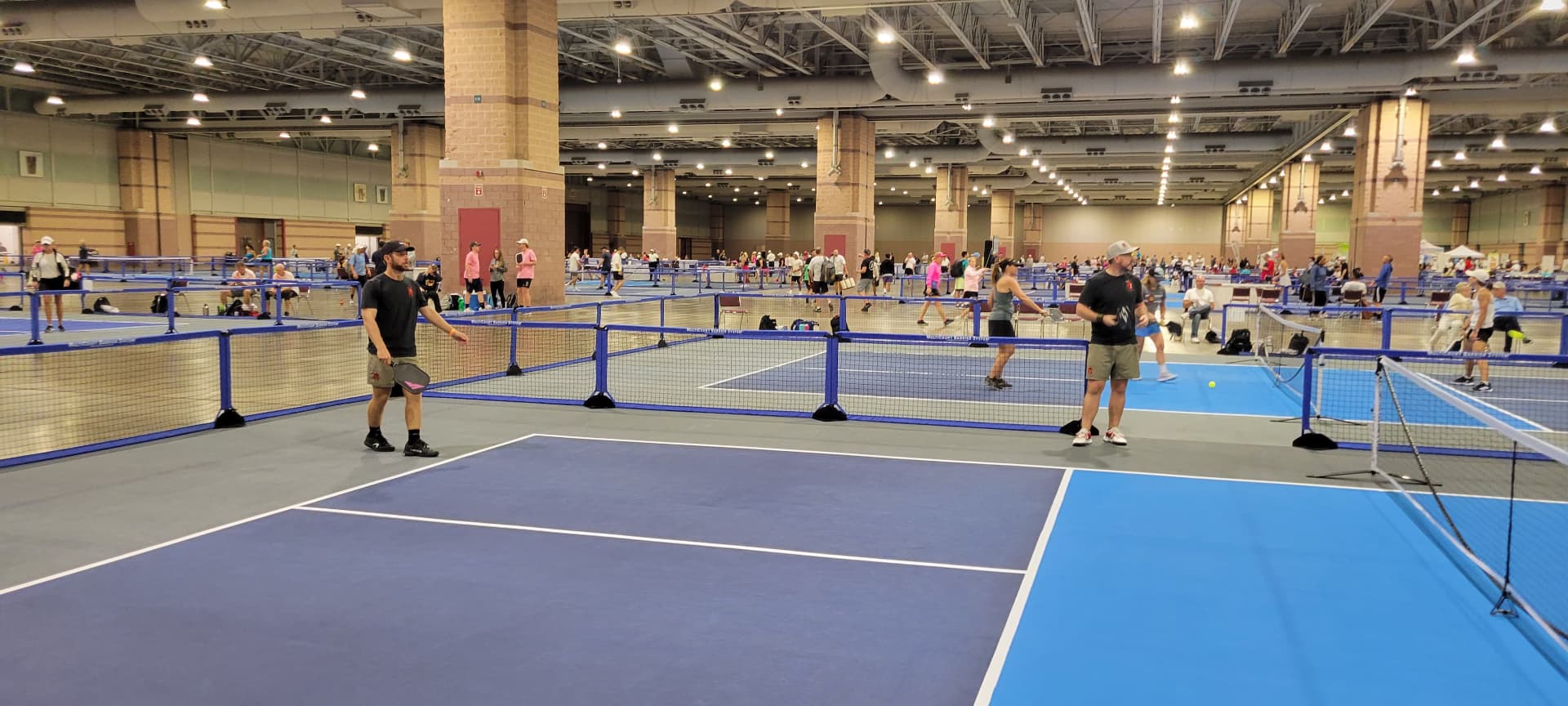
This guide is for event agencies, DMCs, exhibit managers and brand teams who want a pickleball ball machine in a booth, a sponsor village, a product launch or a corporate clinic. In that setting the machine isn't a training tool for one player; it's a crowd-facing station that has to work for a first-timer in dress shoes and a regular who wants to show off a dink, back to back, for hours.
That changes what matters. Power access, hopper size, how fast a host can change settings and whether the feed can be stopped instantly matter more than the top speed on the spec sheet. It isn't a guide to the best machine for your own practice, and it isn't a ranking. Every product fact below comes from the manufacturer's own page, checked on the date above.
How we compared
- Can it run a full session on battery, or does the booth need an outlet and a cord plan?
- Is the hopper big enough to keep a queue moving without constant refills?
- Can a host change speed, spin and height quickly between a first-timer and a 4.0 player?
- Is there a remote, so the host can stop the feed instantly when a guest or a stray ball is in the way?
- Can two people move it from the dock to the booth, and does it fit the booth's storage?
- Specs, warranty and power facts only from the manufacturer's own page, checked on the date above.
No star ratings, no invented test scores and no prices. Retail prices and bundles change often, and for an event the real cost is usually the staffed station, not the machine. Pick by venue, power and format using the table below.
Comparison table
| Machine | Best for | Hopper | Speed | Weight | Power | Watch out for |
|---|---|---|---|---|---|---|
| the pickle by LobsterLobster Sports | A self-contained battery machine for outdoor activations and booths without easy power | 125 balls | 10–60 mph | 35 lb | Rechargeable battery, 2–4 hours per charge | Elevation is set by hand (0–50°), so a host has to adjust it between guests of different levels |
| Pickleball Tutor Spin and PlusSports Tutor | Booths where the setting changes guest to guest and you want options like a 2-line feed or a remote | 125 balls (Spin); 110 balls (Plus) | 10–60 mph (Spin); 10–65 mph (Plus) | 29 lb with battery (Spin); 34 lb (Plus) | Battery up to about 4 hours, or an AC-only version | Features vary a lot by model and options, so specify the exact configuration in writing |
| Spinshot PlayerSpinshot Sports | Clinic stations and brand demos where pre-programmed drills are part of the show | 85 balls | 10–60 mph | 41 lb (without battery) | Internal battery (2–3 hours), external battery, mains power or a hybrid | Smaller hopper means more refills; Spinshot's warranty is 1 year for commercial or club use |
Not ranked by score. Facts as stated on each manufacturer's page on November 2, 2026; battery run times are the makers' figures and vary with settings.
The machines, one by one
1. the pickle by Lobster
Best for: A self-contained battery machine for outdoor activations and booths without easy power
Lobster has made tennis ball machines for decades, and its pickleball machine, called simply 'the pickle,' follows the same pattern: a self-contained, battery-powered unit you can wheel onto a court. Lobster lists a 125-ball capacity, ball speeds from 10 to 60 mph, topspin and backspin, random horizontal oscillation, a feed interval adjustable from 2 to 12 seconds, manual elevation from 0 to 50 degrees, a battery that runs 2 to 4 hours, 35 lb weight, 8-inch wheels, a folding handle and an included remote. Lobster says it works with indoor and outdoor balls, carries a 2-year warranty and is made in the USA.
For an event, the battery is the headline. Plenty of booths and plazas don't have a convenient outlet near the court, and a cord running across a walkway is a trip hazard and a fire-marshal conversation. A machine that runs a full session on its own battery removes that problem. The 2–4 hour range is the maker's figure and depends on speed, spin and feed rate, so for an all-day expo plan on a mid-day charge, a second battery or a nearby outlet for the lunch break.
The 125-ball hopper means fewer pauses to refill, which matters when a queue is waiting. The trade-off is manual elevation: the host has to change the launch angle by hand when a beginner follows a strong player. With a trained host that takes seconds; with no host it doesn't happen, and beginners get balls they can't return.
2. Pickleball Tutor Spin and Plus
Best for: Booths where the setting changes guest to guest and you want options like a 2-line feed or a remote
Sports Tutor sells several Pickleball Tutor models, and the two that fit most event briefs are the Spin and the Plus. Per the maker's page, the Spin throws sidespin at 10–60 mph from a 125-ball hopper and weighs 29 lb with its battery; the Plus adds topspin and underspin, reaches 10–65 mph, holds 110 balls and weighs 34 lb. Both feed a ball every 1 to 6 seconds, use a random oscillator, and run up to about 4 hours on battery, with an AC-only version available. Options include a 2-line feed, a wireless remote and electronic elevation. Sports Tutor lists a 3-year warranty.
What makes the Tutor line useful for activations is that the options map to real booth problems. A wireless remote lets the host pause the machine the moment a guest steps forward or a ball rolls into the aisle. Electronic elevation lets the host change the trajectory without bending over the machine, which keeps the line moving. A 2-line feed alternates forehand and backhand, which is a good 'try it' drill for players who already know the game.
Sports Tutor also lists a smaller Mini model (10–50 mph, 60 balls, 24 lb, about 3 hours on battery) and higher-end Ultra models with preset drills and app or remote control. The Mini's smaller hopper means more refills in a busy booth, and the Ultra features matter more for a clinic than for a two-minute demo. Because the line has so many variants, write the exact model, power option and accessories into the rental or purchase order rather than 'a Tutor machine.'
3. Spinshot Player
Best for: Clinic stations and brand demos where pre-programmed drills are part of the show
Spinshot's Player is the most programmable of the three. Spinshot lists ball speeds of 10–60 mph, a feed interval of 1 to 10 seconds, a maximum trajectory of 60 degrees, and both vertical and horizontal oscillation, so the machine can vary depth as well as side-to-side placement. Its Drill Maker app includes 12 preset drills and lets you build your own. The hopper holds 85 balls (Spinshot recommends the Franklin X-40), and the machine measures about 20 inches high, 12 wide and 18 long.
Power is flexible: Spinshot offers an internal battery rated at 2 to 3 hours, an external battery, mains power, or a hybrid, and notes the machine is 8 lb lighter without the internal battery. It weighs 41 lb before the battery, making it the heaviest of the three, so plan for a cart or a short roll from the loading dock rather than carrying it through a hall.
For a brand activation, app-driven drills are the draw. A host can run a named drill ('the kitchen challenge,' 'third-shot drop') from a phone, and guests get something that feels more like a coached clinic than a ball being thrown at them. One detail to read before buying for event use: Spinshot's warranty is 2 years for personal use but 1 year for commercial or club use, and an activation company is a commercial user.
Want the station built and staffed?
We scope ball-machine and clinic stations as an add-on to a pop-up court: containment, power plan, ball pickup and a host who runs the remote. Send the show, booth size and dates.
Get a quoteSetting up a ball-machine station in a booth
A ball machine in an exhibit hall is a different animal from one on a club court. On a club court the only person in range is the player. In a booth there's an aisle a few feet away, a neighbor's display, a queue, a photographer and a sales rep trying to scan badges. The station has to be designed around that.
Start with the footprint. A full pickleball court is 20 x 44 ft, which most booths can't hold. A machine station usually runs on a shortened half court or a single hitting lane: the machine behind a net, a guest at the kitchen line or baseline, and netting that stops every ball before it reaches the aisle. Our trade show booth activation guide walks through booth sizes and shortened demo courts.
Then decide power before you decide the machine. If the show charges for booth electrical or the outlet is on the wrong side of the space, a battery machine saves money and a cord across the floor. If the machine will run all day, either bring a second battery, schedule charging during lunch, or order an outlet. Our power and lighting requirements guide covers outlet planning and cord safety for pickleball events.
| Item | What to specify | Planner note |
|---|---|---|
| Containment | Netting or a solid backstop behind and beside the hitting area | Balls leave a machine at up to 60 mph; nothing should reach the aisle or the next booth |
| Machine placement | Behind the net, facing away from walkways, with a clear zone around it | Guests should never walk in front of the machine to reach the hitting area |
| Speed setting | Start slow with a soft, high feed and raise it only for experienced players | Every machine here goes down to 10 mph per its maker |
| Host | One trained host per machine with the remote in hand | Pause the feed between guests, during refills and whenever anyone is down range |
| Balls | The ball type the maker recommends, matched to indoor or outdoor | Use one model so the feed is consistent; bring spares for cracked balls |
| Power | Charged batteries plus a charging plan, or an approved outlet and a covered cord path | Confirm outlet location at the site walk; cords across aisles need ramps or covers |
| Ball pickup | Ball tubes, baskets or a hopper plus a host or two to clear balls | Loose balls underfoot are the real injury risk at a booth |
Formats that work at events
The 60-second challenge.The machine feeds a set number of balls at a soft, steady setting and the guest tries to land them in a target zone taped on the far side. It's fast, easy to explain and produces a score, which gives you a leaderboard and a reason for guests to come back. Keep the feed slow; the point is a rally-like rhythm, not a reaction test.
Try-it for beginners. A host shows the grip and a basic forehand, then the machine feeds gentle, high balls to the forehand. This is where machines with quick height changes earn their keep, because the next guest may need something completely different.
Branded mini-clinic. For a product launch or a sponsor village, a coach runs short sessions on a schedule using preset drills. Programmable machines like the Spinshot Player shine here, and a published session schedule turns a walk-up station into an appointment.
Product demo. When the brand is a paddle or apparel company, the machine is how guests feel the product. A consistent feed lets each guest hit the same ball the same way, which makes the demo about the paddle rather than the hitting partner.
Mistakes we see with ball machines at events
Running it too fast. A top speed of 60 mph or more is a spec, not a setting. At a booth, guests should be returning soft, high balls.
No containment. A missed ball that rolls into the aisle is a slip hazard; one that flies into the next booth is a complaint to show management.
No host on the remote. Guests walk in front of machines to pick up balls. Someone has to pause the feed every time.
The wrong balls. Machines are tuned for specific balls, and indoor and outdoor balls play differently. Use what the maker recommends.
Forgetting the dead battery. A machine that dies at 2 p.m. on day one of a three-day show is a dead booth. Plan charging before you load in.
Where the machine fits in the full package
A ball machine is an add-on, not the activation. Guests still need a surface that suits the venue, a net, lines, paddles and balls. Our pop-up equipment comparison covers those pieces, and the equipment rental checklist lists ball machines and clinic stations alongside scoreboards, branding and lighting as optional line items you can paste into a vendor brief.
If you want a deeper look at machines for regular court use (club lessons, an office court, a community facility), our sister site covers courts and equipment for owners at PickleCourt USA.
In partnership with PickleCourt USA.
Add a ball-machine station to your activation
Send the show or venue, booth size, dates, power access and expected traffic. We'll scope the court, the machine station, containment and staff, and quote it in writing. White-label for agencies is available.
Sources: Lobster Sports, the pickle; Sports Tutor, Pickleball Tutor Spin and Plus; Spinshot Sports, Spinshot Player. Accessed November 2, 2026.